Iran says 39 detained at memorial for rights lawyer
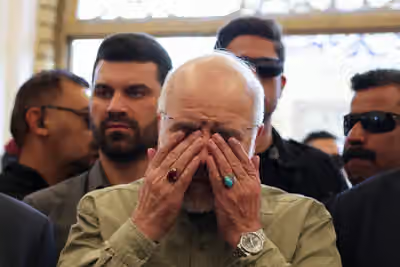
Iranian authorities said on Saturday they had detained 39 people at a memorial ceremony for a prominent rights lawyer in the holy city of Mashhad, confirming the number of arrests after videos showed anti-government and pro-monarchy slogans at the gathering.
The detentions took place during a seventh-day memorial ceremony that drew activists and supporters, some of whom later gathered outside the venue and chanted slogans including “Death to the Dictator” and phrases backing Iran’s pre-1979 monarchy, according to videos posted online.
The memorial was held for Khosrow Alikordi, a prominent rights lawyer and former political prisoner who represented detained protesters. He was found dead in his office in Mashhad last week. Supporters and fellow lawyers have questioned the official account of his death, while Iranian authorities say forensic examinations show he died of a heart attack.
“The seventh-day memorial was held with full cooperation of the responsible bodies,” Mashhad public prosecutor Hassan Hemmati-Far said, adding that authorities allowed funeral and memorial ceremonies to go ahead in Mashhad and the nearby city of Sabzevar.
He said the situation changed after the ceremony ended, when a gathering formed outside the mosque. Hemmati-Far said Javad Alikordi, the lawyer’s brother, along with Nobel Peace Prize laureate Narges Mohammadi and activist Sepideh Gholian, addressed the crowd from atop a vehicle.
“By making provocative remarks, they encouraged those present to chant norm-breaking slogans and disrupt public order,” Hemmati-Far said.
Authorities said police later intervened to manage the scene and that two officers were injured. Hemmati-Far said the incident led to the detention of 39 people.
Families, activists dispute official account
Families of some detainees and rights activists have disputed the authorities’ account, saying those arrested were subjected to violence during detention and have since been held without contact with relatives or access to lawyers.
According to family members, several detainees, including Mohammadi, were beaten during arrest. Mohammadi’s brother, Hamidreza Mohammadi, told AFP she was “beaten on the legs and grabbed by the hair,” adding that her past medical conditions made her detention a serious concern.
“Immediate and full access to medical facilities must be provided, independent and impartial complaints must be registered against those responsible for beatings, threats and insults, and all injured detainees must be sent without delay to forensic medical authorities,” the Narges Mohammadi Foundation wrote in a statement.
Authorities also said Javad Alikordi later left the scene but was arrested hours afterward after posting videos online that officials described as containing false statements.
Hemmati-Far said all detainees were being held in a legal detention facility and that investigations were continuing.
Rights groups and activists say at least several dozen people remain in detention in what they described as incommunicado conditions. Iranian authorities deny wrongdoing and say detainees’ rights are being respected.
Iran is facing growing shortages of vital medicines and could see a sharp deterioration in supplies within months if current conditions persist, an industry official said on Saturday.
“Right now, the crisis is not fully felt by society because the Food and Drug Administration is managing empty warehouses,” said Alireza Chizari, head of Tehran province’s association of medical and pharmaceutical equipment producers. “But if this situation continues, the drug supply will become disastrous within one or two months.”
Iran is currently short of around 20 highly critical hospital medicines, while in recent years the country has consistently faced shortages of 40 to 50 drugs, he said.
Chizari said the widening gap between household incomes and rising medicine prices would directly hurt consumption. “The damage caused by the difference between people’s income and the cost of medicines will certainly hit the drug market,” he said.
Iran’s pharmaceutical sector has come under strain from foreign exchange shortages, sanctions-related hurdles and rising costs. In recent weeks, Iranian media have reported shortages of some imported medicines, including brand-name anti-rejection drugs used by kidney transplant patients, with pharmacies in several cities halting distribution.
Medical specialists have warned that sudden switches from imported medicines to domestic alternatives can pose risks for a minority of high-risk patients, even though locally produced drugs work for most cases.
Drug prices, medical equipment and healthcare costs have surged by about 70% since the government removed a subsidized exchange rate for medicine imports earlier this year, according to domestic media. Insurance coverage has not kept pace with price rises, leaving patients to shoulder more of the cost.
Industry figures and lawmakers have warned that continued delays in foreign currency allocation, rising import and shipping costs and budget strains in insurance funds could deepen shortages in hospitals and pharmacies in the months ahead.
Efforts to ease Tehran’s water shortage through transfers from a nearby dam will only partially address the crisis and could fail entirely if dry conditions persist, a senior water researcher said, warning that years of overuse and policy missteps have depleted reserves.
“The transfer from Taleqan only resolves part of Tehran’s shortage and is not meant to eliminate it altogether,” said Mohammad Javad Zareian, head of the Research Center for Water Resources Studies at the Energy Ministry’s Water Research Institute. “If rainfall deficits continue, Taleqan’s water will not be sufficient.”
The Taleqan Dam, located in Alborz Province, is a hydroelectric facility with an installed capacity of 18 megawatts and serves as one of the five primary water sources supplying the Tehran metropolitan area.
Iran is in its sixth consecutive year of drought, with reservoirs at historic lows. Tehran's Latyan Dam is at its lowest in six decades, Karaj (Amir Kabir) holds under 10% capacity, and Mashhad's dams are below 3%.
Reserves depleted after years of overuse
Iran has faced droughts before, Zareian said, but the past two years have been more severe because buffers that once absorbed shocks have largely vanished. “Previously we had groundwater and storage behind dams, but those have been lost because consumption has exceeded available resources,” he said, adding that errors in water policy and population growth planning compounded the strain.
Long-term trends are moving in the wrong direction, Zareian warned, with declining resources and rising population. Climate change is also intensifying pressure by raising temperatures and reducing precipitation, a pattern seen beyond Iran.
The prolonged dry period has pushed reservoir levels across Iran to historic lows. The crisis is mainly due to decades of mismanagement. Agriculture uses 80 to 90 percent of the country's water but with less than 40 percent efficiency.
Too many dams have been built, leaky pipes waste 15 to 30 percent of supply, wastewater recycling stands at only about 20 percent compared to 85 to 98 percent in neighboring countries, and conservation efforts remain weak.
A young girl carries containers to collect water from a tanker truck amid ongoing shortages in Iran.
Separate livelihoods from drinking water
Zareian argued that Tehran and other large cities must separate livelihoods and economic activity from drinking water needs. Household drinking water accounts for only part of total use, he said, while many industries clustered around major cities are water-intensive.
“Except for high-tech sectors, most industries here consume large amounts of water,” Zareian said. He urged factories to cut consumption or rely on recycling within their own systems, a practice common abroad where industrial water is reused multiple times.
Proposals to pipe desalinated seawater to Tehran are economically unsound, Zareian said, citing prohibitive costs that would require massive state subsidies. “With one-tenth of that cost, demand management can stabilize conditions,” he said.
If rainfall fails to recover, authorities will have little choice but to impose consumption limits, he added, noting that drinking water would remain the priority.
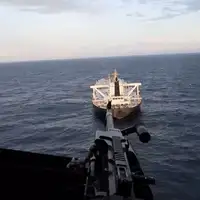
Iranian authorities have detained 18 crew members of a foreign tanker seized in the Gulf of Oman, state media reported on Saturday, saying the vessel was carrying 6 million liters of smuggled fuel.
The detainees include the ship’s captain, Iranian media said, citing the judiciary in Hormozgan province. Authorities did not identify the tanker and said an investigation was underway. The semi-official Fars news agency later reported that the crew included nationals of India, Sri Lanka and Bangladesh.
Iranian officials said the tanker was seized on Friday after committing multiple violations, including ignoring stop orders, attempting to flee, and lacking navigation and cargo documentation.
The detention follows a series of vessel seizures announced by Iranian authorities in recent weeks. In mid-November, the Islamic Revolutionary Guard Corps Navy confirmed the seizure of a Marshall Islands-flagged tanker off Iran’s Makran coast. Later in November, the Guards said they seized an Eswatini-flagged vessel in the Persian Gulf carrying about 350,000 liters of smuggled gasoil.
Iran, which maintains low domestic fuel prices through subsidies and has seen its currency weaken sharply, regularly reports interceptions of vessels accused of moving fuel illegally by sea to its Persian Gulf neighbours and by land to neighboring countries.
The Gulf of Oman and the nearby Strait of Hormuz sit along a major route for global energy shipments, where Iranian forces and international shipping have faced repeated disruptions in recent years.
UN Special Rapporteur for Iran Mai Sato on Friday welcomed the release of an Iranian child bride, warning that the case exposes deep-rooted institutional injustices in Iran’s judicial system.
“The diyah (blood money) has been paid, but while we celebrate saving one life, we cannot ignore the institutional and structural injustices that brought Goli Kouhkan to the brink of death,” Sato said in a post on X.
Kouhkan, a 25-year-old Iranian woman and child marriage survivor who had been sentenced to death for killing her abusive husband, was spared after the victim’s family agreed to forgive her, the judiciary’s news agency reported on Tuesday.
“Goli was sold into marriage as a child and endured years of domestic violence in a country where such violence is not effectively criminalized,” Sato said.
Kouhkan comes from Iran's Baloch minority in the southeast, where poverty and traditional social practices pose serious challenges to women’s rights under the Islamic Republic.
She gave birth at home at 13 without medical care. Attempts to escape the marriage failed because of her undocumented status as a Baloch woman and the societal pressures she faced.
In May 2018, her husband beat both her and their five-year-old son. After a relative was called to intervene, a confrontation ensued that resulted in the husband’s death, according to UN experts who had urged Iran to halt the execution.
“Between 2010 and 2024, at least 241 women were executed in Iran. Notably, in 114 of these cases, the women convicted and executed for murder had killed their husband or partner. Many were victims of domestic violence, child marriage, or were acting in self-defense,” Sato said.
“The case gained widespread international attention, including in global media, but it raises the question: what happens to all the cases that never get heard?” she added.
In Iran, the legal marriage age for girls is 13, and even younger with a guardian’s and judge’s approval. Rights groups say girls and women have little protection from domestic violence, and face major obstacles when trying to divorce.
“The qisas (retribution) system, which conflicts with many international human rights standards, remains in place. We urgently need the complete abolition of the death penalty and protection for women’s rights,” Sato said.
The Sunni militant group Jaish al-Adl hailing from Iran's Baluch ethnic minority announced it would change its strategy toward civil disobedience under a new umbrella group gathering like-minded factions, even as it continued deadly attacks on government forces.
In a video message posted on Telegram, masked spokesman Mahmoud Baluch announced the formation of the new “Popular Fighters Front” on Wednesday which he described as a merger of several Baluch political groups and movements in the restive southeastern region of Iran.
“I am honored to tell the suffering people who long for liberation from the oppression of the rule of the Supreme Leader that the fighters of Sistan and Baluchistan, understanding the country’s critical situation and with the aim of increasing the effectiveness of the struggle” had formed the body, he said.
The announcement came after the new group claimed responsibility for an armed attack which Iranian state media said killed several members of the security forces on Wednesday.
Iran, the United States and several other countries have designated Jaish al-Adl as a terrorist organization, citing its record of bombings, ambushes, kidnappings and suicide attacks targeting the army, border guards and police.
In a written manifesto, the new group said it aims to fight poverty, injustice and discrimination by prioritizing civil action.
“We consider civil activity the natural and legal right of every citizen,” it said. “In this regard, the Popular Fighters Front is pursuing civic, media and political efforts aimed at conveying the people’s voice, raising public awareness and strengthening national cohesion in the face of discrimination and inequality.”
“Civil action must be carried out responsibly, within the law, and with full observance of personal and public security principles,” he added. It did not renounce violence.
Haalvsh, a rights group that documents abuses and unrest in Sistan-Baluchestan, said the merger includes the PADA Baloch Movement, the Nasr-e Baluchestan Movement, Jaish al-Adl, the Mohammad Rasulullah group led by Haji Vahed Bakhsh, as well as groups operating under the label of spontaneous Baloch fighters.
Jaish al-Adl (Army of Justice) emerged around 2012 as a successor to Jundullah, after Tehran's capture and execution of Jundullah’s leader Abdelmalek Rigi.
The group operates mainly in Iran’s Sistan-Baluchistan province along the border with Pakistan and says it fights for political and religious rights for Iran’s Sunni Baloch minority in the Shi'ite theocracy.