Rubio says Venezuela is ‘anchor’ for Iran’s IRGC, Hezbollah in Americas
A supporter of Venezuela's President Nicolas Maduro holds an action figure of "Super Bigote" (Super Mustache), a superhero inspired by the Venezuelan President, as people attend a ceremony hosted by Maduro at Miraflores Palace to swear in new community-based organizations, as US President Donald Trump’s administration ramps up pressure on Maduro’s government, in Caracas, Venezuela, December 1, 2025.
US Secretary of State Marco Rubio cast Venezuela as a regional platform for Iranian influence, describing Nicolás Maduro’s government as a narcotics transit hub that hosts Iran’s Revolutionary Guards and its Lebanese ally Hezbollah.
Rubio, speaking in a Fox News interview broadcast on Tuesday, said: “Iran, it’s IRGC, and even Hezbollah has a presence in South America, and one of their anchor presence – especially for the Iranians – is inside of Venezuela.”
He added: “Where they have planted their flag in our hemisphere is on Venezuelan territory, with the full and open cooperation of that regime.”
Washington is stepping up a counter-drug mission involving US naval assets in the Caribbean and nearby waters.
Rubio also said the administration used limited force to destroy an Iranian nuclear sites earlier this year.
“The President conducted a precise campaign. It wasn’t a prolonged war. It was a 24-hour operation; B-2 bombers left the mainland of the United States, came over a defined target, dropped the payload – 14 missiles or 14 rockets right into the holes of this facility,” he said.
Framing the approach as narrowly tailored, Rubio said: “That’s a great example of the limited and strategic and focused use of American power to achieve something that’s in our national interest. It was in our national interest not to have Iran have a nuclear program that can be turned into a weapons program that could one day threaten the United States.”
Iran and radical Islamism
Rubio tied Iran to what he called a wider campaign by radical Islamist actors against the West.
“Radical Islam has designs, openly, on the West – on the United States, on Europe,” he said.
“And they are prepared to conduct acts of terrorism – in the case of Iran, nation-state actions, assassinations, murders, you name it.”
Rubio also said the administration remains open to diplomacy but skeptical of Maduro’s commitments.
“If you can work out a way where you can bring stability to the hemisphere, you can make Venezuela help be a country that isn’t the base for Iranian influence against and activities against the United States, that would be great,” he said.
The US State Department said Rewards for Justice is offering up to 10 million dollars for information that helps identify or locate two Iran linked cyber actors tied to operations against US critical infrastructure.
The program said Mohammad Bagher Shirinkar oversees the Shahid Shushtari cyber group and that Fatemeh Sedighian Kashi is a long time employee who works closely with him in planning and carrying out cyber operations. Shahid Shushtari is part of the Islamic Revolutionary Guard Corps Cyber Electronic Command and has operated under names that include Emennet Pasargad, Aria Sepehr Ayandehsazan and Net Peygard Samavat Company.
US officials said the group has caused financial damage and disruption to US businesses and government agencies and has targeted news, shipping, travel, energy, financial and telecommunications sectors in the United States, Europe and the Middle East.
Rewards for Justice said Shahid Shushtari actors ran a multi step operation during the 2020 US presidential election and had earlier carried out cyber enabled information operations that used a false flag persona.
The Treasury Department in 2021 designated the group, then known as Emennet, and six of its employees under an executive order for attempting to influence the 2020 election.
The State Department urged people with information on Shirinkar, Sedighian or the Shahid Shushtari group to send tips through its Tor based reporting channel.
A plan to reassess green cards for nationals from 19 countries including Iran after a DC shooting risks collective punishment, legal experts and members of the affected communities warn, as the move plunges thousands of vetted immigrants into limbo.
The announcement came after an Afghan national opened fire on West Virginia National Guard on the day before Thanksgiving last week, killing Sarah Beckstrom, 20, and severely injuring Andrew Wolfe, 24.
“This feels like a form of collective punishment because there was one sole shooter who is not reflective of a broader community of Afghans,” international human rights lawyer Gissou Nia told Iran International.
“It also feels like a move to ban legal immigration completely from certain countries that the Trump administration does not want to see any immigrants from.”
The suspect, Rahmanullah Lakanwal, arrived in the United States in 2021 under a program that granted protections to Afghan partner forces following the US withdrawal from Afghanistan.
Lakanwal sought asylum in 2024 and was granted it in April under the Trump administration according to sources familiar with the matter cited by ABC News.
The administration has so far provided few details about how the re-evaluation would work beyond public statements from US President Donald Trump and senior immigration officials.
Trump, whose political comeback last year depended heavily on his pledge to halt illegal immigration and carry out mass deportations, said he would “permanently pause migration from all third world countries”.
But a lack of clarity has created deep uncertainty for thousands of legal permanent residents — including Iranians, dual nationals and residents of third countries — who wonder whether they will be affected.
The Department of Homeland Security did not immediately respond to an Iran International request for comment.
Kristi Noem, Secretary of the Department of Homeland Security wrote on X after meeting with Trump on Monday: “I am recommending a full travel ban on every damn country that’s been flooding our nation with killers, leeches, and entitlement junkies ... We don’t want them. Not one.”
Supporters of the administration’s move are also speaking out publicly.
Stephen Miller, former White House deputy chief of staff for policy and homeland security advisor, pushed back against Democratic criticism of the Trump administration’s immigration measures, arguing that critics oppose any limits on immigration.
“The Democrat Party is organized around one essential command: No limit of any kind can be placed on the entry of third-world migrants. The failed states of the world must be allowed to empty themselves out into America. And you must pay for their every need, forever,” Miller wrote.
'Political tokens'
Iranian-American organizations say the decision jeopardizes legal commitments made to people who have already undergone years of vetting.
Ali Rahnama of the Iranian American Lawyers Defense Fund (IALDF) said the move threatens fundamental principles of fairness and rule of law.
“Green cards are not political tokens. They are the foundation of family reunions, economic growth and America’s future. They are earned after an elaborate and detailed process,” he told Iran International.
National security analysts caution that the government’s response seeing complex geopolitical dynamics through the prism of a single tragedy.
Dr. Eric Mandel, director of the Middle East Political Information Network (MEPIN) said the administration’s decision must be understood in the broader context of America’s ongoing effort to secure its borders.
He said the United States still needs strict screening to keep out real threats but warned "those escaping the (Iranian) regime’s Shiite jihadists are often the very Iranians most inclined to stand with the United States. Instead of punishing them, US policy should champion the Iranian people and signal unequivocally that America supports their pursuit of democratic change.”
Iran specialist Behnam Ben Taleblu of the Foundation for Defense of Democracies (FDD) said the review could unfairly ensnare Iranians who underwent years of rigorous screening.
“There’s an old Persian saying that goes, ‘a fool throws a stone into a well, and a thousand wise men can’t get it out.’ This best describes the situation facing Iranian green card holders following the shooting,” he said.
“It was already hard enough for Iranians to come to America, especially after the travel ban. Iran has one of the highest brain drain rates in the region."
Sense of blame
Among Afghans, the shooting has triggered not only grief but fear of collective blame. A community member who attended a candlelight vigil outside the White House on Sunday for the two National Guard victims said she is overcome with grief.
"They (the Afghan community) expressed deep sympathy for the victims and called for the strongest punishment for the perpetrator," she said.
The community member who also lived in Iran, who asked to remain anonymous for her safety, said fellow Afghans worry they would now be blamed.
“Afghans have been US partners for two decades," she said," and one person’s crime should not define millions.”
Tehran warily watches events in the Caribbean as its ally Venezuela faces the largest US military deployment in the region in decades, which US officials describe as a bid to confront narco-terrorism
The United States has accused figures close to Venezuelan president Nicolás Maduro of involvement in trafficking into the US.
Uncertainty spiked over the weekend after President Donald Trump declared Venezuela’s surrounding airspace “closed in its entirety,” though he later cautioned reporters not to “read anything into it” regarding immediate military action.
Over two decades, this “Axis of Necessity” has evolved into a channel through which each side supplies what the other lacks: technology, crude oil and refined fuel, political backing abroad and trade routes safe from sanctions.
Logistical artery
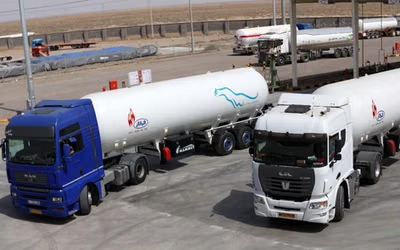
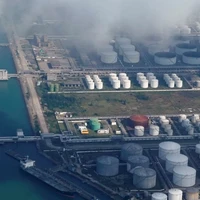
The partnership now functions as a dual-use logistical route linking Tehran and Caracas.
When Venezuela’s refineries faltered, Iran sent technical teams and arranged barter-based energy swaps; when Tehran needed additional outlets for crude, Venezuelan shipments helped maintain cash flow and reservoir management.
Western sanctions authorities say financial intermediaries on both sides have facilitated transactions designed to bypass traditional banking scrutiny.
Gold-for-fuel exchanges emerged as a way to secure hard assets where access to formal channels was limited. Cooperation has also extended into areas with potential military relevance.
These arrangements provided Iran a degree of strategic depth: a distant space where technology, training and covert finance could operate with reduced visibility.
That space is now tightening. With carriers, bombers and surveillance platforms operating near Venezuelan shores, the risk of disruption to sensitive shipments has grown.
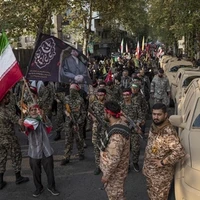
Protesters hold up posters in support of Venezuela, in front of the Swiss embassy in Tehran, which represents US interests in Iran, November 2025
The Hezbollah factor
Iran’s regional strategy depends heavily on non-state partners, especially Hezbollah.
Tehran’s adversaries accuse the group of fundraising in South America through smuggling routes, financial intermediaries and more recently, digital-currency channels.
As the group absorbs battlefield losses and financial strain, its reliance on overseas networks becomes more consequential.
Analysts of proxy finance argue that the Western Hemisphere offers strategic redundancy: if Middle-Eastern channels are disrupted, South American ones can help sustain the organization.
But those networks are themselves under renewed pressure.
Expanded US deployments near Venezuela increase exposure for facilitators who once operated with relative obscurity.
What was envisioned as a fallback corridor is now monitored by carrier strike groups, sanctions investigators and intelligence-sharing partners.
Legal reckoning?
If the Caribbean illustrates military deterrence, Buenos Aires represents a different form of constraint.
Argentine courts and prosecutors have advanced proceedings linked to the 1994 AMIA bombing, issuing findings that senior Iranian officials bear responsibility and designating the attack a crime against humanity.
Warrants and arrest-related measures have followed, some now proceeding in absentia so that non-cooperation no longer halts the process.
Tehran disputes these conclusions, but the judicial record being assembled carries growing diplomatic implications.
This legal trajectory erodes the old perception of Latin America as a permissive periphery. It raises personal risk for senior Iranian figures travelling abroad and increases potential financial exposure for entities linked to designated individuals.
Even without immediate enforcement, these foundations strengthen the prospect of future repercussions.
A less hospitable hemisphere
Three structural trends now converge: tightening maritime surveillance, expanding legal accountability and increased financial scrutiny through sanctions enforcement.
None of this suggests an imminent rupture. Oil can change flags; networks can adapt; facilitators can adopt new identities and routes. But the cost curve has shifted.
Iran has long viewed Latin America as a distant flank—a place where ideology, trade and covert influence could be pursued with limited friction.
That assumption is weakening. A hemisphere once defined by permissiveness is becoming a contested theatre shaped by US presence, judicial persistence and financial vigilance.
The logistical link between Caracas and Tehran still functions. It continues to serve both countries in their shared struggle against sanctions and isolation. But it now faces unprecedented pressure.
And if current trajectory hold, what was once adopted as an avenue of survival may, over time, become an axis of vulnerability.
Iran’s army has expanded electronic surveillance along its borders using advanced cameras and sensors, the commander of the army’s ground forces said on Tuesday.
Brigadier General Ali Jahanshahi told reporters that the upgrades are part of a broader effort to strengthen defenses and prevent illegal crossings. “In addition to new bases and watchtowers, border monitoring is being carried out electronically with advanced cameras and sensors,” he said.
He said construction of a border wall in eastern Iran is under way using domestic contractors and materials, combined with wire fencing and electronic detection systems. The aim, he said, is to curb smuggling and unauthorized movement across the frontier.
Jahanshahi added that the army’s ground forces, operating ten combat brigades, defend Iran’s western, southern and eastern borders alongside police and border guards. The joint operations, he said, have been effective in reducing drug trafficking and cross-border crime.
He also announced plans for a new “Eghtedar” (Power) military exercise in central Iran, saying recent drills have focused on upgrading weapons, tactics and coordination with other branches of the armed forces.
Germany’s embassy in Tehran is operating with sharply reduced visa capacity and expects constraints to persist, the Foreign Office said, citing Iran’s restrictive accreditation of diplomatic staff and significant technical hurdles at post.
The ministry told Iran International that since the June 2025 Iran-Israel hostilities, the embassy has worked in a limited capacity, and both the embassy and its visa section “will, for the foreseeable future, have only a fraction of the personnel” they had before the temporary shutdown.
The reduction of operations “is due in particular to Iran’s restrictive policy on accrediting diplomatic personnel,” read the statement.
Despite the squeeze, Berlin said processing has been gradually expanded in recent weeks by outsourcing application intake to an external service provider and moving case handling to the Federal Office for Foreign Affairs.
“These steps have created additional processing capacity,” the ministry said, adding that the changes especially benefit student-visa applicants and Iranian physicians applying for visas to complete professional recognition procedures in Germany.
Appointment rules have also been adjusted “to ensure the largest possible number of applications can be accepted via the external provider,” the Foreign Office said.
It cautioned, however, that “despite these tangible improvements,” limitations at the Tehran post will remain for the time being.
Germany’s visa services in Tehran have operated at reduced capacity since the June 2025 Iran–Israel conflict, when the embassy temporarily closed, canceled appointments, and said new dates would be issued automatically as capacity allows.
Applicants report prolonged delays and uncertainty, staging weekly protests outside the embassy and TLScontact.
Iranian paper Shargh estimated more than 6,000 delayed cases, including about 4,000 family-reunification files, while IRNA previously put 3,000–4,000 Iranian passports as stuck in foreign missions after wartime closures.