• العربية
  • فارسی
Brand
  • Iran Insight
  • Politics
  • Economy
  • Analysis
  • Special Report
  • Opinion
  • Podcast
  • Iran Insight
  • Politics
  • Economy
  • Analysis
  • Special Report
  • Opinion
  • Podcast
  • Theme
  • Language
    • العربية
    • فارسی
  • Iran Insight
  • Politics
  • Economy
  • Analysis
  • Special Report
  • Opinion
  • Podcast
All rights reserved for Volant Media UK Limited
volant media logo
INSIGHT

'Relentless stress': Iranians struggle to fend off daily hardship

Maryam Sinaiee
Maryam Sinaiee

Iran International

Dec 10, 2025, 20:34 GMT+0Updated: 23:12 GMT+0
A mother and son stand near a road's curb on a rare rainy day, in Tehran, Iran, December 10, 2025

Ordinary Iranians are buckling under the physical and psychological strain of surging prices, toxic air and deepening food and medicine insecurity, officials and experts in Tehran have warned.

The government’s decision to strip subsidized foreign exchange from the import chain for a range of essential goods—including rice, oil, red meat, animal feed and medicines—has pushed living costs sharply higher.

Non-subsidized petrol prices are due to rise later this week, adding to fears of further inflation.

“Without economic security, psychological security cannot exist,” former public health official Naser Ghasemzad told the moderate daily Shargh on Tuesday.

“Citizens must feel confident that if they fall ill, the health system will support them. They need to know that prices are predictable and the economy is relatively stable.”

‘Widespread depression’

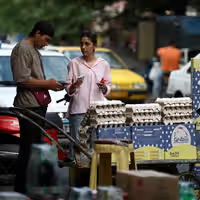
Inflation and collapsing purchasing power have pushed protein and dairy out of reach for many families. Even staples such as rice and bread are becoming unaffordable.

Ghasemzad pointed to alarming trends in the capital. “Around 30 to 40 percent of residents suffer from mild neurological disorders such as anxiety and depression. This is not a small number and reflects the widespread pressures that daily life imposes on people.”

The government insists electronic subsidy cards will cushion the blow. But many say the support falls far short of rising prices and that handouts may help only if regularly adjusted for inflation—a tall order given the government’s cash constraints.

“People wake up every day with new worries—from the exchange rate that affects all prices to the possibility of school or office closures because of pollution,” Tehran resident Arman told Iran International. “The stress is relentless.”

Fouad, a father in the capital, describes an “unending cycle.”

“Every time we find a solution to one problem, like buying equipment to secure emergency electricity, another crisis emerges. It creates a sense of helplessness and mental exhaustion.”

‘Medicine running out’

Drug shortages and soaring prices are intensifying the pressure, particularly for patients with chronic or life-threatening conditions.

Dr. Akbar Abdollahi of Iran’s Food and Drug Administration recently warned that factories now hold “less than one month’s supply” of some essential medicines.

Distribution centers have under two months, and pharmacies under three. Twenty-one hospital drugs are already in shortage, and 800 more face potential disruption because of currency and liquidity constraints.

“Given current conditions, shortages could worsen next year,” said Ebrahim Hashemi, chairman of the Iranian Drug Distributors Association.

For those reliant on specialized treatment, the situation is becoming desperate.

“The government’s removal of subsidies is like stamping a death sentence on patients,” said Younes Arab, head of the Thalassemia Patients Association, warning that some families are contemplating selling organs to pay for their children’s medication.

On the verge

Social pressures are adding further strain.

Ultra-hardliners are pushing renewed hijab enforcement, and authorities are targeting businesses that fail to comply.

The government of Masoud Pezeshkian has also failed to deliver on promises to lift internet filtering.

It is an intense and dangerous climate, sociologist Iman Jajarmi warned in an interview with the Shargh newspaper on Tuesday. “Even minor social issues can escalate into political crises.”

Most Viewed

Text of US-Iran memorandum released
1

Text of US-Iran memorandum released

2

Toronto shooting probe uncovers trail leading to Tehran

3

US says Iran won't get funds upfront under MoU

4

Khamenei shifts responsibility for MoU as Iran, US implement Hormuz terms

5

US says Iran deal will end enrichment, destroy uranium stocks, cap missiles

Banner
Banner
Banner

Spotlight

  • Who in Tehran is opposing a deal with Washington?
    INSIGHT

    Who in Tehran is opposing a deal with Washington?

  • A fragile compact: ambiguities that could undermine US-Iran MoU
    ANALYSIS

    A fragile compact: ambiguities that could undermine US-Iran MoU

  • A thaw with the US won't fill Iranian tables overnight
    INSIGHT

    A thaw with the US won't fill Iranian tables overnight

  • Why some think a weakened Iran could emerge stronger
    ANALYSIS

    Why some think a weakened Iran could emerge stronger

  • Atlas of Iran missile cities: The hidden network behind Tehran’s missile power
    SPECIAL REPORT

    Atlas of Iran missile cities: The hidden network behind Tehran’s missile power

  • Toronto shooting probe uncovers trail leading to Tehran

    Toronto shooting probe uncovers trail leading to Tehran

•
•
•

More Stories

From crisis to stalemate: Tehran settles into post-war diplomatic freeze

Dec 10, 2025, 16:18 GMT+0
•
Behrouz Turani
From crisis to stalemate: Tehran settles into post-war diplomatic freeze
100%
Female members of Iran's paramilitary Basij hold Iranian flags on a state-sponsored group hike in the mountains overlooking Tehran, December 9, 2025

The mood in Tehran appears to be shifting from a sense of imminent danger that followed the June war to a more resigned belief that diplomacy with Washington is stuck in a strategic stalemate rather than a temporary lull.

Across the political spectrum, officials and commentators now speak less about breakthroughs and more about the constraints that make a return to the negotiating table unlikely.

“This is a structural lock that has evolved out of developments in recent years,” international relations professor Mohsen Jalilvand told the moderate outlet Fararu.

The deadlock, Jalilvand argued, stems from Tehran’s red lines: uranium enrichment and missiles—which he said form the core of Iran’s “security architecture and deterrence doctrine,” and therefore “cannot even be part of preliminary talks.”

The Trump administration last month responded to a message from Iran conveyed through the Saudi crown prince by saying three US conditions for any negotiations with Tehran remain unchanged, sources told Iran International.

These include Iran completely halting uranium enrichment, ending support for armed allies in the Middle East and accepting curbs on its ballistic missile program. Tehran has long dismissed the demands as a non-starter.

Many in Tehran believe previous rounds of bargaining delivered few tangible gains while reinforcing a cycle of pressure and concession that Iran cannot afford to repeat.

Washington’s messaging has done little to shift these perceptions.

US Middle East envoy Tom Barrack insisted last week that President Donald Trump wants an agreement with Iran—but on his terms.

Jalilvand warned that the upcoming visit of Israel’s prime minister, Benjamin Netanyahu, to Washington will likely raise the political cost of any rapprochement with the United States.

‘Like before June war’

Inside Iran’s parliament, the view is similarly bleak.

MP Beitollah Abdollahi told the reformist outlet Rouydad24: “There are no negotiations with the United States on the horizon,” warning that the situation was similar to the period before a surprise Israeli military campaign in June.

In the six months since that conflict, Tehran has rebuilt parts of its regional posture, tightened internal discipline, and recalibrated its rhetoric.

What once looked like an emergency phase has settled into a colder equilibrium: no active escalation, no meaningful diplomacy, and a widening perception inside Iran that neither side is prepared to assume the political risk required for movement.

Iranian officials are increasingly portraying US expectations as calls for fundamental transformation rather than technical compromises.

A December 8 commentary on Rouydad24 said this shift in mood was evident in Foreign Minister Abbas Araghchi’s recent emphasis on “managing hostilities” instead of avoiding conflict or resolving the standoff.

MP Ali Hashemi had one of the more sobering assessments.

“(Araghchi) knew that talks with the US had reached a deadlock at least three weeks before the war with Israel,” he said on Tuesday. “This explains his shift.”

Iran's cultural opening was won by Gen Z not granted by state, analyst says

Dec 9, 2025, 21:21 GMT+0
•
Negar Mojtahedi
Iran's cultural opening was won by Gen Z not granted by state, analyst says
100%
Group of unveiled Iranian girls standing before a famous mosque in Isfahan, Iran.

A dramatic cultural opening is sweeping across Iran, not as a government reform but as a bottom-up movement driven by a young generation that is less willing to be intimidated by the state, Iran analyst Omid Memarian told Eye for Iran.

Street concerts, outdoor festivals, late-night parties and music events have become increasingly visible in Tehran and beyond. Young people, many without the headscarves which are required for women, have filled pop and jazz concerts while street bands draw large crowds on central boulevards.

“This has nothing to do with the government,” Memarian said. “It is a very massive force underneath the society, and they are opening pathways that my generation was not able to even touch.”

Images and reports from across the country show men and women running together in a desert marathon in Kerman, while on Kish Island in the Persian Gulf the organizers of a separate marathon were arrested after women ran without hijabs.

  • Kish Marathon: hijab controversy or political score-settling?

    Kish Marathon: hijab controversy or political score-settling?

Local media said more than 5,000 people took part in the Kish race, and photographs of female runners posing with medals and uncovered hair circulated widely online. Judicial officials accused organizers of “violating public decency” and said warnings about the dress code had been ignored.

The apparent cultural opening has been tolerated by authorities in its bid to shore up popular support in the wake of the punishing conflict with Israel and the United States, even as they have stepped up arrests and executions.

Memarian said the opening is not sudden. For years, multiple demographics “have been pushing inch by inch,” and many have paid a price. But two events accelerated it: the death of Mahsa Amini in morality police custody in 2022, which triggered nationwide protests and the twelve-day war between Iran and Israel earlier this year.

In June, Israel launched a surprise military campaign on Iranian nuclear facilities, missile production sites, killing nuclear scientists along with hundreds of military personnel and civilians.

Iran retaliated with waves of drones and ballistic missiles, prompting a week of exchanges. The United States then intervened directly, striking three Iranian nuclear sites at Fordow, Isfahan and Natanz with bunker-busting bombs.

Many Iranians spent nights sheltering in parking garages and stairwells. The government urged calm and vowed that its defenses had “full control,” yet many ordinary people said they felt unprotected.

“People were left alone. They saw the regime could not protect them. That created a huge vacuum and emboldened many Iranians,” Memarian said.

He emphasized that the changes are not limited to affluent parts of Tehran.

“It is a very widespread movement. From Tehran to small cities and villages, people are voicing their demands, imposing their lifestyle on the system.” Social media has erased the geographic divide, he added, allowing young people in remote areas to follow the same trends as their peers in urban centers.

“We have a massive explosion of expectations inside the country,” he said. “They are not going to let the government write their destiny. There’s no going back.”

Despite ongoing arrests and a rise in executions, officials have responded cautiously. The judiciary chief recently said the current relaxed approach to hijab enforcement “cannot continue,” and conservative voices have warned that “the Islamic revolution will soon disappear” if the trend continues.

Memarian said the state’s enforcement network sees the social shift as existential. “Those who favor repression are part of a massive, expensive machine,” he said. “Their identity, paycheck and power come from it. If they lose this, it’s over.” Some insiders, he added, now believe they cannot win. “They fear this is the beginning of the end. The domino has started to fall.”

Iran’s economy remains under strain, with sanctions, inflation, water shortages and energy problems. Yet Memarian said young Iranians remain focused on building their future ... one where the "Islamic Republic is something from the past.”

Iranian academic hits raw nerve with scorn of poor in power

Dec 9, 2025, 02:35 GMT+0
•
Maryam Sinaiee
Iranian academic hits raw nerve with scorn of poor in power
100%
Iranian academic Mahmood Sariolghalam

A prominent academic’s assertion that many of Iran’s problems stem from “the dominance of the economically weak class” in governance has stoked outrage in a country whose theocracy bills itself as a champion of the downtrodden.

In a recent interview, Mahmood Sariolghalam, a US-educated professor of international relations at Tehran’s Shahid Beheshti University, argued that senior positions should not be held by individuals from the country’s lower economic strata.

“No one from the lower economic strata should be allowed to become foreign minister or finance minister,” he said, adding that such posts require the “expertise and rational capacity of the mind.”

Sariolghalam, who held senior roles at the Center for Scientific Research and Middle East Strategic Studies under presidents Mohammad Khatami and Hassan Rouhani, framed the remarks as an analysis of development patterns rather than a social judgment.

Critics from across the spectrum accused him of class discrimination, delegitimizing the political agency of Iran’s poor and promoting an elitist technocratic worldview.

But others were more sympathetic as many observers have questioned Tehran's management of deepening diplomatic, economic and resource challenges.

For decades since the 1979 Islamic Revolution, positions of authority from local officials to the presidency have often been filled by loyal cadres often drawn from poorer demographics.

Under pressure, Sariolghalam told the reformist Ensaf News his remarks had been distorted, insisting he had highlighted the developmental role of the middle class, not the poor.

“The middle class matters not only in financial terms but also for its intellectual, educational, and investment-oriented capacities,” he said, citing Japan as an example of middle-class resilience.

‘Oligarchy’

Experts have cited the dangers of sanctions and economic mismanagement to Iran's middle class, which economists and political scientists often view as a key source of dynamism in society.

International academics Mohammad Reza Farzanegan and Nader Habibi published research in the European Journal of Political Economy in which they said sanctions on Iran had decimated the middle class and the political benefits it could bring.

"The sanctions regime on Iran was far from being a surgical strike; instead, it was a sledgehammer that smashed the very group that represents the best hope for a more moderate and stable future," they wrote in an editorial on Al-Jazeera.

In a front-page editorial titled “The Savior Class,” the centrist daily Sazandegi defended Sariolghalam's tack.

“The emphasis on the ‘middle class’ … is not meant to suggest economic superiority,” it wrote, but to underline the need for “security, mental order and relief from livelihood pressures” for sound decision-making.

The paper argued he was criticizing systems that allow “individuals who lack intellectual, managerial, or mental qualifications” into key posts.

A group of academics echoed that defense, arguing governance failures stem from the rise of opportunistic figures who wield power to “compensate for their own life shortcomings.”

Hardline outlets reacted fiercely. Several accused Sariolghalam of equating poverty with “mental deficiency” and advocating a “technocratic oligarchy” at odds with the Islamic Republic’s valorization of the mostaz’afin — often translated as “the dispossessed.”

“The downtrodden and the barefooted are expected to endure a bleak fate… while the aristocrats and the affluent… sit upon their backs and rule over them,” the IRGC-linked Javan proclaimed.

State to blame

Conservative daily Khorasan accused Sariolghalam of shifting blame for failed engagement with the West onto the “lower classes.”

Conservative media also tied the remarks to former president Hassan Rouhani, casting them as part of broader ideological failings among Iran’s technocratic current.

“The mind behind Rouhani’s thinking,” as Mehr News branded Sariolghalam, had exposed “one of the deepest intellectual flaws” of Iran’s centrists: that only they know how to run a country.

Some moderate voices pointed out that the ferocity of the debate revealed deeper structural problems.

Journalist Ahmad Zeidabadi argued in Ham-Mihan that Tehran’s decades-long, excessive rhetorical defense of the poor had created conditions in which “Sariolghalam’s repulsive statement has somehow gained acceptance.”

Rebellion tamed: why Iran is turning rap into a controlled industry

Dec 8, 2025, 19:18 GMT+0
•
Negar Mojtahedi
Rebellion tamed: why Iran is turning rap into a controlled industry
100%
A freestyle hip-hop live performance in Tehran

Rap has moved from the margins to the spotlight in Iran, where it is being promoted on streaming platforms, entertainment shows and Instagram feeds tied to state interests and seen by millions.

To many viewers it looks like a cultural opening: a genre long associated with underground resistance now visible on mainstream screens.

But researcher and artist Siavash Rokni, a postdoctoral fellow at McGill University in Montreal who studies Iranian youth culture, pop music and the communication dynamics of social movements, argues that that the reality is more complicated.

“It is a public relations performance,” he said. “It is fooling a lot of people, and we need to stop being fooled by it.”

Rokni has followed the evolution of Iran’s rap scene across five generations. He sees the new appetite for rap not as legalization but domestication, turning underground culture into something profitable and controllable.

Entertainment shows and “normal” rappers

One of the most watched programs in this space is BaZia, hosted by a former Iranian state television personality now living in Turkey. According to Rokni, the show’s guest selection and narratives suggest an ongoing connection with Iran.

“Technically speaking, he is no longer connected to the system,” Rokni said. “But the way he chooses his guests shows there is a connection.”

The rappers appearing on BaZia help normalize a particular type of rap that is not inclusive of all aspects of this cultural practice. Many of the same rappers featured on BaZia are now set to appear in a new rap-themed program hosted by him called GANG. Rokni says it shows how this was part of a larger plan to create momentum for the new show while normalizing a particular narrative of regime approved rap.

The narrative, Rokni said, “comes very slowly” through a sequence of interviews. Artists describe performing abroad but wanting to return. Producers talk about the economic advantage of bringing rap back while being able to control the content.

Money, control and aesthetics

Much of Iran’s music economy is in the hands of a profit-minded clique, Rokni said.

“The people who are running this oligarchical capitalism are connected to the Islamic Republic,” he said. “They just want to make cash.”

He stressed that the motivation is not necessarily ideological. Many simply benefit from the system’s structures.

The appearance of rap on screens has been accompanied by pressure and arrests behind the scenes. In early October at least five rappers and a composer were detained in Tehran and Shiraz, according to the Center for Human Rights in Iran.

Security forces raided homes, seized phones and recording equipment and transferred the men to detention.

Within days videos appeared on their Instagram accounts with shaved heads and visible tattoos, apologizing on camera. Lawyers told CHRI the accounts had been taken over by cyber police.

One of the most high profile cases remains Toomaj Salehi, whose lyrics became an anthem of the Women Life Freedom movement.

He was arrested, abused in detention, sentenced to death, released on bail and then rearrested after publicly describing his treatment. Supporters say he is targeted because he refuses to leave Iran or be silent.

Female rappers face even greater constraints. Iran bans solo female singers from performing publicly or releasing their own vocals, forcing artists into exile or underground spaces. Studios refused to record them and venues were raided for illegal performances.

Why normalize rap at all?

Rokni traces the logic back to then Iranian president Mohammad Khatami era when the government offered small cultural openings to create a sense of possibility.

“You free some cultural restrictions and reconcile with the people,” he said. “You give hope. And that can be taken away very easily.”

He called this strategy dishonest. Licensing and televised satire, he said, do not signal reform. They are tools for narrative management.

Oppression, he argued, is often brief.

“They put a lid on it,” he said. “But the program starts after that.”

The backlash against licensed rappers, especially those connected to the Woman, Life, Freedom movement, has been emotional. Some consider state approved albums a betrayal. Others see economic survival.

Rokni believes the solution is parallel economies, enabling musicians to make money without going through state linked producers or licensing offices.

“Do it yourself,” he said. He pointed to artists who built audiences through Instagram and streaming platforms.

In today’s Iran rap carries two meanings. One version is polished, licensed and safe. The other remains underground created by musicians who refuse to compromise.

Both exist at once but only one is protected.

Holy irony: how a theocracy secularized Iran

Dec 8, 2025, 17:25 GMT+0
•
Naeimeh Doostdar
Holy irony: how a theocracy secularized Iran
100%
A man riding a bicycle stares at the grand mosque (known both as the Shah Mosque and the Imam Mosque), in Isfahan's historic Naqsh-e Jahan square, Iran, November 2025

Half a century of rule built on clerical authority has secularized Iran, available data suggests, with most still believing in God but not in the theocracy.

The story is not the “death of religion,” as it may appear from social media snippets depicting once unheard of public concerts and women spurning the mandatory hijab, but a fundamental reordering of how Iranians relate to faith.

Recent surveys by the Netherlands-based Group for Analyzing and Measuring Attitudes in Iran (GAMAAN) found 68% oppose the continuation of the Islamic Republic. Support for its leader and revolutionary principles fell from 18% to 11% between 2022 and 2024.

A leaked culture ministry survey reported that 73% favor separating religion and state. A peer-reviewed article by Ali Sarihan of Maryland's St. Mary's College, published in the journal Religions puts support for a secular system at around 70%.

Yet other indicators show Iran is not secular in the familiar Western sense. The World Values Survey (WVS) still finds 96% identify as Muslim and only 1.3% as atheist.

Faith endures, it seems. It is political Islam that is losing ground.

Hidden secularism

Classic secularization theory imagined that modernization would push religion out of public life. Iran shows something more layered: personal belief can survive even as the political project built around it collapses.

Sociologist Asef Bayat has called this “post-Islamism”—a phase in which political Islam has exhausted its appeal, even as many Iranians retain some form of private faith.

Iran is not “non-religious,” Bayat argues. It is post-theocratic in its political aspirations.

Religious practice has thinned markedly.

Sarihan's study also suggests that the share of Iranians who “always or often” pray fell from 78% in 2015 to 55% in 2023—a steady decline shaped, and likely accelerated in recent years, by repression and economic crisis.

The WVS relies on face-to-face interviews, which in a country like Iran give respondents every incentive to conceal dissent or non-conformity.

Belief recast

Religious rituals remain part of everyday life.

The Shi'ite religious holy days of Muharram and Arbaeen still draw large crowds especially outside major cities, and shrines remain busy.

But for younger Iranians, who express the highest levels of political dissatisfaction, religion no longer aligns with state intrusion into private life.

The compulsory hijab, morality policing and the regulation of personal behavior have turned religion, for many, into a vehicle of control.

The widespread protests of 2022, known by their rallying cry of Woman, Life, Freedom, exposed this rupture. The slogans were never an assault on faith itself but on the state’s claim to define and enforce it.

On social media, hashtags rejecting the Islamic Republic sit comfortably alongside posts defending personal belief. The distinction between faith and religious governance has become unmistakable.

Coercion to choice

Iran’s path to secularization is unusual because it runs in two directions at once: from above and from below.

Heavy-handed enforcement—from hijab rules to cultural censorship—has alienated generations and inadvertently strengthened the case for separating religion and power.

GAMAAN’s highest recorded opposition to the theocratic system came at the height of the 2022 protests, when women’s bodily autonomy became the central battleground: four out of five respondents said they would vote “no” to an Islamic Republic in a hypothetical referendum.

Meanwhile, everyday acts of defiance are reshaping religious life from the ground up.

Women walk unveiled. Families who still value faith increasingly bypass official religious bodies. Younger Iranians look for ethics and spirituality beyond state-sanctioned channels.

God versus government

Two caricatures usually obscure the real picture. Iran is not a “godless society”: personal belief, ritual and religious meaning remain widespread. But nor is it the devout political community the state insists it governs.

The Islamic Republic’s project of political Islam has lost its authority, and most Iranians now prefer a secular political order.

The theocracy has produced one of the region’s strongest secularizing shifts—not through reform but through coercion. The more it has enforced religious rule, the more clearly Iranians have separated faith from the state.

Iran today stands between private, chosen belief and state-imposed religion.

The secularization of politics is now a structural threat to Islamic rule—one that often goes unnoticed amid a myriad of more immediate, louder crises.