The intervention comes after weeks of criticism from hardline media outlets, clerics and political factions that viewed the agreement as a dangerous concession to Washington.
While the ultraconservative Paydari Party is often portrayed as the main opponent of rapprochement with the United States, recent debate in Iran has highlighted a broader network of political, media and ideological actors resisting a Tehran-Washington understanding.
In a message issued after the signing of the memorandum, Mojtaba Khamenei warned that actions creating “pessimism among the people” effectively serve the enemy, language widely interpreted as a rebuke to hardline critics of the agreement.
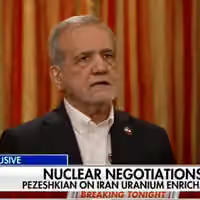
Both Pezeshkian and Ghalibaf quickly issued statements pledging to follow the leader's guidance and defend the negotiating process.
The apparent effort to impose discipline on the debate has coincided with growing scrutiny of those opposing diplomacy.
'Negotiation is haram'
One of the most detailed assessments came from Khabar Online, which argued that resistance to the ongoing negotiations should not be viewed as ordinary criticism but as an organized campaign to undermine diplomacy, attack key officials and deepen national divisions.
The report identified state television, IRIB, as the leading institutional opponent of an agreement. It cited remarks by hardline clerics who used the broadcaster's platforms to denounce negotiations with the United States.
Among them was cleric Gholamreza Ghassemian, who declared on state television that “negotiation is haram,” while arguing that those pursuing talks were acting contrary to divine principles. Another cleric, Sheikh Esmail Ramezani, insisted that relations with Washington were impossible.
Khabar Online accused IRIB of functioning as the mouthpiece of a single political faction rather than a national broadcaster and even alleged that portions of the leader's recent warnings against discord were downplayed to preserve a hardline narrative.
The report also pointed to figures associated with the late president Ebrahim Raisi's administration, arguing that some remained more focused on domestic political rivalries than on supporting diplomacy endorsed by the state's highest institutions.
Messianic detractors
The Paydari Party appeared third on the list. The article described it as a rigidly ideological parliamentary bloc that has used its network of lawmakers and media outlets to challenge the negotiating team and question the merits of engagement with Washington.
Yet even Paydari represents only part of the opposition.
In a separate interview with Rouydad24, former lawmaker and security official Mansoor Haghighatpour argued that resistance to a Tehran-Washington agreement also reflects the influence of the messianic Hojatiyeh association, whose legacy remains the subject of recurring debate in Iran.
The article did not mention several familiar hardline voices who have also opposed diplomacy. Among them are Kayhan editor Hossein Shariatmadari, a longtime critic of engagement with the United States, and MP Esmail Kowsari, who continued issuing threats against Washington and regional states during the war and subsequent ceasefire.
'Harsh response'
The divisions echo debates surrounding the 2015 nuclear agreement, when hardline factions accused negotiators of capitulation while supporters argued diplomacy was necessary to ease pressure on the country.
Ghalibaf was more explicit in defending the current process, warning that those acting against the leader's guidance “under the guise of obeying the Leadership” would face a “harsh response from the nation.”
For now, however, public criticism appears to have subsided. The day after the memorandum was signed, Iranian media largely fell silent on opposition to a possible agreement.
Whether that reflects a direct effort by the leadership to quiet dissent, or merely a temporary pause as political factions adjust to the new reality, may become clearer in the days ahead.
What is already apparent is that resistance to a deal with Washington extends well beyond any single party or faction—and that the leadership has signaled it expects those disputes to remain contained.