Iran’s top judge signals tougher line on hijab

Iran’s judiciary chief said the current approach to hijab will not continue, outlining coordinated steps with police, prosecutors and regulators to curb what authorities call social disorders.

Iran’s judiciary chief said the current approach to hijab will not continue, outlining coordinated steps with police, prosecutors and regulators to curb what authorities call social disorders.
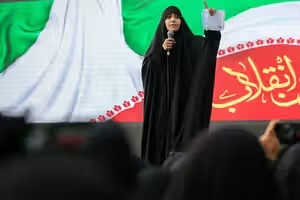
Part of today’s social disorder, Gholamhossein Mohseni Ejei said, stemmed from conduct related to hijab.
“This situation should not continue, and none of us can be indifferent toward what the law and the expectations of religious citizens demand,” Ejei added.
Intelligence bodies, Ejei said, had received orders to identify groups he described as “organized promoters of improper hijab,” and that police were obligated to intervene when offenses were openly visible.
“With such cases there will be legal action,” he warned. Restaurants, cafés and other venues had been warned they would face firm measures if violations occurred on their premises, he added, noting that closures would no longer be limited to brief periods.
He also said government bodies involved in public ceremonies would be held accountable if “unlawful behavior” occurred at their events.
Lawmakers press for firmer action
155 lawmakers on Tuesday wrote to Ejei accusing the judiciary of passivity toward growing noncompliance with the dress rules.
They said uneven enforcement by executive bodies had fueled what they called social disorder, urging the courts to “restore governance” by ensuring all institutions apply existing regulations consistently.
The lawmakers also criticized some judges and officials for what they described as lapses "that had allowed moral decline and social abnormalities to spread," urging action within the current legal framework.
Tensions intensified after a leaked audio file suggested Supreme Leader Ali Khamenei had issued written instructions for stronger implementation of the mandatory hijab following an intelligence ministry warning about declining discipline.
Officials confirmed the directive but rejected suggestions of cabinet disagreement, while conservative outlets described it as an explicit call for decisive measures.
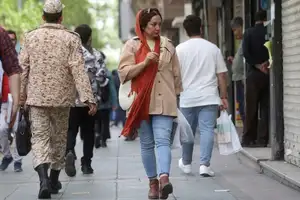
Despite escalating pressure, many women and girls continue to appear unveiled in public spaces.
In numerous districts of the capital, uncovered women now form the majority on streets and in shops, while widely shared videos show mixed gatherings, music and casual clothing.


Despite facing a growing domestic gas deficit and widespread use of highly polluting fuel oil, Iran’s gas deliveries to Turkey have continued to surge according to official Turkish energy statistics.
Newly released data from Turkey’s Energy Market Regulatory Authority (EMRA), affiliated with the Ministry of Energy show that Iran supplied more than 5.5 billion cubic meters of gas to Turkey during the first nine months of 2025—17% more than in the same period last year and 45% higher compared to 2023.
Buffeted by stiff Western and international sanctions, Tehran appears to be seeking revenue from abroad even as it faces severe gas shortages at home.
A confidential Oil Ministry document obtained by Iran International in mid-2025 showed an annual jump by nearly half in fuel oil, or mazut, consumption last year.
This is despite its being one of the most polluting forms of fossil fuel on earth.
It is not yet clear how much mazut consumption has risen this year, but the deputy oil minister says Iran is expected to face a daily gas deficit of 300 million cubic meters during this winter’s peak demand. Last year, the shortfall was 250 million cubic meters; in 2023, it was about 200 million.
Bleak outlook
With the onset of cold weather and rising household gas demand across large parts of the country, industries and power plants have increasingly switched to burning mazut, causing dangerous air pollution in major cities including the capital Tehran.
A recent report by Iran’s Department of Environment on the mazut and diesel supplied to Tehran-area power plants shows sulfur content 10 to 100 times higher than international standards.
Had Iran halted its gas shipments to Turkey, the statistics show it could have reduced domestic fuel oil consumption by roughly 20 million liters per day, given that natural gas is the cleanest fossil fuel alternative.
Yet the Islamic Republic insists on maintaining its gas exports to Turkey and supplies roughly the same amount to Iraq.
Last year, Iran exported 15 billion cubic meters of gas, equivalent to 15 billion liters of mazut in energy content. If exports had been suspended, not only would Iran have avoided burning mazut domestically, it would have also saved 7 million liters of diesel per day.
Why does Iran have a gas shortage?
Part of Iran’s gas deficit stems from the slowdown in the development of gas production projects due to the government’s financial constraints and the limited technological capabilities of domestic oil companies.
Stiff Western and international sanctions have made updating the country's already creaky energy infrastructure yet more difficult.
For example, between 2010 and 2020, Iran’s gas output grew at an average annual rate of 5.2%, but growth has dropped to 1–2% in recent years, according to BP statistics.
Another critical factor is the decline in pressure at Iran’s section of the South Pars gas field, shared with Qatar—a decline that began in 2024. South Pars supplies over two-thirds of Iran's gas.
Years ago, Qatar collaborated with major Western energy companies to install 20,000-ton platforms—15 times heavier than Iran’s current offshore platforms—along with huge compressors in the Qatari section (the North Field).
But neither Iran nor its Chinese partners possess the technical capacity to manufacture such large-scale equipment.
Declining pressure
About nine months ago, Iran’s Oil Ministry signed a $17 billion contract with four domestic firms to implement pressure-boosting operations at South Pars. However, instead of installing 20,000-ton platforms, the plan calls for 4,000-ton structures, and for using weaker compressors instead of the massive units required.
An Iranian-British oil and gas engineer—designer of a BP mega-platform in Azerbaijan’s Caspian waters and currently working on the Qatari side of South Pars—told Iran International that the specifications of platforms and compressors outlined in the Iranian contract are inadequate to resolve the field’s pressure decline.
The engineer, who requested anonymity, added that restoring pressure on the Iranian side requires much larger platforms capable of hosting a full power plant, giant compressors and facilities for separating various gas streams and condensates.
The pressure in Iran’s section of South Pars was about 120 bar until two years ago, but has since been dropping by 6 bar per year, significantly reducing gas output.
Mohammad Oliya, CEO of MAPNA—one of the four companies awarded the $17 billion contract—said earlier this month that “no funding has yet been allocated” for the pressure-boosting project.
At the same time, the Revolutionary Guards-linked Tasnim news agency reported that although the contract was signed in March, no action beyond a series of study meetings and initial assessments has occurred.

An Iranian singer who won a Grammy for a ballad which became the unofficial song for a scotched national uprising in 2022 has incurred fury for announcing the release of an album which received an official state license.
Earlier this week, he revealed that digital and physical pre-orders for his debut record, Real, were open on his website—a surprise to many after he had recently complained of new restrictions, including being barred from gyms and concerts.
Hajipour gained international recognition in 2022 with Baraye, the song widely associated with Iran’s Woman, Life, Freedom protest movement and winner of the Grammy for Best Song for Social Change.
His arrest soon after the song went viral, and the pressure that followed, made him one of the most visible cultural figures linked to the unrest, which authorities quashed with deadly force.
The approval of his album by Iran’s culture ministry quickly drew criticism from dissidents who argue that official licenses remain a privilege often withheld as punishment for dissent.
‘Privilege is privilege’
“You’re not the people’s Shervin,” wrote Sheldon, a dissident account with nearly 250,000 followers. “You’re a regime-made figure. If you were anything else, you’d have been eliminated like thousands of artists of this homeland.”
Others framed the license as a symbol of privilege in a politicized system. “Privilege is privilege,” wrote X user Arash Aalam, “whether it’s tiered internet access or permission to distribute an album when others are deprived of such a natural right.”
Hajipour hit back on social media.
“I finally managed to release my album after three years of being banned from working and unemployment,” he wrote. “How does that contradict the collective interests of our people? I don’t want to leave Iran. I just want to work … May I die if I ever betrayed anyone.”
Hajipour has released unlicensed songs in the past couple of years, including Ashghal (“Trash”), which became one of the most-watched Persian music videos of the year with nearly 30 million views in the first 24 hours.
‘Lynching from afar’
The artist’s popularity was apparent in many sympathetic posts on social media.
“I’m angry that Shervin applied for a permit, but I won’t forget his song reached everyone’s ears and created such remarkable emotional unity during the protests,” wrote Mahsa on X, vowing not to let the state “destroy that unity.”
Some had harsher views about his critics, pointing fingers at dissidents outside Iran. “This is not criticism, it’s lynching by the mob,” wrote Tehran-based journalist Hossein Yazdi on X.
“Dirty and cowardly lynching from behind keyboards with fake accounts, by the very ones who sip hundred-dollar coffee in the best places in the world while prescribing do's and don't's to a young artist inside Iran who was brave enough to speak of the people's pain.”
Against permits
The dispute comes amid a broader shift in Iran’s cultural sphere.
Since the widespread protests of 2022, many artists have chosen to work without permission, refusing to submit their creations for government vetting.
Filmmakers have produced entire features inside the country without permits—often defying hijab mandate and other rules—and sent them directly to international festivals.
Musicians, visual artists and writers have similarly turned to unlicensed work, forming a parallel creative economy outside the state’s control.

A lopsided war with Israel and the United States in June rattled Iran’s political order, but it survives through smarter coercion and the disarray of forces that might otherwise bring it down.
Internal contestation is harsher than at any time in recent memory, with competing factions trying to preserve or redefine their place in a system that has lost the capacity for reform or institutional expansion.
Yet Iran's nearly 50-year-old theocracy persists, compensating for poor governance with stiff security control and the careful redistribution of shrinking resources.
Just as authorities have slackened enforcement of Islamic social rules, allowing unveiled women and open-air concerts in public, it has stepped up a crackdown on political dissent and alleged spies.
Opposing this order are three forces whose interaction with the securitized state produces neither fundamental change nor imminent collapse, but something closer to endurance through erosion.
Those are: people inside Iran fighting localized economic and professional battles without organized networks, an exiled opposition adept at narrative and symbolism but detached from lived realities inside Iran and foreign actors committed to curbing Tehran’s nuclear and regional strength but not to toppling it.
One system, many channels
The Islamic Republic is structured around the Supreme Leader, whose authority ultimately resolves all major decisions. Around this axis sits an intricate constellation of parallel institutions, security councils, loyalty networks and overlapping hierarchies.
Policymaking is multi-layered. But decision-making is ultimately his sole prerogative.
President Masoud Pezeshkian recently issued a telling statement that unmanageable infighting would ensure should Ali Khamenei somehow exit the scene. It underscores a basic fear: without the Leader’s centrality, the power networks would drift apart.
Nothing illustrates this better than the way “system” is used interchangeably for both the political order and the leader himself.
Khamenei functions less as the manager of a unified apparatus than as the referee of internal conflicts. The state bureaucracy is not the engine of governance but one node among political, security and economic bodies each pursuing their own interests.
The 12-day war intensified these fissures. The removal of influential IRGC figures disrupted long-standing balances and sharpened factional sensitivities.
The Babak Zanjani affair illuminates the power politics at play.
Sprung with little explanation from a death sentence for corruption, the disgraced tycoon now not only walks free but weighs in regularly on politics, even appearing to threaten former President Hassan Rouhani with death in a tweet this week.
Such a rapid rehabilitation could not occur without powerful establishment backing.
Unorganized discontent
The war’s economic toll—passed on to society through inflationary policies—has deepened hardship and widened discontent. Iran’s society today is in ferment but unorganized: protests erupt across workplaces and cities, but without intermediary institutions they remain local and short-lived.
A recent nurses’ strike in Mashhad, much like the truck drivers’ strike before it this spring, showed the pattern clearly: strong anger, weak connective tissue.
The labor market’s collapse into unstable, platform-based work illustrates a society living in permanent emergency. Eight million rideshare drivers do not prove total collapse, but they reveal a mass shift toward insecure livelihoods.
Economic stress drains the psychological capacity for sustained organization; survival overrides solidarity.
Provincial centers skew toward economic protests, while peripheral regions experience conflict mainly through security confrontation.
The recurring demolition of homes in Baluchistan in southeastern Iran is one example of a strategy that provokes local resistance but rarely ratchets up because no networks link periphery grievances to central demands.
Inside Iran, opposition forces function like isolated islands. Outside, the opposition produces abundant media output but struggles to translate daily grievances into a shared political language.
The gap between “voice” abroad and “life” inside has produced an opposition that amplifies frustrations but does not alter the balance of power.
Survival on the edge
The Islamic Republic continues not as an effective state but as a mechanism that defers crises day by day. Security has replaced policy; the cost of maintaining power rises constantly as the quality of governance decays.
The system persists because no countervailing power with organizational depth has yet emerged.
European-triggered international sanctions and intermittent threats from the United States and Israel show that containment—not internal transformation—may be the ultimate priority from outside powers.
External pressure accelerates economic and infrastructural decay but cannot substitute for domestic political change.
For the West, Iran remains a security file, not a political project.
Foreign actors may accelerate or intensify pressure, but the indispensable condition for change is alignment between internal and external forces around a shared language and objective.
Until such convergence forms, the Islamic Republic will remain in a state of endurance through erosion—able to enforce the status quo even as it becomes less capable of maintaining stability or basic services.

In Iran today, the riskiest act is neither protest nor journalism. It's conversation.
Around eleven o’clock on a winter Thursday night in Tehran, when smog hangs low and the city braces for yet another morning of inflation, something improbable happens.
People lift their phones and dial into a live call-in program that invites them to do what the state has discouraged for nearly 50 years, speak to one another without fear. In no other broadcast media do Iranians speak so freely.
Conversation, elsewhere, is a habit. In Iran, it is an act of retrieval. The Islamic Republic has regulated public expression so thoroughly that even a modest exchange, an honest memory, an unfiltered admission can feel subversive.
Authoritarian systems seldom fear noise, they fear permeability, the small openings through which private truth seeps back into collective life.
Conversation cannot, on its own, remake a country.
But it can remind people that they still constitute a public, and that a public, once it begins to speak, is difficult to extinguish.
On Thursday nights in Tehran, beneath a sky thick with pollutants and unspoken truths, that public can be heard, quietly but insistently, returning to life.
Each week I begin my program the same way: "What should Iran talk about tonight?" And the phone lines come alive.
Nostalgia
The first caller, a woman in Tehran named Artemis, speaks with the steadiness of someone who has carried a sentence around all day.
We know what we have lost, she begins, political rights, economic stability, clean air, the artists and scientists driven into exile. But we do not talk enough about what survived. Our culture, our sense of who we were.
She identifies as a monarchist, yet her critique is directed at her own camp. When monarchists scream and insult online, she says, they betray the very values they claim to defend, dignity, coexistence.
She pauses. Iran was once a place where different voices lived safely, she claims: we should try to be those voices again. It is a simple thought, but in a country where political language has been battered for decades, simplicity can sound radical.
Then the tone of the program shifts. A man named Ehsan calls from abroad with the urgency of someone carrying unresolved grief.
The time for talk is over, he declares. Forest fires, a collapsing currency, students expelled from school—none of it, he argues, will change until Iranians swear an oath to reclaim their homeland.
His language is harsh, almost martial, yet the emotion beneath it is unmistakably human: grief straining toward agency.
'I was wrong'
Then, a quieter voice enters the line, one woven deeply into Iran’s cultural memory.
Esfandiar Monfaredzadeh, the composer behind the defining soundtracks of pre-revolution Iranian cinema and several anthems that accompanied the uprising of 1979, speaks with a calm that cuts through the evening’s tension.
To many, he embodies the contradictions of that era, an artist who lent his talent to a revolution that promised liberation and delivered something narrower. What he does next is rare for his generation.
"I was wrong," he says. "I hope the generations after me can forgive us."
The confession does not land softly for everyone. A woman named Irandokht calls in, her voice tight with exhaustion. You left, she tells him. We stayed. And we live with what followed.
Her anger is not directed solely at him, it is aimed at the long silence surrounding his generation, decades in which few publicly reckoned with how a movement born in the language of justice hardened into repression.
Monfaredzadeh listens and responds without defensiveness. Under the Shah, he explains, Iranians had social and cultural freedoms, but not political ones.
Under the Islamic Republic, even those limited freedoms contracted. Until political freedom exists for everyone, he says, monarchists, republicans, leftists, Islamists, there can be no future worth building.
Other callers widen the frame. A woman from Karaj admits that during recent protests many workers stayed home out of fear of losing their salaries, leaving young demonstrators exposed.
Another describes an improvised referendum, the clanging of pots and pans from balconies, a city speaking through metal because speech itself had become unsafe.
I close the program the same way each week, Take good care of the person sitting next to you, I say, and sign off the national dialogue.
Then I sit for a moment longer and think to myself, we have a long way to go, yet the possibility of change feels close.
So close, no matter how far.

Blood reserves supplying 180 hospitals across Tehran have dropped after two weeks of heavy smog and widespread remote working reduced donor turnout, provincial officials said, warning the shortfall is beginning to affect daily supply plans.
Mohammadreza Mahdizadeh, head of Tehran Province Blood Transfusion, said the capital needs about 1,500 units a day but donations have slipped to roughly 1,100–1,200, creating a daily gap that erodes inventories.
He said mobile teams that previously collected at government offices cannot operate effectively because many staff are working from home, and even where teams can visit, “only one-third of employees are on site,” limiting volunteers.
He added that expected rain later this week typically depresses visits further.
Nationwide stocks stand at about 33,000 units – equal to 4.8 days of supply – but Tehran’s cover has fallen to 3.4 days, according to Babak Yektaperast, acting social affairs deputy at the national blood service.
He said advances in surgery and routine organ transplants have raised structural demand for blood products, widening the impact when donor turnout dips.
Yektaperast said air pollution is not, by itself, a barrier to giving blood, adding that high-risk groups such as children, the elderly, pregnant women and people with underlying diseases are already exempt from donating under blood service protocols.
“Some people may experience throat or eye irritation or chest pain from pollution, and we advise them not to donate,” he said, adding that most healthy adults remain eligible.
He said smog still depresses visits because residents prefer to stay home, while polluted days also bring more hospital admissions for conditions such as cardiac problems, upsetting the balance between donations and demand.
Daily, about 7,500 units are donated nationwide and 7,000 distributed, he said.
Mahdizadeh urged residents – “especially women and young people” – to treat donation as an essential errand during smog alerts and to check the provincial website for collection site hours.
Other provinces report pressure too. In Mazandaran, influenza and seasonal colds have sharply reduced donor turnout across all blood groups, the provincial blood service chief said on Wednesday.
Structural needs also weigh in the southeast. Sistan-Baluchestan has around 3,400 thalassemia patients who together require roughly 8,000 units a month, Yektaperast said, adding that accidents and other emergencies further strain local stocks.