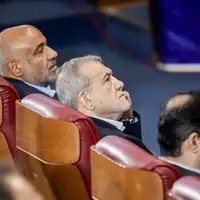
In his first message after the signing of the MoU, Mojtaba Khamenei said on Thursday he authorized the agreement only after President Masoud Pezeshkian, as head of the Supreme National Security Council, accepted responsibility for safeguarding Iran’s national rights and the interests of the “Resistance Front.”
He said Pezeshkian had pledged on behalf of himself and other council members to protect Iran’s rights and those of the Resistance Front, and had made clear that excessive US demands would be rejected.
“He also made clear that if the American side seeks excessive demands, they will not accept them,” Khamenei said.
The message reflected a pattern long associated with his father’s leadership: endorsing a major decision while maintaining a degree of political distance from its outcome.
By emphasizing Pezeshkian’s responsibility and the Supreme National Security Council’s assurances, Khamenei appeared to leave himself room to fault the government if the MoU falters, while retaining credit if it holds.
In his message, Khamenei said Iranian officials had made extensive efforts “out of compassion and goodwill” to reach the agreement, while accusing US President Donald Trump of acting “out of desperation” and using “all kinds of leverage” to secure it.
In-person talks with US
Khamenei also appeared to prepare the ground for upcoming in-person meetings between Iranian and American officials, saying, “It is self-evident that the in-person negotiations that will take place in the future will not mean acceptance of the enemy’s position.”
The message appeared aimed at both justifying his approval of the MoU and shifting political responsibility for its outcome to Pezeshkian and the Supreme National Security Council, as hardliners continued to criticize the agreement.
“From this moment, we — you, the proud nation, and this humble servant — will await the realization of the stated conditions,” he said.
US says blockade lifted
US Central Command said on Thursday that American forces had lifted the blockade on all maritime traffic entering and exiting Iranian ports and coastal areas in accordance with Trump’s direction.
“American forces are not impeding the transit of vessels to or from Iranian ports on the Persian Gulf and Gulf of Oman,” CENTCOM said in a post on X.
“All US military blockade enforcement efforts have ceased,” it added.
CENTCOM said US naval ships would remain in the area to ensure all aspects of the agreement were “adhered to, obeyed and in full force and effect.”
Iran sets Hormuz procedures
Iran’s Supreme National Security Council in turn said commercial vessels seeking passage through the Strait of Hormuz must submit requests to the Persian Gulf Strait Administration through PGSA.ir, in line with clause 5 of what Tehran calls the Islamabad memorandum of understanding.
The council said no fees would be charged to applicants for 60 days under the terms of the MoU, adding that the costs would be covered by the Iranian government.
It said the Persian Gulf Strait Administration had been instructed to process and respond to requests “with speed and priority” to help implement the objectives of the agreement.
The council added that because of “special conditions” and safety risks along the route, ships must pass through the strait at the assigned time and along the assigned route to ensure safe transit and prevent maritime incidents.
The parallel announcements marked the first visible steps by both sides to implement the maritime provisions of the MoU, after weeks of confrontation in the Persian Gulf and the Strait of Hormuz.
The Strait of Hormuz arrangements are among the first practical tests of the MoU, which began implementation Thursday and opened a 60-day period for negotiations toward a final agreement.
For Iran, the new process allows Tehran to retain a role in managing passage through the strait while waiving fees for 60 days and pledging to facilitate traffic. For Washington, the lifting of the blockade signals a reciprocal step while keeping US naval forces in the area to monitor compliance.