Filmmaker Jafar Panahi vows Iran homecoming despite new prison sentence
Iranian director Jafar Panahi speaks at the 22nd edition of Marrakech International Film Festival, in Morocco, Thursday, Dec. 4, 2025
Dissident Iranian filmmaker Jafar Panahi said he will return to Iran after completing the Oscar campaign for his latest film, despite being sentenced in absentia this week to one year in prison on charges of propaganda against the state.
“This sentence happened in the middle of this process, but I will finish this campaign and go back to Iran as soon as possible after,” Variety magazine quoted Panahi as saying at the Marrakech Film Festival in Morocco.
“I have only one passport … the passport of my country, and I wish to keep it,” Panahi added. “Although I was given the opportunity, even in the hardest years, I never considered leaving my country and being a refugee elsewhere.”
Panahi’s remarks come after his lawyer, Mostafa Nili, announced the prison sentence issued against the filmmaker in absentia earlier this week.
Panahi, whose movies have repeatedly brought him into conflict with Iranian authorities, said he is aware of the risks of returning.
“I know my films don’t please the government,” he said. “But that’s not a reason for me not to go back to my country.”
Panahi’s latest film, It Was Just an Accident, inspired by his experience as a political prisoner, is France’s submission for the Oscars and screened at the Marrakech festival on Thursday.
It was filmed in secret in Iran and follows the moral journey of a group of former political prisoners who believe they have captured their torturer.
In May, Panahi received the Palme d’Or at the 78th Cannes Film Festival for the film.
Panahi has faced restrictions and arrests for more than a decade.
He was sentenced in 2010 to six years in prison and a 20-year ban on filmmaking, travel and giving interviews, though he continued to work in secret. In 2022, he was detained again and spent seven months in prison before launching a hunger strike that led to his release in early 2023.
Some Iranian youths disillusioned by poor amenities in the Islamic theocracy are increasingly taking to a homemade codeine drink known as lean, education and health professionals told Iran International.
Lean is a mixture made by combining cough syrups containing codeine with sweetened beverages. The name lean refers to the sedating effect of codeine, which can make users feel unsteady or inclined to recline.
Long popular abroad and popularized in some corners of American hip hop culture, the habit is potential fatal.
It is sometimes known as purple drink because certain cough syrups contain dyes that turn the mixture violet, though local versions in Iran often appear in other colors depending on the medicines used.
The mixture, according to the expert, spreads easily because it can be prepared with medicines already found in many Iranian homes or purchased cheaply over the counter.
Alcohol and drugs are strictly forbidden in the Islamic Republic, and authorities have executed hundreds of people this year accused of drug offenses.
But basic codeine syrups and antihistamines require no special authorization, making the drink inexpensive, discreet and accessible to young people with limited means.
'Highly addictive'
The counsellor, who asked not to be named due to security concerns, said the mixture first surfaced in parks and schoolyards where teenagers gather after long days in classrooms where education is often by rote and has a strong focus on ideological content conforming to the ruling theocracy.
Students, she said, were searching for “something that breaks the monotony” after hours spent in lessons centered on ideological narratives and obligatory religious themes.
She described the drink’s beginnings as “born out of boredom,” saying that many adolescents felt they had no engaging place to spend their time.
“Recreation is squeezed, cultural choice is narrow and even access to a simple beer is criminalized,” she said. “When all conventional outlets are shut, young people invent alternatives.”
Lean is a highly addictive mixture that slows the body’s functions and can cause drowsiness, euphoria, nausea, dizziness, visual disturbances and hallucinations.
Mixing it with alcohol or sedatives greatly increases the risk of dangerously slowed breathing, low oxygen levels, brain injury, seizures, coma or death.
Long-term use can damage teeth, impair memory and vision and lead to serious heart and breathing problems.
Government oversight
Health professionals say the drink spread quietly because Iran lacks a unified system to track unusual purchases of over-the-counter medicines. Basic cough syrups containing codeine are widely available, and the country’s fragmented regulatory framework does not flag high-volume sales or patterns of youth misuse.
A Tehran pharmacist, Omid, said its abuse was predictable.
“When oversight is inconsistent and pharmacies operate without shared monitoring tools, teenagers can gather ingredients unnoticed,” he said. “These medicines sit in almost every home, and no authority has built a mechanism to prevent misuse.”
Omid told Iran International that the state’s regulatory posture has long focused on punitive measures against alcohol while failing to address practical gaps in the medical supply chain. “The priorities are mismatched,” he said.
Education system failure
The trend, according to the counsellor, also reflects shortcomings within classrooms where students rarely receive consistent health education or clear information about the dangers of misusing common medicines.
Instead, timetables remain filled with obligatory ideological material that leaves little room for life-skills programs or discussions about adolescent well-being.
Parents, the counsellor said, receive almost no guidance from schools on the needs of Gen Z or the pressures they experience. “Families are left to guess what their children are going through,” she said.
“Instead of equipping parents with tools, the curriculum focuses on messaging that feels distant from young people’s realities.”
Many teenagers, she added, report feeling disconnected from school content and turn to private rituals and drink simply to “break the cycle” of pressure they cannot voice openly.
Families on their own
Parents who encounter the issue typically do so after it has taken root. This late detection, according to the pharmacist, reflects a systemic failure.
“There is no coordinated pathway between schools, clinics and households,” he said. “Warnings come only after the consequences appear.”
Gen Z’s experimentation, the counsellor added, reflects unmet needs rather than deliberate risk-taking. “If young Iranians had engaging cultural venues, balanced schooling and genuine recreation, this drink would never have become a pattern.”
The two experts said the drink’s spread among 13- to 28-year-olds is a direct product of policy choices: narrow social freedoms, numbing school content, criminalization of ordinary leisure, fragmented pharmaceutical oversight and insufficient support for parents.
Iran will attend the draw for the 2026 World Cup in Washington DC on Friday after initially threating a boycott, while a travel ban looks set to bar Iranian fans.
Iran had sought nine visas for its delegation but only four were granted, including for head coach Amir Ghalenoei, spokesman Amir Mehdi Alavi said on Thursday.
Mehdi Taj, the federation’s president, did not receive a visa.
Earlier in the week, Iran's football authorities said they would boycott a draw for the US-hosted 2026 World Cup in Washington DC slated for Friday after visas for two top officials were rejected.
But on Thursday, Iranian media reported that the federation will now send Ghalenoei and Omid Jamali, the head of its international relations office, to attend the draw.
The White House on Wednesday said Iran’s national team will be allowed to enter the US for the World Cup but suggested that Iranian fans will be barred, citing existing travel bans and declined to rule out immigration raids at matches.
“The President has, in his executive order, certainly named Iran as one of the countries whose teams will be exempt to come here,” the head of the White House task force on the World Cup, Andrew Giuliani, told reporters.
Asked whether there would be ICE raids at matches, Giuliani said “the President does not rule out anything that will help make American citizens safer.”
Iran will play in their fourth straight World Cup finals when the tournament opens across the United States, Canada and Mexico on June 11.
Football fandom is endemic in Iran despite only lukewarm endorsement by the ruling Islamic theocracy and its team regularly qualifies for the World Cup.
Iran’s government said inflation stems from unfunded promises financed by unbacked money printing and bank credit, adding it has capped budget growth at about 2% and halted most other outlays in a bid to curb price pressures.
“The moment we print money without backing, inflation rises and people pay the price,” President Masoud Pezeshkian said during a visit to the southwestern city of Yasuj.
Monetary expansion driven by unfunded pledges, he said, “takes money from people’s pockets” and intensifies existing pressures.
Economists widely link Iran’s continued inflation and the collapse of the rial to persistent reliance on money creation.
The government’s use of bank borrowing and indirect central bank financing expands the monetary base without matching growth in real output, entrenching price instability.
Iran’s rial continued to weaken on Wednesday in a sign of flagging confidence in the country's troubled economy, with the US dollar trading at an all-time high above 1.2 million rials according to local exchange-rate websites.
Iran's broad money doubled during the 2.5-year presidency of Ebrahim Raisi, according to statistics from the country’s Central Bank (CBI).
Broad money, the total money supply within an economy, is the primary cause of rampant inflation in Iran.
Over the past years, Iran’s Central Bank has ceased publishing government budget reports.
Local media tracking shows that in the past year, food prices in Iran have risen by an average of more than 66%.
According to the Supreme Audit Court of Iran, however, it is estimated that since 2018 – when the US withdrew from the Joint Comprehensive Plan of Action (JCPOA) and imposed sanctions on Iran’s oil exports – the government's annual budget deficit has consistently exceeded 30%.
The Iranian government has been compensating the budget deficit by borrowing money, in particular, from the banking system.
A worker inspects freshly printed Iranian banknotes
Budget capped
Pezeshkian said his administration set an unprecedented ceiling on expenditure. “For the first time, we have kept budget growth to around two percent and cut the rest,” he said.
Some recipients, he added, had protested reduced allocations but argued that expanding spending without resources would heighten inflation rather than solve shortages.
He added that the government could not “spend from people’s pockets” for short-term gains and warned that raising expectations without funding would deepen internal disputes.
“If we think the situation is fine, that the government has money and is not giving it, or if we only raise our own expectations, we will increase disagreements and conflicts.”
Iran’s judiciary chief said the current approach to hijab will not continue, outlining coordinated steps with police, prosecutors and regulators to curb what authorities call social disorders.
Part of today’s social disorder, Gholamhossein Mohseni Ejei said, stemmed from conduct related to hijab.
“This situation should not continue, and none of us can be indifferent toward what the law and the expectations of religious citizens demand,” Ejei added.
Intelligence bodies, Ejei said, had received orders to identify groups he described as “organized promoters of improper hijab,” and that police were obligated to intervene when offenses were openly visible.
“With such cases there will be legal action,” he warned. Restaurants, cafés and other venues had been warned they would face firm measures if violations occurred on their premises, he added, noting that closures would no longer be limited to brief periods.
He also said government bodies involved in public ceremonies would be held accountable if “unlawful behavior” occurred at their events.
Lawmakers press for firmer action
155 lawmakers on Tuesday wrote to Ejei accusing the judiciary of passivity toward growing noncompliance with the dress rules.
They said uneven enforcement by executive bodies had fueled what they called social disorder, urging the courts to “restore governance” by ensuring all institutions apply existing regulations consistently.
The lawmakers also criticized some judges and officials for what they described as lapses "that had allowed moral decline and social abnormalities to spread," urging action within the current legal framework.
Tensions intensified after a leaked audio file suggested Supreme Leader Ali Khamenei had issued written instructions for stronger implementation of the mandatory hijab following an intelligence ministry warning about declining discipline.
Officials confirmed the directive but rejected suggestions of cabinet disagreement, while conservative outlets described it as an explicit call for decisive measures.
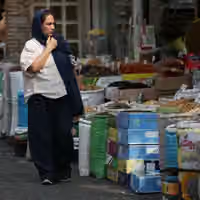
Despite escalating pressure, many women and girls continue to appear unveiled in public spaces.
In numerous districts of the capital, uncovered women now form the majority on streets and in shops, while widely shared videos show mixed gatherings, music and casual clothing.
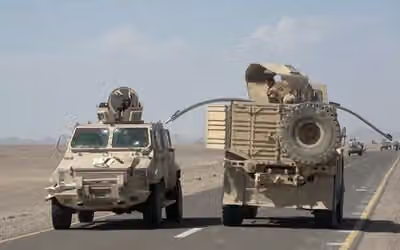
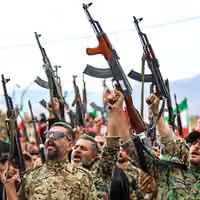
Iraq will remove Lebanon’s Hezbollah and Yemen’s Houthis from an asset-freeze list after the Iran-aligned groups were included in an official publication, officials said on Thursday.
The Justice Ministry’s gazette carried a committee decision freezing funds of designated entities and, in error, named Hezbollah and the Houthis, according to Reuters.
A letter from the acting deputy governor of the Central Bank asked the Committee for the Freezing of Terrorists’ Funds to delete the clause, two bank sources was cited by the outlet.
Tasnim, an outlet close to Iran’s IRGC, framed Baghdad’s correction as a climbdown under intense public and political pressure, saying Iraq’s Central Bank “backed off” after outrage over the Gazette notice.
Prime Minister Mohammed Shia’ al-Sudani said Iraq had approved freezing only the assets of entities and individuals linked to Islamic State and al Qaeda, in line with UN Security Council Resolution 1373 and following a request from Malaysia.
He ordered an urgent investigation “to hold accountable those responsible” for the mistake and stressed Baghdad’s stance on Lebanon and the Palestinians was “principled and not subject to exaggeration.”
The clarification followed publication in issue No. 4848 of the Iraqi Gazette of Decision No. 61 by the Committee for the Freezing of Terrorists’ Assets, which named 24 entities and ordered their funds frozen.
The committee is chaired by Central Bank Governor Ali Mohsen al-Alaq, with members from the anti-money-laundering office and the ministries of finance, interior, foreign affairs, justice, trade, communications, and science and technology, as well as the integrity, intelligence and counter-terrorism bodies.
The committee said on Thursday that the publication was meant to cover ISIS- and al-Qaeda-related listings only and that unrelated groups appeared because the list was released before final revisions were completed. It said a corrected version will be printed in the official gazette.
Publication of the committee’s decision in the Justice Ministry’s gazette led some outlets to report that Hezbollah and the Houthis had been designated terrorist entities, prompting denunciations from politicians aligned with Iran-backed factions.
Hussain Mouanes, a lawmaker from a bloc affiliated with Kataeb Hezbollah, called the government’s conduct “irresponsible” and accused it of failing to defend Iraq’s sovereignty.
Lawmaker Mustafa Sanad, who shared the gazette and is aligned with Popular Mobilization Forces-linked blocs, condemned the designations on social media.
Iraq has balanced relations with both the United States and Iran, but faces mounting risks to its financial system if it falls foul of global sanctions regimes.
Hezbollah and the Houthis are key members of a broader network of Iran-backed groups across the region.
Iran views Iraq as a strategic economic and political partner amid Western sanctions, while Baghdad remains wary of being drawn into US efforts to squeeze Tehran and its regional allies.