A female speaker addresses the crowd at a state-sponsored pro-hijab rally in Tehran, Iran, November 28, 2025
Tehran may be poised to carry out a politically explosive crackdown on Islamic veiling after Supreme Leader Ali Khamenei issued a directive to step up enforcement according to a leaked directive.
An audio file surfaced online in which senior cleric Hossein Rafiei asserted that Khamenei had instructed the government to step up enforcement of the Islamic dress code on Iranian women.
Official scrutiny of women's dress had eased in the year's since the death of a young woman, Mahsa Amini, sparked nationwide protests in 2022 which were violently suppressed.
The laxness had appeared to reach new levels following a 12-day war with Israel and the United States in June, as authorities appeared keen not to stoke public anger.
Rafiei said Khamenei issued the written order after reviewing an intelligence ministry report completed three months after the conflict. The precise timing was not clear.
Several cabinet members, he alleged, had initially objected but President Masoud Pezeshkian “insisted on abiding by the order.”
One of the ministers, the head of the Government Information Counci Elias Hazrati later confirmed the directive but denied any cabinet dispute.
The president and ministers, he said, oppose “coercive methods such as the morality patrols” that have often “worsened the situation.”
Hardline mobilization
Hardline factions seized on the revelation as a mandate to intensify pressure on women.
They quickly organized a social campaign for a November 28 march, coinciding with the traditional death anniversary of Fatima, the Prophet Mohammed’s daughter.
“The Leader’s remarks on the report … have shaken officials,” lawmaker Ghasem Ravanbakhsh said at an event in Tehran on Friday.
“(Khamenei) emphasized in his message that supervisory bodies are obliged to identify and take action against organizers and agents responsible for the problems that have arisen regarding hijab and chastity.”
Poster for Friday's hijab march
‘Government’s obligation’
The conservative daily Khorasan, aligned with Speaker Mohammad-Bagher Ghalibaf, bashed Hazrati for implying that Iran’s leadership was divided on the issue.
Khamenei’s directive, the editorial asserted, was an “explicit directive” for decisive action against those who disrupt public and social order, invoking a criminal offense under Iranian law.
The paper warned that “the slightest misunderstanding … or conflation of ‘enforcement’ with ‘tension’ could once again pave the way for a repeat of bitter past experiences.”
Khamenei’s reserved position
Khamenei had refrained from explicitly addressing the hijab issue in public for a year, but on November 3 urged women to “remind” those around them of its religious significance.
His last major intervention before that was in April 2023, when he accused foreign intelligence services of encouraging hijab defiance and called such acts “religiously and politically haram (forbidden).”
It remains unclear when Khamenei reviewed the intelligence report or issued his directive, but the leak reframes several recent official comments.
On November 18, during a Cultural Revolution Council meeting, Pezeshkian said adherence to hijab norms “should begin from within government bodies,” not through coercion or confrontation.
On August 30, he had warned that strict enforcement could “create conflict in society” and spark tensions the government may be unable to contain.
‘Enemy tools’
A string of recent cultural events in Tehran has drawn backlash after videos showed participants ignoring hijab rules.
Tehran Design Week, held at the University of Tehran’s Fine Arts campus, was shut down earlier this month after a Basij student protest accused the venue of becoming a site for “inappropriate entertainment.” The Basij is a domestic enforcement militia.
Since August, at least 20 cafes, restaurants and wedding halls have been closed nationwide for alleged violations ranging from “serving alcohol” to “nudity” and “mixed-gender dancing,” according to the reformist daily Ham Mihan.
Recent reports also indicate expanding non-coercive enforcement tools, including digital and administrative controls such as disabling SIM cards of violators and heightened scrutiny of celebrities and influencers who openly reject the hijab.
Chief Justice Gholamhossein Mohseni-Ejei has described the undermining of the veil as among the “enemy’s tools” and warned that event organizers—as well as authorities issuing permits—could be prosecuted as accomplices if violations occur under their watch.
An illustration showing an ancient Iranian soldier and a Revolutionary Guard member holding a weapon together, displayed during a November 7 ceremony in Tehran where a statue of pre-Islamic Persian King Shapur I was unveiled.
Tehran’s unveiling of a towering statue depicting the Roman Emperor Valerian kneeling before pre-Islamic Persian King Shapur I has renewed criticism of the Islamic Republic’s appeal to nationalist sentiment following the June war with Israel.
For over forty years, the theocracy purged ancient Persian history from schoolbooks, replacing it with post-Islamic narratives. But after the 12-day conflict with Israel, officials have turned to the distant pre-Islamic past to rally a divided society.
From murals of ancient kings and soldiers to patriotic songs added to Shi’ite mourning ceremonies performed before Supreme Leader Ali Khamenei, Tehran now embraces imagery once deemed heretical by its own revolutionary ethos.
The statue unveiled in Tehran's Revolution Square
'Kneel before Iran' campaign
Tehran’s Revolution (Enghelab) Square was the scene of an unusual spectacle on Friday as officials unveiled a massive bronze statue depicting Roman Emperor Valerian kneeling in submission before Sassanid King Shapur I, commemorating Iran’s victory at the Battle of Edessa (260 AD).
The event was held under the slogan “Kneel before Iran,” part of what authorities describe as a campaign to project “national unity and historical pride” following the June war with Israel.
Tehran Mayor Alireza Zakani, a staunch ultraconservative, said on X: “Enmity with Great Iran can only end in kneeling before this historic nation.”
Municipal official Davood Goodarzi said the installation would be accompanied by visual displays depicting “other victories of Iranians over foreign aggressors,” including the defeat of British forces by local commander Rais-Ali Delvari, Mirza Kuchak Khan’s resistance against Russian troops, and Surena’s triumph over Rome at the Battle of Carrhae in 53 BCE.
The goal, Goodarzi said, is “strengthening concepts such as national dignity, social unity, and Iranian identity.”
The statue, he said, would remain temporarily at Revolution Square before being moved to a city gateway “where it will stand as the first emblem of Iran before diplomats and foreign visitors.”
Unveiled women were allowed to attend the unveiling ceremony—an uncommon scene at events organized by Tehran’s ultra-hardline municipality.
The turn to the pre-Islamic past
The sharp reversal also recalls remarks once made by Khamenei. In a 2011 speech, he asserted that “all the great military victories of this nation came after Islam,” dismissing pre-Islamic accounts as “things that are not documented.”
In 1987, he had said that prophets triumphed over kings such as Cyrus and that “nothing remains of these monarchs in history but names remembered with derision.”
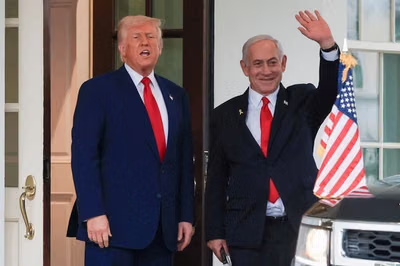
Nevertheless, pro-government social media accounts have now gone so far as to circulate posters equating Khamenei himself with Shapur, showing him standing with a staff as Benjamin Netanyahu and Donald Trump kneel before him. The caption reads: “You will kneel before Iran.”
Image circulating by hardliners on social media
'Hypocrisy'
Pro-government figures have hailed the move as a patriotic success. Conservative political reporter Hossein Saremi posted: “Today’s grand Iranian gathering showed that people and the state share one essence: Iran itself. Nothing can take our homeland away.”
Others, however, called the spectacle “hypocrisy.” Journalist Gholamhossein Pashaei wrote on X: “Every year you close Pasargadae to stop people from celebrating Cyrus Day, yet you unveil Shapur’s statue in Enghelab Square with drums and fireworks during Fatimiyya (mourning period)!”
Dissident commentator Hamid Asafi called the ceremony “a perfect snapshot of the Islamic Republic’s contradictions.”
On Telegram he wrote: “A week ago they closed Cyrus’s tomb out of fear of the crowds, and now they glorify Shapur in the same breath. The Islamic Republic fears living history but poses for selfies with its corpse.”
He added: “They know people no longer respond to rosaries and sermons. That’s why they’ve brought history back to the stage—in a controlled costume. If they can’t erase the past, they’ll try to own it.”
The irony deepened as UNESCO formally recognized Cyrus’s Charter as one of the earliest human-rights documents.
President Masoud Pezeshkian wrote on X: “Iran, the cradle of dialogue, justice, and coexistence, can still inspire peace today.”
Users swiftly replied, questioning how such pride could coexist with a government that blocks access to Cyrus’s tomb each year to those wishing to visit it on his birthday.