US dollar hits all-time high of 1.19 million Iranian rials
A currency exchange in Tehran, Iran, October 5, 2025.
Iran’s rial continued to weaken on Monday afternoon in a sign of flagging confidence in the country's troubled economy, with the US dollar trading at an all-time high above 1.19 million rials according to local exchange-rate websites.
The rise outstrips a previous record of 1.17 million hit on September 30 after European states moved to reimpose UN sanctions on Iran over its disputed nuclear program, further constraining its trade opportunities.
By Monday afternoon, the dollar was trading at just over 1.19 million rials, the Euro about 1.38 million and the UK Pound near 1.57 million.
Local exchange-rate websites also showed the Emami gold coin — Iran’s most traded benchmark coin used by households and investors as a store of value — hitting a fresh record above 1.26 billion rials, extending a sharp rise that began over the weekend.
The latest slide in the rial comes amid soaring inflation, renewed volatility in Iran’s unofficial markets and continued uncertainty over stalled nuclear talks with the United States.
The US dollar, which traded at about 140,000 rials in 2018, has risen roughly eight-fold since Donald Trump restored US sanctions on Iran seven years ago.
Britain, France and Germany triggered the so-called snapback mechanism to restore UN sanction under Security Council Resolution 2231, citing Iran's failure to comply with its nuclear obligations.
The move restored UN penalties previously suspended under the resolution, tightening external constraints on Iran’s economy. Tehran denies seeking a nuclear weapon and accuses the United States and European countries of economic warfare.
On Monday, local media reported that alongside fading hopes for reviving nuclear talks, rising gasoline prices have also contributed to turbulence in Iran’s currency and gold markets.
After months of debate, the government formally introduced a three-tier gasoline pricing system, with the third rate set to take effect at 50,000 rials on December 6.
A state body in Iran tasked with purveying Islamic values concealed the conviction of a senior official for raping and sexually assaulting his young daughters, a source in the Islamic Ideology Dissemination Organization (IIDO) told Iran International.
Nasir Abedi, the former administrative and financial deputy of IIDO's Tehran office, had been convicted of rape and sexual abuse of one daughter and assault against another, according to the source who requested anonymity for fear of retaliation.
Abedi, the source said, repeatedly assaulted one girl before she turned twelve, adding that a forensic examiner confirmed rape and the court upheld the findings.
But senior figures, the source added, intervened in the judicial process as the case progressed.
The charge relating to the second child was removed from the final verdict following internal pressure, leaving only one count of rape. The sentence of flogging “was never carried out because of outside interference,” the source told Iran International.
Former administrative and financial deputy of IIDO Tehran office, Nasir Abedi
The organization, according to the source, also acted to block any public disclosures once details of the case circulated internally.
Potential death sentences
Under Iranian criminal law, sexual relations with close relatives constitute one of the gravest offenses, carrying a potential death sentence if penetration is legally established.
While cases involving coercion against children can result in capital punishment or other severe penalties, proceedings within family structures are often influenced by pressure from political, clerical or security institutions.
The timing of the revelations coincides with the International Day for the Elimination of Violence Against Women, drawing renewed attention to domestic and sexual violence in Iran.
Advocacy groups and survivors have long argued that opaque judicial processes allow politically connected offenders to evade serious consequences.
Past cases echo similar pressures
The Islamic Republic has faced earlier allegations of interference in sexual-abuse cases involving figures.
Another notable case involved Saeed Toosi, a prominent Qur’an reciter linked to the Supreme Leader’s office, whose accusers said judicial proceedings collapsed under political influence.
Saeed Toosi (right) and Iran's Supreme Leader Ali Khamenei
Abedi previously held positions in other religious foundations, including the Ghadir International Foundation, and in public statements had described the IIDO as an institution “serving Islam” and “affiliated with the leader.”
The organization identifies the promotion of what it calls “pure Islam” as its mandate and plays a central role in enforcing the compulsory hijab and state-endorsed social norms.
Transparency concerns
Although many sexual-violence cases in Iran remain confidential, available reports suggest incidents involving women and children have risen in recent years.
Activists say survivors often lack safe reporting channels and face family pressure and social stigma, while state bodies have at times prioritized institutional reputation over accountability.
The latest allegations highlight the structural obstacles confronting survivors who seek justice and the enduring role of secrecy in shielding powerful offenders.
Iran is facing a fresh shortage of the brand-name anti-rejection drug Myfortic with pharmacies halting distribution in several cities and clinicians warning that forced switches to substitutes could endanger a minority of kidney-transplant patients.
Patients in Mashhad said rations shrank from two months to one week before stocks of the drug (mycophenolic acid 360 mg) “fell to zero,” with pharmacists advising a move to domestically made equivalents, the ILNA news agency reported.
Fatemeh Pour-Rezagholi, secretary of Iran’s Kidney Transplant Scientific Association, said originator-brand supplies have not been distributed recently, citing foreign-exchange constraints, sanctions-related frictions and customs delays.
She added that Iranian versions are available and effective for most patients, but unplanned brand changes can be stressful or risky for those early post-transplant or with prior rejection. Importers have indicated the original brand may return later in winter, according to ILNA.
Doctors and pharmacists told ILNA that 70-80% of recipients tolerate domestic formulations, but roughly 10-20% may require a specific brand or closer therapeutic-drug monitoring.
Patient groups and clinicians are urging clearer import timetables, steadier FX allocation for critical transplant drugs and contingency guidance to minimize unplanned switches.
Clinicians say the fiscal and human costs are far higher if grafts fail and patients return to dialysis, and have asked regulators to protect a baseline of imports for high-risk cases while stabilizing domestic supply for the majority.
US sanctions policy formally exempts most medicines and many medical devices, with humanitarian channels – such as Switzerland’s state-backed payment mechanism – designed to process vetted transactions.
In practice, suppliers and aid groups say persistent “over-compliance” by global banks, shippers and insurers fearful of sanctions risk, which can delay or block payments, shipments and insurance even for lawful medical goods.
Economists also point to the rial’s volatility and domestic pricing and procurement rules as recurring hurdles that raise import costs and complicate supply planning.
According to Mehr News on Monday, Iran has raised medicine prices several times in recent months under a “realistic pricing” policy meant to support the domestic pharmaceutical industry, but insurance coverage has not kept pace – leaving patients to shoulder a growing share of drug costs as reimbursements lag behind the hikes.
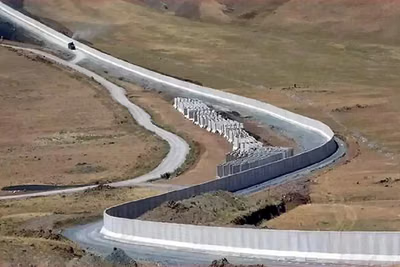
Iran and Turkey have agreed to start building a new joint rail line that will serve as a strategic trade corridor between Asia and Europe, Iranian foreign minister Abbas Araghchi said Sunday.
The Marand–Cheshmeh Soraya transit line, which will run toward Turkey’s Aralik border region, will span about 200 kilometres and cost roughly $1.6 billion.
Iranian authorities say construction is expected to take three to four years to complete.
Speaking in Tehran alongside his Turkish counterpart Hakan Fidan, Araghchi said the two sides had agreed in their meeting “to begin work, on a priority basis, to connect the two countries’ railway lines at the border.”
Earlier this month, Iran’s transport minister Farzaneh Sadegh said the project would transform the southern section of the historic Silk Road into an “all-rail corridor ensuring the continuity of the network between China and Europe”.
She said it would enable “fast and cheap transport of all types of cargo with minimal stops”.
The ancient Silk Road linked East Asia to the Middle East and Europe for centuries before declining with the rise of maritime trade routes.
China launched its Belt and Road Initiative in 2013, seeking to revive those connections through major maritime, road and rail projects. Despite close political relations with China, Iran has been largely left out of the initiative’s major investments.
Iran has sought to expand infrastructure and trade ties with neighbouring states as it works to revive its strained economy.
Iran is expanding its network of schools abroad with two new institutions in Iraq’s Kurdistan region and the reopening of a school in Saudi Arabia, the country’s education minister announced on Sunday.
Iran's semi-official ISNA cited education minister Alireza Kazemi as saying that Iranian school in Jeddah has reopened after years of closure.
The move, Kazemi said, has "increased Iran’s educational influence in the region."
Iran’s only school in Saudi Arabia was closed in 2016 after Iran withdrew its diplomatic staff from the kingdom.
At the time, Iranian reported that the school had 15 students and two Iranian teachers, who returned to Iran along with the diplomats after the ambassador left Saudi Arabia.
In January 2016, Saudi Arabia severed ties with Iran in 2016 following the storming of its embassy in Tehran during a dispute over Riyadh's execution of Shiite Muslim cleric Sheikh Nimr al-Nimr.
Nimr, who was one of the leaders of the Shiite protests in Saudi Arabia in 2011, had studied in Iran’s religious city of Qom.
Iran's Supreme Leader Ali Khamenei called the execution of Nimr "a political mistake and a great sin".
In 2020, Iran’s state-run English-language newspaper Tehran Times reported that the education ministry was overseeing 95 Iranian schools in 43 countries. However, in 2022, Iranian media, citing the deputy head of the Centre for International Affairs and Overseas Schools, said the number of overseas schools had fallen by about half, without giving a new total.
Iran’s diesel contains sulfur levels up to 15,000 parts per million (PPM), far above the global standard of 10 PPM, a senior industry representative said, warning that poor-quality fuel is contributing to severe air pollution in major cities.
Hamid Hosseini, spokesperson for the Union of Petroleum Products Exporters, told Didban Iran on Sunday that even Afghanistan does not permit diesel above 2,000 PPM. He said Iran must invest in desulfurization technology to meet international standards.
“Our diesel has about 10,000 to 15,000 PPM of sulfur, while the global standard is 10,” he said.
Hosseini said Iran has the technical ability to produce Euro-4 and Euro-5 standard gasoline, but high domestic consumption leaves the oil ministry little choice but to distribute lower-octane fuel.
High-quality gasoline produced at some refineries is mixed with lower-quality batches before reaching the distribution network, he added.
He said pollution is also driven by aging vehicles and heavy diesel use in urban areas.
Nearly half of Iran’s 20 million registered cars are classified as old or high-emitting, while about four million motorcycles operate in Tehran alone.
Hosseini said Iran consumes roughly 120 million liters of gasoline per day and that scrapping older vehicles could significantly reduce both fuel use and emissions.
He added that sanctions have also limited investment in refinery upgrades, affecting the country’s ability to consistently produce cleaner fuel.