UK Foreign Secretary Yvette Cooper said new sanctions on more than 70 Iranian individuals and organizations linked to Iran’s nuclear program send “a clear message to Tehran” that Britain will “continue to take every step necessary” to prevent Iran from developing a nuclear weapon.
“Iran’s nuclear program has long been a serious concern to the international community, as a significant threat to global peace and security,” Cooper said in a statement on Tuesday.
“The international community has repeatedly given Iran a chance to provide credible assurances about the intent of the program, which they have repeatedly failed to do.”
She said that since Iran stopped complying with the 2015 nuclear deal in 2019, accumulating a stockpile of enriched uranium “48 times over the limit,” the UK and its European partners had tried to resolve the issue through negotiations, offering Tehran a final chance in July to avoid renewed sanctions.
“Iran chose not to engage,” she said.
“We will continue to pursue diplomatic routes and negotiations and we continue to urge Iran to comply,” she added.

Once relegated to the world of academic social science, the term "paradigm shift" has gained traction in Iran's political discourse after a punishing 12-day war with Israel and the United States exposed the country's weakness.
With new international sanctions set to deepen economic suffering and no diplomatic or domestic opening yet visible, the severity of Iran's predicament is clear.
The term "paradigm shift" has become a euphemism for fundamental change to Iran’s political system, specifically, curbing Supreme Leader Ali Khamenei’s nearly four decades of autocratic rule.
As Iran's primary and often sole decision-maker, Khamenei has shaped not only strategic affairs but also the daily operations of government, media and public life.
But a remarkable exchange between two natural political opponents aired by an independent media outlet appears to show that both sides of the political spectrum grasp the need for a profound shift, albeit couched in politically inoffensive terms.
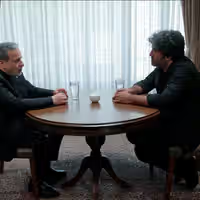
On September 29, the Iranian website Entekhab posted a YouTube video featuring a debate between two prominent figures: Mohammad Reza Bahonar, a conservative heavyweight and member of the Expediency Council and Abolfazl Shakouri Rad, former leader of the reformist Unity of the Nation Party.
In the 90-minute video, Bahonar emphasized that a paradigm shift does not mean regime change.
“It’s not about abandoning principles,” he said. “It’s about adapting them to new realities. The revolution’s core, Islamic governance and independence, remains intact. But the world has changed. We can’t ignore the demands of the youth or the country’s economic challenges.”
Shakouri Rad agreed, framing the shift in terms of Thomas Kuhn’s theory of scientific revolutions: “This is Kuhn’s paradigm shift applied to politics, old models collapse under pressure. Iran is facing this due to sanctions, demographics and technological globalization.”
Kuhn (1922–1996) was an American historian and philosopher of science who popularized the concept of paradigm shifts.
'Mini-shifts'
Bahonar noted that Iran has experienced “mini-shifts” before, under President Akbar Hashemi Rafsanjani (1989–1997), who pursued economic liberalization, and President Mohammad Khatami (1997–2005) who pushed for reforms despite resistance from Khamenei.
These shifts, Bahonar argued, were pragmatic rather than ideological.
Shakouri Rad added historical context: “Paradigm shifts often occur during crises like the 1979 revolution or the 1988 ceasefire with Iraq. Today, we’re in a post-heroic phase. War veterans no longer dominate politics. Over 60% of the population is under 30. They demand transparency and reject the resistance narrative.”
Bahonar called for economic reform as the cornerstone of any shift: “The Resistance Economy is a good idea, but it will fail without global engagement. Sanctions have crippled us. A real shift requires pragmatic diplomacy. Domestically, we must decentralize power and empower local councils.”
Shakouri Rad focused on ideological reform, touching on the foundational theocratic doctrine of the country.
“Velayat-e Faqih (Guardianship of the Jurist) needs reinterpretation, not abolition. We must transition from exporting revolution to practicing defensive realism," he said.
Despite their differences, both politicians agreed on the need for generational transition. Shakouri Rad elaborated: “We need a hybrid model of Islamic values with modern efficiency, like Turkey’s early Erdogan era. The solution is bottom-up change through elections, not top-down fatwas. Data shows 70% of Iranians want better ties with the West.”
Bahonar warned of the risks of delay: “If the shift is too slow, economic collapse could trigger unrest.” Shakouri Rad echoed the concern: “Without change, brain drain will accelerate.”
Responding to viewers’ questions at the end of the segment, Bahonar reiterated: “Shift means dialogue, not submission. Change is an Islamic duty. The ‘evolve or perish’ idea isn’t Western—it’s Quranic adaptation.”
China maintains that resolving the Iran nuclear issue peacefully through political and diplomatic means is the only viable path, and that Beijing opposes the use of force, sanctions, or pressure, Chinese foreign ministry spokesperson Guo Jiakun said on Tuesday.
Lebanon's Hezbollah in a statement on Tuesday condemned the snapback of United Nations sanctions against Tehran, describing it as a result of collusion between European countries, the United States, and Israel.
The statement described the Europeans' move to trigger the snapback mechanism as "part of the war that the United States and Israel have launched against the Islamic Republic."
"The war's goal was not merely the destruction of Iran’s nuclear capability — as the aggressors claimed — but in fact aimed at overthrowing the Islamic system and creating chaos and instability in Iran.”
Hezbollah reaffirmed its support for the Islamic Republic and Supreme Leader Ali Khamenei, stressing: “With God’s help, and by relying on the wisdom and courage of its leadership and the awareness and solidarity of its proud people, Iran will be able to withstand this new aggression.”

Iran’s currency fell to a record low in Tehran’s unofficial market on Tuesday, days after the reimposition of UN snapback sanctions, trading at more than 1.14 million rials per US dollar.
The rate briefly climbed to 1.143 million rials during the day, marking the lowest level in history. The euro traded at 1.34 million rials and the British pound at 1.53 million rials amid mounting pressure on Iran’s financial markets.

The Committee to Protect Journalists (CPJ) has condemned restrictions imposed by Iran’s judiciary on media coverage of European-triggered international sanctions imposed on Iran over the weekend.
“Iran's judiciary has announced it is monitoring media coverage of the newly reimposed sanctions and may take legal action against outlets it accuses of causing public unrest, citing concerns about ‘disturbing the public's psychological security,” CPJ Middle East and North Africa program director Sara Qudah said on X on Tuesday.
“Such broadly defined charges are part of a wider pattern by authorities to restrict free expression, discourage open debate and pressure journalists and others reporting on sensitive issues,” Qudah added.
The UN sanctions were initiated by France, Germany and Britain last month after they accused Iran of spurning diplomacy and inspections related to its disputed nuclear program.
Western countries and Israel suspect Tehran of pursuing nuclear weapons capabilities in a charge denied by Iran, which calls the sanctions an illegal attempt at bullying.
They came into force on September 28 and include arms embargoes and banking restrictions set to deepen pain on the country's already febrile economy.
Last month, Iran’s intelligence ministry warned of potential consequences of the sanctions' return, including roiled markets, deeper unemployment and more profound popular discontent.
Iran’s judiciary has long used vague legal charges to prosecute journalists, who often face Islamic revolutionary courts and jailtime for reporting in the public interest.
Reporters Without Borders (RSF) ranked Iran 176th out of 180 countries in its 2024 World Press Freedom Index, placing it among the world’s most repressive nations for media.
The ranking is consistent with previous years, with Iran repeatedly cited as one of the “five biggest prisons for journalists,” along with China, Myanmar, Turkey and Egypt.