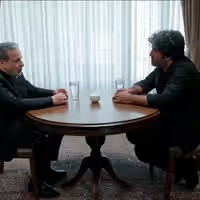
“They (Western parties) thought the monster they created out of the snapback would frighten us so much that we’d be ready to give away any concession," Iran's foreign minister Abbas Araghchi told reporters on the last day of his New York visit.
"Certainly, that’s not the case. We have already lived under the very resolutions they’re now trying to revive. People will see that no more sanctions will be imposed beyond what the United States has already enforced, and that it won’t have an extraordinary impact. It will only carry political and strategic effects.”

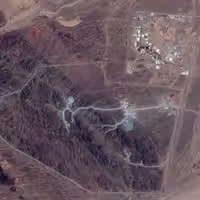
US President Donald Trump described at length to a group of senior military officers outside Washington DC on Tuesday his recollection of attacks on Iranian nuclear sites on June 22, especially the underground facility at Fordow.
"The B-2 bombers were incredible. That is stealth. They went into that, I was with General Cain and Pete and we were in the War Room, but we're watching them go in. And they were totally untouched. They were not seen. They were literally not seen. They dropped their bombs. They hit, every single one of them hit its target," Trump said.
"It was total obliteration ... Not only did they hit their targets, these chutes, and think of this here, way up in the sky, there was no moon, it was dead dark. Couldn't see a thing. You couldn't see them, but they had, I guess, a beam going right into these chutes. Every single one of those bombs went right down those chutes into a Granite Mountain. I think it's the last time they're going to build air chutes. They had these air shoots that were nice, beautiful. They were meant for us," Trump said.
"Let me tell you, they couldn't have worked any better. So they flew for 37 hours total, back and forth, no stops, no nothing," he added. "I asked the question, what happens if it gets hit? 'Sir, you don't want to know about that, right?' I don't want to know about that."
Israel found out the location of a Supreme National Security Council meeting in Tehran on June 16 through Iran’s urban surveillance network, an Iranian lawmaker said.
“All the city cameras at our intersections are in the hands of Israel,” Mahmoud Nabavian, a member of the parliament’s national security committee, said.
“Everything on the internet is in the hands of Israel, meaning that if we move, they find out.”
Nabavian also accused inspectors of the UN nuclear watchdog of espionage. “Many inspectors of the International Atomic Energy Agency are spies."

US President Donald Trump told top military leaders called to a meeting at a base outside Washington DC on Tuesday that his proposal to end the nearly two-year-old war in Gaza would solve "lots" of wars in the region, without elaborating.
"(This) could be the settlement in the Middle East that hasn't happened for 3,000 years ... But we got it, I think settled," he added. "We'll see Hamas has to agree, and they don't. It's going to be very tough on them, but it is what it is. But all of the Arab nations, Muslim nations, have agreed. Israel has agreed. It's an amazing thing. It just came together."
"If this works out, what we did yesterday with the Middle East, then that's more than a war. That's lots of wars, that's all combined. That's a lot of wars. Many of you were over there in many different capacities in many different countries, that there was a that's a big that's a big part of the earth."

Iran’s rial weakened further on Tehran’s free market on Tuesday, days after the reimposition of UN snapback sanctions, trading at 1,133,000 per dollar, 1,330,300 per euro and 1,522,900 per pound, according to local exchange rates.
An Iranian lawmaker said on Tuesday that the price of resisting Western pressure was “far less” than compromise, as Tehran faces renewed sanctions under the snapback mechanism.
Mohammad Sadat Ebrahimi, who represents Shushtar and Gotvand, told parliament that Iran “will never bow to aggressors” and that yielding would legitimize Israel and undermine national sovereignty, state media reported.
He praised President Masoud Pezeshkian’s stance at the United Nations and said Iran, unlike Afghanistan or Libya, would not surrender to US demands.
He added that with unity and support from neighboring states, the impact of sanctions could be neutralized within months.