Lebanon's Hezbollah in a statement on Tuesday condemned the snapback of United Nations sanctions against Tehran, describing it as a result of collusion between European countries, the United States, and Israel.
The statement described the Europeans' move to trigger the snapback mechanism as "part of the war that the United States and Israel have launched against the Islamic Republic."
"The war's goal was not merely the destruction of Iran’s nuclear capability — as the aggressors claimed — but in fact aimed at overthrowing the Islamic system and creating chaos and instability in Iran.”
Hezbollah reaffirmed its support for the Islamic Republic and Supreme Leader Ali Khamenei, stressing: “With God’s help, and by relying on the wisdom and courage of its leadership and the awareness and solidarity of its proud people, Iran will be able to withstand this new aggression.”

Iran’s currency fell to a record low in Tehran’s unofficial market on Tuesday, days after the reimposition of UN snapback sanctions, trading at more than 1.14 million rials per US dollar.
The rate briefly climbed to 1.143 million rials during the day, marking the lowest level in history. The euro traded at 1.34 million rials and the British pound at 1.53 million rials amid mounting pressure on Iran’s financial markets.

The Committee to Protect Journalists (CPJ) has condemned restrictions imposed by Iran’s judiciary on media coverage of European-triggered international sanctions imposed on Iran over the weekend.
“Iran's judiciary has announced it is monitoring media coverage of the newly reimposed sanctions and may take legal action against outlets it accuses of causing public unrest, citing concerns about ‘disturbing the public's psychological security,” CPJ Middle East and North Africa program director Sara Qudah said on X on Tuesday.
“Such broadly defined charges are part of a wider pattern by authorities to restrict free expression, discourage open debate and pressure journalists and others reporting on sensitive issues,” Qudah added.
The UN sanctions were initiated by France, Germany and Britain last month after they accused Iran of spurning diplomacy and inspections related to its disputed nuclear program.
Western countries and Israel suspect Tehran of pursuing nuclear weapons capabilities in a charge denied by Iran, which calls the sanctions an illegal attempt at bullying.
They came into force on September 28 and include arms embargoes and banking restrictions set to deepen pain on the country's already febrile economy.
Last month, Iran’s intelligence ministry warned of potential consequences of the sanctions' return, including roiled markets, deeper unemployment and more profound popular discontent.
Iran’s judiciary has long used vague legal charges to prosecute journalists, who often face Islamic revolutionary courts and jailtime for reporting in the public interest.
Reporters Without Borders (RSF) ranked Iran 176th out of 180 countries in its 2024 World Press Freedom Index, placing it among the world’s most repressive nations for media.
The ranking is consistent with previous years, with Iran repeatedly cited as one of the “five biggest prisons for journalists,” along with China, Myanmar, Turkey and Egypt.

US members of Congress on Tuesday tabled the bipartisan Seized Iranian Arms Transfer Authorization (SEIZE Act), a measure designed to fast-track the transfer of confiscated Iranian weapons to unspecified US partners.
The legislation, introduced by Congressman Josh Gottheimer (NJ-5), is co-led by Representatives Jefferson Shreve (IN-6), Jared Moskowitz (FL-23), and Rich McCormick (GA-7). In the Senate, companion legislation was introduced by Senators Ted Budd (R-NC) and Mark Kelly (D-AZ).
Currently, weapons intercepted by US Central Command often face a year-long legal review process before they can be distributed. The SEIZE Act seeks to cut through that delay, ensuring seized arms can be redirected swiftly to bolster America’s allies.
“Iran — the world’s largest state-sponsor of terror — continues to arm proxies that threaten American troops, our bases, and our allies. The SEIZE Act ensures that when these illegal weapons are intercepted, they help our allies who need them, instead of our adversaries,” said Rep. Gottheimer.
“Our bipartisan, bicameral legislation will cut through red tape, strengthen our strategic partnerships, keep Americans safe, and counter Iranian aggression.”
Rep. Jefferson Shreve described the bill as “commonsense legislation” that keeps weapons from “sitting idle” and instead puts them “where they belong: protecting America.”
“When the United States seizes illegal Iranian weapons, those weapons should be made available to support our security goals. The SEIZE Act makes sense and is a smart, bipartisan effort to ensure that these stockpiles are transferred quickly to trusted allies who are working every day to counter shared threats. This is a practical step that makes America, our servicemembers, and our partners safer,” said Rep. Jared Moskowitz.
According to the Department of Homeland Security, between May 2021 and January 2023, the US Navy intercepted shipments during maritime security operations in the Gulf of Oman and the Arabian Sea that included more than 9,000 rifles, 284 machine guns, 194 rocket launchers, 70 anti-tank guided missiles and 700,000 rounds of ammunition. The arms were destined for the Iran-backed Houthi group in Yemen.
Supporters of the SEIZE Act argue that ensuring these weapons are quickly transferred strengthens strategic partnerships and enhances collective defense at a time of heightened tensions across the Middle East.
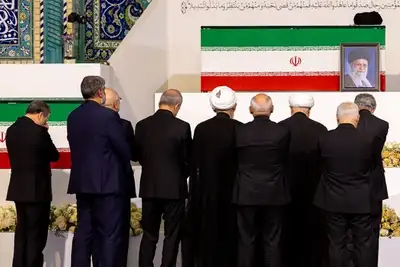
“They (Western parties) thought the monster they created out of the snapback would frighten us so much that we’d be ready to give away any concession," Iran's foreign minister Abbas Araghchi told reporters on the last day of his New York visit.
"Certainly, that’s not the case. We have already lived under the very resolutions they’re now trying to revive. People will see that no more sanctions will be imposed beyond what the United States has already enforced, and that it won’t have an extraordinary impact. It will only carry political and strategic effects.”

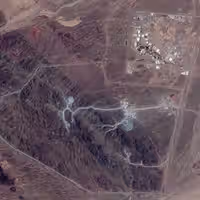
US President Donald Trump described at length to a group of senior military officers outside Washington DC on Tuesday his recollection of attacks on Iranian nuclear sites on June 22, especially the underground facility at Fordow.
"The B-2 bombers were incredible. That is stealth. They went into that, I was with General Cain and Pete and we were in the War Room, but we're watching them go in. And they were totally untouched. They were not seen. They were literally not seen. They dropped their bombs. They hit, every single one of them hit its target," Trump said.
"It was total obliteration ... Not only did they hit their targets, these chutes, and think of this here, way up in the sky, there was no moon, it was dead dark. Couldn't see a thing. You couldn't see them, but they had, I guess, a beam going right into these chutes. Every single one of those bombs went right down those chutes into a Granite Mountain. I think it's the last time they're going to build air chutes. They had these air shoots that were nice, beautiful. They were meant for us," Trump said.
"Let me tell you, they couldn't have worked any better. So they flew for 37 hours total, back and forth, no stops, no nothing," he added. "I asked the question, what happens if it gets hit? 'Sir, you don't want to know about that, right?' I don't want to know about that."