Iran open to direct US talks if indirect negotiations progress - report
Iran could potentially agree to direct talks with the United States on the nuclear issue if progress is made during initial indirect negotiations, independent journalist Laura Rozen reported on Thursday citing an Iranian source.
The source, whom Rozen said spoke on condition of anonymity, indicated that indirect talks could begin in the next two to three weeks, likely in Oman, if the US is willing to engage. The talks are expected to be private at first.
Rozen cited the source as saying that if the indirect talks are successful in establishing a framework for negotiations, they could pave the way for direct talks.
The report added that Iran's negotiating team is expected to include Iran's Deputy Foreign Minister for Political Affairs Majid Ravanchi, who was a key figure in talks which achieved a previous international nuclear deal, and Deputy Foreign Minister for Legal Affairs Kazem Gharibabadi.
Hungarian Prime Minister Viktor Orban speaks to the media next to Israeli Prime Minister Benjamin Netanyahu, in Budapest, Hungary, April 3, 2025.
Israeli Prime Minister Benjamin Netanyahu accused Iran of leading what he called an “assault on civilization” during joint remarks with Hungarian Prime Minister Viktor Orban in Budapest on Thursday.
Netanyahu's visit followed Hungary’s formal decision to withdraw from the International Criminal Court earlier in the day. The Israeli leader is sought under an ICC arrest warrant for alleged war crimes in Gaza.
“This is important for all of civilization as we fight this battle against barbarism,” Netanyahu said. “We are fighting a similar fight for the future of our common civilization.”
He said that civilization itself is “under assault from radical Islam” spearheaded by Iran.
Iran-backed Hamas militants launched an attack on Israel on Oct. 7 2023, killing some 1,200 people and taking around 250 hostages to Gaza.
Israel's ongoing incursion into Gaza has killed more than 50,000 people, according to Palestinian health authorities, with nearly a third of the dead under 18.
Tehran and its allies were dealt significant setbacks last year, including Israeli attacks that severely weakened Iran's ally in Lebanon Hezbollah and helped dislodge the Assad dynasty in Syria, Tehran's oldest Arab ally.
On Oct. 26, Israel launched air strikes on Iran which it said knocked out Iran’s Russian-supplied air defense system.
Since Donald Trump took office in the United States for his second term as president, Tehran has issued repeated warnings against further attacks.
It has also conducted continuous military drills since early January. After reviving the "maximum pressure" campaign of sanctions from his first term, Trump on Sunday mooted bombing Iran if it does not agree to a new nuclear deal.
A high-ranking Iranian judge and member of the so-called Death Committee which oversaw the execution of thousands of dissidents in the late 1980s, has died.
The head or Iran's judiciary issued a condolence message on Thursday saying Hossein Ali Nayeri had been bedridden due to a lengthy illness, attributing the sickness to his years of work.
"Certainly, this ailment was due to many years of service to the holy system of the Islamic Republic of Iran and the judiciary," Gholamhossein Mohseni Ejei was quoted as saying by the judiciary's Mizan news agency.
Nayeri's death comes after a court employee in January shot dead two veteran Supreme Court judges, Mohammad Moghiseh and AliRazini, before killing himself. Initial news reports at the time mentioned a third judge being injured but officials said an injured bodyguard was the only other victim.
Born in 1956, Hossein Ali Nayeri served as the religious judge of Tehran's Evin Prison from 1983 to 1989 and was appointed by the founder of the Islamic Republic Ruhollah Khomeini.
During this period authorities routinely executed political prisoners. Nayeri was a key member of a judicial panel - later known as the "Death Committee" - which condemned thousands of prisoners to death in the summer of 1988.
Following his tenure at Evin Prison, Nayeri served as the Deputy Chief Justice of the Supreme Court from 1989 to 2013 and as the head of the Judges Disciplinary Court from 2013 to 2022.
On Wednesday, a hacktivist group said the Iranian police intelligence agency has issued thousands of gun permits to senior state officials to fend off assassination.
A former Iranian diplomat says Europe's implicit support for President Donald Trump’s pressure campaign on Iran reflects the extent to which Tehran’s relations with European powers have deteriorated.
Kourosh Ahmadi, who previously served at Iran’s mission to the United Nations in New York, argued in an analysis published on a Tehran-based website that despite growing rifts between the Trump administration and Europe, European governments have refrained from criticizing Trump’s hardline approach toward Iran.
“Europe’s current silence or alignment with Trump on Iran comes at a time of unprecedented tension between Europe and the United States, as Trump and his team have shown nothing but contempt and hostility toward America’s traditional allies,” Ahmadi wrote. This, he said, underscores how severely Tehran’s ties with Europe have eroded over the past three years.
France’s foreign minister warned Wednesday that a military confrontation with Iran could become “almost inevitable” if world powers fail to quickly reach a new agreement on Tehran’s nuclear program. The statement followed a rare, closed-door meeting convened by President Emmanuel Macron with senior ministers and experts to assess the Iran situation.
A senior Iranian diplomat called on the Shanghai Cooperation Organization (SCO) on Thursday to condemn recent threatening rhetoric by the US president against Iran.
Speaking at a meeting of SCO deputy foreign ministers in Moscow, Majid Takht-Ravanchi, the Political Deputy of Iran’s Ministry of Foreign Affairs, referred to US President Donald Trump’s recent threat to use force against Iran.
He described such statements as dangerous and in violation of fundamental principles of international law and the UN Charter.
Takht-Ravanchi noted Iran’s request for the UN Security Council to condemn these remarks and urged the SCO to adopt a similar stance in denouncing the US approach to uphold international peace and security.
Iran's Supreme Leader Ayatollah Ali Khamenei attends a graduation ceremony for student officers and guard trainees in Tehran, Iran September 13, 2019.
Iran's newly published budget law reveals the Islamic Revolutionary Guard Corps’ (IRGC) major share of oil revenues and public funds—and opens the door for the IRGC and Supreme Leader–linked institutions to take control of state assets.
In the past Iranian year, which ended on March 20, a portion of the country’s oil exports was allocated to the armed forces—particularly the IRGC—under the pretext of “strengthening national defense.” This year not only has the military’s share of oil export revenues grown significantly, but direct government budget allocations to the armed forces have also sharply increased. Additionally, the law expands the authorization for crude oil transfers to other entities, including those involved in nuclear programs.
Meanwhile, the budget law allows IRGC-affiliated entities—such as Khatam al-Anbiya Construction Headquarters—as well as institutions linked to Supreme Leader Ali Khamenei’s office, like the Execution of Imam Khomeini’s Order (EIKO), to acquire state assets as a means of settling government debt owed to them.
Military's share of oil
President Masoud Pezeshkian’s government has projected daily oil exports of 1.85 million barrels for the current fiscal year, which began on March 21. Of this, one-third—valued at $12.4 billion—will be directly allocated to the armed forces and their specialized military projects, a figure that has tripled compared to the previous year. The remaining oil revenues, along with total gas export earnings, estimated at $33.5 billion, will be divided among the government budget, the National Development Fund, and the National Iranian Oil Company.
Another key point is that the government has set the exchange rate for oil allocated to the armed forces at roughly 600,000 rials per euro—while the euro trades at around 1.14 million rials on the open market. This disparity creates a major financial windfall for the military, enabling them to sell the oil and convert the proceeds at market rates, effectively pocketing the difference.
Moreover, the military has priority in oil sales, meaning any decline in national exports will primarily impact the government’s share. If the armed forces are unable to export their allocated share, the government is obligated to compensate them with equivalent cash payments.
Despite the government’s target of exporting 1.85 million barrels of oil per day this fiscal year, data from commodities intelligence firm Kpler—obtained by Iran International—shows that the average daily delivery of Iranian crude to Chinese ports, Iran’s sole oil customer, stood at approximately 1.34 million barrels in the first quarter of 2025. That’s down from a daily average of 1.5 million barrels in 2024.
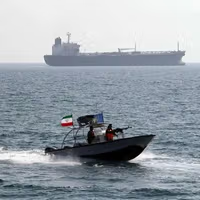
Additionally, the Trump administration has launched a campaign to reduce Iran’s oil exports to “zero”, and several tanker tracking and energy consulting firms previously told Iran International that Iranian oil exports could drop by about half a million barrels per day in the coming months.
Kpler also reported this week that Chinese independent refineries, known as "teapots," appear to be pausing new orders of Iranian crude oil following Washington's first imposition of sanctions on a Chinese refinery, Shandong-based Shouguang Luqing Petrochemicals.
In addition to the armed forces, the Iranian government has authorized five other entities—including those involved in “nuclear energy projects”—to sell oil directly.
At least part of these funds will likely be directed toward nuclear activities unrelated to electricity production, like sensitive and controversial uranium enrichment that the US and its allies object to.
Moreover, beyond revenues from direct oil sales under the so-called “strengthening national defense” initiative, the military and security forces are also set to receive 10% of the government’s general budget for personnel salaries.
Transfer of state assets to the military and supreme leader's office
Amid a lack of transparency surrounding the economic activities of the IRGC and institutions under the Supreme Leader’s control, unofficial reports suggest these entities dominate roughly half of Iran’s informal or “shadow” economy. Over the past two decades, much of the government’s privatization program has veered off course—rather than transferring assets to the true private sector, state-owned properties have been handed over at heavily discounted rates to the IRGC and Supreme Leader–affiliated institutions.
These entities also play a major role in Iran’s infrastructure development. Yet the exact amount the government owes them for state-assigned construction projects remains unclear. What is clear, however, is that the 2025 budget law specifically authorizes the IRGC-linked Khatam al-Anbiya Construction Headquarters and the Supreme Leader–controlled Execution of Imam Khomeini’s Order (EIKO) to receive up to two quadrillion rials (approximately $2 billion) worth of state assets as repayment for outstanding government debts.
This year, the government plans to sell 15.8 quadrillion rials in state-owned assets, of which 13% is earmarked for transfer to the military and institutions tied to the Supreme Leader—if budget targets are met. Given the weakness of Iran’s private sector, it is widely expected that, once again, entities under the IRGC and Supreme Leader’s control will acquire the lion’s share of these assets.