Europe's silence on Trump shows weak ties with Iran – Ex-diplomat
A former Iranian diplomat says Europe's implicit support for President Donald Trump’s pressure campaign on Iran reflects the extent to which Tehran’s relations with European powers have deteriorated.
Kourosh Ahmadi, who previously served at Iran’s mission to the United Nations in New York, argued in an analysis published on a Tehran-based website that despite growing rifts between the Trump administration and Europe, European governments have refrained from criticizing Trump’s hardline approach toward Iran.
“Europe’s current silence or alignment with Trump on Iran comes at a time of unprecedented tension between Europe and the United States, as Trump and his team have shown nothing but contempt and hostility toward America’s traditional allies,” Ahmadi wrote. This, he said, underscores how severely Tehran’s ties with Europe have eroded over the past three years.
France’s foreign minister warned Wednesday that a military confrontation with Iran could become “almost inevitable” if world powers fail to quickly reach a new agreement on Tehran’s nuclear program. The statement followed a rare, closed-door meeting convened by President Emmanuel Macron with senior ministers and experts to assess the Iran situation.
A senior Iranian diplomat called on the Shanghai Cooperation Organization (SCO) on Thursday to condemn recent threatening rhetoric by the US president against Iran.
Speaking at a meeting of SCO deputy foreign ministers in Moscow, Majid Takht-Ravanchi, the Political Deputy of Iran’s Ministry of Foreign Affairs, referred to US President Donald Trump’s recent threat to use force against Iran.
He described such statements as dangerous and in violation of fundamental principles of international law and the UN Charter.
Takht-Ravanchi noted Iran’s request for the UN Security Council to condemn these remarks and urged the SCO to adopt a similar stance in denouncing the US approach to uphold international peace and security.
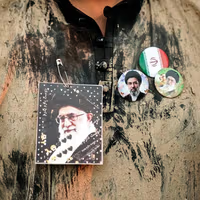
Iran's Supreme Leader Ayatollah Ali Khamenei attends a graduation ceremony for student officers and guard trainees in Tehran, Iran September 13, 2019.
Iran's newly published budget law reveals the Islamic Revolutionary Guard Corps’ (IRGC) major share of oil revenues and public funds—and opens the door for the IRGC and Supreme Leader–linked institutions to take control of state assets.
In the past Iranian year, which ended on March 20, a portion of the country’s oil exports was allocated to the armed forces—particularly the IRGC—under the pretext of “strengthening national defense.” This year not only has the military’s share of oil export revenues grown significantly, but direct government budget allocations to the armed forces have also sharply increased. Additionally, the law expands the authorization for crude oil transfers to other entities, including those involved in nuclear programs.
Meanwhile, the budget law allows IRGC-affiliated entities—such as Khatam al-Anbiya Construction Headquarters—as well as institutions linked to Supreme Leader Ali Khamenei’s office, like the Execution of Imam Khomeini’s Order (EIKO), to acquire state assets as a means of settling government debt owed to them.
Military's share of oil
President Masoud Pezeshkian’s government has projected daily oil exports of 1.85 million barrels for the current fiscal year, which began on March 21. Of this, one-third—valued at $12.4 billion—will be directly allocated to the armed forces and their specialized military projects, a figure that has tripled compared to the previous year. The remaining oil revenues, along with total gas export earnings, estimated at $33.5 billion, will be divided among the government budget, the National Development Fund, and the National Iranian Oil Company.
Another key point is that the government has set the exchange rate for oil allocated to the armed forces at roughly 600,000 rials per euro—while the euro trades at around 1.14 million rials on the open market. This disparity creates a major financial windfall for the military, enabling them to sell the oil and convert the proceeds at market rates, effectively pocketing the difference.
Moreover, the military has priority in oil sales, meaning any decline in national exports will primarily impact the government’s share. If the armed forces are unable to export their allocated share, the government is obligated to compensate them with equivalent cash payments.
Despite the government’s target of exporting 1.85 million barrels of oil per day this fiscal year, data from commodities intelligence firm Kpler—obtained by Iran International—shows that the average daily delivery of Iranian crude to Chinese ports, Iran’s sole oil customer, stood at approximately 1.34 million barrels in the first quarter of 2025. That’s down from a daily average of 1.5 million barrels in 2024.
Additionally, the Trump administration has launched a campaign to reduce Iran’s oil exports to “zero”, and several tanker tracking and energy consulting firms previously told Iran International that Iranian oil exports could drop by about half a million barrels per day in the coming months.
Kpler also reported this week that Chinese independent refineries, known as "teapots," appear to be pausing new orders of Iranian crude oil following Washington's first imposition of sanctions on a Chinese refinery, Shandong-based Shouguang Luqing Petrochemicals.
In addition to the armed forces, the Iranian government has authorized five other entities—including those involved in “nuclear energy projects”—to sell oil directly.
At least part of these funds will likely be directed toward nuclear activities unrelated to electricity production, like sensitive and controversial uranium enrichment that the US and its allies object to.
Moreover, beyond revenues from direct oil sales under the so-called “strengthening national defense” initiative, the military and security forces are also set to receive 10% of the government’s general budget for personnel salaries.
Transfer of state assets to the military and supreme leader's office
Amid a lack of transparency surrounding the economic activities of the IRGC and institutions under the Supreme Leader’s control, unofficial reports suggest these entities dominate roughly half of Iran’s informal or “shadow” economy. Over the past two decades, much of the government’s privatization program has veered off course—rather than transferring assets to the true private sector, state-owned properties have been handed over at heavily discounted rates to the IRGC and Supreme Leader–affiliated institutions.
These entities also play a major role in Iran’s infrastructure development. Yet the exact amount the government owes them for state-assigned construction projects remains unclear. What is clear, however, is that the 2025 budget law specifically authorizes the IRGC-linked Khatam al-Anbiya Construction Headquarters and the Supreme Leader–controlled Execution of Imam Khomeini’s Order (EIKO) to receive up to two quadrillion rials (approximately $2 billion) worth of state assets as repayment for outstanding government debts.
This year, the government plans to sell 15.8 quadrillion rials in state-owned assets, of which 13% is earmarked for transfer to the military and institutions tied to the Supreme Leader—if budget targets are met. Given the weakness of Iran’s private sector, it is widely expected that, once again, entities under the IRGC and Supreme Leader’s control will acquire the lion’s share of these assets.
A man is seen at an exit of the refinery plants of Chambroad Petrochemicals in Binzhou, Shandong province, China October 24, 2019.
Small Chinese non-state refineries—known as “teapots”—appear to be holding off on new orders of Iranian crude following Washington’s recent sanctions on Shouguang Luqing Petrochemicals, a refinery based in Shandong.
According to market intelligence cited by maritime data firm Kpler, no fresh deals for Iranian crude have been reported since March 20.
Iran’s main oil customers are small Chinese refineries, officially not linked to state structures, most of which are based in Shandong, where 90% of Iranian oil cargoes is discharged.
Refiners are assessing the risks associated with continuing to purchase Iranian crude and are closely monitoring the repercussions faced by the sanctioned Shouguang Luqing Petrochemicals, which has a refining capacity of 60,000 barrels per day.
While there are currently no indications that banks have cut off financing for Luqing, the refinery's ability to secure financing and maintain operations could influence the decisions of other teapots, particularly those heavily reliant on Iranian crude as their primary feedstock, according to Kpler.
Despite the cautious approach to new orders, China's imports of Iranian crude are still projected to show a significant month-on-month increase in March.
As of March 26, Iranian cargoes transported by vessels not listed under US Office of Foreign Assets Control (OFAC) sanctions appeared to have discharged successfully in Chinese ports, suggesting that ports have not yet turned away Iranian crude despite the tighter US sanctions.
Iran’s oil sales to China dropped sharply in January. Data from Kpler shows that Iran’s oil deliveries to China fell below 850,000 barrels per day in the period, compared to over 1.8 million barrels per day in October last year.
However, the recent US move to sanction Huizhou Huaying, an oil terminal in southern China, may prompt some ports to re-evaluate the risks of accepting sanctioned vessels in the future.
Data indicates that two Aframax tankers blacklisted by OFAC earlier this year managed to discharge Iranian crude at the ports of Yangshan and Dongying this week.
The US sanctions on the Chinese refinery come as part of Washington's efforts to maximize economic pressure on Iran to disrupt its access to financial resources. Iran's oil sales are a key target of these sanctions.
A new bipartisan bill in the US is pushing for measures to empower Iranians to help overthrow the government in favour of a democratic alternative including facilitating greater internet access and funding for dissidents.
The Maximum Support Act, introduced by Reps. Joe Wilson (R-SC) and Jimmy Panetta (D-CA), would require the administration to develop an aggressive interagency strategy aimed at backing Iranian dissidents who would be pivotal in the process.
Israel's Foreign Minister Gideon Saar speaks during the visit of the US Secretary of State, Marco Rubio, to the Yad Vashem Holocaust Memorial museum in Jerusalem February 16, 2025.
Israel's foreign minister said the country is not ruling out a diplomatic path to prevent Iran obtaining a nuclear weapon, adding that there were signs that there could be indirect talks between Tehran and the United States.
"We don't hold discussions with the Iranians, as you know, but they made it clear they are ready to an indirect negotiations with the US, and I will not be surprised if such negotiations will start," Israeli Foreign Minister Gideon Saar said on Thursday following a meeting with his French counterpart in Paris.
“What's important is the objective, and the objective is not to have Iran with nuclear weapon. I think it's international consensus, and we don't exclude the diplomatic path,” he added.
Iran denies seeking nuclear weapons, though hardliners are calling for the country's Supreme Leader Ali Khamenei to drop the religious ban on nuclear weapons, an argument that has gained pace in the wake of threats from US President Donald Trump.
Trump recently threatened to bomb Iran if a deal is not reached within a two month deadline, prompting a sharp response from Khamenei, who warned of a "heavy blow in return" if Iran were attacked. The exact start date of Trump's deadline to Iran remains unclear.
According to two US officials cited by Axios, the White House is seriously considering the Iranian proposal for indirect nuclear talks, even as the US military significantly increases its presence in the Middle East.
"Iran is a dangerous state with an extremist regime that works intensively against regional stability, exporting the Islamist revolution and spreading terrorism in the region," Saar said after the meeting with Jean-Noël Barrot.
Since October 7 when Iran-backed Hamas invaded Israel, killing 12,000 mostly civilians and taking more than 250 others hostage, Iran's allies have launched attacks on Israel from Syria, Iraq, Lebanon and Yemen.
"The most extremist regime in the world shouldn't possess the most dangerous weapon in the world," he added.
Along with the US, France was pivotal in securing the ceasefire between Israel and Iran's largest proxy, Hezbollah in Lebanon. Following the Lebanese militia's assault on Israel in allegiance with Hamas in Gaza, the archenemies came the closest to war since 2006 before the ceasefire which came into effect in November.
"We shouldn't allow Hezbollah to recover and rearm, and we will not let it happen," said Saar, as the fragile ceasefire continues amid allegations from both sides of breaches.
"Inside Lebanon, there is cooperation between Iran, Hezbollah, and Hamas, and we will not allow terror activities from there against Israel and our civilians. We will not allow to come back to the reality of October 6th on any of Israel's borders."
On Tuesday, the Israeli military said it assassinated a Revolutionary Guards member coordinating Hamas and Hezbollah operations in Lebanon.
Hassan Ali Mahmoud Badir, a member of Hezbollah's Unit 3900 and the Revolutionary Guards Quds Force, was killed in the Dahiyeh area of Beirut, a stronghold of the Iran-backed Hezbollah militia.
"Badir recently operated in cooperation with the Hamas terrorist organization, directed Hamas terrorists, and assisted them in planning and advancing a significant and imminent terror attack against Israeli civilians," a statement released on Tuesday said.
"Given the immediacy of the threat, Badir was struck immediately in order to eliminate the threat posed by a terror attack intended to harm Israeli civilians."