Cameras To Be Used in Iranian Institutions for Hijab Monitoring

Amir Hossein Bankipour, a member of the Iranian Parliament, recently detailed more surveillance measures under the proposed Hijab and Chastity Bill to crack down on hijab defiance.

Amir Hossein Bankipour, a member of the Iranian Parliament, recently detailed more surveillance measures under the proposed Hijab and Chastity Bill to crack down on hijab defiance.
According to Bankipour, the bill mandates that all cameras in both public and private institutions be connected to the police force to monitor compliance with the Islamic dress code.
Bankipour said that “a first offense of violating the hijab rules would result in a suspended fine of 15 million rials (About 25 USD). A repeat offense would trigger an additional fine of 30 million rials (About 50 USD), accumulating to 45 million rials (75 USD) payable within three weeks.”
His comments emerge amidst controversy, as the Hijab and Chastity Bill has yet to receive approval from the Guardian Council.
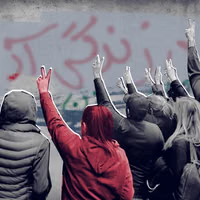
The proposed law was drafted following widespread protests ignited by the death of Mahsa Amini in September 2022. Amini, 22, died in custody of the morality police for allegedly breaching the hijab mandate.
The utilization of CCTV for monitoring hijab adherence has raised concerns about privacy and the misuse of surveillance for financial gain through fines, rather than ensuring the safety of employees.
Previous government actions have included seizing vehicles from women who removed their hijab while inside their cars, requiring hefty fines for their release, despite such measures having no basis in Iranian law and the vehicle being considered a private space.
Bankipour said changes such as laws requiring municipalities to convert 20 to 30 percent of parks into areas exclusively for women are underway as the state continues its battle against a nationwide hijab rebellion.
Massive numbers of Iranian women in public spaces like streets, shops, malls, restaurants, and even government facilities, can be seen without the mandatory hijab as the nation's women defy the long-standing rule imposed since the founding of the Islamic Republic, in spite of state crackdowns.
Critics of Iran’s President Ebrahim Raisi are demanding to know why he has not acted upon promises to pursue rampant corruption among top government officials that has led to many recent scandals.
Instead, the government has re-doubled its efforts to force women to wear the hijab, sending back the notorious ‘morality police’ to the streets to harass and intimidate women.
The morality police street patrols are known as Guidance Patrols (Gasht-e Ershad) in Iran. The public is highly critical of the recent return of the patrols to enforce hijab laws under a plan spearheaded by the interior ministry called the Nour (Light) Plan.
It was in the custody the morality police that Mahsa Amini lost her life in September 2022 at the age of 22. Amini’s death sparked several months of protests across the country and triggered widespread defiance of compulsory hijab. Some commentators in Tehran now say that the situation will never return to the pre-2022 status, when almost all women used a headscarf in public.
The Raisi government has become an advocate of Guidance Patrols and completely forgotten its election promises of dismantling them, an editorial in the reformist Shargh newspaper on May 1 said while criticizing the full force return of the patrols to the streets.
A Shargh newspaper's editorial on May 1 sharply criticized the Raisi government for embracing hijab Guidance Patrols, reneging on its election pledge to dismantle them, and sanctioning their resurgence on the streets.
Raisi made the promise during his election campaign in 2021. Official media such as the government mouthpiece, the Islamic Republic News Agency (IRNA), claim that the “Administrators’ Guidance Patrol” has made “an 80 percent progress” through evaluation and surveillance of government administrators’ performance in the past two years.
The government had promised to launch special investigative units as “guidance patrols” to clamp down on corruption, but no verifiable information has emerged to prove that actual investigative operations took place.
Hasan Darvishian, appointed by Raisi as his Special Inspector to supervise anti-corruption patrols, disclosed several months ago that the government had dismissed over ninety administrators for misconduct or incompetence. These included officials appointed by both previous administrations and Raisi's own.
In response to recent public backlash, Darvishian asserted on Thursday that the patrol's mandate had been rigorously executed within the "people's government." However, critics contend that rather than combatting corruption and inefficiency, the government has concentrated its efforts on purging dissenting voices to solidify hardliner control over state institutions, including universities.
The government has a hard time to convince the public about the sincerity of its anti-corruption claims due to several massive corruption cases such as the $3.5bn Debsh Tea case and other scandals that so far have not resulted in any prosecutions or transparency.
“They should have dealt with the wrongdoing government officials instead of forcing women and girls into vans and creating bitter incidents like the sad incident of Mahsa Amini’s [death in the custody of morality police],” Nazer Khabar news website said in an unattributed editorial last week, criticizing the government for letting massive corruption go unpunished due to political considerations.
The article also highlighted the recent oversight of corruption allegations against one of Tehran’s Friday imams, Kazem Sedighi, despite the government's purported efforts to combat corruption, inefficiency, and negligence.
Last month, undeniable evidence emerged implicating Sedighi in the illicit acquisition of a $20 million land plot in northern Tehran. Despite this, he faced no legal action or removal from his position. Instead, he merely admitted to being "neglectful" after being exposed, and things returned to normal.
The revelation of Sedighi's land acquisition scandal, brought to light by a whistleblower, sparked outrage in Iran. Initially, Sedighi denied any involvement and claimed that his signature on the deeds had been forged.
“Instead [of taking action against Sedighi], once again they dragged crying and screaming women and girls into the [police vans,]” Nazer Khabar wrote, adding that the experience of using the ‘morality police’ was a failed experience the authorities were repeating.

More than 230 Iranian activists have condemned the government's corruption claiming that "a limited ruling class" has "reached astronomical wealth while political obstruction and suppression increase."
The statement reflects deep concerns over the chronic crises that have gripped Iran in various sectors ranging from economic to political realms.
Signatories of the statement include prominent figures such as Alireza Rajaie, a dissident journalist who lost an eye in the hands of iran's security forces, Abolfazl Ghadiani, Moteza Alviri, once an ally but now staunch critic of Iran's supreme leader, and former MP Parvaneh Salahshouri, who collectively urge for immediate action to remedy the situation.
They highlighted recent events including the execution sentence against Toomaj Salehi for his protest music, which activists see as an indication of ongoing political and religious autocracy.
Furthermore, they said reports of severe punishments, such as the amputation of fingers for theft, contrast sharply with the government's leniency towards high-level corruption and violations in the regime.
The activists' statement paints a picture of the socioeconomic conditions, highlighting that no substantial progress has been made to alleviate inflation, corruption, or the recession as over one third of Iranians are now living under the poverty line.
According to official statistics, Iran now ranks as the eighth country globally with the highest misery index and fares poorly in international happiness and economic growth metrics. The statement emphasizes the plight of ordinary Iranians, citing that a worker would need over two centuries to afford an apartment in Tehran, underlining the severity of the economic disparities.
The signatories called for a step-by-step structural transition and a comprehensive re-evaluation of policies to address the crises holistically, urging for the establishment of professional and academic organizations within civil society.

The secretary of the union of Iran’s university professors warned that the Interior Ministry and the National Security Council now dominate the country’s universities.
“Unfortunately, there has been a lot of government interference at the universities. The power of the Ministry of Science has diminished and it seems it is the Interior Ministry that gives orders to universities,” said Karen Abrinia Saturday in an interview with relatively independent news website Khabaronline.
According to Abrinia, around 200 university professors faced “restrictions” last year, 25 of whom were fired from their positions over their support for the 2022 nationwide uprising triggered by the death in morality-police custody of Mahsa Amini.
Some university professors were sacked, some were denied tenure or annual promotion, and for some, their salaries were suspended, he remarked, further adding that these actions targeted those who supported the 2022 protests by “signing statements or publicly declaring their positions.”
Abrinia stated that many of these professors have been told that they can go back to work only if they “sign a letter of repentance and express their regret” over their past positions. “The university is an institution of science and it needs to be independent … The real damage now is the loss of autonomy from universities,” he pointed out.
All these pressures, coupled with low wages and poor economic conditions, have led to increasing frustration among university teachers, especially the young ones, and can drive them to emigrate, he warned.
In August, Etemad news in Iran released a list of 157 tenured professors who were dismissed, forced into retirement, or banned from teaching for their criticism and dissenting views from 2006 to the end of August 2023. The “purge” has gained momentum since the 2022 Woman, Life, Freedom movement with at least 52 dissident university professors being dismissed, the report said.
In March, Mohammad Moghimi, the pro-regime chancellor of the University of Tehran, denied allegations of purging academics based on their political beliefs, instead accusing those dismissed of "moral issues."
A university professor specialized in Educational Sciences told Iran International that following the 2022 nationwide uprising, the universities have transformed into “prisons” and the security forces, directly and indirectly, try to monitor and control “the smallest issues related to professors, even their personal lives.”
The university is turning into a puppet in the hands of those in power who want academic institutions to exactly reflect the mainstream ideology of the Islamic Republic, said the professor who spoke on condition of anonymity.
She added that the university, as an academic institution, has always been affiliated with the state in Iran, but after the Mahsa uprising, the university has lost "all its autonomy" and even the slightest act of resistance is suppressed.
“Based on the new regulations set for the professors’ promotion, they need to attend courses about the necessity of the Islamization of universities or they will be denied tenure,” she went on to say.

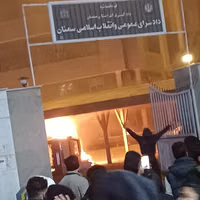
One person was killed, and three others were injured during an armed conflict on Saturday evening in Zahedan with Basij militia forces deployed to the scene.
The conservative website Tabnak wrote initial reports indicating that a "terrorist team" was identified and encircled by security forces on Kowsar Street in Zahedan.
However, the Fars News Agency, which is associated with the Revolutionary Guards, attributed the incident to personal disputes, though it did not provide additional details.
Halvash news which covers the province, said a more extensive security presence, including plainclothes agents, had been deployed to the scene as fighting lasted for around two hours, with a reconnaissance drone spotted monitoring the situation.
This latest incident in Zahedan occurs against the backdrop of heightened regional instability. On April 4, clashes in two southern cities of the Sistan-Baluchestan province resulted in over 20 deaths involving security forces and members of the Jaish al-Adl militant group.
In related developments, the Southeast Headquarters of the Ground Forces of the Revolutionary Guards announced the recent arrest of several individuals at a religious school in Rask. The suspects were accused of supporting the insurgent Sunni Baluch group Jaish al-Adl. The Revolutionary Guards claim the cooperation of local residents facilitated the arrests.
Jaish al-Adl, however, has denied any affiliation with those detained, condemning the arrests as "a clear lie and conspiracy." The group, which is designated as a terrorist organization by Iran and several Western governments, warned of potential repercussions and advised against further provocations.
“The security apparatus of the regime must be aware that such actions are a clear provocation of the Jaish al-Adl organization…, and as such, these acts could have unpredictable consequences for our land,” read the group’s statement.

Heavy rainfalls have led to significant flooding across 21 regions in Iran, affecting residential areas and agricultural lands.
According to the Red Crescent's emergency response organization, the floods have sparked a crisis that spans much of the country.
The Meteorological Organization of Iran warned of a new wave of precipitation starting Sunday and spreading to multiple regions.
The latest natural tragedy comes after mid-April's rainfall which caused severe flooding and waterlogging in Sistan-Baluchestan province, destroying dozens of villages and disrupting utilities for at least 300 others. It comes when the country is already facing its hardest economic times amid ongoing social oppression.
Social media users and local reports have highlighted a lack of emergency aid during the incidents, during which several people reportedly lost their lives. Despite forecasts that the new wave of rain might not lead to flooding, recent days have seen flooded streets and damaged infrastructure in various cities.
One of the hardest-hit areas was Shabestar county in East Azarbaijan, where floods have caused significant destruction.
In Dezful, in Khuzestan province, severe damage to civil and agricultural infrastructure has been reported, with homes and city parks submerged. The local officials have responded by closing riverside parks and ordering the evacuation of vehicles from these areas.
Video footage sent to Iran International shows severe flooding in the streets of Ahvaz, following the rainfall on Friday.
Hossein Zafari, deputy of the Crisis Management Organization, noted that floods in the provinces of Ilam and Chaharmahal and Bakhtiari have resulted in livestock losses, threatening the livelihoods of hundreds of farmers.
The provinces of Khorasan Razavi and Tehran have also reported damage from the recent heavy rains, leading to floods in several villages and areas with more displacement expected.