Flooding In Iran Affects 21 Provinces

Heavy rainfalls have led to significant flooding across 21 regions in Iran, affecting residential areas and agricultural lands.

Heavy rainfalls have led to significant flooding across 21 regions in Iran, affecting residential areas and agricultural lands.
According to the Red Crescent's emergency response organization, the floods have sparked a crisis that spans much of the country.
The Meteorological Organization of Iran warned of a new wave of precipitation starting Sunday and spreading to multiple regions.
The latest natural tragedy comes after mid-April's rainfall which caused severe flooding and waterlogging in Sistan-Baluchestan province, destroying dozens of villages and disrupting utilities for at least 300 others. It comes when the country is already facing its hardest economic times amid ongoing social oppression.
Social media users and local reports have highlighted a lack of emergency aid during the incidents, during which several people reportedly lost their lives. Despite forecasts that the new wave of rain might not lead to flooding, recent days have seen flooded streets and damaged infrastructure in various cities.
One of the hardest-hit areas was Shabestar county in East Azarbaijan, where floods have caused significant destruction.
In Dezful, in Khuzestan province, severe damage to civil and agricultural infrastructure has been reported, with homes and city parks submerged. The local officials have responded by closing riverside parks and ordering the evacuation of vehicles from these areas.
Video footage sent to Iran International shows severe flooding in the streets of Ahvaz, following the rainfall on Friday.
Hossein Zafari, deputy of the Crisis Management Organization, noted that floods in the provinces of Ilam and Chaharmahal and Bakhtiari have resulted in livestock losses, threatening the livelihoods of hundreds of farmers.
The provinces of Khorasan Razavi and Tehran have also reported damage from the recent heavy rains, leading to floods in several villages and areas with more displacement expected.
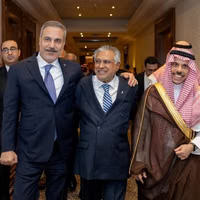
Iran will have no mercy for drug traffickers, warned Attorney General Mohammad Movahedi-Azad amid rising concerns about the country’s alarming rate of drug-related executions.
“We will have no mercy on the criminals associated with violent crimes, especially the drug traffickers who are death dealers and burn people’s lives with the fire of addiction,” he said on Saturday.
According to Amnesty International’s report, Iran conducted at least 853 executions in the past year, marking the highest figure in eight years, more than half of those linked to drug-related offenses.
In April, 82 Iranian and international human rights groups called on the United Nations Office on Drugs and Crime (UNODC) to suspend its cooperation with Iran until it halts drug-related executions.
The coalition highlighted that prisoners charged with drug offenses are sentenced to death by the Revolutionary Courts in Iran based on “torture-tainted confessions, without due process and fair trial rights and often without access to a lawyer.”
“We are concerned that hundreds more will be executed in the coming months if we do not increase the political cost of these executions for the Islamic Republic. We call on all human rights organizations and activists to take part in a special global campaign to stop drug-related executions in Iran,” the statement read.
Mahmood Amiry-Moghaddam, the Director of the Norway-based Iran Human Rights Organization, warned that the UNODC has remained silent about the sharp hike in drug-related executions in the country, while it cooperates with Tehran on combating drug trafficking.
The drug-related executions are “aimed at instilling fear and preventing more protests” and have been carried out “without any political cost and consequences,” he stressed.

The Islamic Republic’s Education Minister is criticizing UNESCO’s 2030 Education Agenda for promoting “gender equality,” labeling it as contradictory to Iranian culture.
The minister, Reza Morad Sahraei, continued his criticism, telling the state-run Tasnim news agency that the document was "dictated from outside" and, under the administration of Ebrahim Raisi, is "completely cut out of any planning process."
The UN 2030 Agenda for Sustainable Development is a set of standards developed by UNESCO that provides children and young people with a basic understanding of the environment, human rights, and the elimination of discrimination in society.
The UN General Assembly adopted the document in September 2015 with the goal of improving the quality of education worldwide. The document was signed by member states, who agreed to anticipate the financing needed to improve education, prevent child abuse, and promote gender equality.
While the Iranian government signed on to the document under former president Hassan Rouhani (2013-2021), it was not implemented after Supreme Leader Ali Khamenei explicitly criticized it, claiming it promoted the "defective, destructive and corrupt Western lifestyle."
In a speech at a 2022 UNESCO summit, the country’s current President, Ebrahim Raisi, described the 2030 Education Plan as "one-dimensional and secular." He said the Islamic Republic had drafted its own “transformation” document based on “Iranian-Islamic educational philosophy.”

A year later, Iran's Supreme Council of the Cultural Revolution (SCCR) announced a resolution called the "revocation of the 2030 document." SCCR is a regime policy body responsible for developing and formulating scientific, educational, religious, and research strategies. In 2023, the EU and UK designated this unelected body accountable exclusively to Ali Khamenei.
Since the Islamic Revolution in 1979, the state has relentlessly attempted – and failed – to indoctrinate Iranians with its Islamist ideology through the country’s education system.
Following the significant involvement of the young generation in the nationwide anti-regime protests in 2022, the state initiated "purges" targeting thousands of staff within the country’s educational system, aiming to remove individuals perceived as threats.
Scores of teachers who supported the protests were expelled, and many were forced to retire early, while 3,500 clerics and seminarians have instead been hired as teachers instead to fill some of the tens of thousands of new positions created to deal with the shortage.
An education ministry spokesperson, Ali Farhadi, has stated that the ministry only learned about the recruitment after it had occurred. “We, too, found out that these individuals had been accepted [for the positions] after the examinations [of candidates for teaching positions] were held,” he claimed.

Regime-run media, however, has been advocating that clerics become teachers for months.
Despite the fact that the clergy have operated unofficial schools before, lawmakers hastily approved a proposal in January to have the Ministry of Education issue licenses to persons and legal entities wishing to establish private schools attached to mosques if they meet certain building requirements.
A gender-specific school curriculum and textbook changes were also discussed by Education Minister Reza Morad Sahraei in November.
Against this backdrop, teachers claim the regime’s policies and changes have transformed the country's schools into “religious and military bases”.
A December interview with Khabar Online, a domestic outlet, reported teachers' concerns about plans to "shift schools away from their primary function,” stating that ideological and religious studies have taken over most of the content of the school curriculum, even science, causing students to lose interest in the subject.

The appointment of Jamileh Alamolhoda, the wife of President Ebrahim Raisi, to the executive board for faculty recruitment at Tehran University has stirred controversy.
Political figures close to the government have voiced their discontent for the appointment of Alamolhoda who has denied the oppression of women in Iran They labeled the appointment as an act of nepotism and favoritism at the university known as a hotbed of government-appointed loyalists. She also does not the academic credentials to be part of such a committee.
She is the daughter of firebrand Shiite cleric Ahmad Alamolhoda, who has close ties to Supreme Leader Ali Khamenei, and known for his extremist views on foreign policy and mandatory hijab.
In response to mounting pressure, the public relations department of Tehran University's Family Sciences Department issued a statement defending Alamolhoda's appointment, citing her "legal” right to the appointment.
The controversy unfolds against a backdrop of political turmoil within Iranian academia, especially at Tehran University, where numerous professors have faced expulsion, suspension, or forced retirement under Raisi's government.
Last August, Etemad newspaper published a report documenting the expulsion of 157 professors from Iranian universities, indicating a trend that commenced with Raisi's assumption of office in 2021. The wave of suspensions and expulsions has prompted student councils to denounce it as part of a broader effort to purge universities nationwide.
The phenomenon of "political purification" extends beyond academia, with regime hardliners targeting rivals across various organizations and institutions. Coined by former Parliament Speaker Ali Larijani, the term describes efforts by ultraconservative allies of President Raisi to consolidate power by sidelining other politicians and officials.
The trend of purges within academia traces back to Mahmoud Ahmadinejad's presidency and has persisted through Hassan Rouhani's administration and President Raisi's tenure. Over the years, successive governments have systematically expelled experienced professors for their perceived "secular views" and other political reasons.
The second wave of purges, intensifying shortly after the protests of the Woman, Life, Freedom movement in September 2022, has escalated with the support of senior officials.
In addition, the Raisi government has been widely criticized for its poor record in managing the economy, blamed partly on the appointment of incompetent hardliner loyalists to important positions.
Alamolhoda is also known for some of her unusual actions and statements, such as expressing her aspiration to write a book similar to that of Michelle Obama. “They asked me to write a book similar to this one. I read the book, and it was very beautiful, captivating, and influential. I even showed some parts of it to the president, and he said that writing a book in this field is the right thing to do.”
She was thrust into the limelight last September when she accompanies her husband to the UN General Assembly. She spoke to some of the world’s top media, including ABC and Newsweek.

Eight students from the Anwar al-Haramain religious school in Sistan-Baluchestan have been arrested by the Revolutionary Guards (IRGC) accused of supporting insurgent Sunni Baluch group Jaish al-Adl.
The campaign of Baluch activists reported that on Saturday, military forces launched a raid on the residential home and religious school of Mowlavi Fazl ul-Rahman Kouhi in Rask. During the raid, the forces confiscated mobile phones and apprehended eight students.
The report further highlighted the absence of a judicial warrant during the raid, which involved breaking into the home and religious school owned by Fazl ul-Rahman Kouhi, currently incarcerated in Vakilabad prison, Mashhad.
The IRGC accused the suspects of involvement in attacks against police and Revolutionary Guard stations in December and April.
Jaish al-Adl has carried out dozens of large and small operations over the years against Iranian military forces, particularly the IRGC, including cross-border attacks and abduction of border guards and security personnel as well as bombings.
The government in Iran considers Jaish al-Adl a terrorist organization. The militant group says it seeks greater rights and better living conditions for ethnic minority Baluchis.
In mid-January, the Revolutionary Guards launched a missile strike on Jaish al-Adl positions within Pakistani territory. The incident strained relations between Iran and Pakistan, leading to retaliatory actions from Islamabad within Iranian borders. However, both countries have since declared a resolution to the tensions.

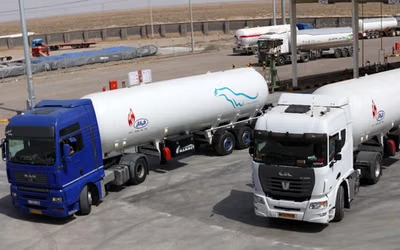
While Iran's efforts to become a regional transit hub over the last two decades have failed, talks are reportedly underway with 21 countries to launch free economic zones aimed at boosting the sector.
Presidential advisor Hojjat Abdolmaleki, who also serves as the secretary of the Supreme Council of Free Zones in Iran, claimed that the Islamic Republic has signed memoranda of understanding (MoUs) with six countries in this field. Although he did not specify the names, he mentioned that the Taliban is interested in investing in Iran’s Chabahar port, near Pakistan’s border.
His claim coincided with Iranian authorities seizing the first Afghanistan-Turkey rail freight transit through Iran since April 20, while officials made contradictory statements about the reasons behind the seizure.
The train, carrying 1,100 tons of talc minerals, traveled along the Khaf-Herat railway, which was inaugurated last summer in the presence of Taliban and Iranian officials. It arrived at Iran's Rozanak station on the border with Afghanistan on April 20 but was halted there for reasons that remain unclear.
Following this, Iran made a peculiar move by detaching the locomotive and relocating it to an undisclosed site.
While officials have yet to provide clarification on this matter, the Minister of Roads and Urban Development, Mehrdad Bazrpash, signed multiple Memoranda of Understanding (MoUs) with the UAE on May 2, encompassing the transportation sector. This occurred during the inaugural meeting of the Joint Economic Committee, marking its first convening in a decade following tensions between Iran and certain Arab states.
The Arab states, including Saudi Arabia, Kuwait, and the UAE, resumed diplomatic relations with Iran in 2022 following their ceasefire agreement with Iran-backed Houthi rebels in Yemen.
Iran’s transit plans
Iran has signed multiple unsuccessful deals with foreign countries over the last two decades in an attempt to become a regional transit hub, encompassing cargo, oil, gas, and electricity agreements.
One such agreement is the North-South Corridor, intended to facilitate the transit of cargoes from India to Afghanistan, Central Asia, and Russia, but it has yet to materialize.
India also signed an agreement to develop Iran’s Chabahar port as a part of the North-South corridor in early 2010s.
India partially initiated the Chabahar project and has been overseeing it since 2019. Though, apart from a few humanitarian shipments to Afghanistan, it has not yet facilitated the transit of any goods through Iran to foreign countries. This is largely due to Iran's failure to complete the 630-km Chabahar-Zahedan railway over the past two decades.
Iran has also failed to complete the 162-kilometer Rasht-Astara railway, which is intended to link with the rail networks of the Republic of Azerbaijan and Russia.
Tehran is additionally burdened by US sanctions and enduring tensions with both regional and Western states. Consequently, Iran managed to transit only 1.5 million tons of foreign cargo via its rail network last year, primarily consisting of Turkmen sulfur.
This volume represents a mere 20% of the international rail freight passing through the Republic of Azerbaijan, for example.
China has also omitted Iran from the $1-trillion "Belt and Road Initiative" project, opting instead to transit its goods to the West via the route through Central Asia, Azerbaijan, Georgia, and Turkey.
India has also excluded Iran from its transit routes priorities by signing MoUs with UAE and Saudi Arabia in 2023 to launch the India–Middle East–Europe corridor.

In terms of the logistics performance index (LPI), the World Bank has ranked Iran among the poorest countries. Last year, the Islamic Republic ranked 123 of the 139 countries compared, marking the lowest score among all neighbors, except Afghanistan. Even Iraq outperformed Iran in terms of LPI, ranking 115 globally.
Iraq is preparing to launch a huge transit project from The Faw Grand Port to Turkey's borders. The Faw Grand Port in southern Iraq, developed 80%, will be the largest port in the Persian Gulf. The port is being built by the South Korean company Daewoo on the Faw Peninsula, south of Basra, at a cost of about $5 billion and is projected to be completed in 2025.
Iraq plans to invest $17 billion to complete transit routes from the Faw Grand Port to Turkey. This initiative gained momentum when Iraq, Turkey, UAE, and Qatar signed a Memorandum of Understanding (MoU) to develop this project on April 22. Turkey itself ranks 11th globally in terms of logistics market value with $100 billion worth in 2023.