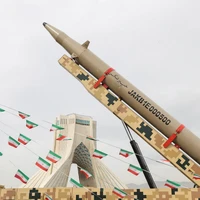
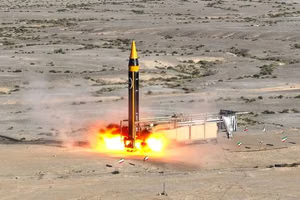
Iranian flags hang next to a missile on display during the forty-seventh anniversary of the Islamic Revolution in Tehran, Iran, February 11, 2026. Majid Asgaripour/WANA/Reuters
An Iranian lawmaker’s claim that Tehran’s missiles can now travel 4,500 kilometers and a front-page boast by Tehran daily Hamshahri that all of Europe is within reach have renewed questions about Iran’s ability to strike the continent.
Experts told Iran International the threat should be taken seriously, though Iran has yet to demonstrate that it can reliably hit targets at that distance.
Ahmad Bakhshayesh Ardestani, a member of Iran’s parliamentary National Security and Foreign Policy Committee, made the 4,500-kilometer claim on Monday without offering technical evidence.
Hamshahri, a newspaper run by Tehran’s municipality, touted a range of roughly 5,000 kilometers. The Islamic Revolutionary Guard Corps (IRGC) has said it lifted its self-imposed 2,000-kilometer limit but has given no details about whether longer-range missiles have been deployed.
What the Diego Garcia launches showed
The clearest indication that Iran may have exceeded its old 2,000-kilometer limit came in March, when it reportedly fired two missiles toward Diego Garcia, a joint US-British military base in the Indian Ocean. One was intercepted and the other failed in flight.
Jim Lamson, a senior research associate at the James Martin Center for Nonproliferation Studies at Middlebury College, assessed that both were intermediate-range ballistic missiles, or IRBMs, capable of traveling at least 4,000 kilometers.
“It does show that Iran had developed at least prototypes of IRBMs, but their design and production status remain unclear,” Lamson said.
He said US and Israeli strikes damaged Iran’s missile development and production facilities, leaving it unclear whether Tehran could build more of those missiles in the near term.
Farzin Nadimi, a senior fellow at the Washington Institute for Near East Policy who specializes in Iran’s military capabilities and Persian Gulf security, said Iran could build on its existing missile technology to extend its reach.
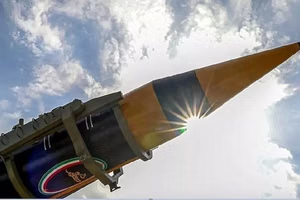
He suspects the two missiles fired toward Diego Garcia may have been modified versions of the Khorramshahr-4, a medium-range missile with a declared range of about 2,000 kilometers. Their identity remains unconfirmed.
“So they were technically capable of reaching Diego Garcia,” Nadimi said, citing the flight paths of both missiles.
The reported launches suggest Tehran was willing to attempt a strike well beyond its old limit.
Nadimi said some parts of southeastern Europe are already within reach of Iran’s existing missiles. He estimated that a range of 4,000 to 4,500 kilometers could put much more of Europe within reach, potentially including Britain.
What Europe should prepare for
Simone Ledeen, who oversaw US defense policy for the Middle East as a deputy assistant secretary at the Pentagon, said the threat to Britain and Western Europe is emerging and called on European governments to invest in missile defense now.
“European governments should plan for the capability arriving rather than wait for proof of it,” Ledeen said.
What Europe should prepare for
Simone Ledeen, who oversaw US defense policy for the Middle East as a deputy assistant secretary of defense, said the threat to Britain and Western Europe was emerging and called on European governments to invest in missile defense now.
“European governments should plan for the capability arriving rather than wait for proof of it,” Ledeen said.
She said the most immediate danger comes from missiles that can already reach US forces and allies in the Middle East.
Reaching the continental United States would require a missile with substantially greater range. Ledeen and Nadimi said Iran’s space program provides some of the technology relevant to developing an intercontinental ballistic missile, a capability that would require further development and testing.
Why Tehran is making the threat now
Tehran’s latest missile claims came a day after US President Donald Trump told Fox News he was inclined to resume strikes on Iran after the new year if no deal was reached.
Kerri Bitsoff, a former senior US Treasury official who helped impose sanctions on networks supplying Iran’s missile and drone programs, said Tehran is using its longer-range missile claims to pressure Washington and its allies to back away from further military action and to turn public opinion against the war.
Bitsoff said Iran’s ability to rebuild and resupply its missile program is under strain. In her view, publicizing a longer range gives Tehran a way to exert pressure while its ability to field those missiles remains uncertain.
“I read it as once again, the regime looking for leverage,” Bitsoff said.
A healthcare worker tends to a patient receiving respiratory support in an intensive care unit at a hospital in Iran.
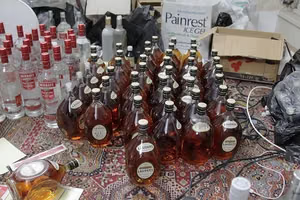
The poisoning of around 150 people and deaths of at least five from adulterated drinks have sparked widespread criticism of Iran's alcohol ban, with citizens blaming the policy for unsafe products and some accusing state institutions of distributing them.
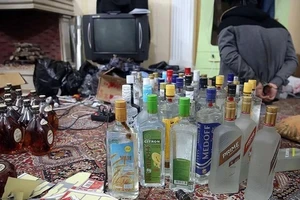
At least five people have died after consuming counterfeit alcoholic drinks in Neyshabur, Shiraz and Marvdasht in recent days, according to official figures.
The number of people poisoned in Neyshabur reached 120, with four deaths, Milad Taqdisi Heydarian, acting deputy for treatment at Neyshabur University of Medical Sciences, said on November 22.
One patient was declared brain-dead and 11 others required intubation, according to the official figures.
Health officials in Shiraz also reported around 30 methanol poisoning cases in Shiraz and Marvdasht, leaving one person dead and four in intensive care.
Citizens blame prohibition for unsafe drinks
The poisonings prompted widespread reactions from Iran International's audience, with many arguing that the Islamic Republic's ban on alcohol production, sales and consumption has fueled an unregulated market.
"Look at the result of prohibition. This is how they end up giving people poison," one citizen wrote.
Another criticized those who blamed the victims for drinking alcohol, questioning why Iran does not permit the sale of alcoholic drinks that meet international safety standards.
Several respondents argued that prohibition had failed to stop consumption while removing safeguards against dangerous products.
"People in our country drink alcohol. At least legalize it and regulate it. That would be better than the current situation," one citizen wrote.
"I don't drink, but its import and sale should be legalized," another said.
Fatal alcohol poisonings have repeatedly occurred in Iran. In December 2025, eight people died and one lost their sight after consuming contaminated drinks in separate cases in Iranshahr and Bampur.
Alcohol poisoning accounted for around five percent of 4,232 poisoning-related deaths during the first five months of the Iranian calendar year, according to a forensic medicine report published in October 2025.
Homemade and counterfeit alcoholic drinks were identified as major causes.
Revolutionary Guards accused of involvement
Some respondents accused institutions linked to the Islamic Republic, including the Revolutionary Guards, of distributing contaminated drinks.
"The Revolutionary Guards themselves distribute these counterfeit products," one citizen wrote.
Another described those supplying adulterated drinks as "system-affiliated sellers."
One respondent said methanol was advertised on Instagram as "90 percent corn alcohol" for 3000,000 rials per liter and accused the Revolutionary Guards of supplying it.
The actual number of alcohol poisoning cases could be [up to 10 times higher than emergency admission figures https, Deputy Health Minister Alireza Raisi said in October 2025, explaining that some victims avoid treatment because of fear or other reasons.
Methanol poisoning can cause blindness, severe organ damage and death. Health officials in Neyshabur have yet to identify the substance responsible for the latest poisonings.
The deaths have renewed criticism of restrictions that citizens say leave consumers dependent on an unregulated market, with some demanding legalization and quality controls to prevent further fatalities.
The front page of Tehran’s municipal newspaper Hamshahri on Monday featured an image under the headline “All of Europe within Iran’s range.”
Iranian officials have renewed threats against military bases in Europe, with a lawmaker saying the country's missiles can now reach 4,500 kilometers, more than twice their previously declared range.
Ahmad Bakhshayesh Ardestani, a member of parliament's National Security and Foreign Policy Committee, said Monday that Iran's missile range had increased from 2,000 to 4,500 kilometers, placing European military bases within reach.
“Our young leader has announced that missiles must be made accurate and capable of precision strikes. This means we have Europe within our grasp,” Bakhshayesh Ardestani said.
The lawmaker offered no independent technical evidence for the 4,500-kilometer figure. Iran's previously declared missile range of approximately 2,000 kilometers already placed parts of southern and southeastern Europe within reach.
Daily threatens European bases
Hamshahri, a newspaper owned by Tehran Municipality, published an image on Monday under the headline “All of Europe within Iran's range.”
The newspaper suggested that an order to respond to attacks without geographical restrictions could signal a shift in Iran's military strategy.
“Increasing the range of ballistic missiles to approximately 5,000 kilometers has raised concerns among Western countries,” Hamshahri wrote.
On November 3, Hamshahri published a map identifying US military bases and infrastructure across Europe as potential targets. Another article published by Hamshahri Online, citing the newspaper Javan, identified facilities in Cyprus and Greece.
Ebrahim Azizi, chairman of parliament's National Security and Foreign Policy Committee, said Monday that Iran's armed forces had developed the capability to make “enemies” regret attacking the country and were at their highest level of readiness, according to Tasnim, a news agency affiliated with the Revolutionary Guards.
Khamenei orders longer-range missiles
Qassem Qoreishi, deputy head of the Basij organization, said on November 18 that Mojtaba Khamenei had ordered the armed forces to increase missile range in response to the possibility of US operations shifting to more distant bases.
The following day, Qoreishi said Khamenei had also called for greater missile accuracy.
Mohammad Mokhber, an adviser to Khamenei, previously interpreted the leader's call for responses without geographical restrictions as removing limits on missile range.
The Revolutionary Guards subsequently announced that Iran's self-imposed 2,000-kilometer limit had been lifted, without specifying whether longer-range missiles had been developed or deployed.
Tasnim has suggested that modifications to the Khorramshahr-4 missile, including reducing warhead weight, could extend its range to between 3,000 and 4,000 kilometers.
Missile capabilities face questions
An earlier Revolutionary Guards attack on the joint US-British base at Diego Garcia in the Indian Ocean involved two missiles, neither of which reached its target. One was intercepted and the other failed during flight.
Israeli officials estimated their range at approximately 4,000 kilometers, while the Associated Press raised the possibility that satellite-launch technology contributed to the extended range.
The unsuccessful strike did not establish that Iran possesses missiles capable of consistently delivering accurate strikes at such distances.
Damage to missile facilities and difficulties obtaining foreign components have further constrained production, leaving questions about whether Iran's declared longer-range capabilities can be deployed reliably.
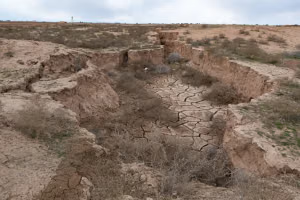
Deep cracks cut through dry ground in Iran, illustrating the impact of land subsidence.
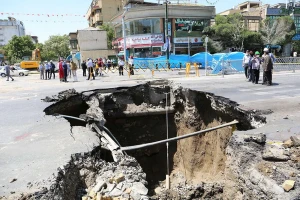
The area affected by land subsidence in southwestern Tehran has expanded by around 20% over the past two years, driven by continuous groundwater extraction to supply drinking water to the capital, a senior Iranian official said on Monday.
Around 650 million cubic meters of groundwater are extracted annually from approximately 1,200 wells to supply Tehran and its surrounding areas, Ali Beitollahi, head of the earthquake and risk assessment department at Iran's Road, Housing and Urban Development Research Center, said.
Unlike agricultural wells, which may operate for only a few hours a day depending on seasonal demand, urban water supplies require year-round extraction, he said.
The continued pumping of groundwater in areas already affected by subsidence is lowering water tables and degrading water quality, Beitollahi said.
Buildings, gas pipelines, water networks and sewage systems could suffer structural damage as the ground sinks, he warned, adding that population density and earthquake risks must also be considered when assessing the danger.
Subsidence spreads across Iran
Iran's largest subsidence zones overlap with its most densely populated metropolitan areas, particularly Tehran and neighboring Karaj, followed by Isfahan, Beitollahi said.
The entire Isfahan metropolitan area is exposed to subsidence risks, he added.
The scale of the problem has expanded nationwide. Land affected by subsidence increased tenfold over eight years, from approximately 10,000 to 100,000 square kilometers, Reza Shahbazi, deputy head of Iran's Geological Survey, said in September.
A parliamentary research report cited by Shargh newspaper in June warned that subsidence had reached a critical stage, with around half of Iran's population living in affected areas.
Population concentration strains water supplies
Around 40% of Iran's population lives within 100 kilometers of 10 major population centers, including Tehran and Mashhad, according to Beitollahi.
The concentration of jobs, infrastructure and services in these areas has increased demand for water, energy and food, placing further pressure on groundwater reserves.
Water conservation alone cannot resolve the problem because of the scale of population concentration, Beitollahi said.
He called for creating employment opportunities and improving living conditions elsewhere in Iran to reduce pressure on Tehran and Karaj, warning that continued population concentration would make future water supplies unsustainable.
A shopkeeper works by lamplight inside a clothing store during a power outage in Iran.
Scheduled power cuts have resumed across Iran, disrupting homes, businesses and schools, with a lawmaker saying electricity shortages could cost more than one million jobs.
People in Tehran, Isfahan, Shiraz, Mashhad, Yazd, Kermanshah and Ardebil reported hours-long outages, often without notice, in messages sent to Iran International on Sunday.
“Today, November 22, we are at school and the power has gone out. It is cloudy, and we are sitting in class in the dark,” a student in Mashhad wrote.
The disruptions have also affected water supplies and internet access.
Fuel shortages force renewed power cuts
Mohammad Allahdad, chief executive of state electricity company Tavanir, announced Saturday that residential and commercial power restrictions would begin November 22 because of fuel shortages at power plants.
Outages could last two hours every other day, increasing to two hours daily if temperatures fall further, Allahdad said.
The cuts have returned just two months after summer. During winter, increased household demand for natural gas used in heating reduces supplies available to thermal power plants, which generate most of Iran's electricity.
Economic journalist Mahtab Gholizadeh told Iran International that worsening gas shortages had disrupted electricity supplies even before severe winter weather arrived.
“Reforming energy consumption is the country's most urgent and important issue, and these reforms must begin with natural gas, not gasoline,” Parliament Speaker Mohammad Bagher Ghalibaf said Sunday.
Natural gas accounts for 73% of Iran's energy mix, compared with 9% for gasoline, Ghalibaf added.
Electricity shortages threaten jobs
Electricity shortages have contributed to 600,000 job losses over the past six months by reducing industrial production, lawmaker Nasrollah Pejmanfar told parliamentary news agency Khaneh Mellat on Sunday.
More than one million workers could lose their jobs if the shortages continue, Pejmanfar added.
Residential buildings stand largely dark at dusk, illustrating the impact of recurring power cuts across Iran.
Around 16% of electricity demand at industrial estates went unmet during the Iranian year ending March 2026, with conditions worsening since then.
Industrial operators also face charges 4.5 times official electricity tariffs, squeezing profit margins and discouraging investment, Pejmanfar said.
Schools left in the dark
The outages have reached schools already struggling with inadequate heating.
Parents previously told Iran International that children attended lessons wrapped in blankets because heating systems were switched off.
“How are teachers supposed to teach and students supposed to learn with the lights off?” a Tehran resident asked, referring to President Masoud Pezeshkian's advice to conserve electricity.
Others described disruptions to water supplies and internet connections, alongside rising electricity bills.
In Arak, one person questioned why a 70-square-meter apartment had received a thirty-million-rial electricity bill despite continuing restrictions.
President's energy-saving advice draws criticism
President Masoud Pezeshkian said November 19 that he slept wearing a jacket and extra clothing and kept his household lights switched off to save energy.
“We sold our jackets so we could put bread on the table for our wives and children for one night,” a person in Mashhad wrote to Iran International.
Others questioned whether officials' families faced similar heating shortages.
Government spokesperson Fatemeh Mohajerani raised the possibility of natural gas cuts earlier in November, while Pezeshkian said November 21 that winter shortages could create further problems.
Some Iranians attributed the recurring outages to mismanagement of the country's energy resources.
The renewed cuts have intensified pressure on households and businesses already struggling with rising costs and reduced industrial production.
A patient receives treatment in a hospital intensive care unit in Iran. (File photo)
The number of people poisoned by bootleg alcohol in the northeastern Iranian city of Neyshabur has risen to 120, with four dead, health officials said late on Sunday, and police said they had arrested 12 people over its production and sale.
The toll has climbed fast. On Saturday, officials reported 66 people poisoned, and by midday Sunday, 72.
By Sunday night, 120 people had been admitted to hospitals, Seyed Milad Taghdisi Heydarian, acting deputy for treatment at Neyshabur University of Medical Sciences, told the Mehr news agency.
Eleven patients were on ventilators and one had been declared brain dead, he said.
All of the dead and the brain-dead patient were men. Eighteen patients have been sent to hospitals in Mashhad, the provincial capital, about 120 kilometers to the west, and 16 have been discharged.
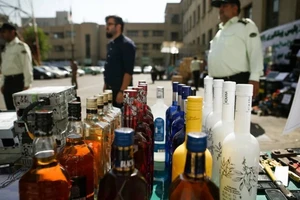
Police first arrested eight suspects, then three men and a woman they described as the main producers and distributors, Neyshabur's police chief, Mojtaba Mohebbati, said. The investigation was continuing, he said.
Officials have not said what caused the poisonings. Methanol, an industrial alcohol often found in counterfeit drinks, causes blindness, kidney failure and death, and dialysis is one of the main treatments for it.
A banned drink, a deadly market
Alcohol is banned in Iran for Muslims, who face flogging if caught drinking. Only recognized religious minorities are allowed to make it for private use. The ban has created a large black market in which homemade and counterfeit drinks, often made with cheap industrial alcohol, have repeatedly caused mass poisonings.
The worst came in early 2020, when hundreds of people died after drinking methanol in the false belief that it would protect them from COVID-19.
In July 2025, 31 people sought hospital treatment after drinking counterfeit alcohol in Dezful, in the southwest. One died and five were admitted to intensive care. In November 2025, eight people died of alcohol poisoning in Iranshahr and Bampur, in the southeast. One lost their sight.
The real number of alcohol poisonings in Iran could be up to 10 times what emergency departments record, Deputy Health Minister Alireza Raisi said in October 2025. Many people who fall ill avoid hospitals for fear of prosecution.
In September 2025, Raisi called Iran's per capita alcohol consumption a public health challenge and urged more treatment centers. Admissions for alcohol dependence at addiction treatment centers had risen by as much as 50 percent over the previous five years, the Rouydad24 news site reported that month.
Medical personnel in Iran attend to a patient on a stretcher in a hospital emergency ward. (File photo)