• العربية
  • فارسی
BrandBrand
  • Iran Insight
  • Politics
  • Economy
  • Analysis
  • Special Report
  • Opinion
  • Podcast
  • Live TV
  • Iran Insight
  • Politics
  • Economy
  • Analysis
  • Special Report
  • Opinion
  • Podcast
  • Live TV
  • Theme
  • Language
    • العربية
    • فارسی
  • Iran Insight
  • Politics
  • Economy
  • Analysis
  • Special Report
  • Opinion
  • Podcast
  • Live TV
All rights reserved for Volant Media UK Limited
volant media logo

Shipping firm sold vessel below value to Shamkhani sons, Iranian outlet says

Nov 16, 2026, 09:37 GMT+0
File photo of Mohammad Hossein Shamkhani, son of Iran's slain security chief Ali Shamkhani

Iran's state-linked shipping company sold a damaged container vessel for less than $6 million to a firm owned by the sons of a senior Iranian official, raising questions over asset sales and shareholder interests, an Iranian news outlet reported Monday.

The Shahraz vessel was sold to Admiral, a company owned by the sons of Ali Shamkhani, a former secretary of Iran's Supreme National Security Council who was killed in Israeli attacks, and returned to commercial service after repairs costing several million dollars, Rouydad24 reported on November 16.

"Each of these cases raises serious questions about decision-making, pricing, the selection of buyers or recipients, the financial recording of transactions and the responsibility of managers," Rouydad24 wrote.

The website called for the publication of transaction documents and financial assessments to establish whether the sales served the interests of shareholders in the publicly listed Islamic Republic of Iran Shipping Lines (IRISL).

Damaged vessel sold below $6 million

The Shahraz container ship ran aground near the Singapore Strait on May 11, 2020, sustaining extensive hull damage.

The vessel was subsequently sold to Admiral for less than $6 million after incurring salvage and maintenance costs, Rouydad24 reported.

The outlet said the ship's recoverable scrap value may have exceeded its sale price, while shareholders received insufficient information about salvage expenses and insurance compensation.

Admiral subsequently spent several million dollars repairing Shahraz before returning it to commercial operations.

Rouydad24 questioned why IRISL had not undertaken the repairs itself and whether the vessel's commercial viability had been assessed before its sale.

It also sought details on whether the transaction involved a public auction or direct negotiations, how the buyer was selected and whether conflicts of interest existed.

Shamkhani shipping network faces US sanctions

Hossein Shamkhani, a son of Ali Shamkhani, has operated internationally under the aliases Hugo Hayek and Hector.

The US Treasury Department announced on July 14 that it was intensifying efforts to disrupt his network over shipping activities that circumvent US sanctions.

The network remains a major participant in Iranian oil exports and has expanded into container shipping and global commodities trading, according to the Treasury Department.

The measures followed earlier US sanctions against Shamkhani and much of his financial and shipping network in July 2025 and April 2026.

Bloomberg reported in August 2024 that the Dubai-based Milavous Group, where Shamkhani is a senior executive, had generated billions of dollars trading commodities from Iran, Russia and other countries.

A confidential document obtained by Iran International on November 9 showed that Shamkhani had long dominated Iranian oil sales in the United Arab Emirates and used a vessel purchased with an Iranian government loan to transport Russian oil.

Iran International has also detailed an oil trading network linked to Revolutionary Guards intelligence, including a confidential letter from Shamkhani to Supreme Leader Ali Khamenei.

Fuel sales raise shareholder questions

IRISL continued supplying fuel to Admiral from its international operations allocation for a period after selling Shahraz, Rouydad24 reported.

The website said supplying fuel to a potential commercial competitor was not necessarily a violation, but questioned the pricing, revenue, authorizations and economic rationale.

"In a publicly listed company, the company's resources and commercial capacities must be used in accordance with its economic interests," Rouydad24 wrote.

The report called for disclosure of the sale proceeds received, Admiral's ultimate beneficial owners and any potential conflicts of interest involving those who approved the transaction.

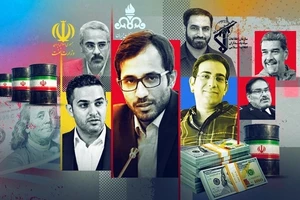
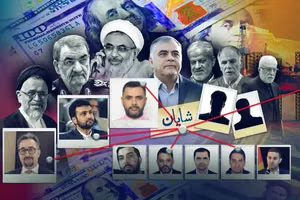
The questions follow Iran International investigations into oil trading networks involving relatives of senior Islamic Republic officials, including the son of former Revolutionary Guards commander Mohsen Rezaei and relatives of two ministers.

Reports of organized corruption involving politically connected figures have drawn public anger as Iranians face mounting economic pressure and difficulties affording basic necessities.

The Shahraz transaction has renewed questions over the management of state-linked commercial assets and whether their sale benefits shareholders or politically connected buyers.

  • US sanctions Shamkhani 'shipping empire' for moving Iranian oil

    US sanctions Shamkhani 'shipping empire' for moving Iranian oil

  • Iran acquires oil facilities in China to bypass US sanctions, leaked document shows

    Iran acquires oil facilities in China to bypass US sanctions, leaked document shows

  • US sanctions oil network tied to Iranian tycoon Shamkhani

    US sanctions oil network tied to Iranian tycoon Shamkhani

  • Son of Khamenei adviser sues Bloomberg over oil trade allegations - Iran media

    Son of Khamenei adviser sues Bloomberg over oil trade allegations - Iran media

  • Inside the alleged IRGC Intelligence takeover of Iran’s sanctioned oil trade

    Inside the alleged IRGC Intelligence takeover of Iran’s sanctioned oil trade

Most Viewed

Iran state TV says modified missile could reach US base in Britain
1

Iran state TV says modified missile could reach US base in Britain

2

Seven years after ‘Bloody November,’ Iran rations gasoline it dares not reprice

3

Third US carrier joins Iran blockade, Bessent warns of economic collapse

4

Blair's sister-in-law attended Iran conference linked to IRGC spy recruitment - Telegraph

5

Democrats push to end Iran war, Republicans dig in

Banner

Spotlight

  • Can higher fuel prices curb Iran’s smuggling problem?
    ANALYSIS

    Can higher fuel prices curb Iran’s smuggling problem?

  • Canadian MP to flag paintball gun findings after Iran protest blindings
    PODCAST

    Canadian MP to flag paintball gun findings after Iran protest blindings

  • Locks for cash: inside Iran's booming hair trade

    Locks for cash: inside Iran's booming hair trade

  • Seven years after ‘Bloody November,’ Iran rations gasoline it dares not reprice

    Seven years after ‘Bloody November,’ Iran rations gasoline it dares not reprice

  • Iranians and Israelis can defeat the IRGC together, says Arab-Israeli activist
    ONE-ON-ONE

    Iranians and Israelis can defeat the IRGC together, says Arab-Israeli activist

  • Iran's oil output plunges below pre-war domestic needs
    ANALYSIS

    Iran's oil output plunges below pre-war domestic needs

Banner
Banner
Banner
Banner
Banner
Banner
  • Mohsen Rezaei’s son among nine identified in $11-billion Iran oil network

    Mohsen Rezaei’s son among nine identified in $11-billion Iran oil network

•
•
•

More Stories

Third US carrier joins Iran blockade, Bessent warns of economic collapse

Nov 16, 2026, 00:06 GMT+0
100%
F/A-18 Super Hornet fighter jets prepare for takeoff aboard the USS George Washington aircraft carrier. (CENTCOM/X)

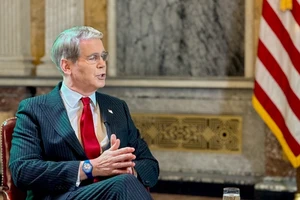
A third US aircraft carrier arrived in the Middle East Sunday, joining forces enforcing a blockade of Iranian ports, while Treasury Secretary Scott Bessent warned of a historic economic collapse in Iran, predicting a 25 percent contraction over the coming year.

The USS Theodore Roosevelt entered the US Central Command's area of operations on Sunday, ABC News reported, citing a US official. It joined the USS George H.W. Bush and USS George Washington, which have been operating in the Arabian Sea.

The naval deployment comes as Washington maintains economic pressure on Tehran. Bessent told Fox News on Sunday that Iran's economy could contract by 25 percent over the coming year.

“So this is one of the fastest collapses in history,” he said.

The remarks echoed a warning Bessent made in an interview with Iran International last month.

“I would predict that from March of '26 until March of '27, the economy would contract more than 25 percent, which is more than the Soviet Union contracted after its collapse,” he told Iran International on October 26.

Reuters reported Saturday that President Donald Trump was considering holding off on further strikes unless Iran or Yemen's Iran-backed Houthis launched new provocations. Saudi Crown Prince Mohammed bin Salman and Turkish President Tayyip Erdogan had urged him not to resume attacks, according to the report.

The risk of renewed fighting remains, however. Bahrain, home to the US Navy's Fifth Fleet, said its air defenses intercepted several Iranian aerial attacks Sunday, while the IRGC claimed to have targeted a US radar installation with six drones. The claimed strike was not independently confirmed.

Two days earlier, the US military said it had intercepted two drones without damage, rejecting a separate Iranian claim that it had struck an American early-warning radar.

Israel has also continued consultations with Washington over Iran. Mossad chief Roman Gofman returned from talks with senior US officials, Israeli outlet Ynet reported, while Axios said Prime Minister Benjamin Netanyahu had sought discussions about renewed strikes.

In Tehran, Parliament Speaker Mohammad Bagher Ghalibaf warned Sunday that another US attack could widen the conflict.

“If the Americans make a mistake this time, the geography of the battle will be determined by the capabilities and will of our armed forces,” he said.

Iranian Foreign Minister Abbas Araghchi is expected to visit Oman on Tuesday for talks with his counterpart, according to state media. Oman has previously mediated between Tehran and Washington.

Iran facing one of fastest economic collapses ever, Bessent says

Nov 15, 2026, 17:34 GMT+0
100%
A man walks past a currency exchange office displaying foreign exchange rates in Tehran, Iran.

US Treasury Secretary Scott Bessent said on Sunday that Iran was experiencing one of the fastest economic collapses in history, as Washington expanded its pressure campaign beyond a naval blockade to target the country's land-based supply routes.

Speaking to Fox News, Bessent predicted that Iran's rial would lose 25% of its value between March 2026 and March 2027, comparing the pace of the decline with the economic turmoil that followed the Soviet Union's collapse.

"To put that in perspective, the Russian economy went down 22% over three years when the Soviet Union collapsed," Bessent said. "So this is one of the fastest collapses in history."

Bessent argued that the deteriorating conditions were putting increasing pressure on Iran's political and military establishment, even as senior officials remained insulated from the consequences.

"A lot of the leadership, they're like rats in a sewer pipe," he said. "They are in underground bunkers, and they don't see how bad it is up top."

He also said US restrictions had severely limited Iranian officials' ability to travel abroad.

"And we have them completely isolated. We have an airline quarantined," Bessent said.

"They can't fly to London to see their family, Paris to see their girlfriends, Geneva to visit their money."

Bessent suggested that the economic pressure was beginning to cause concern within the Islamic Republic's leadership.

"We could see from the public statements, the public statements from the politicians began in the summer. Now we're seeing the IRGC get worried," he said, referring to Iran's Revolutionary Guards.

  • Bessent says Iran economy will contract by more than 25%

    Bessent says Iran economy will contract by more than 25%

  • US Treasury chief moves to military base after Iranian threats

    US Treasury chief moves to military base after Iranian threats

  • Bessent's tax boycott and fuel advice sparks debate among Iranians

    Bessent's tax boycott and fuel advice sparks debate among Iranians

US expands blockade to target Iran's land routes

Bessent's remarks came just over a week after the US military announced Task Force Iron Gate, an initiative designed to expand Washington's economic pressure campaign beyond its existing naval blockade.

Announced by US Central Command on November 7, the task force aims to disrupt the movement of advanced weapons, dual-use technologies, sanctioned materials and illicit revenue across Iran's land borders and the Caspian Sea.

The 20-member team, based in Tampa, Florida, will coordinate with US government agencies to restrict Tehran's access to military supplies and financial resources.

"The establishment of Task Force Iron Gate reinforces the success of our ironclad blockade against Iran at sea," CENTCOM commander Admiral Brad Cooper said.

The US military said its naval blockade had prevented Iran from exporting more than $25 billion worth of crude oil, an estimate that could not be independently verified.

President Donald Trump declared the new task force operational on November 8, saying it would further restrict Iran's access to international trade.

"Task Force Iron Gate is in full force and effect in the Islamic Republic of Iran," Trump wrote on Truth Social. "Coupled with history's greatest Naval Blockade, very little gets into, or out of, Iran!"

Pence says ending military campaign was a mistake

Former Vice President Mike Pence said on Sunday that the United States had halted its military campaign against Iran too soon and disputed Vice President JD Vance's assessment of why Republicans suffered losses in the midterm elections.

"Vice President Vance is wrong," Pence said on NBC's Meet the Press.

Pence argued that American forces had achieved substantial military successes during Operation Epic Fury, including destroying much of Iran's navy, establishing air superiority and attacking thousands of military targets.

He criticized the administration's decision to suspend operations after five weeks, describing the move as an embrace of the "politics of appeasement."

"There's an old saying that you don't make peace with your enemy, you make peace with your defeated enemy," he said.

  • Vance blames Iran war for election losses as Trump weighs next move against Tehran

    Vance blames Iran war for election losses as Trump weighs next move against Tehran

  • Opportunity or trap? Vance's Iran war remarks divide Tehran

    Opportunity or trap? Vance's Iran war remarks divide Tehran

  • Trump shifts Vance away from Iran talks, says deal unnecessary

    Trump shifts Vance away from Iran talks, says deal unnecessary

Pence pointed to continued Iranian military activity in the Persian Gulf as evidence that Tehran remained willing to confront Washington.

Vance has attributed Republican electoral losses to the Iran war and its economic consequences, including higher fuel prices. President Donald Trump, meanwhile, said on Thursday that Washington no longer needed a deal with Tehran and directed Vance to shift his attention from Iran diplomacy to domestic corruption investigations.

Bahrain reports fresh attacks as Iran vows retaliation

The dispute over Washington's strategy came as Bahrain reported intercepting further Iranian aerial attacks on Sunday, highlighting the continuing risk of military escalation despite the suspension of large-scale US strikes.

Bahrain's military said its air defenses destroyed several aerial threats before they reached their targets, following the interception of two drones Friday.

The country's Foreign Ministry condemned the attacks as violations of its sovereignty and urged the UN Security Council to take action against Tehran.

"These attacks constitute a blatant aggression against Bahrain's sovereignty and territorial integrity," the ministry said.

Iranian Foreign Ministry spokesperson Esmaeil Baghaei, asked about the strikes, said Tehran would continue responding to attacks against it.

"We have previously said that we will not leave any attack unanswered, and we will continue this approach from now on," Baghaei said on Sunday.

Israeli opposition to Islamic Republic transcends party lines

Nov 15, 2026, 14:44 GMT+0
•
Kambiz Tavana
100%
Former military chief Gadi Eisenkot, Israeli Prime Minister Benjamin Netanyahu, heads of parties and other Israeli officials gather for a family photo on the day of the inauguration of Israel's 26th parliament, at the Knesset in Jerusalem, November 10, 2026.

Opposition to the Islamic Republic will remain a point of consensus in Israel regardless of who forms its next government, according to Israeli-American journalist and Iran analyst Emily Schrader.

"It's not a partisan issue in Israel," she told Iran International's Kambiz Tavana. "No one in the mainstream, from left to right, wants the Islamic Republic to continue."

Prime Minister Benjamin Netanyahu's bloc won 53 of the Knesset's 120 seats in last month's election. Although opposition leader Gadi Eisenkot's Yashar party won fewer seats than Netanyahu's Likud, Eisenkot emerged with broader parliamentary support and was tasked by President Isaac Herzog with forming a government.

Schrader said the outcome reflected domestic grievances rather than Netanyahu's record against Iran and its allies.

"Netanyahu internationally and Netanyahu domestically are very, very different equations," she said, adding that most Israelis respect how he handled the war with Iran and the fight against Hezbollah, including the pager operation.

She pointed instead to anger over the hostage negotiations, Netanyahu's corruption trial and the absence of a state commission of inquiry into the failures of Oct. 7.

Asked whether an Eisenkot government would be softer on Tehran, she said representatives of Yashar had told her they support regime change.

"If there is a unity government that would see Eisenkot and Netanyahu together, most likely we're not going to see a lot of policy changes," she said. "Probably a very similar approach to Iran, which I think will be the case anyway."

The bigger domestic change, she said, could come over the drafting of ultra-Orthodox men into the army, one of the main election issues.

100%
Emily Schrader, an Israeli-American journalist and Iran analyst, speaks in an interview with Iran International's Kambiz Tavana in Washington DC on Nov. 13, 2026

'That's how desperate they are'

Schrader said the world had failed to grasp the desperation of Iranians living under the Islamic Republic.

"The Iranian public is in such a state of crisis, in such a state of desperation, that there were people who wanted their country to be bombed," she said. "Not their country, but the IRGC and the regime. But that's how desperate they are."

She criticized the UN General Assembly's Nov. 11 vote to elect Iran to its Committee for Programme and Coordination, with 144 votes, for a three-year term starting in January.

The vote came, she said, "after they massacred at least 40,000 of their own people in the streets in two days."

"Why is this not being spoken about? On what planet is that a normal thing to do?" she said, adding that the Islamic Republic was now significantly weaker, creating an opening for Iranians even if it survived.

US President Donald Trump told radio host Hugh Hewitt on Nov. 12 that it "would be a defeat" if Iran's rulers were still in power when he leaves office. Schrader said she was "cautiously optimistic" about relief for Iranians.

She said both the Trump administration and Netanyahu's government now felt pressure to deal with Iran following their respective elections, pointing to Trump's remarks to reporters the day after the US midterms, when he was asked whether Republicans had lost because of the Iran war.

Speaking to reporters on Nov. 4, after Democrats won control of both chambers of Congress, Trump said it was "largely true" that the war had hurt Republicans because it "drove the gasoline up a little bit," but added that "if I had to do it again, I'd have to do it again," Newsweek reported.

Accounts posing abroad

Schrader also addressed a recent online dispute with Persian-language accounts that accused her of working against Netanyahu during the Israeli election campaign.

She alleged that some accounts presenting themselves as users in Germany and Britain were actually operating from inside Iran during the internet shutdown.

"There were some things that were true mixed in with things that weren't true, which is a very classic tactic that we've seen from the IRGC," she said.

She acknowledged she had explained the debate over monarchy and democracy poorly, but said the two were "not mutually exclusive."

"When it comes to Iran, it's not up to me. It's up to the Iranian people," she said.

"It really breaks my heart to see how the Iranian people are crying out for help," Schrader said. "There are teenagers willing to die to free their country, for the hope of freeing their country."

Democrats push to end Iran war, Republicans dig in

Nov 14, 2026, 20:42 GMT+0
100%
Newly elected democratic members of Congress, who have flipped Republican seats gather for photos at the US Capitol in Washington, DC, US, November 12, 2026.

US Democratic lawmakers are stepping up efforts to end the war with Iran after their sweeping midterm election victory, promising legislative action when they take control of Congress in January.

Democrats won control of both chambers of Congress in the November 3 elections, a defeat for Republicans that President Donald Trump and Vice President JD Vance acknowledged was driven in part by public dissatisfaction with the war.

“Last week, voters were loud and clear: Trump’s economy doesn’t work for Americans,” Senate Democrats said in a statement on X on Friday.

“When Senate Democrats are back in the majority next year, we will take immediate action to end Trump’s war in Iran, stop his reckless tariffs, and lower costs for everything from energy to groceries to housing.”

A Reuters/Ipsos poll released Tuesday found that 71 percent of Americans wanted Congress to pass legislation ending the conflict, including 93 percent of Democrats and 51 percent of Republicans.

The growing pressure has reached the current Republican-controlled Congress, where Representative Thomas Massie of Kentucky, a frequent critic of Trump, has pledged to force another vote on ending the war before his term expires.

Massie introduced a War Powers resolution on November 10 directing the president to remove US forces from hostilities with Iran.

In a post on X Saturday, Massie said he could force a vote by mid-December, provided House Speaker Mike Johnson does not cancel scheduled legislative days. He added that two other resolutions seeking to end the war could reach the House floor even sooner.

But Republican lawmakers, including some who have criticized the conflict, remain reluctant to use congressional powers to force its conclusion.

“A Republican Congress is not going to send bills to a Republican president that he's going to veto,” Representative Tom Cole of Oklahoma, chairman of the House Appropriations Committee, told reporters this week.

The disagreement is expected to become a central issue in negotiations over government funding, which expires on December 11, raising the possibility of another shutdown confrontation.

Several Republicans have previously joined Democrats in attempts to restrict Trump's military operations, although most of the party has remained aligned with the president.

A war that was supposed to last weeks

The pressure has intensified as the conflict approaches its ninth month, far exceeding the administration's initial expectations.

“We are now in week 37 of Trump’s ‘2 to 3 week’ war with Iran,” Democratic Representative Jason Crow of Colorado wrote on X.

Representative Jimmy Panetta, a California Democrat, also accused Defense Secretary Pete Hegseth of continuing the war in violation of the War Powers Resolution of 1973 and failing to provide transparency over deadly strikes on civilians, including an elementary school in Iran.

“Congress will exercise its constitutional authority to hold him accountable,” Panetta said.

Democrats will have several options when they take control of Congress on January 3, including legislation restricting military operations, limits on war funding and congressional investigations into the administration's conduct.

But their ability to compel an end to the conflict remains uncertain. Trump could veto legislation passed by Congress, requiring two-thirds majorities in both chambers to override him.

Iran state TV says modified missile could reach US base in Britain

Nov 14, 2026, 19:04 GMT+0
100%
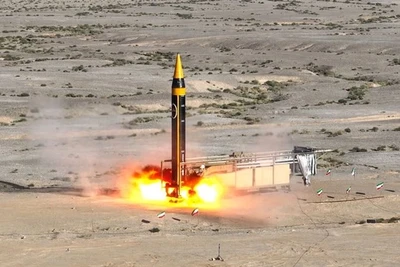
A new surface-to-surface 4th generation Khorramshahr ballistic missile is launched at an undisclosed location in Iran, in this picture obtained on May 25, 2023.

Iranian state television has warned that modified versions of the country's Khorramshahr ballistic missile could reach American military bases in Europe, explicitly naming RAF Fairford in Britain as a potential target.

"The range of Iran's missiles is not limited to what they have seen," the report, broadcast Saturday, said, claiming that modifications to the Khorramshahr's warhead could increase its range severalfold.

The Khorramshahr-4, unveiled in 2023, has a claimed range of 2,000 kilometers while carrying a warhead weighing 1,500 kilograms. A lighter warhead could extend its range, although the extent of any increase remains unverified.

The broadcast included a review of missiles and drones Iran has used in its wars with Israel and the United States since June 2025, presenting the Khorramshahr as part of a broader arsenal capable of threatening American installations farther afield.

In a warning directed at Britain, the report suggested that British air defenses were not necessarily more capable than Israel's, which it claimed Iranian missiles had already penetrated during the war.

There has been no independent confirmation that Iran possesses a modified Khorramshahr capable of reaching RAF Fairford.

The broadcast invoked an order by Supreme Leader Mojtaba Khamenei that Iran's armed forces should face no geographical restrictions in responding to attacks by the United States or Israel.

Khamenei issued the directive on October 31, calling for immediate and effective retaliation without geographical limits and ordering military commanders to update their list of potential targets.

Iran's Revolutionary Guards subsequently said the country's longstanding self-imposed limit of 2,000 kilometers on ballistic missile ranges had been lifted, although they did not specify whether longer-range missiles had been developed or deployed.

The broadcast follows a series of warnings from senior Iranian officials that American bases in Europe and on distant islands could become targets if Washington launches further attacks.

Mohsen Rezaei, secretary of Iran's Supreme National Security Council, said earlier this week that Tehran would no longer confine its response to nearby US military installations and could strike bases in European countries.

The threats come as diplomatic efforts to end the war remain stalled, with Tehran demanding an end to the US naval blockade of Iranian ports and relief from sanctions before negotiations can resume.

Washington has maintained its economic pressure campaign, while President Donald Trump has declared that he wants a total victory over Iran and suggested the United States no longer needs a negotiated agreement.

The latest state television report went further than previous warnings by naming a specific British installation and linking the threat to a purportedly extended-range version of the Khorramshahr missile.