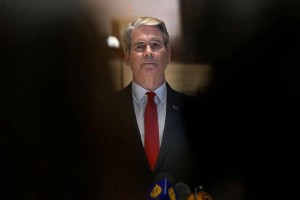
Iran’s military strength exceeds US claims, says defense ministry spokesman
Iran’s Defense Ministry spokesman said Wednesday that the country’s weapons reserves rely on strategic production and upgraded technology, putting the country’s military capacity beyond figures cited by officials.
In a post on X, Reza Talaei-Nik said Iran’s military capabilities had strengthened and that the war’s outcome was clear: “Either Iran’s legitimate demands will be accepted, or the enemy will surrender on the battlefield.”
Workers struggling with mounting debts and rising living costs are offering their kidneys, liver tissue and bone marrow for sale to repay debts and keep their homes, the labor-focused ILNA news agency reported on November 11.
Advertisements offering organs for sale cover walls, metal doors and buildings along some streets in central Tehran, where ILNA interviewed workers and other residents whose earnings no longer cover their basic expenses.
Farhang Hosseini Street, widely known as "Kidney Street," has become a gathering point for people seeking buyers, partly because of its proximity to a municipal medical facility and a charity supporting kidney patients.
The advertisements extend beyond kidneys to liver tissue, bone marrow and other body parts, according to ILNA.
Workers seek billions of rials for kidneys
Most people advertising kidneys for sale are workers and individuals facing serious financial difficulties, an employee at Sadra Hospital told ILNA.
Asking prices generally range from 30 billion to 40 billion rials ($11,500 to $15,300), although kidneys from people with O-positive blood may be offered for eight billion rials ($3,100). Prices for rarer blood groups can reach 50 billion rials ($19,200), the employee said.
A 30-year-old motorcycle courier in Tehran said he had rejected an offer of 15 billion rials ($5,750) for his kidney, plus an expected two billion rials ($770) from insurance, but the amount would not cover his debts.
The courier is now seeking at least 35 billion rials ($13,400).
Another man, a self-employed worker aged about 58, said he needed between seven and eight billion rials ($2,680 to $3,070) to settle an outstanding check and was prepared to sell an organ for 20 to 30 percent below the usual asking price.
The accounts come as financial pressures leave growing numbers of households struggling to afford basic necessities.
Around eight million people have fallen into absolute poverty and malnutrition because of the government's mishandling of preferential currency subsidies, parliamentary social affairs committee chairman Ali Babaei Karnami said on November 8.
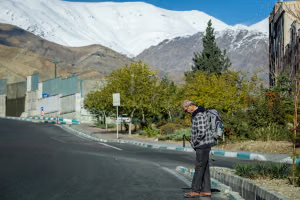
An Iranian woman walking past a wall displaying an advertisement for the sale of body organs.
Up to 50 million more people face difficulties affording food, Babaei Karnami said.
Multiple organs advertised for sale
Some workers are advertising several organs simultaneously in hopes of securing enough money to settle their debts.
A 33-year-old construction worker told ILNA he wanted 40 billion rials ($15,300) for his bone marrow and had also advertised his kidney and liver tissue for sale.
"I have advertised my liver and kidney for sale as well. I have all my medical examination results and health documents, and I am completely healthy," the worker said.
Another worker had advertised his kidney, liver tissue and testicle for sale, saying his financial difficulties had left him with few options.
After an ILNA reporter explained that testicular transplantation was not performed in Iran, the worker said he had been unaware of that and was willing to sell whichever organ attracted a buyer first and offered the highest payment.
The advertisements highlight the widening gap between earnings and household expenses.
Minimum-wage workers typically earn between 200 million and 300 million rials ($77 to $115) a month, including benefits, while independent labor activists estimate that a household needs around one billion rials ($383) monthly to cover basic living costs, according to ILNA.
Workers on temporary or seasonal contracts face additional difficulties, including unstable employment and earnings below the minimum wage.
Financial hardship forces difficult choices
Reports of people selling organs to cover living expenses have emerged repeatedly in recent years.
In March 2024, Tejarat News reported that young Iranians, including teenagers, were offering kidneys and bone marrow for sale to meet their financial needs.
Financial difficulties have also affected access to medical treatment.
Two retirees died after abandoning medical treatment because they could no longer afford it, Jalal Hashemi, chairman of the Homa retirees' association, said on October 26.
In January 2022, Hossein Biglari, head of the Kermanshah Kidney Patients Support Association, said some Iranians were traveling to Iraq to sell their kidneys for higher prices in dollars.
For construction workers and motorcycle couriers, physical health is essential to earning a living.
Selling an organ may temporarily relieve financial pressures but could undermine their health and ability to work in the future, ILNA wrote, highlighting the longer-term consequences for workers turning to their own bodies to repay debts.
Students across Iran are attending classes without adequate heating despite freezing temperatures and heavy rainfall, as the government warns of possible gas shortages but insists on keeping schools open, according to accounts received by Iran International.
Government spokesperson Fatemeh Mohajerani warned on November 10 of possible gas cuts in Tehran and other parts of the country but said the government's policy remained focused on maintaining in-person education.
The warnings come as families face growing school expenses, including demands to cover utility bills, while unreliable internet access and the cost of online learning complicate alternatives to classroom teaching.
Students bring blankets to freezing classrooms
Students and parents from several cities told Iran International that schools had refused to turn on heating systems despite falling temperatures.
"We are shivering from the cold at school, but they tell us they need an Education Ministry directive before turning on the heaters," one student said.
A student in the northwestern city of Ardebil said radiators remained off despite snowfall on November 9, with school officials citing energy shortages.
"Things have reached the point where some students are bringing travel blankets with them," the student said.
In Tabriz, northwestern Iran, where temperatures fell to minus five degrees Celsius, students said school officials refused to switch on radiators and told them to warm classrooms with their breath.
Students in the northern city of Chalus, northwestern Miandoab and Abyek near Tehran described similar conditions, including heavy rainfall, flooding and unheated classrooms.
A parent in the northern city of Amol said students at a private school had fallen ill after attending classes in severe cold.
"If these children catch a cold, how can we afford to treat even a simple cold at these prices?" the parent asked.
Broken heating systems and school fees
Accounts from students suggest the problem extends beyond restrictions on heating use to deteriorating infrastructure and insufficient funding.
A student in Gilan province, northern Iran, said radiators at their high school had remained broken since last year, except in the principal's office.
In Tehran, students described classrooms without heating, while one said their school lacked both electricity and gas. Another said officials blamed budget shortages for keeping radiators off.
A student in Karaj said the school, attended by approximately 500 students, had no classroom heating despite collecting substantial enrollment fees.
In Borujerd, Lorestan province, a student questioned spending priorities after the school installed two surveillance cameras in every classroom without providing adequate heating or cooling.
More than 500 schools in Chaharmahal and Bakhtiari province were undergoing heating upgrades and other repairs, Tabnak reported on November 6, citing earlier comments by a provincial school infrastructure official.
Heating problems had also delayed the opening of five or six educational projects.
Families face rising education costs
School closures offer no straightforward solution for families struggling with internet disruptions, expensive data packages and limited access to equipment for online education.
An Iran International Instagram poll published on August 27 found that 61 percent of approximately 55,500 respondents preferred online learning, citing concerns including student safety and financial pressures.
The remaining 39 percent favored classroom education, pointing to poor internet connectivity, electricity outages and declining educational quality online.
Financial demands from schools have added to families' difficulties.
Iran International reported on November 1 that some public schools were asking parents to contribute toward electricity, water and gas bills, maintenance and classroom equipment.
A student in Ahvaz said school officials demanded 1000,000 rials per pupil for examination papers and warned that those who failed to pay would receive a minus grade.
Another parent said a public elementary school in Tehran demanded 2,500,000 rials for a routine examination.
The charges add to the financial burden on families in a country where the minimum monthly wage stands at about 166 million rials, equivalent to roughly $61 at the current exchange rate.
Argentine Air Force planes fly over during the National Flag Day ceremony in Buenos Aires, Argentina June 20, 2025.
Iran designated Argentina’s navy and air force as terrorist organizations on Wednesday, invoking a 2019 law on reciprocal action after Buenos Aires designated Iran’s Islamic Revolutionary Guards (IRGC) as a terrorist organization.
Iran’s Foreign Ministry said Argentina’s move was hostile and violated fundamental principles of international law. It said the 2019 law, adopted after the United States designated the IRGC as a terrorist organization, applies to countries that follow or support that US decision.
“All countries that in any way follow or support the US decision to designate the IRGC as a terrorist organization will be subject to reciprocal action,” the ministry quoted the law as saying.
Iran’s Foreign Ministry said the Argentine government would bear responsibility for “all consequences arising from this action.”
Argentina designated the Islamic Revolutionary Guards a terrorist organization on March 31, broadening a years-long effort by Buenos Aires to hold Tehran and its proxies responsible for the deadliest attacks in the country’s history.
President Javier Milei’s office said Argentina had added the IRGC to its public registry of individuals and entities linked to terrorism and its financing, a move that allows financial sanctions and operational restrictions.
The United States was the first to designate the IRGC as a terrorist organization, adding it to its Foreign Terrorist Organizations list in 2019. Canada listed the entire corps as a terrorist entity under its Criminal Code in 2024. The European Union also added it to its terrorist list in February 2026.
Other governments have used different legal categories. Australia listed the IRGC as a “state sponsor of terrorism” in November 2025, while Britain designated it as a threat to national security in July 2026 under its State Threats Act.
Argentina tied its decision directly to the 1992 bombing of the Israeli Embassy in Buenos Aires, which killed 29 people and wounded more than 200, and the 1994 bombing of the AMIA Jewish community center, which killed 85 people and wounded more than 300.
The announcement also renewed attention on Ahmad Vahidi, the IRGC chief commander and former Iranian defense minister, who has long been sought by Argentine authorities over the AMIA case.
At the time, Vahidi was the head of the Quds Force, the external operations branch of Iran's sprawling paramilitary organization the Islamic Revolutionary Guards.
Following an international arrest warrant issued by Argentine judicial authorities in 2006, Interpol placed him on its wanted list the following year.
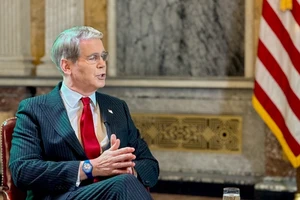
US Treasury Secretary Scott Bessent attends a bilateral meeting between US President Donald Trump and Britain's Prime Minister Andy Burnham during the 81st United Nations General Assembly (UNGA) in New York City, US, September 22, 2026.
The US Treasury Department confirmed on Tuesday that Secretary Scott Bessent had relocated from his Washington home to a military base following threats against his life from Iran.
"Threats against Sec. Bessent reached more than an advanced stage, which is why he and his family made the move," a senior Trump administration official told Fox News Digital.
The New York Times first reported the relocation, citing three people familiar with the matter. Reuters subsequently confirmed the move through two sources, while Fox News Digital obtained confirmation from the Treasury Department.
Security concerns intensified after photo of residence published
A person familiar with the matter told Reuters that concerns about Bessent's safety intensified after The Wall Street Journal published an aerial photograph of his residence in Washington's Georgetown neighborhood.
The photograph made it possible to identify the property's location, the source said, heightening security concerns amid the threats attributed to Iran.
"The news media has an obligation to act responsibly amid growing threats against public officials," the person told Reuters.
The military base where Bessent and his family relocated has not been publicly identified.
A senior administration official told Fox News Digital that the threats reflected the effectiveness of Washington's economic pressure campaign against Tehran, arguing that Iran was targeting the official responsible for the strategy.
A Treasury spokesperson told Fox News Digital that Bessent would "not be deterred by the Iranian regime's threats."
Bessent has overseen Operation Economic Outcast since August, a campaign combining financial sanctions and restrictions on trade to pressure Tehran over its military activities and the disruption of shipping through the Strait of Hormuz.
US intelligence warns Iranian plots have advanced
The reported threats follow a warning from a senior US intelligence official that Iranian plots targeting American personnel and citizens had reached an advanced stage.
Reuters said it reviewed a memorandum containing the warning late last month.
The New York Times also reported that US officials had identified specific threats they considered serious.
The newspaper said US officials assessed Iran's ability to carry out large-scale attacks in the United States and other overseas locations as limited.
Iran has previously denied involvement in plots to attack officials or other individuals on American soil.
Bessent oversees US blockade and sanctions on Iran
The Treasury Department's economic pressure campaign has targeted Middle Eastern bank branches and financial services companies that Washington says facilitate transactions involving Iran.
The measures operate alongside a US naval blockade of Iranian ports, intended to restrict Tehran's oil revenue and pressure it to halt attacks on commercial shipping and reopen the Strait of Hormuz.
The waterway, a major route for global energy exports, has faced severe disruptions since the United States and Israel launched their military campaign against Iran on February 28.
Washington has also expanded its efforts beyond maritime routes. On November 7, US Central Command announced Task Force Iron Gate, a new initiative to disrupt shipments of advanced weapons, dual-use technologies and sanctioned materials across Iran's land borders and the Caspian Sea.
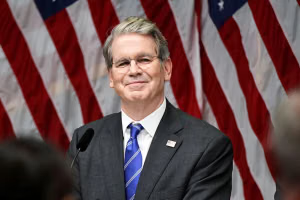
US Rep. Jim Jordan (R-OH) speaks to the media on the day of House Republican leadership elections at the US Capitol in Washington, DC, US, November 10, 2026.
Rep. Jim Jordan, a strong supporter of President Donald Trump's military campaign against Iran, was elected House Republican leader Tuesday, placing a longstanding critic of Tehran's nuclear program at the head of the party's diminished congressional ranks.
The Ohio Republican defeated House Majority Leader Steve Scalise of Louisiana by 106 votes to 73 in a closed-door secret ballot, following Republican defeats in the November 3 midterm elections.
Jordan, chairman of the House Judiciary Committee and a founding member of the conservative House Freedom Caucus, will become minority leader when Democrats take control of the chamber in January.
His election puts one of Trump's most dependable congressional allies in charge of Republican opposition to the incoming Democratic majority, including potential disputes over the administration's handling of the Iran war.
A longstanding opponent of Iran's nuclear program
Jordan has consistently opposed diplomatic concessions to Tehran and supported efforts to prevent Iran from acquiring nuclear weapons.
In September, he described Iran as the world's largest state sponsor of terrorism and reiterated his opposition to its nuclear ambitions.
“We cannot let them get a nuclear weapon,” he told Newsmax.
In an August interview with Ohio broadcaster WLIO, Jordan defended Trump's military campaign and said Washington needed to complete its mission against Iran.
“The president's right when he says we can't let them get a nuclear weapon, and I agree with that,” Jordan said.
His position extends back to the 2015 nuclear agreement negotiated under President Barack Obama.
Jordan voted against approving the Joint Comprehensive Plan of Action, which restricted Iran's nuclear activities in exchange for sanctions relief. He also supported legislation preventing the Obama administration from easing sanctions under the agreement.
Support for Trump's military authority
Jordan's voting record during the 2026 Iran war indicates strong support for the administration's military operations.
In a March 12 interview with CNN's Kasie Hunt, Jordan argued that Americans should accept temporarily higher gasoline prices and other economic costs resulting from the war to prevent Iran from acquiring nuclear weapons.
“If that means prices go up for a short time, I think Americans understand,” he said, adding that the military campaign was justified despite its economic consequences.
In March, June, July and September, he voted against resolutions directing Trump to withdraw US forces from hostilities with Iran, according to congressional voting records.
In June, Jordan appeared on Sean Hannity's radio program to defend Trump's approach to Iran and his warnings of renewed military action if Tehran violated its commitments.
His position contrasts with lawmakers, including some Republicans, who have argued that the prolonged conflict requires explicit congressional authorization.
The leadership change could strengthen Trump's influence over the House Republican conference on Iran policy, particularly on military operations, sanctions and opposition to nuclear concessions.
Jordan will nevertheless lead the minority in a Democratic-controlled House, where Republicans will have limited power to advance legislation independently.
His influence may therefore rest primarily on maintaining Republican support for Trump's Iran strategy, resisting attempts to restrict presidential military authority and shaping the party's position on any eventual agreement with Tehran.