• العربية
  • فارسی
BrandBrand
  • Iran Insight
  • Politics
  • Economy
  • Analysis
  • Special Report
  • Opinion
  • Podcast
  • Live TV
  • Iran Insight
  • Politics
  • Economy
  • Analysis
  • Special Report
  • Opinion
  • Podcast
  • Live TV
  • Theme
  • Language
    • العربية
    • فارسی
  • Iran Insight
  • Politics
  • Economy
  • Analysis
  • Special Report
  • Opinion
  • Podcast
  • Live TV
All rights reserved for Volant Media UK Limited
volant media logo

Pezeshkian appoints former acting defense minister as adviser

Oct 20, 2026, 13:41 GMT+1

Iranian President Masoud Pezeshkian appointed Majid Ebn al-Reza as his adviser on defense affairs, state media reported on Tuesday.

Ebn al-Reza had served as acting defense minister since March, after former minister Aziz Nasirzadeh was killed in the opening strikes of the war. Before becoming caretaker minister, he was deputy defense minister.

His appointment comes after parliament approved Mehrdad Akhlaghi as the new defense minister on Sunday.

Most Viewed

US and Israel threaten renewed Iran strikes, Tehran warns of response
1

US and Israel threaten renewed Iran strikes, Tehran warns of response

2

Iran rolls out regional Data Authority amid threats to Mideast tech infrastructure

3

Iran threatens stronger response to new US attack as Lavrov visits Tehran

4

Trump says US may ‘soon finish the job’ on Iran, Netanyahu vows to topple regime

5
VOICES FROM IRAN

Iranians report mass security warnings over social media activity

Banner
Banner
Banner
Banner
Banner

Spotlight

  • Iran deal remains elusive amid risk of renewed strikes
    ANALYSIS

    Iran deal remains elusive amid risk of renewed strikes

  • Ex-president's remarks expose divide over costs of Iran’s Palestine policy

    Ex-president's remarks expose divide over costs of Iran’s Palestine policy

  • Teenager killed by gunshot to eye after arrest in Iran, source says

    Teenager killed by gunshot to eye after arrest in Iran, source says

  • Soaring medical costs and staff shortages strain Iran’s hospitals
    VOICES FROM IRAN

    Soaring medical costs and staff shortages strain Iran’s hospitals

  • Architect of Guards' missiles becomes Iran's defense minister

    Architect of Guards' missiles becomes Iran's defense minister

  • Iran risks losing ground as East-West trade routes expand
    ANALYSIS

    Iran risks losing ground as East-West trade routes expand

  • Tehran’s diplomatic paralysis leaves Iran caught between deal and escalation

    Tehran’s diplomatic paralysis leaves Iran caught between deal and escalation

•
•
•

More Stories

Saudi Arabia should join US-led push for change in Iran, analyst says

Oct 20, 2026, 12:09 GMT+1
•
Kambiz Tavana
100%

Saudi Arabia should join forces with the United States, Israel and the United Arab Emirates to help bring about political change in Iran, rather than continue policies that have failed to contain Tehran's regional influence, an analyst told Iran International.

The Islamic Republic's support for Yemen's Houthis has exposed the limits of Saudi military power and diplomacy, making a broader coalition against Iran necessary, said Hussain Abdul-Hussain, a research fellow at the Foundation for Defense of Democracies.

“I'm not saying the Marines should land anywhere in Tehran,” Abdul-Hussain said. “I'm just saying push the regime enough so that the other Iranians can take over.”

The proposed strategy, he said, would draw on the US-led coalition that expelled Iraqi forces from Kuwait in 1991, with Saudi Arabia providing regional political support for a campaign aimed at weakening the Islamic Republic and enabling Iranians to determine their country's political future.

  • Iran giving Houthis targeting intelligence for Saudi attacks - WSJ

    Iran giving Houthis targeting intelligence for Saudi attacks - WSJ

Such a coalition could fundamentally alter the regional balance of power and influence the calculations of China and Russia, Abdul-Hussain added.

Iran's Houthi leverage

The Houthis have emerged as one of the Islamic Republic's most effective regional allies, maintaining their military capabilities despite years of Saudi-led operations and pressure on other Iran-backed armed groups.

Their geographical distance from Israel has also made them more difficult to weaken than Hezbollah in Lebanon or Iran-aligned militias in Iraq, according to Abdul-Hussain.

The challenge, he said, has become more pronounced since the withdrawal of Emirati forces from Yemen following divisions within the Saudi-led coalition.

Pro-UAE militias had provided some of the coalition's most effective ground forces, leaving Saudi Arabia increasingly dependent on air power and Yemeni government forces weakened by corruption, inflated troop numbers and divisions, Abdul-Hussain said.

  • Iran’s weakened axis still bites as Houthis escalate against Saudi Arabia

    Iran’s weakened axis still bites as Houthis escalate against Saudi Arabia

Airstrikes alone cannot defeat an armed group operating from mountainous terrain and fortified positions, he argued, drawing comparisons with Israel's experience fighting Hezbollah in 2006 and 2023.

The absence of reliable ground partners has therefore allowed the Houthis to remain a persistent military challenge despite Saudi Arabia's superior conventional capabilities.

The group's operations also serve Iran's wider regional strategy by placing Saudi energy infrastructure and shipping routes within reach of an Iranian ally.

Recent Houthi advances and strikes on Saudi territory reflect a broader Iranian message that disruptions to its own oil exports could be accompanied by pressure on other regional producers, particularly as Saudi Arabia shifts exports toward the Bab el-Mandeb shipping route, Abdul-Hussain added.

Saudi diplomatic failures

Saudi Arabia's continued diplomatic engagement with the Islamic Republic has failed to reduce the security challenge posed by Iran's regional allies, Abdul-Hussain said.

Maintaining an ambassador in Tehran and inviting Revolutionary Guards officials to Saudi National Day celebrations, even as Saudi energy infrastructure faces missile strikes, sends a message of weakness rather than diplomatic pragmatism, he argued.

100%
Armed Houthi fighters carry rocket-propelled grenade launchers in Yemen.

The UAE, despite its smaller size and closer geographical proximity to Iran, had previously demonstrated greater willingness to sever diplomatic relations with the Islamic Republic, according to Abdul-Hussain.

Saudi Arabia's diplomatic outreach to Turkey and Pakistan has also produced limited practical support against the Houthis and the Revolutionary Guards, he said.

Abdul-Hussain attributed part of the problem to a Saudi leadership structure in which advisers are reluctant to challenge prevailing assumptions, leaving decision-makers without a credible alternative to their existing strategy.

“They have to swallow their pride with the Emiratis and the Israelis,” Abdul-Hussain said. “This is the key.”

Restoring cooperation with Abu Dhabi and establishing open relations with Israel would provide the foundation for a more effective regional alignment against Iran, he added.

Such cooperation would need to be public rather than confined to private security arrangements, particularly because Israeli participation could expose Israeli shipping to additional Houthi operations.

Saudi Arabia's decision to condition normalization with Israel on Palestinian statehood has further complicated the formation of an anti-Iran coalition, Abdul-Hussain said.

The shift, he noted, has moved Riyadh away from Crown Prince Mohammed bin Salman's earlier emphasis on prioritizing Saudi national interests, without producing corresponding security benefits for the kingdom.

Coalition against Iran

A coalition modeled on the international military campaign that expelled Saddam Hussein's forces from Kuwait in 1991 could provide a framework for confronting the Islamic Republic without a US ground invasion of Iran, Abdul-Hussain said.

Saudi Arabia played a central role in assembling regional support for that campaign, lending political legitimacy to a military operation led by the United States.

A similar alignment involving Washington, Riyadh, Abu Dhabi and Israel could apply sustained pressure on Iran's ruling establishment while leaving the ultimate outcome to Iranians themselves, according to the analyst.

“Throw all the chips behind President Trump and the war on Iran, and push for regime change,” Abdul-Hussain said.

The proposed approach would mark a departure from Saudi Arabia's efforts to balance diplomatic relations with Iran against military operations targeting its regional allies.

  • Houthis more effective Iran ally than Hezbollah, Yemen expert says

    Houthis more effective Iran ally than Hezbollah, Yemen expert says

Rather than continuing to absorb the costs of confronting the Houthis without weakening their principal backer, Saudi Arabia should help organize a broader campaign directed at the Islamic Republic itself, Abdul-Hussain argued.

The central objective, in his view, would not be a foreign occupation of Iran but sufficient external pressure to create an opportunity for Iranians to replace the country's ruling establishment.

Pakistan army chief arrives in Tehran after flurry of high-level regional visits

Oct 20, 2026, 11:51 GMT+1
100%
Pakistan's Chief of Army Staff Field Marshal Asim Munir. File Photo

Pakistan’s army chief Asim Munir arrived in Tehran on Tuesday, the latest senior official to move through the region after Russian Foreign Minister Sergei Lavrov held talks in the Iranian capital and US War Secretary Pete Hegseth made an unannounced visit to Israel.

Iranian state media reported Munir’s arrival on Tuesday afternoon, but there was no clear account of his agenda.

Foreign Ministry spokesman Esmail Baghaei said earlier Tuesday that he did not know the reason for Munir’s visit.

“We need to speak with him to see what he intends to discuss,” Baghaei said during a press conference.

Tehran plays down mediation speculation

A spokesman for parliament’s National Security and Foreign Policy Committee separately said the visit should not be interpreted as a new mediation effort.

The trip by Munir and other senior Pakistani military and security officials was “solely within the framework of bilateral relations, strengthening border cooperation and neighborly ties,” Ebrahim Rezaei Ghashghavi said.

He said it was unrelated to mediation or any new initiative concerning the conflict around the Strait of Hormuz.

Lavrov held Tehran talks a day earlier

Munir’s arrival came a day after Lavrov met President Masoud Pezeshkian and Foreign Minister Abbas Araghchi in Tehran.

Pezeshkian told Lavrov that Iran rejected attempts by countries to impose their will through force but remained ready to resolve regional disputes through dialogue.

He also thanked Russia for what he described as its support during the recent war and called for closer cooperation with Moscow and Beijing.

Lavrov said Russia and Iran shared similar views on international affairs and supported continued diplomatic consultations.

Hegseth moves through Israel and CENTCOM

At the same time, Hegseth was moving through the region.

He met Israeli Prime Minister Benjamin Netanyahu during an unannounced visit to Israel on Monday. Axios reported that the meeting took place while Washington and Israel were discussing the possibility of renewed major combat operations against Iran, though neither side publicly disclosed what Hegseth and Netanyahu discussed.

Hegseth later said he visited US forces serving under Central Command, describing them as being on a “historic mission.”

Trump says US could leave war

The diplomatic and military visits come as President Donald Trump sends mixed signals about the next phase of the conflict.

At a campaign rally in Kansas on Monday, Trump said the United States was already in a position to leave the war.

“Somebody said you could leave right now. It’s true. We could leave right now,” Trump said, adding that Iran would not obtain a nuclear weapon.

Trump also said Iran’s military and senior leadership had been severely weakened and questioned whom Washington could negotiate with.

The movement of senior officials through Tehran, Israel and the wider region therefore comes with no clear diplomatic track yet emerging, while Washington continues to maintain a military presence and Tehran keeps contacts open with Russia, Pakistan and other regional powers.

Iran Air chief says 30 to 40 operational aircraft destroyed in war

Oct 20, 2026, 09:28 GMT+1
100%

Between 30 and 40 of Iran’s operational aircraft were destroyed during the war, while another 70 to 80 were hit, Iran Air chief executive Taher Abdolhai said on Monday.

Abdolhai said Iran had a little over 300 aircraft in total, but only around 130 to 140 were operational before the latest losses, according to Nournews, a media outlet close to Iran’s Supreme National Security Council.

He said the scale of damage varied. Some aircraft were hit by missiles and suffered holes in their fuselages, while one Iran Air aircraft was “completely pulverized.”

Wartime losses cut into an already limited fleet

The figures suggest the war significantly reduced an aviation fleet that was already constrained by sanctions, aging aircraft and difficulties obtaining spare parts.

Abdolhai’s estimate is higher than some earlier figures given by Iranian officials. The secretary of Iran’s Association of Airlines had previously estimated that about 20 aircraft suffered serious damage.

Mohammadreza Rezaei Kouchi, head of parliament’s Civil Commission, had separately said around 50 aircraft were damaged and 10 destroyed.

It remains unclear how many of the damaged aircraft can be repaired and returned to service.

Sanctions have long constrained Iran’s aviation sector

Iran’s commercial aviation industry has for years faced restrictions on buying aircraft, sourcing parts, carrying out maintenance and receiving services at some foreign airports.

Abdolhai said those restrictions had made it harder for Iran Air to maintain its fleet and had also cut the airline off from some profitable markets.

The wartime losses have added another layer of pressure by shrinking the pool of aircraft available for commercial flights and reducing the industry’s ability to preserve routes and revenue.

Final scale of damage remains unclear

Abdolhai did not give a final estimate for the financial cost of the losses or say how many damaged aircraft were beyond repair.

The differing figures offered by Iranian officials also make the full scale of the damage difficult to establish independently.

Iran’s threats ring out from parliament struggling to meet or connect

Oct 20, 2026, 03:28 GMT+1
•
Maryam Sinaiee
100%
Iranian lawmakers attend a virtual parliamentary session, October 18, 2026. (ISNA)

Iran’s new defense minister threatened the US and Israel during a parliamentary session held online over fears of attack, but even the virtual meeting faltered when poor internet connections prevented 25 lawmakers from voting on his appointment.

Mehrdad Akhlaghi was elected defense minister on Sunday with 237 votes in favor and 15 against. Alireza Salimi, a member of parliament’s presiding board, said 277 lawmakers attended the virtual session but 25 were unable to register their votes because of internet connectivity problems.

Akhlaghi issued his warning during the same session, saying another US or Israeli “miscalculation” would trigger Iran’s response.

Parliament has relied heavily on remote sessions during the war, after lawmakers amended its internal rules in July to allow virtual plenary meetings during emergencies.

Iranian media have also raised questions about attendance and voting participation during virtual sessions. At one virtual session on July 28, held to examine the International Crime Countermeasures Bill, 50 lawmakers were absent. Of the 240 lawmakers present, 37 did not participate in the vote.

No explanation was given for why the 37 lawmakers did not vote.

Hardline lawmaker Meysam Zohourian has also criticized the pace of parliamentary work. He said online sessions were being held no more than twice a week and warned that, at the current pace, approving the so-called “Infiltration Bill,” which lawmakers are examining, could take a year.

Political dispute over remote sessions

Restrictions on in-person sessions have intensified a dispute between parliament Speaker Mohammad-Bagher Ghalibaf and his hardline opponents, including members of the Paydari Front and allies such as the Masaf group.

Some of Ghalibaf’s hardline critics have accused him of supporting restrictions on in-person sessions to reduce his exposure to possible US or Israeli attacks and to shield President Masoud Pezeshkian’s government, including Foreign Minister Abbas Araghchi, from parliamentary pressure.

Hamid Rasaei, a hardline Tehran lawmaker who was sentenced to prison on charges of defaming Ghalibaf and recently began serving his sentence, has been among the most vocal opponents of holding parliamentary sessions online.

Another hardline lawmaker, Mojtaba Zolnouri, recently said 117 lawmakers had signed a letter calling for a return to in-person parliamentary activity. According to Zolnouri, the signatories argued there was no longer any reason to hold meetings remotely.

Media outlets supportive of Ghalibaf and his political allies have strongly rejected the accusations.

On October 11, Iman Shamsaei, head of parliament’s communications center, rejected claims that restrictions on in-person plenary sessions were intended to protect Ghalibaf’s life. Instead, he argued, it was necessary to prevent parliament from losing its quorum.

Shamsaei argued that if the number of representatives fell below the constitutional two-thirds quorum, parliament would be unable to carry out its legislative and oversight functions and new elections could become necessary.

Criticism spreads on social media

The dispute has also played out on social media, particularly among hardline supporters of the Paydari Front and Ghalibaf’s political allies.

On Sunday, hardline journalist Fereshteh Sadeghi criticized the claim that parliament remained operational because some meetings were being held online.

“Parliament is closed. The fact that its committees have held meetings here and there, or that online sessions have been arranged — with many lawmakers unable to connect — does not mean parliament is open,” she wrote on X.

Reformist journalist Davoud Heshmati focused on the internet problems that prevented lawmakers from voting.

“This is no joke. Twenty-five lawmakers did not have a decent internet connection to carry out their parliamentary duties and participate in an important vote to elect the defense minister. This is a clear and real example of the situation we live in,” he wrote.

Other users defended the continuation of remote sessions, arguing that some hardline lawmakers were pushing for a return to in-person meetings because in-person sessions provided them with a platform to obstruct the government.

Questions over parliament’s public legitimacy

The controversy comes amid broader questions about the parliament’s standing with the public.

Turnout in Iran’s 2024 parliamentary elections fell to a record low for the Islamic Republic, with participation particularly weak in Tehran, where only 24% of eligible voters cast ballots.

Despite the dispute over whether parliament is functioning effectively, lawmakers have continued to advance controversial legislation during the war, including the so-called Infiltration Bill.

The dispute underscores a broader contradiction: critics say remote sessions have impaired parliament’s ability to function effectively, even as lawmakers continue advancing legislation that could impose further restrictions on Iranian society.

Iran deal remains elusive amid risk of renewed strikes

Oct 20, 2026, 01:00 GMT+1
•
Negar Mojtahedi
100%
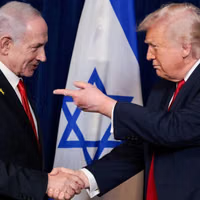
FILE PHOTO: U.S. President Donald Trump points his finger towards Israeli Prime Minister Benjamin Netanyahu as they shake hands during a press conference after meeting at Trump’s Mar-a-Lago club in Palm Beach, Florida, U.S., December 29, 2025. REUTERS/Jonathan Ernst/File Photo

Washington and Tehran may still reach a limited deal, but fundamental disagreements leave open the prospect of renewed escalation, analysts told Iran International, with the period after elections in Israel and the United States emerging as a potential turning point.

Diplomatic efforts are continuing, with Qatar and Pakistan pushing for an agreement and The New Arab reporting Monday, citing sources familiar with mediation efforts, that a breakthrough could be announced this week.

The analysts interviewed by Iran International were more cautious, however, seeing little evidence that either side has made the concessions required for a broader agreement and identifying the coming elections as a factor that could shape the timing of diplomacy or renewed military action.

Danny Citrinowicz, an Iran specialist and former head of the Iran branch in Israeli Defense Intelligence, said continuing diplomatic exchanges did not amount to evidence of an imminent breakthrough because neither side appeared ready to make the compromise required for one.

"In order to have a breakthrough, one side needs to show significant compromise. And I don't see that in the Iranian side," he told Iran International.

Washington wants substantial restrictions on Iran's uranium enrichment capabilities, while Tehran is prioritizing relief from the US blockade and sanctions, alongside the restoration of maritime traffic through the Strait of Hormuz.

Iranian Foreign Minister Abbas Araghchi said Sunday that Tehran's seven-day proposal remained on the table. Under the proposal, Iran would reopen the strait within seven days if Washington accepted Tehran's conditions, paving the way for renewed negotiations.

Alex Vatanka, director of the Iran Program at the Middle East Institute, saw greater scope for a limited arrangement than a comprehensive settlement, arguing that both Trump and Tehran have short-term incentives to reduce tensions without resolving their fundamental differences.

Trump, he argued, faces political pressure ahead of the November 3 midterm elections and could benefit from a diplomatic achievement. Tehran, meanwhile, needs economic relief as the blockade continues to undermine its finances.

"You might have a deal that could create ceasefire conditions for a short period of time, of weeks and months," Vatanka told Iran International.

But he said he had seen little indication that Tehran was willing to accept the kind of comprehensive agreement Trump could present as a major improvement over the 2015 nuclear deal.

Iran's leadership, Vatanka argued, believes it has paid a heavy price for its nuclear program while demonstrating its ability to disrupt the global economy through the Strait of Hormuz. Economic pressures could encourage a narrow agreement, but sweeping concessions risk exposing divisions within the Islamic Republic's leadership.

A deal under the threat of force

The diplomatic activity comes as US President Donald Trump and Israeli Prime Minister Benjamin Netanyahu have intensified warnings of renewed military action.

On Sunday, Trump threatened to "soon finish the job" against Iran unless Tehran changed course, while giving Netanyahu his endorsement ahead of Israel's October 27 election.

Netanyahu, who has explicitly identified the removal of the Islamic Republic as an Israeli objective, has said Israel is prepared to act independently of Washington if necessary.

On Monday, Netanyahu released a video of a telephone conversation with Trump following the US president's endorsement of his reelection campaign.

"Donald, we have a job to finish, you said it, and we'll finish it together. We'll finish it, and no one else will do it," Netanyahu told Trump.

Shayan Samii, a geopolitical and national security analyst, said Trump's combination of negotiations and military threats allowed him to preserve both outcomes: claiming a diplomatic victory if talks succeed or demonstrating resolve through military action if they fail.

"The United States wants to keep the diplomatic avenue still open and valid. Why? Because it helps for domestic political purposes," Samii told Iran International.

"It allows Trump to say, I'm giving diplomacy all the chances in the world, but at the same time I'm keeping the pressure on them."

He also interpreted Trump's endorsement of Netanyahu as an attempt to increase Washington's leverage over the Israeli leader should he remain in power.

Samii suggested Iran or its regional allies could provoke a confrontation ahead of Israel's election, potentially providing a pretext for renewed strikes. He presented this as a possible scenario, not evidence of a planned operation.

Russia could influence the diplomatic track

Russian Foreign Minister Sergei Lavrov's visit to Tehran on Monday added another dimension to the diplomatic maneuvering.

Vatanka said Russia possesses considerably greater leverage over Iran than mediators such as Pakistan, Qatar or Oman, partly because Tehran depends on Moscow for diplomatic support.

That influence could become significant if negotiations require difficult concessions, including a possible arrangement to transfer Iran's highly enriched uranium to Russia.

But Vatanka questioned whether Moscow's interests necessarily aligned with Tehran's.

Russia would mediate "primarily to use it to get what Putin wants from Trump on the Ukraine front," he said.

Vatanka suggested Moscow could seek concessions from Washington over Ukraine in exchange for helping facilitate an agreement with Iran.

Tehran, however, may resist being used as a bargaining chip, particularly if Russian pressure requires abandoning positions the Islamic Republic considers fundamental.

Why the post-election period could prove decisive

If diplomacy fails to produce a breakthrough, Citrinowicz sees renewed escalation as increasingly difficult to avoid — but the elections may affect when it happens.

"With no breakthroughs, escalation is inevitable, because the status quo is unstable," he said.

He cautioned, however, that inevitable did not necessarily mean imminent.

The upcoming elections could influence the timing of any military operation. Israelis vote on October 27, followed by the US midterms on November 3.

Citrinowicz identified the period after the November 3 US midterms but before the newly elected Congress takes office in January as a possible window for military action, particularly if Republicans lose control of one or both chambers.

Vatanka similarly identified the post-election period as a potential turning point, arguing that Washington and Israel could consider additional pressure against Tehran once immediate electoral calculations had passed.

He said options could include continued enforcement of the blockade, limited military strikes and other measures designed to weaken or divide the Iranian establishment.

Yet the prospect of renewed military action raises a deeper question: whether Trump and Netanyahu ultimately seek the same outcome.

Citrinowicz argued that while the two leaders might agree on military targets, their strategic objectives could diverge.

"Netanyahu seeks to topple the regime, and Trump seeks to reach a good agreement with the same regime that Netanyahu seeks to topple," he said.

"Operationally, maybe there will be eye to eye in terms of what to attack, but strategically, I'm not sure if they see eye to eye."

That divergence leaves a central question unresolved: even if Washington and Israel agree on another round of strikes, they may not agree on what those strikes are ultimately meant to achieve.