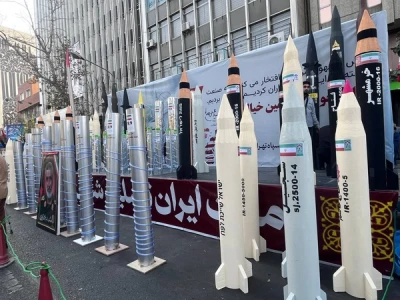
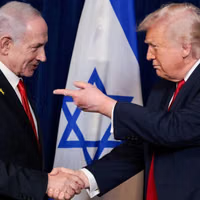
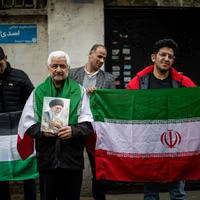
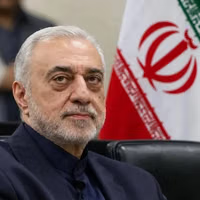
The disagreement goes beyond whether Iran should support Palestinians. It concerns who decides the extent of that support, what costs Iranians should bear and whether a change in rhetoric would translate into a different foreign policy.
In remarks circulated from an October 13 meeting of the Baran Foundation in Tehran, Khatami who is considered the leader of Iran’s Reform Front said the Islamic Republic’s intervention in Palestinian affairs had imposed heavy costs on its people and that he disagreed with the policy.
He challenged Israel’s legitimacy while drawing a distinction between moral support for Palestinians and intervening in their affairs or making decisions on their behalf.
Part of his speech recalled an exchange during a visit to the United States in 2006, when he said he had argued that Palestinians should determine their own future and that Iran should not put itself in their place.
That distinction drew criticism from different directions. Hardliners portrayed support for Palestinians as a religious, legal and security obligation. Some opponents of the Islamic Republic questioned whether Khatami’s remarks reflected a meaningful policy rethink or an effort to preserve the political system through a more conciliatory approach.
Hardliners defend Iran’s role
Javan, a newspaper affiliated with the Revolutionary Guards, rejected Khatami’s argument in an October 15 article titled “Mr. Khatami! Defending Palestine Is Islamic and Moral, as Well as Legal.”
The newspaper argued that Iran’s support rested on religious and legal grounds as well as moral ones, citing Ali Khamenei’s declaration in 2022 that Tehran would defend Palestinians “in any way we can.”
It accused Khatami of reducing the issue to a moral responsibility and denying a legal basis for intervention. Iran, other countries and international organizations were obliged to defend Palestinian self-determination, the newspaper argued.
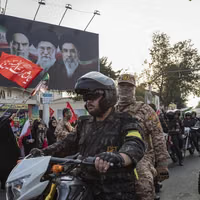
Javan also framed his remarks against the backdrop of what it called a war imposed by the United States and Israel on Iran and the “Axis of Resistance,” Tehran’s network of regional allies.
“Khatami is aware of all these obvious facts, probably deliberately refrains from mentioning them, and, worse still, distorts reality against Iran’s national interests,” it said.
Some pro-establishment social media users made a security argument, saying Iran could not separate its own interests from the Palestinian issue.
“Let us even disregard our human and religious duty,” an X user named Hossein Harandi wrote, before asking: “But what about our own security? Can we disregard that?”
A shift in emphasis, with a longer history
Khatami’s remarks place greater emphasis on the costs to Iranians, though his argument that Palestinians should decide their own future has precedents in his earlier statements.
During his presidency from 1997 to 2005, he defended the Palestinian intifada as a legitimate struggle against repression and called for a boycott of Israel, the return of Palestinian refugees and an independent Palestinian state with Jerusalem as its capital.
In a 2006 Financial Times interview, he said Iran would accept a Palestinian state alongside Israel if the elected Hamas government freely accepted that outcome. He also said Hamas’s rights as an elected government had to be respected.
His support for Palestinian self-determination has coexisted with praise for armed action against Israel.
Following the Hamas-led October 7, 2023, terrorist attack, Khatami described it as “a great achievement for the Palestinian people after 70 years,” attributing it to decades of humiliation, repression and oppression.
He also accused Western countries of unconditional support for Israel and argued that the territory’s future should be determined by Palestinians, including Muslims, Christians and Jews, whether living there or displaced as refugees.
His latest remarks therefore raise a question about the extent of the change: whether he is challenging Iran’s underlying policy or drawing a sharper line between support for Palestinians and intervention on their behalf.
Opponents question reformists’ motives
Khatami’s criticism comes from within the Islamic Republic’s political establishment. Opposition to Tehran’s regional spending has long featured in anti-government protests as part of a broader challenge to the system itself.
“Neither Gaza nor Lebanon, my life for Iran,” a slogan that gained prominence during the 2009 Green Movement and returned during successive waves of unrest, expresses demands to prioritize Iranians over Tehran’s regional allies amid economic hardship.
For some opponents of the Islamic Republic, the question is whether reformists’ criticism reflects a policy rethink or an effort to preserve the system. They interpreted Khatami’s comments alongside former Foreign Minister Mohammad Javad Zarif’s recommendation that Iran abandon calls for revenge over the killing of Revolutionary Guards commander Ghasem Soleimani.
They suggested that reformists were trying to present themselves to US President Donald Trump as more acceptable negotiating partners, though the remarks themselves provide no evidence of a plan to replace Iran’s leadership.
Their broader criticism concerned whether reformists could change the relationship between the Islamic Republic’s foreign policy and the interests of its citizens.
One government opponent characterized Khatami’s position as an acknowledgment that Iran had paid a devastating price for its Palestine policy, without a willingness by those associated with the system to relinquish power.
Another described reformism as a means of preserving the Islamic Republic while giving it a more acceptable image abroad.
“The issue is not simply who governs,” the user wrote. “The issue is who, in the name of ‘rationality and negotiations,’ pays for the system’s survival at the expense of the people and by surrendering national interests.”
Other users welcomed Khatami’s distinction between supporting Palestinians and intervening in their affairs. One described his approach to the Palestinian issue as “very constructive and worthy of respect,” regardless of his other positions.
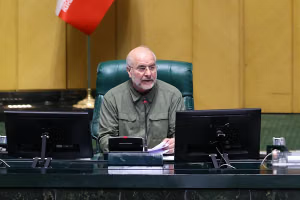
The debate also highlights the limits of reformist influence: President Masoud Pezeshkian’s administration, backed by reformists, has shown no willingness to change Iran’s Palestine policy.
Even if it were willing to do so, authority over Iran’s strategic direction rests with the supreme leader rather than the elected government.