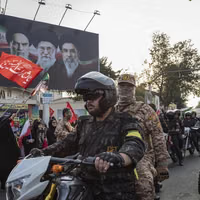
Iran summons Irish envoy over EU criticism of Hormuz threats, repression
Iran summoned Ireland's ambassador to protest an EU statement condemning Tehran's threats to shipping in the Strait of Hormuz and repression of its own citizens.
Irish Ambassador Aidan Cronin was called to the Foreign Ministry on Monday as Ireland holds the rotating presidency of the Council of the EU. The October 16 EU statement also condemned large-scale executions in Iran and called for respect for Iranians' right to determine their future.
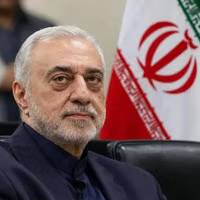
Alireza Yousefi, a senior Iranian Foreign Ministry official, rejected the EU's criticism and blamed insecurity in the Strait of Hormuz on US and Israeli military strikes, which he said had received support from some European countries.
Yousefi also accused the EU of double standards on human rights and criticized its policies toward Iran's nuclear program.
At least 15 women and girls have been reported killed across Iran over the past month, many allegedly by husbands, brothers or other male relatives, Iranian news outlet Rokna reported, as legislation aimed at protecting women from violence remains stalled.
The killings come amid renewed calls to pass legislation aimed at protecting women from violence, which has remained stalled for more than a decade.
Rokna documented cases in Tehran, Isfahan, Tabriz, Kermanshah and Qeshm, among other locations, with victims ranging from teenage girls to elderly women.
The cases included suspected so-called “honor” killings and killings reportedly linked to disputes over separation and family finances. The motives behind several deaths remain unclear, and investigations are ongoing.
Yeganeh Hosseinzai, a 16-year-old victim of child marriage, who was killed in Bakharz, northeastern Iran.
Among the victims was 16-year-old Yeganeh Hosseinzai, who died on October 9 in Bakharz, in northeastern Iran's Razavi Khorasan province, with signs of severe physical assault.
Hosseinzai had been married to a relative at the age of 10 and began living with him at 14. Her husband was arrested on suspicion of her murder.
Mina Soltani, who was killed by her husband in Isfahan, central Iran.
In the central city of Isfahan, 40-year-old Mina Soltani, a mother of two, was killed by her husband on October 8. Before the killing, the man reportedly sent their 21-year-old son out of the house and locked their younger child, aged 10, in a room.
Maryam Yarmohammadi, who was killed by her brother on Qeshm island, southern Iran.
On Qeshm island in southern Iran's Hormozgan province, 28-year-old Maryam Yarmohammadi, a mother of two, was stabbed to death by her brother on October 5. Reports cited a suspected so-called "honor" motive.
An 18-year-old woman was shot dead in Shahroud, in north-central Semnan province, on October 4. Her 19-year-old brother confessed to killing her the following day, with financial and family disputes cited as possible motives.
In Tehran's Majidiyeh neighborhood, a man confessed to strangling his 70-year-old wife, citing suspicions about her as the motive.
In another incident in the capital's Khak-e Sefid neighborhood, a 47-year-old man set fire to a building where his mother-in-law lived after his wife refused to resume their marriage. The September 30 attack killed four people, including two women. The perpetrator also died.
Fereshteh Yousefzadeh and her two daughters, who were killed in a family shooting in Dehloran, western Iran.
In Dehloran, in western Iran's Ilam province, 38-year-old Fereshteh Yousefzadeh and her three children, aged nine and 14, were shot dead by her husband, Mohammad Mohammadi, who subsequently died by suicide.
In the western city of Kermanshah, 46-year-old Fatemeh Lotfi and her 26-year-old daughter, Zahra Shahbazi, were shot dead. The family's 18-year-old son was identified as the main suspect.
A woman and her two children were killed by the father of the family in Tabriz, northwestern Iran.
In Tabriz, northwestern Iran, a 45-year-old man killed his wife and two children before dying by suicide. The children's genders were not disclosed.
In a separate case in the same city, a man killed his wife and moved her body onto a street in an attempt to make her death appear to have resulted from a traffic accident.
Fatemeh-Sadat Tabatabaei was killed in Bam, southeastern Iran.
In Bam, in southeastern Kerman province, the husband of Fatemeh-Sadat Tabatabaei was arrested in connection with her killing. Investigators were also reportedly examining the possible involvement of her father-in-law.
Not all the reported killings involved relatives.
In Tehran, a 27-year-old woman was shot dead at her workplace on October 10 by a man with whom she had previously been in a romantic relationship.
In Saravan, in southeastern Iran's Sistan and Baluchestan province, Mahsa Bozorgzadeh, a young mother, died on October 11 after unidentified assailants poured gasoline over her and set her on fire. The perpetrators and their motive remain unknown.
Rokna said it had excluded additional reported killings because investigations were ongoing or details about the victims and circumstances could not be confirmed. The exact dates of some of the killings it documented were also unavailable.
Separate report highlights wider toll
Separately, the Iranian newspaper Sazandegi reported Friday that at least nine women and girls had been killed by family members or people close to them since September 23.
The newspaper warned that the true scale of femicide in Iran remained unknown because of the lack of comprehensive and transparent official statistics.
The two reports should not be treated as separate tallies, as the extent of overlap between them is unclear
The human rights organization Hengaw documented at least 207 femicides across Iran in 2025, including 31 involving suspected so-called "honor" motives.
According to Hengaw, at least 13 women were killed after rejecting marriage proposals, 10 after seeking divorce, and 10 victims of child marriage were killed by their husbands during the year.
The organization said many of the killings were committed by people close to the victims, including husbands, former husbands, fathers, brothers and other family members.
Lawmaker urges action on stalled protection bill
The reported killings come as legislation intended to protect women against violence remains stalled after more than a decade of disagreements between the government and parliament.
Iranian lawmaker Ahmad Bigdeli, a member of parliament's Social Affairs Committee, called for the bill's passage on October 14, saying it could help prevent killings of women by family members.
"We should not wait for an incident to occur before thinking about legislation or amending the law," Bigdeli told Iranian news outlet Jamaran.
He said the legislation had been moving between parliament and the government for 12 years, with disagreements over its name and wording, including the use of terms such as "violence" and "crime," contributing to delays.
Bigdeli said the proposed law included measures aimed at prevention, criminalization and punishment, arguing that disputes over wording should not stand in the way of its passage.
Iran has no comprehensive domestic violence law to prevent abuse and protect survivors, according to Human Rights Watch, which has criticized discriminatory legal provisions affecting women.
Under Iranian law, fathers and paternal grandfathers who kill their children or grandchildren are exempt from qisas, or retaliatory punishment, although other penalties may apply.
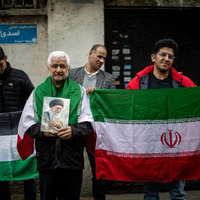
Photo by ISNA shows Islamic Republic loyalists gathering outside Spain’s embassy in Tehran on March 28, 2026, at a rally to thank Spain’s government and people for what participants described as support for the Islamic Republic and the Palestinian cause.
Former President Mohammad Khatami’s criticism of the costs of Iran’s intervention in Palestinian affairs has fueled debate over Tehran’s policy, with hardliners defending its role and some opponents of the Islamic Republic questioning the motives behind his remarks.
The disagreement goes beyond whether Iran should support Palestinians. It concerns who decides the extent of that support, what costs Iranians should bear and whether a change in rhetoric would translate into a different foreign policy.
In remarks circulated from an October 13 meeting of the Baran Foundation in Tehran, Khatami who is considered the leader of Iran’s Reform Front said the Islamic Republic’s intervention in Palestinian affairs had imposed heavy costs on its people and that he disagreed with the policy.
He challenged Israel’s legitimacy while drawing a distinction between moral support for Palestinians and intervening in their affairs or making decisions on their behalf.
Part of his speech recalled an exchange during a visit to the United States in 2006, when he said he had argued that Palestinians should determine their own future and that Iran should not put itself in their place.
That distinction drew criticism from different directions. Hardliners portrayed support for Palestinians as a religious, legal and security obligation. Some opponents of the Islamic Republic questioned whether Khatami’s remarks reflected a meaningful policy rethink or an effort to preserve the political system through a more conciliatory approach.
Hardliners defend Iran’s role
Javan, a newspaper affiliated with the Revolutionary Guards, rejected Khatami’s argument in an October 15 article titled “Mr. Khatami! Defending Palestine Is Islamic and Moral, as Well as Legal.”
The newspaper argued that Iran’s support rested on religious and legal grounds as well as moral ones, citing Ali Khamenei’s declaration in 2022 that Tehran would defend Palestinians “in any way we can.”
It accused Khatami of reducing the issue to a moral responsibility and denying a legal basis for intervention. Iran, other countries and international organizations were obliged to defend Palestinian self-determination, the newspaper argued.
Javan also framed his remarks against the backdrop of what it called a war imposed by the United States and Israel on Iran and the “Axis of Resistance,” Tehran’s network of regional allies.
“Khatami is aware of all these obvious facts, probably deliberately refrains from mentioning them, and, worse still, distorts reality against Iran’s national interests,” it said.
Some pro-establishment social media users made a security argument, saying Iran could not separate its own interests from the Palestinian issue.
“Let us even disregard our human and religious duty,” an X user named Hossein Harandi wrote, before asking: “But what about our own security? Can we disregard that?”
A shift in emphasis, with a longer history
Khatami’s remarks place greater emphasis on the costs to Iranians, though his argument that Palestinians should decide their own future has precedents in his earlier statements.
During his presidency from 1997 to 2005, he defended the Palestinian intifada as a legitimate struggle against repression and called for a boycott of Israel, the return of Palestinian refugees and an independent Palestinian state with Jerusalem as its capital.
In a 2006 Financial Times interview, he said Iran would accept a Palestinian state alongside Israel if the elected Hamas government freely accepted that outcome. He also said Hamas’s rights as an elected government had to be respected.
His support for Palestinian self-determination has coexisted with praise for armed action against Israel.
Following the Hamas-led October 7, 2023, terrorist attack, Khatami described it as “a great achievement for the Palestinian people after 70 years,” attributing it to decades of humiliation, repression and oppression.
He also accused Western countries of unconditional support for Israel and argued that the territory’s future should be determined by Palestinians, including Muslims, Christians and Jews, whether living there or displaced as refugees.
His latest remarks therefore raise a question about the extent of the change: whether he is challenging Iran’s underlying policy or drawing a sharper line between support for Palestinians and intervention on their behalf.
Opponents question reformists’ motives
Khatami’s criticism comes from within the Islamic Republic’s political establishment. Opposition to Tehran’s regional spending has long featured in anti-government protests as part of a broader challenge to the system itself.
“Neither Gaza nor Lebanon, my life for Iran,” a slogan that gained prominence during the 2009 Green Movement and returned during successive waves of unrest, expresses demands to prioritize Iranians over Tehran’s regional allies amid economic hardship.
For some opponents of the Islamic Republic, the question is whether reformists’ criticism reflects a policy rethink or an effort to preserve the system. They interpreted Khatami’s comments alongside former Foreign Minister Mohammad Javad Zarif’s recommendation that Iran abandon calls for revenge over the killing of Revolutionary Guards commander Ghasem Soleimani.
They suggested that reformists were trying to present themselves to US President Donald Trump as more acceptable negotiating partners, though the remarks themselves provide no evidence of a plan to replace Iran’s leadership.
Their broader criticism concerned whether reformists could change the relationship between the Islamic Republic’s foreign policy and the interests of its citizens.
One government opponent characterized Khatami’s position as an acknowledgment that Iran had paid a devastating price for its Palestine policy, without a willingness by those associated with the system to relinquish power.
Another described reformism as a means of preserving the Islamic Republic while giving it a more acceptable image abroad.
“The issue is not simply who governs,” the user wrote. “The issue is who, in the name of ‘rationality and negotiations,’ pays for the system’s survival at the expense of the people and by surrendering national interests.”
Other users welcomed Khatami’s distinction between supporting Palestinians and intervening in their affairs. One described his approach to the Palestinian issue as “very constructive and worthy of respect,” regardless of his other positions.
The debate also highlights the limits of reformist influence: President Masoud Pezeshkian’s administration, backed by reformists, has shown no willingness to change Iran’s Palestine policy.
Even if it were willing to do so, authority over Iran’s strategic direction rests with the supreme leader rather than the elected government.
A person walks as flames rise during civil unrest, the day after a national day of demonstrations against the cost of living and rising fuel prices, in Paris, France, October 18, 2026.
Ongoing protests and unrest in France prompted Iranian commenters to revisit the country’s role in the 1979 Islamic Revolution and criticize Western responses to crackdowns in Iran, with many calling the turmoil “karma” in response to an Iran International Instagram question.
A review of nearly 3,000 comments on the post suggests that many respondents viewed events in France through Iran’s political history and their own experiences, focusing more on Western governments’ policies than on the French protesters’ demands.
Humor and sarcasm featured prominently, alongside anger over France’s hosting of the Islamic Republic’s founder Ruhollah Khomeini before the revolution and frustration with international responses to the suppression of Iranian protests.
Others emphasized the right to protest and the different risks demonstrators face in France and Iran. The comments reflect the views of those who responded, rather than a representative sample of Iranian public opinion.
Memories of the 1979 revolution
One recurring theme was France’s decision to host Khomeini in the months leading up to Iran’s 1979 revolution.
Many respondents interpreted the unrest through that historical experience, arguing that France was now facing the consequences of its past policies toward Iran.
A demonstrator wearing a costume stands in front of burning flames, in Paris, France, October 18, 2026.
One respondent wrote: “France should pay the price for decades of supporting extremist groups, including Islamists, leftists and communists.”
Another drew a direct comparison: “The protests in France are exactly reminiscent of 1979 in Iran.”
Commenters also invoked expressions associated with the revolution, including the refrain “The scent of flowers, lilies and jasmine is in the air,” promises of free water and electricity, and sarcastic suggestions that France should establish its own Islamic Republic.
Unrest viewed as ‘karma’
“Karma” was a recurring word in the responses. Some users described the unrest as France’s past policies coming back to haunt it, while others expressed satisfaction without addressing the protesters’ demands.
One respondent wrote: “The world is round. Now they’ll suffer as we have for the past 47 years.”
Another said: “When responses to the Islamic Republic’s crimes are limited to words, statements and expressions of concern, the whole world should see the consequences.”
These comments linked satisfaction at France’s troubles to accumulated anger over Western governments’ dealings with the Islamic Republic.
‘We are deeply concerned’
Other respondents mocked the diplomatic language Western governments and international organizations have used in response to the killing and repression of protesters in Iran.
Phrases such as “We express concern,” “We call on both sides to exercise restraint,” “We are closely monitoring developments,” and “These are their internal affairs and none of our business” appeared repeatedly.
Bodies of victims killed in Iran’s January protests – Kahrizak, Iran.
One respondent wrote: “We are closely monitoring developments in France. It seems they are not ready for democracy yet.”
Another said: “I’m sure the United Nations has expressed concern about the situation and called on both sides to exercise restraint.”
The sarcasm reflected frustration with what commenters viewed as inadequate international responses to repression in Iran.
Immigration and Islamism
Some respondents linked the unrest to France’s immigration policies and what they described as the growing influence of Islamist movements and extremism in Europe.
Their comments combined concerns about Europe’s future with criticism of the French government’s approach to immigration and religious and political groups. These were commenters’ interpretations, rather than established explanations for the protests.
Different risks for protesters
Other respondents emphasized the differences between protesting in France and Iran.
One user asked: “Why can young people in France return home after protesting?”
Amid the sarcasm and expressions of anger, the question drew attention to the risks Iranian demonstrators face at the hands of security forces.
Protests in Iran over the past decade, including demonstrations over economic hardship and labor grievances, have repeatedly faced violent crackdowns.
Iran International previously reported that at least 36,500 Iranians were killed during the January protests, describing the killings as the largest street massacre in Iran’s history.
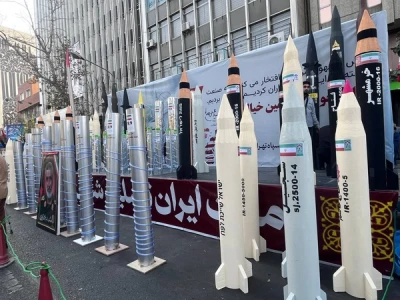
An Iranian ballistic missile launches from a desert test site, sending clouds of dust and smoke into the air.
Iranian military officials warned of a stronger response to any renewed US attack on Monday, as Russia's foreign minister visited Tehran for talks and regional security concerns grew following Houthi attacks on Saudi Arabia.
Russian Foreign Minister Sergei Lavrov met his Iranian counterpart Abbas Araghchi during an official visit, with talks also planned with President Masoud Pezeshkian.
The visit came as Iranian officials discussed the prospect of renewed fighting with the United States and the country's military capabilities.
Russian Foreign Minister Sergei Lavrov (left) and Iranian Foreign Minister Abbas Araghchi hold talks in Tehran on October 19, 2026.
Iran threatens US against new attack
The Revolutionary Guards said that Iran would respond more forcefully to any renewed US military action.
“The US entered the war with all its might, and it is certainly not in a position now to start a new conflict that would bring it any new gains,” Revolutionary Guards spokesman Hossein Mohebi said on Monday.
Mohebi said most US bases in the region were inactive and American forces had moved hundreds of kilometers away from Iran.
Revolutionary Guards deputy commander Mostafa Izadi said US naval forces had moved approximately 700 kilometers away to avoid Iranian missiles, according to the Guards-affiliated Fars news agency.
Senior Guards adviser Mohammadreza Naghdi separately said Iran's missile facilities had survived heavy bombardment and its strategic stockpiles remained intact.
Germany summons Iranian ambassador
Germany summoned Iran's ambassador on Monday over attempted attacks targeting Josef Schuster, head of the Central Council of Jews in Germany, and Volker Beck, chairman of the German-Israeli Society.
“Attacks on Jewish life and on those who defend it are something we will not tolerate - anywhere, and especially not in Germany,” the German Foreign Ministry wrote on X.
The ministry condemned Iran's activities and said the attempted attacks would have legal consequences.
Israeli Foreign Minister Gideon Sa'ar also criticized Araghchi after the Iranian foreign minister accused French President Emmanuel Macron of supporting US military action against Iran.
Sa'ar accused Iran of suppressing protesters at home while criticizing France over its response to unrest.
Regional security concerns grow
Saudi Arabia's Civil Defense said the danger had passed in the southern Najran region after an earlier alert over a potential threat.
The announcement followed a Houthi attack on a Yemeni government military camp in Shabwa province that killed at least 18 people, Reuters reported, citing government and medical sources.
The US State Department urged Americans across the Middle East to exercise heightened vigilance, warning that Houthi attacks could disrupt flights and airspace.
The US Embassy in Riyadh separately warned that Iran and groups supporting it could target American interests overseas.
Economic uncertainty weighs on Iran
The prospect of renewed conflict has also affected economic activity, according to an Iranian lawmaker.
“When conditions are unstable, no one can make decisions about their life and future; they cannot make a deal, invest or take action,” Mohammadmehdi Shahriari, a member of parliament's national security committee, said on Monday.
Shahriari said proposals for negotiations with Washington had been raised and officials should be allowed to formulate a response.
Another lawmaker, Mohammad Rashidi, rejected suggestions that Iran's economy was approaching collapse under US pressure.
Meanwhile, Iran Air chief executive Taher Abdolhay said the national airline had only six operational aircraft despite employing more than 9,000 people, down from a fleet of 40.
Abdolhay cited operational restrictions and air traffic difficulties, adding that the airline had faced obstacles to flights intended to bring medicine into Iran.
The developments featured the competing pressures facing Iran, with officials emphasizing military preparedness and diplomatic engagement as concerns over renewed fighting continue to affect regional security and economic activity.
Amirmohammad Hatami, an 18-year-old mechanic from Shahin Shahr, Isfahan province, who was killed after being wounded and detained on January 9, 2026.
An 18-year-old mechanic was killed by a gunshot to his right eye after being wounded and detained on January 9, according to information obtained by Iran International from a source close to his family.
The family of Amirmohammad Hatami spent 20 days searching prisons, morgues and security facilities before identifying his badly injured body through an old scar on his right shoulder.
Hatami, a young man of Bakhtiari origin, lived in Shahin Shahr in the central province of Isfahan, the source said.
His relatives initially had no information about his detention or where he had been taken after being wounded.
Family's 20-day search
Hatami's relatives began searching for him after his disappearance, visiting intelligence offices, police stations, facilities affiliated with the Revolutionary Guards, forensic medicine centers, prisons and morgues in Shahin Shahr and surrounding areas.
None of the authorities provided information about his whereabouts, according to the family source.
During the search, relatives opened around 100 black body bags each day, hoping to find Hatami among those killed.
After 20 days, the family received a phone call asking one of its members to come and identify a body.
Signs of torture on body
Hatami's body was inside a black bag when relatives were finally allowed to examine it.
"When we went to identify Amirmohammad, his body was inside a black bag. The blood had dried on his body, and he was unrecognizable. His body and face were completely bruised," the source told Iran International.
A woman places flowers on the grave of Amirmohammad Hatami, an 18-year-old mechanic from Shahin Shahr who was killed after being wounded and detained on January 9, 2026.
The account described severe injuries to Hatami's ears, damage to his eyes and multiple wounds across his body.
Marks from beatings with chains were also visible, according to the source, who said the family believed Hatami had been severely tortured before his death.
His injuries were so extensive that relatives could not identify him by his face and instead recognized an old scar on his right shoulder.
A young mechanic known as 'Oosta'
Hatami worked as a mechanic and was known locally as "Oosta," a Persian term for a skilled craftsman or master of a trade.
Despite his young age, he had developed considerable mechanical skills, according to people close to him.
Friends and relatives described Hatami as hardworking, kind and responsible, saying he helped support his family financially and cared about helping working children.