• العربية
  • فارسی
BrandBrand
  • Iran Insight
  • Politics
  • Economy
  • Analysis
  • Special Report
  • Opinion
  • Podcast
  • Live TV
  • Iran Insight
  • Politics
  • Economy
  • Analysis
  • Special Report
  • Opinion
  • Podcast
  • Live TV
  • Theme
  • Language
    • العربية
    • فارسی
  • Iran Insight
  • Politics
  • Economy
  • Analysis
  • Special Report
  • Opinion
  • Podcast
  • Live TV
All rights reserved for Volant Media UK Limited
volant media logo

Iran shipped jet fuel to Myanmar despite US blockade - Reuters

Oct 16, 2026, 11:51 GMT+1
An Indian liquefied petroleum gas (LPG) carrier, Shivalik, arrives at Mundra Port via the Strait of Hormuz, amid the US-Israel conflict with Iran, in Gujarat, India, March 16, 2026.

Iran managed to export jet fuel to Myanmar and send several shipments of liquefied petroleum gas out of the region despite a US naval blockade that has largely halted its crude exports, Reuters reported on Friday.

Satellite imagery and analysis by maritime intelligence group SynMax showed a tanker carrying Iranian jet fuel reached Myanmar in September, Reuters said.

Myanmar’s military government did not respond to Reuters’ request for comment on whether it had received the cargo.

The United States imposed targeted sanctions on Myanmar’s jet-fuel sector in 2023, citing military airstrikes on civilians. Myanmar’s military has denied deliberately targeting civilians.

LPG cargoes also passed through

At least eight gas tankers carrying Iranian LPG left the Gulf of Oman since mid-July, according to analysis by United Against Nuclear Iran, which tracks tanker movements using ship and satellite data.

The cargoes totaled an estimated 4.1 million barrels, UANI senior research analyst Jemima Shelley told Reuters.

Four people involved in maritime security and tracking Persian Gulf oil movements told Reuters that Iran had been concealing some cargoes among a growing number of ship-to-ship transfers by other regional producers off Oman.

Some Iranian LPG tankers transferred cargoes near the Omani coastal towns of Shinas and Sohar, while others waited in the Gulf of Oman before continuing their voyages, Shelley said.

Most then sailed toward Malaysia’s Eastern Outer Port Limits for additional ship-to-ship transfers, with China considered the likely ultimate destination, according to UANI’s analysis.

Most Iranian crude exports remain blocked

The shipments remain a fraction of Iran’s previous energy exports and do not appear to represent a broad breakthrough in the blockade.

Shelley said the LPG movements appeared to reflect “more opportunism” than a new Iranian strategy for moving large volumes of oil and petroleum products on smaller ships.

Iranian crude exports fell to zero in September, according to Kpler, marking the first month without a shipment since the analytics firm began tracking Iranian exports in 2013.

Six of the eight LPG tankers identified by UANI, as well as the vessel carrying jet fuel, were under US sanctions for transporting Iranian petroleum or petrochemical products, Reuters said.

US military says blockade remains in force

US Central Command said the blockade remains “ironclad.”

A US military official told Reuters that a ship passing through the area does not necessarily mean it evaded the blockade. US forces assess vessels individually, including by reviewing their documents, and some can be allowed through for humanitarian reasons, the official said.

The official added that being on a US sanctions list does not automatically make a vessel subject to interdiction and that US forces sometimes monitor ships without taking action for operational reasons.

CENTCOM said this week that four commercial vessels had been disabled and 135 ships turned around during the three months since the latest blockade was imposed.

The blockade was first introduced in April, lifted in June following a draft US-Iran understanding and reimposed on July 14 after that arrangement collapsed.

Washington questions shipping data

A US Treasury spokesperson questioned whether tracking data alone could show that vessels had successfully evaded the blockade, noting that ships can spoof locations or operate under false identities.

The spokesperson said such data should be treated cautiously and said Washington’s sanctions campaign and naval blockade were sharply restricting Iran’s access to export revenue.

The Iranian government did not respond to Reuters’ request for comment.

Torbjorn Soltvedt of Verisk Maplecroft told Reuters that worsening economic conditions could push Iran to take greater risks in trying to move petroleum products abroad, particularly jet fuel if domestic aviation restrictions leave Iranian refineries with excess supply.

Most Viewed

‘We cannot bring America to its knees,’ former Tehran mayor says
1

‘We cannot bring America to its knees,’ former Tehran mayor says

2

Tehran signals escalation in conflict IRGC likens to a ‘world war’

3

Iran’s strikes on Persian Gulf water and power were deliberate - Reuters

4

Tehran hospital locks its main building and treats patients in the courtyard

5

Ignore prices and economy is fine, Iran ex-minister says

Spotlight

  • Ignore prices and economy is fine, Iran ex-minister says

    Ignore prices and economy is fine, Iran ex-minister says

  • Iran police killed brothers celebrating Khamenei’s death, source says

    Iran police killed brothers celebrating Khamenei’s death, source says

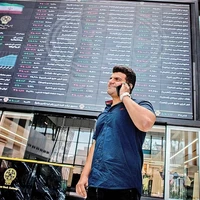
  • Nowhere else to go? The puzzle behind Iran’s stock rally
    INSIGHT

    Nowhere else to go? The puzzle behind Iran’s stock rally

  • Iran escalates Hormuz tanker attacks in gamble ahead of US midterms
    ANALYSIS

    Iran escalates Hormuz tanker attacks in gamble ahead of US midterms

  • Can US sanctions derail Iran’s China trade route?
    ANALYSIS

    Can US sanctions derail Iran’s China trade route?

Banner
Banner
Banner
Banner
Banner
•
•
•

More Stories

Iran speaker says government overstepped on anti-terror finance rules

Oct 16, 2026, 11:43 GMT+1
•
Niloufar Goudarzi
100%
Iranian parliament speaker Mohammad Bagher Ghalibaf (left) and President Masoud Pezeshkian

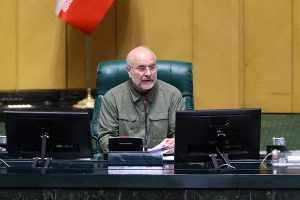
Iranian Parliament Speaker Mohammad Bagher Ghalibaf has ruled that part of the government’s anti-terror financing regulations violates Iranian law, saying decisions on who is designated as terrorist must remain with the Supreme National Security Council.

In a letter to President Masoud Pezeshkian, Ghalibaf objected to amended government rules that kept national working groups involved in deciding which individuals, groups and organizations should face terrorism-related financial restrictions.

The rules cover measures including freezing or blocking assets.

Ghalibaf said Iranian law gives the Supreme National Security Council responsibility for identifying terrorist individuals, groups and organizations, and that the government could not give that authority to its own working groups.

What did the government change?

The cabinet adopted regulations setting out how terrorism-related financial restrictions should be applied.

They created a national working group to review cases involving people and organizations that could be placed on terrorism-related lists. The group also had a role in decisions that could lead to assets being frozen.

The government later amended the rules so that the working group would be established with the Supreme National Security Council’s approval and operate under its direction.

But the amended rules still allowed the group to make some listing decisions. Ghalibaf said that remained inconsistent with the law because the council itself, rather than a government working group, has the legal authority to determine who Iran considers terrorist.

  • Iran parliament speaker sends anti-terror finance law for implementation

    Iran parliament speaker sends anti-terror finance law for implementation

  • Iran’s president signs law joining UN anti-terror finance convention with conditions

    Iran’s president signs law joining UN anti-terror finance convention with conditions

  • Q&A: All you need to know about Iran's FATF problem

    Q&A: All you need to know about Iran's FATF problem

What does Ghalibaf’s ruling change?

The letter concerns the government regulation used to implement the law, not Iran’s underlying law against terrorist financing.

It also does not address Iran’s membership in international treaties. The issue is narrower: whether the cabinet gave its working groups powers that Iranian law reserves for the Supreme National Security Council.

Ghalibaf issued the finding through Iran’s established system for reviewing cabinet regulations. His letter says the government must correct the disputed provision within the legal deadline and that the part found unlawful will lose effect if it is not corrected.

Why this matters internationally

The dispute comes as Iran tries to address shortcomings identified by the Financial Action Task Force, or FATF, the international body that sets standards against money laundering and terrorist financing.

Iran has remained on FATF’s high-risk list since 2020. FATF says Tehran has still not completed most of the action plan it accepted in 2016 and continues to call on other countries to apply financial countermeasures.

Those measures are separate from US sanctions, but both make it harder for Iranian banks and businesses to maintain normal relationships with financial institutions abroad.

One of FATF’s outstanding demands is for Iran to have an effective system for identifying and freezing terrorist assets in line with relevant UN Security Council resolutions.

  • FATF opponents are profiteers of Iran's isolation, economist says

    FATF opponents are profiteers of Iran's isolation, economist says

  • US policy on Iran: can money achieve what sanctions couldn't?

    US policy on Iran: can money achieve what sanctions couldn't?

  • Long-delayed law may ease Iran's way out of financial isolation

    Long-delayed law may ease Iran's way out of financial isolation

Iran has already changed laws and joined two treaties

Iran has spent years changing its financial laws in response to FATF concerns.

It amended its domestic counter-terror financing law in 2018 and its anti-money-laundering law in 2019.

Last year, Iran also completed accession to two UN treaties that had been politically disputed for years: the Palermo Convention against transnational organized crime and the International Convention for the Suppression of the Financing of Terrorism.

Joining those treaties did not mean Iran joined FATF. FATF is a separate organization that judges whether a country’s laws and enforcement meet its standards.

Joining the treaties was not enough for FATF

Iran joined both treaties with reservations, including conditions allowing it to apply them within the framework of its own constitution and domestic laws.

In the case of the Terrorist Financing Convention, Iran also formally said the Supreme National Security Council would determine which individuals, groups and organizations it considers terrorist.

FATF said in June that Iran’s reservations to both treaties were “overly broad” and that its domestic implementation was still not in line with FATF standards. It also said Iran had failed to address the majority of its original action plan.

So Iran can legally be a party to the UN treaties while still falling short of FATF requirements.

The problem at the center of Ghalibaf’s ruling

The latest dispute goes directly to one of those unresolved questions.

Iran needs a system capable of identifying terrorist-linked individuals and organizations and freezing their assets. But under Iran’s own legal framework, Ghalibaf says the decision about who is considered terrorist must be made by the Supreme National Security Council, not delegated to government working groups.

The government must therefore adjust its implementation rules without weakening the financial controls Iran is trying to demonstrate to FATF.

US alert puts Iran’s overseas religious finance networks under scrutiny

Oct 15, 2026, 22:20 GMT+1
100%
Supporters of Iran's Islamic Revolutionary Guard Corps (IRGC) with a banner in central London, UK, June 2022

The US Treasury’s latest warning over Iran’s alleged abuse of religious charities puts renewed attention on religious and charitable organizations outside Iran that have separately faced criminal, regulatory or government scrutiny over financial or institutional links to Tehran.

The Treasury Department’s Financial Crimes Enforcement Network (FinCEN) on Thursday issued an alert asking financial institutions to report potential Iranian government abuse of religious charity networks, including the diversion of khums, a religious levy paid by Shiite Muslims.

Treasury said organizations collecting such payments may act on behalf of prominent Iranian ayatollahs with ties to the government and may use informal financial channels, including hawala networks and cash couriers, to transfer money to Iran or Iran-linked actors.

“Under President Trump’s leadership, Treasury will not allow the Iranian regime to continue its long history of abusing religious institutions to line the pockets of its elites and fund terrorism,” Treasury Secretary Scott Bessent said.

FinCEN identified several red flags, including charities soliciting donations without apparent charitable activity; organizations receiving large donations from unknown sources over a short period before transferring significant sums to other nonprofits; attempts to evade reporting or recordkeeping requirements; and recipients with no clear business relationship to a charity withdrawing its transfers in cash or sending them onward.

The alert also says no single indicator establishes illicit or suspicious activity.

The alert does not identify specific religious centers in the United States or Europe as participants in the conduct described. But US and European authorities have previously investigated organizations with alleged institutional or financial links to the Islamic Republic.

These cases involved different allegations and legal proceedings and should not be treated as equivalent evidence of diverted religious donations.

Khums case in the United States

A US criminal case cited in the alert involved khums payments collected for transfer to Iran without the required US Treasury licenses.

In 2024, Muzzamil Zaidi and Asim Mujtaba Naqvi pleaded guilty to conspiring to violate US sanctions by collecting tens of thousands of dollars for transfer to Iran, including funds collected in the name of then-Supreme Leader Ali Khamenei.

According to the Justice Department, Zaidi received permission in 2018 to collect khums on behalf of several clerics. Zaidi and Naqvi subsequently collected religious payments as well as donations purportedly intended to help victims of the war in Yemen.

Prosecutors said the men arranged for money to reach Iran and Khamenei’s office by using friends, relatives and other associates to carry cash out of the United States. In one instance, 25 travelers on a religious pilgrimage to Iraq carried dollars that were subsequently taken to Iran. The amounts were structured below $10,000 to avoid scrutiny, according to court documents.

FinCEN cited the Zaidi and Naqvi prosecution in Thursday’s alert as an example of illicit transfers involving khums payments.

Alavi Foundation’s long-running US case

The broader question of Tehran-linked financial activity in the United States has also surfaced in the long-running litigation surrounding the Alavi Foundation and the 650 Fifth Avenue office tower in Manhattan.

US prosecutors alleged in the case that entities associated with the property concealed an ownership interest held by Iran’s state-owned Bank Melli. The litigation ultimately ended in a global settlement that the Justice Department announced in March 2026 would provide approximately $318 million to victims of Iran-sponsored terrorism.

Alavi admitted no liability or wrongdoing under the settlement and rejected allegations that it had operated as an agency or instrumentality of the Iranian government. The foundation said all claims against it and its properties were dismissed with prejudice and that it transferred its assets, including its interest in 650 Fifth Avenue, to a newly created, IRS-approved public charity and would cease operations once its affairs were wound down.

Scrutiny in Britain

Britain’s Charity Commission has separately taken regulatory action involving the Islamic Centre of England, a Shiite religious institution in north London.

The Charity Commission opened a statutory inquiry in 2022 over what it described as serious governance concerns. The inquiry followed an official warning related to two events at the center in 2020 that eulogized Qassem Soleimani, the former commander of the IRGC’s Quds Force who was under UK sanctions.

The regulator later appointed an interim manager after finding failures by trustees to comply with their legal duties and protect the charity’s assets.

In May 2025, the Charity Commission said it had found misconduct and/or mismanagement during its ongoing inquiry and ordered governance reforms. During the inquiry, a requirement in the center’s governing document for one trustee to serve as the official UK religious representative of Iran’s supreme leader was removed, and the occupant left the role. The regulator said the change addressed concerns about conflicts of interest and an apparent lack of independence.

The trustees disputed some of the regulator’s findings. The Commission also discharged the interim manager after she implemented specified improvements, leaving further reforms to the trustees.

The Commission said at the time that its statutory inquiry remained ongoing.

Germany shut down Khamenei-linked center

Germany banned the Islamic Centre Hamburg, or IZH, and its affiliated organizations in July 2024, saying the organization pursued Islamist extremist goals.

Germany’s Interior Ministry said IZH acted as a direct representative of Iran’s Supreme Leader and sought to bring about an Islamic revolution in Germany. Authorities searched 53 premises in eight German states, and four Shiite mosques were closed as a result of the ban. then-Interior Minister Nancy Faeser said the measure did not apply to the peaceful practice of Shiite Islam.

German authorities subsequently ordered IZH head Mohammad Hadi Mofatteh to leave the country. Hamburg’s domestic intelligence agency identified him as the official deputy of Iran’s Supreme Leader Ali Khamenei in Germany.

Iran protested the German action and summoned Berlin’s ambassador in Tehran.

A focus on financial pathways

Thursday’s US alert does not allege that all Shiite charities or religious centers are conduits for Tehran. FinCEN explicitly said legitimate charities should have access to financial services and instructed banks to use a risk-based approach rather than treating the sector as inherently suspicious.

Instead, the alert focuses on how religious donations can potentially intersect with sanctions evasion and informal financial networks.

The US khums prosecution documented religious payments collected in the United States and cash carried toward Iran for receipt by the Office of Iran’s Supreme Leader. The cases in Britain and Germany are distinct: British regulators raised governance and independence concerns involving a center whose governing document had required a trustee to serve as the supreme leader’s official UK religious representative, while German authorities said IZH acted as the supreme leader’s direct representative.

FinCEN’s new alert asks financial institutions to look for indicators of potential Iranian government abuse of religious charities, including patterns that could indicate funds are being transferred to Iran or Iran-linked actors through informal financial channels.

Iran threatens to reconsider UK ties over RAF Fairford allegations

Oct 14, 2026, 01:57 GMT+1
100%
B‑1B Lancer bomber at the RAF Fairford airbase, which hosts US Air Force personnel, in Fairford, Gloucestershire, Britain, September 27, 2026. According to the police, security measures were increased around the air base after police arrested several men on suspicion of offences under the Explosives Act. REUTERS/Toby Shepheard TPX IMAGES OF THE DAY

Iran on Tuesday summoned Britain’s ambassador and threatened to reconsider diplomatic relations after London blamed the IRGC for a suspected plot targeting a US-used airbase and Britain’s intelligence chief warned of growing Iranian threats to military sites.

The confrontation stems from a September 27 security incident near RAF Fairford in Gloucestershire, southwest England. Five British men were initially arrested after three suspicious vans were stopped near the base. Police found gasoline in the vehicles but no explosives.

Two more men, including a dual British-Iranian national, were subsequently arrested. All seven have been released on bail.

US officials told Reuters that the suspected plot involved a possible Iranian drone attack. Trump later said a threat linked to Iran prompted Washington to withdraw its B-1 bombers from Fairford, adding that the United States knew who had made the threat.

The Trump administration believes the Iranian threats were intended to kill US personnel and destroy American aircraft, AP reported Tuesday, citing a US official. British officials have not confirmed that assessment, and it remains unclear whether those arrested near Fairford were connected to the alleged drone threat.

RAF Fairford has been used by US bombers involved in strikes against Iran. Tehran has previously said bases used to attack its territory could be considered legitimate targets.

Fairford fuels Iran-UK confrontation

British Prime Minister Andy Burnham said Monday the suspected plot was “highly likely” coordinated in Iran and “almost certainly” directed by the Islamic Revolutionary Guard Corps. Home Secretary Shabana Mahmood said investigators believed an individual based in Iran was behind the incident.

Britain summoned Iran's ambassador and sanctioned two Iranian nationals over alleged involvement in hostile operations abroad.

Tehran responded Tuesday by summoning British Ambassador Hugo Shorter. Iranian Foreign Ministry official Alireza Yousefi rejected the accusations, demanded evidence and warned that Tehran would “seriously reconsider” bilateral relations if Britain failed to substantiate its claims.

The diplomatic confrontation came as MI5 Director General Ken McCallum warned Tuesday that Iran was increasingly turning its attention to military sites and other “harder targets” in Britain.

McCallum said the Fairford incident was “not unique” and that more than 50 people had been arrested in Iran-linked operations in Britain over the previous 12 months. He said Iranian activity had increasingly extended beyond traditional targets such as opponents of Tehran to Jewish sites and military installations.

Britain, the United States and 27 other countries also backed London's attribution of Iranian involvement in the Fairford incident, saying it followed a broader pattern of alleged Iranian attacks and hostile activity abroad.

Iran has denied involvement in the Fairford incident and rejected British accusations of directing hostile operations in the country.

UK blames IRGC for RAF plot, vows crackdown on Iranian networks

Oct 12, 2026, 17:28 GMT+1
100%
A B-1 bomber takes off from RAF Fairford airbase, as the US removes its B-1 bombers one week after several men were arrested on suspicion of offences under the Explosives Act, in this screengrab obtained from a social media video in Fairford, Gloucestershire, Britain October 4, 2026.

Britain said on Monday that Iran’s Islamic Revolutionary Guard Corps had “almost certainly” directed a suspected plot targeting RAF Fairford, as it vowed to crack down on Iranian criminal networks, sanctioned two Iranian nationals and summoned Iran’s ambassador.

RAF Fairford in southwest England, which had been used by US bombers to carry out strikes on Iran, became the focus of a major security operation after five British men were arrested nearby in the early hours of Sept. 27 on suspicion of terrorism and explosives offences.

US officials have said the suspected plot involved a drone attack. President Donald Trump said last week that an Iran-linked threat had prompted the United States to withdraw its bombers from the base.

“I can confirm our assessment that it is highly likely to have been coordinated in Iran, almost certainly directed by Iran’s Islamic Revolutionary Guard,” Prime Minister Andy Burnham told parliament.

Iran has denied involvement. Iran’s ambassador to Britain, Seyed Ali Mousavi, on Monday rejected any Iranian role in the suspected plot and said Tehran was willing to cooperate with British authorities investigating the incident, state news agency IRNA reported.

Details of the suspected plot remain limited. The five British men were later released on police bail under what authorities described as stringent conditions. Two other arrested men, including a British-Iranian national, were also released.

Police said petrol was found in vans seized during the investigation but no viable explosive was discovered.

“We will not tolerate these threats on our soil,” Burnham said. “We will crack down on Iran's use of criminal networks, using our full range of powers to target them and their funding streams, and we will bring further sanctions to restrict the capacity of Iran and the IRGC to do us harm.”

Sanctions and diplomatic summons

Foreign Secretary Ed Miliband said he had instructed his department to summon Iran’s ambassador.

“Iran’s continued attempts to undermine the security of the United Kingdom and international partners through its criminal networks, proxy groups and state-backed malign activity is unacceptable,” Miliband said.

Britain also sanctioned Ruhollah Bazghandi and Shahram Ali Reza Tamarzadeh Jakki under its Iran sanctions regime.

The UK’s Foreign, Commonwealth & Development Office said Bazghandi, whom it identified as the IRGC’s head of counterespionage operations, was suspected of planning or conducting espionage for Iran and of involvement in threatening, planning or conducting attacks against people and assets in Britain or other countries.

Jakki was sanctioned for allegedly supporting or assisting activity involving threats, plans or attacks against people outside Iran. Britain described him as a facilitator for the already sanctioned Zindashti criminal network, which it says has been involved in plots targeting Iranian dissidents.

Joint condemnation

Foreign ministries from nearly 30 countries, including the United States, Canada, France and Germany, issued a joint statement condemning “Iran’s use of violent attacks, including the acts of lethal plotting, arson, sabotage, cyber-attacks, and other hybrid activities against us and our partners.”

“The UK has also concluded this event demonstrates the IRGC’s continued willingness to project hostile activity beyond its borders through covert networks and proxy actors,” the statement said.

British authorities have for years accused Iran of involvement in plots and attempted assassinations in Britain using criminal networks and proxies, allegations Tehran has repeatedly denied. Britain said last year that it had identified 20 credible Iran-backed threats to kill or kidnap people based in the UK.

In July, Britain used new state-threat powers to ban support for the IRGC and Harakat Ashab al-Yamin al-Islamiya, or HAYI, a linked group that had claimed responsibility for seven attacks earlier this year targeting sites connected to Jewish and Israeli communities and Persian-language media.

Can US sanctions derail Iran’s China trade route?

Oct 12, 2026, 03:57 GMT+1
•
Umud Shokri
100%
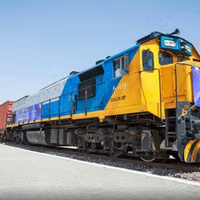
File photo: The inaugural double-stack container train linking Iran and China, July 2024

Washington’s new sanctions are unlikely to stop a China–Iran freight train at the border, but may make the route Tehran has turned to under pressure from the US naval blockade costlier and less reliable.

The blockade has sharply restricted maritime trade, while years of sanctions have squeezed Iran’s access to international finance. But not every trade channel had already closed.

Trains carrying goods from China were still reaching Iran before the latest US measures. The question now is whether sanctions on Iran’s railway companies will narrow that remaining route and complicate the flow of goods, including auto parts, carried on it.

Last week, the US Treasury designated three Iranian rail companies: the state-owned Islamic Republic of Iran Railway Company, known as RAI; Raja Passenger Trains Company; and private freight operator Railway Transportation Company.

The department said Iran had turned to rail to sustain trade and transport oil as the maritime blockade took hold.

The sanctions block the US-based property of the designated companies and prohibit US persons from dealing with them, while separate sectoral determinations give Washington wider scope to impose future designations. They do not automatically block every foreign railway, freight company or shipment connected to Iran.

The more immediate effect may be caution among companies involved in the trade. Banks may reject payments. Insurers and equipment suppliers may refuse to handle business involving designated companies. Others may charge higher fees or take longer to process shipments.

None of this would close the railway, but together it could make the route less dependable.

A useful route, with clear limits

The China–Iran rail connection is no longer just a proposal. In September, a block train bound for Iran was reported traveling through Kazakhstan, Uzbekistan and Turkmenistan before entering at Sarakhs.

A train from Xi’an to Iran’s Aprin dry port in 2025 was reported to have taken about 15 days, compared with an estimated 30 to 40 days by sea. Iranian railway officials also reported that 43 freight trains arrived from China in the first nine months of 2025.

Those figures show a route in use, although they do not indicate how much of Iran’s overall trade moves by rail.

Rail can move selected goods, industrial inputs, equipment and containerized cargo faster than shipping by sea. But it cannot replace the volume carried by tankers or bulk freighters.

Treasury says Iran is using rail to help transport oil, but its announcement provides no figures for oil moved this way. There is therefore little evidence that rail is a meaningful substitute for seaborne oil exports.

The new designations could nevertheless complicate the China route. Freight must be coordinated among operators, border agencies and terminals in several countries, making the response of Chinese and Central Asian companies important to how disruptive the sanctions ultimately prove.

Auto parts show where the sanctions overlap

The automotive sanctions create a second pressure point because auto parts from China have traveled to Iran by rail.

In 2025, Iran Khodro reportedly received an all-rail shipment through Sarakhs. The head of the local special economic zone said the route reduced transit and stockpiling time from about 50 days to 15.

Sanctions on automakers and rail operators could therefore put pressure on the same supply chain from two directions.

Procurement and payment may become harder, while freight companies and intermediaries may avoid shipments linked to designated firms.

The impact on car production, however, will depend on what parts are affected, how much stock manufacturers have and whether other suppliers or routes are available.

The trains may run, but at a price

The blockade has squeezed Iran’s maritime options; the rail sanctions raise the risks attached to an overland alternative.

They may not stop the China–Iran connection, but could make it costlier and less predictable by deterring the banks, insurers and logistics firms that keep shipments moving.

How much traffic falls will depend largely on the response of Chinese and Central Asian operators.

For now, the railway remains open. But as Iran leans more heavily on the trade routes still available to it, Washington is trying to make those routes harder to use.