OPEC+ agrees in principle to keep November oil targets steady - Reuters
OPEC+ has agreed in principle to keep oil production targets unchanged for November, Reuters reported, citing three sources close to the matter ahead of the group’s meeting on Sunday.
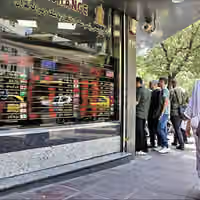
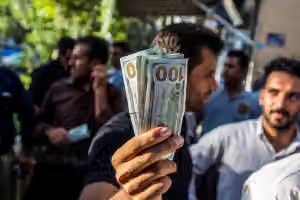
Iran’s currency fell to another record low against the dollar on Sunday, extending its decline during a US campaign aimed at restricting the Islamic Republic’s oil exports and financial flows.
The dollar traded at 2.723 million rials on the open market earlier on October 4, up 1.3% from the previous day.
The euro climbed above 3.06 million rials and the British pound surpassed 3.59 million rials.
US pressure targets oil revenue
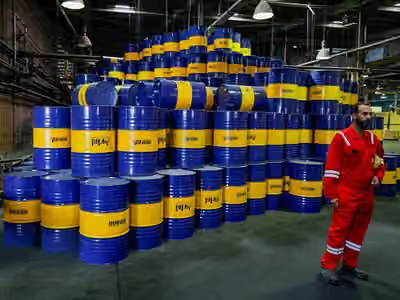
Washington has sought in recent weeks to restrict the Iranian government's financial lifelines through a naval blockade, efforts to prevent Iranian oil exports and measures targeting channels used to move oil revenue.
US Treasury Secretary Scott Bessent said on October 3 that Iran would have no oil cargoes on the water this week and would earn no revenue from such shipments, describing it as a first.
Bessent described the US military campaign, naval blockade and economic isolation of the Islamic Republic as interconnected elements of Washington’s strategy.
Iranian parliament deputy speaker Ali Nikzad had earlier said the United States would “never” be able to reduce Iran’s oil exports to zero.
Government moves to curb currency slide
Iranian authorities are seeking ways to contain the currency’s decline and inflation as economic pressure increases.
Tasnim news agency, which is affiliated with the Revolutionary Guards, reported on Sunday that five Iranian banks were selling up to $10,000 to each person over 18 at a rate of 2.57 million rials per dollar on the second day of an official foreign currency program.
The banks participating in the program are Mellat, Tejarat, Melli, Saderat and Saman, according to Tasnim.
Lawmaker Mehdi Kouchakzadeh criticized the central bank program during an online parliamentary session on Sunday, questioning why it had been introduced at what he described as a time of severe foreign currency shortages.
“Other than their friends, dealers and thieves, who can afford to buy this $10,000?” Kouchakzadeh said. “This is money for butterfly skin patients and struggling people that is going into the pockets of capitalists and thieves.”
Kouchakzadeh called the policy a “crime” and urged parliament speaker Mohammad Bagher Ghalibaf to prevent its implementation.
The physical management of foreign currency was of “fundamental importance,” Ghalibaf said in response, promising to pursue the issue.
Supreme National Security Council Secretary Mohsen Rezaei attended a meeting of the government’s economic coordination headquarters on October 3 and said the country was going through one of its most difficult periods.
Despite the deepening economic crisis and growing pressure on citizens, the Islamic Republic continues to pursue policies that have fueled confrontation, particularly its standoff with the United States and its nuclear program.
US President Donald Trump gestures during a rally at Butler High School in Vandalia, Ohio, US, October 3, 2026.
US President Donald Trump said Saturday he was approaching a decision on Iran, warning Tehran faced the “easy way or the hard way” as the Pentagon kept military options open amid continued attacks on commercial vessels in the Strait of Hormuz.
“We have a decision that I’ll make about Iran,” Trump told reporters. “Iran has been decimated, so the only question is it’ll either be the easy way or the hard way.”
Trump also said Iran was “virtually giving up” any plans to obtain a nuclear weapon, while reiterating that Tehran would never be allowed to acquire one.
Defense Secretary Pete Hegseth gave a clearer indication of what the harder option could involve, saying the Pentagon was working to ensure Trump retained “all the options he needs on the table” if Iran refused to abandon its nuclear ambitions.
“Iran will never, ever, ever have a nuclear weapon,” Hegseth said, describing Trump as “hell-bent and determined” to prevent it.
Pentagon preserves military options
Hegseth declined to say whether the USS Theodore Roosevelt carrier strike group, dispatched from San Diego last week, would be sent to the Middle East, saying his job was to give Trump the widest possible “decision space.”
He said Iran was trying to rebuild missile and other military capabilities damaged by US strikes but argued that damage to its defense industry had slowed that effort.
The military pressure has remained concentrated around the Strait of Hormuz, where Hegseth claimed Washington, rather than Tehran, now controlled the waterway. He described the US blockade as “ironclad” and said traffic was moving back toward pre-war levels.
Commercial vessels, however, continue to face attacks.
Iranian state media reported Saturday that another oil tanker had been hit in the strait. The IRGC-affiliated Fars News identified the vessel as the Ore Vinst and claimed it had been traveling under US escort when it was targeted while heading toward Oman.
The United States has not reacted to the claim yet.
The incident followed a series of attacks on ships transiting Hormuz even as Washington has escorted vessels through the waterway and sought to restore energy flows.
US says pressure campaign is cutting Iran’s revenue
The blockade is also intended to deny Tehran the oil income Washington says it needs to rebuild its military capabilities.
Treasury Secretary Scott Bessent said Iran would have no oil shipments at sea this week and therefore no revenue from those cargoes, describing the blockade and subsequent economic isolation as the next stages of a campaign that began with US military strikes.
“We had kinetic [action], we destroyed their navy, their air force, substantially depleted their drone and missile capability,” Bessent said.
“Then we went to what the president calls the Iron Wall and the blockade,” he added. “And now we have Operation Economic Outcast and we are isolating them economically like it’s never happened before.”
White House Communications Director Steven Cheung also said Iranian oil exports had been “stopped completely” and cited a Bloomberg report putting inflation at almost 90%.
Iran’s government has acknowledged increasing economic pressure while rejecting Washington’s claim that its strategy is succeeding.
President Masoud Pezeshkian said Saturday his government had adopted a “new posture” to manage what he described as exceptional conditions.
“The enemy’s plan in recent months has been to cut the country’s vital arteries with the aim of putting pressure on the Iranian people,” he wrote on X.
Pezeshkian said the pressure had increased but argued that government measures and public cooperation had prevented Iran’s adversaries from achieving their objectives.
Diplomatic channel remains open
Trump’s pending decision comes with diplomacy still technically alive but with no clear sign of a breakthrough after the latest contacts between Washington and Tehran.
The conservative Sobh-e No newspaper which is close to Iran’s chief negotiator Mohammad Bagher Ghalibaf reported Saturday that Iran was reviewing a US proposal conveyed through Qatar setting out a roadmap and timetable for further negotiations.
The paper said Tehran continued to demand that Washington first meet its commitments, including sanctions relief and the release of frozen Iranian funds, and that Iran’s principal conditions remained unchanged.
Those contacts follow talks in New York that failed to produce an agreement, with the two sides remaining divided over the terms for ending the war and reopening Hormuz.
For now, Trump has continued to present the choice as Iran’s: accept a deal under mounting military and economic pressure or face what he calls the “hard way.”
A watchtower of Rajaeishahr Prison before demolition
One of the last watchtowers at Iran’s Rajaei Shahr (Gohardasht) prison was demolished Saturday, as authorities dismantle a site of mass political executions despite longstanding warnings that its destruction could erase evidence of crimes against humanity.
The prison in Karaj in western Tehran was one of the sites of the 1988 massacre of political prisoners. The exact nationwide toll remains unknown amid official secrecy, but rights groups estimate that around 5,000 people were executed across Iran.
Gohardasht was central to the prosecution of Hamid Nouri, a former Iranian prison official sentenced to life imprisonment by a Swedish court in 2022 for war crimes and murder over his role in the executions there. His conviction was upheld on appeal, but Sweden released him in June 2024 in a prisoner exchange with Iran.
Authorities have presented the prison’s redevelopment as a project to provide cultural facilities, university space and parks following its closure in 2023.
Warnings over destruction of evidence
When the prison closed in August 2023, the Norway-based Iran Human Rights organization called for urgent action to prevent its demolition, warning that evidence of atrocities could be lost before the full scope of the crimes was established.
“Gohardasht Prison is the place where crimes against humanity were committed by those who currently hold key positions in the Islamic Republic,” its director, Mahmood Amiry-Moghaddam, said at the time.
“We still don’t know the full scope of those crimes and destroying the evidence is without doubt one of the key motivations behind its closure.”
The organization described the closure as part of a systematic effort to erase traces of state crimes. Its warning came after Nouri’s conviction, while his appeal was still pending.
Executions at Rajaei Shahr continued long after the 1980s. Iran Human Rights said at least 530 people were executed there on murder charges alone between 2015 and 2022.
The group also cited reported efforts to destroy or alter Khavaran cemetery in southeastern Tehran, where victims of the 1988 massacre were buried in unmarked mass graves. Victims’ families had appealed to the UN human rights chief to prevent destruction or interference at the cemetery, it said.
Authorities promise parks and cultural facilities
A Saturday report by Iran’s state-linked Student News Network described the falling watchtower as the end of a familiar urban landmark. It did not address the prison’s role in the 1988 massacre or the warnings about preserving evidence.
Officials have justified the closure by citing a law requiring prisons to move outside cities, alongside complaints about prison-related traffic and other neighborhood problems.
Judiciary chief Gholamhossein Mohseni Ejei ordered the closure in April 2023. The prison was emptied by August that year, with prisoners transferred to Ghezel Hesar, according to the state media account.
Demolition of the perimeter walls began in the final month of the Iranian year ending in March 2026 and intensified in September, the report said. The head of Iran’s prisons organization described their removal as necessary to settle the land’s future and enable new projects.
Authorities say the roughly 60-hectare site will include green space, a women’s park, a cultural center, an auditorium and an art gallery. They have also pledged to retain the main prison building for university and cultural uses.
A screen-grab of a CENTCOM video shows USS George Washington conducting flight operations in the Middle East
An unannounced meeting of President Donald Trump’s senior national security team at Camp David, as another aircraft carrier and thousands more US troops move toward the Middle East, has raised the prospect of another major operation against Iran.
None of this establishes that Trump has decided to resume attacks. But together, the developments would give him substantially greater military capacity at a time when diplomatic efforts to end the war have made little progress.
Vice President JD Vance chaired Friday’s meeting at Camp David, according to Axios, with Secretary of State Marco Rubio, Defense Secretary Pete Hegseth, special envoy Steve Witkoff, CIA Director John Ratcliffe and Joint Chiefs Chairman Gen. Dan Caine among those attending.
Three US officials told Axios that Iran and the conflict involving the Houthis in Yemen were discussed during the several-hour meeting. The White House has not disclosed what, if anything, was decided.
Trump convened senior foreign-policy officials at Camp David in June 2025, just days before Israel began its war with Iran, with several of the same officials attending. The parallel does not mean events will follow the same course, but it gives Friday’s meeting added significance.
More ships, aircraft and troops
The USS Theodore Roosevelt carrier strike group and USS Makin Island amphibious readiness group are heading to the Middle East, carrying more than 7,000 sailors and 2,000 Marines, according to US officials.
The USS George H.W. Bush and USS George Washington are already in the region, along with the USS Boxer amphibious readiness group. If the deployments overlap, the United States could have three carrier strike groups and two amphibious groups in the region by the end of October.
Some of the deployments may involve replacing forces that have spent months in the region rather than preparations for an offensive. But they would leave commanders with substantially more options if Trump orders operations to intensify.
Trump keeps military option open
The deployments come as negotiations between Washington and Tehran have stalled, with Qatar attempting to bridge differences between the two sides.
Trump told TIME this week that renewed US military action after the November midterm elections was “possible” if an acceptable agreement was not reached.
“I believe right after the election we’ll win, but maybe before the election,” Trump said Thursday, while describing Iran as “ready to fold up.”
Asked Friday what he intended to do next on Iran, Trump declined to elaborate, saying reporters would have “a big story” if he gave them the answer and adding: “You’ll see.”
Preparing for retaliation
Washington is also strengthening defenses against the kind of Iranian response that could follow renewed US attacks.
Additional Patriot air-defense systems have been deployed to protect critical energy infrastructure in Saudi Arabia and Qatar, while the growing naval presence provides further defensive as well as offensive capacity.
Iran retains missiles and drones and has demonstrated its ability to threaten shipping and regional infrastructure. The Strait of Hormuz remains a major vulnerability, as recent incidents involving commercial vessels have underlined.
A US maritime blockade has severely constrained Iranian oil exports, while the Treasury Department this week widened its Operation Economic Outcast sanctions campaign into Iran’s automotive and rail industries.
Military and economic pressure are therefore increasing even as Washington continues to pursue a diplomatic route.
The question is whether that force is intended to strengthen Washington’s hand at the negotiating table or to give Trump a military option if he concludes the negotiations have failed.
Rowers Kimia Zarei and Zeinab Norouzi celebrate with their gold medals after winning the women’s lightweight double sculls
Iranian women have delivered a record-breaking performance at the 2026 Asian Games, winning medals across an unusually broad range of sports and achieving a series of firsts for the country.
From first women’s gold medals in rowing and taekwondo to first female medalists in weightlifting and first women’s medal in a running event, the Games in Japan have produced breakthroughs across disciplines in which Iranian women have historically had little presence on the continental podium.
The results are particularly striking given the restrictions Iranian women face under the Islamic Republic over what they wear, which sports they can compete in and the resources available to them.
Perhaps the most striking came on the water.
Within about 20 minutes on September 24, Iranian women won their country’s first two Asian Games rowing golds. Fatemeh Mojallal won the lightweight single sculls before Kimia Zarei and Zeinab Norouzi took gold in the lightweight double sculls.
Mojallal also won bronze in the single sculls, while Zarei and Norouzi added silver in the double sculls. Mahsa Javer, Soha Fakhri, Saghi Maleki and Hengameh Kamyab took silver in the quadruple sculls.
Iranian climber Sarina Ghaffari competes at the 2026 Asian Games in Aichi-Nagoya, Japan.
Iranian women finished the rowing competition with two golds, two silvers and a bronze.
The achievement came after preparations were severely disrupted by the war.
Zarei told the Olympic Council of Asia that the rowers spent around 50 days training at home after their camp was cancelled, using rowing machines rather than getting on the water.
They eventually returned to camp despite the continuing conflict.
“We risked our lives because we wanted this moment,” Zarei said, adding that Iranian women and athletes in particular face “very unique challenges.”
Iran’s Zahra Kahrizi competes in padel at the 2026 Asian Games in Aichi-Nagoya, Japan.
Women were excluded from many disciplines after the 1979 Islamic Revolution and remain required to compete under state-mandated dress rules. Their access to facilities, funding and international competition has also frequently lagged behind that of male athletes.
Four years ago, the death of Mahsa Amini in morality-police custody sparked the Woman, Life, Freedom uprising, which grew into a broader challenge to state restrictions on women.
Since then, young Iranian women have increasingly defied compulsory hijab and other limits on their public lives, driving a social transformation that has continued despite the state’s efforts to reassert control.
Women’s participation in sport has also steadily expanded, sometimes producing success in disciplines where an Iranian female presence at elite international level is relatively recent.
Hengameh Hadiyani competes in artistic gymnastics at the Asian Games
Twenty-year-old Hengameh Hadiyani made history simply by competing, becoming the first Iranian woman to take part in artistic gymnastics at the Asian Games since the 1979 revolution.
She competed in the vault qualification, placing 13th.
Iranian women had effectively been excluded from international gymnastics for decades, with officials citing mandatory dress requirements as an obstacle to participation.
As recently as 2023, a senior Iranian sports official said standard gymnastics attire was incompatible with the Islamic Republic’s “cultural standards.”
But Hadiyani’s full-body competition outfit, designed to comply with Iran’s dress rules while allowing her to compete, drew widespread attention and praise.
Zahra Zarei competes in the women’s 400 metres at the 2026 Asian Games, where she won silver
In athletics, Zahra Zarei ran the 400 metres in 52.38 seconds to win silver, becoming the first Iranian woman to win an Asian Games medal in a running event.
There was another first in weightlifting.
Reihaneh Karimi, 20, lifted a combined 243kg in the 77kg category to take bronze, becoming Iran’s first female Asian Games medalist in weightlifting.
Two days later, 17-year-old Mahsa Beheshti added bronze in the 86kg category.
Iran only began fielding women internationally in weightlifting in recent years. In Nagoya, it produced two medalists, one just 17.
Saghar Moradi Sheikhlari celebrates with her gold medal after winning the women’s under-67kg taekwondo title.
Another landmark came on Friday, when 19-year-old Saghar Moradi Sheikhlari won the women’s under-67kg taekwondo title, becoming the first Iranian woman to win an Asian Games gold in the sport.
A day later, Fatemeh Ahmadi won bronze in women’s taekwondo +67 kg.
Iranian women also took silver in kabaddi after losing a closely fought final 37-34 to India. It continued an unusual run of consistency for the team, which has now won a medal at five consecutive Asian Games, including gold in 2018.
In karate, Fatemeh-Zahra Saeidabadi won silver in the women’s under-55kg competition, while Fatemeh Sadeghi, Sepideh Amini and Zeinab Hosseini took another silver in team kata. Fatemeh Barmaki added bronze in kurash.
Reyhaneh Karimi celebrates after a successful attempt in the women’s 77kg weightlifting event, where she won bronze.
Iran also won bronze in mixed team shooting through Hanieh Rostamian and Vahid Golkhandan.
Not every breakthrough came with a medal. Meshkatolzahra Safi and Mandegar Farzami became the first Iranian women to win singles matches in tennis at an Asian Games, both advancing from the opening round in Nagoya.
Female athletes also competed in mixed events in tennis, table tennis, archery and the mixed 4x400-metre relay.
Their presence across those events further reflected the breadth of the women’s contribution to Iran’s Games.
Hanieh Rostamian and Vahid Golkhandan celebrate after winning bronze for Iran in the mixed team shooting event at the 2026 Asian Games.
Across rowing, athletics, weightlifting and taekwondo, Iranian women rewrote several parts of the country’s Asian Games record within the space of a few days.
Zarei has said she hopes the visibility of athletes like her can encourage another generation of Iranian girls.
“I always try to show the good part of an athlete’s life and motivate the girls at home,” she told the Olympic Council of Asia.
“I always try to show them that you can do this, you can do that, and you can be successful.”