• العربية
  • فارسی
Brand
  • Iran Insight
  • Politics
  • Economy
  • Analysis
  • Special Report
  • Opinion
  • Podcast
  • Live TV
  • Iran Insight
  • Politics
  • Economy
  • Analysis
  • Special Report
  • Opinion
  • Podcast
  • Live TV
  • Theme
  • Language
    • العربية
    • فارسی
  • Iran Insight
  • Politics
  • Economy
  • Analysis
  • Special Report
  • Opinion
  • Podcast
  • Live TV
All rights reserved for Volant Media UK Limited
volant media logo

US aims to drain Iran’s remaining revenue, Bessent says after new sanctions

Oct 1, 2026, 21:40 GMT+1

The United States is targeting Iran’s remaining sources of revenue to further weaken its ability to fund military operations and activities abroad, Treasury Secretary Scott Bessent said Thursday on X.

“The Iranian regime's ability to fund its war machine and inflict terror on the world has been severely diminished thanks to Operation Economic Outcast,” Bessent wrote, adding that the latest measures against Iran’s industrial sectors were intended to help the United States and its partners “drain the regime’s revenue once and for all.”

Bessent’s post on X quoted a Treasury Department post saying the department is targeting some of the last significant elements of Iran’s industrial infrastructure, including its rail and automotive conglomerates, which the department said have been co-opted by the Islamic Republic and the IRGC.

Most Viewed

Iranian hardliners turn on Ghalibaf and judiciary after lawmaker’s sentencing
1
INSIGHT

Iranian hardliners turn on Ghalibaf and judiciary after lawmaker’s sentencing

2
INSIGHT

US ‘feedback’ leaves Iran debating the price of diplomacy

3

German-based aid worker gets 10-year prison sentence in Iran

4
INSIGHT

Tehran weighs what comes next if US diplomacy fails

5

Iran takes US response to cabinet, Hormuz clashes continue

Banner

Spotlight

  • Iran oil exports vanish as regional flows surpass prewar levels

    Iran oil exports vanish as regional flows surpass prewar levels

  • Iran turns to younger children in postwar ideological push
    ANALYSIS

    Iran turns to younger children in postwar ideological push

  • US ‘feedback’ leaves Iran debating the price of diplomacy
    INSIGHT

    US ‘feedback’ leaves Iran debating the price of diplomacy

  • ‘I never asked about regime change’: Student speaks out after El-Sayed exchange

    ‘I never asked about regime change’: Student speaks out after El-Sayed exchange

  • Iranian hardliners turn on Ghalibaf and judiciary after lawmaker’s sentencing
    INSIGHT

    Iranian hardliners turn on Ghalibaf and judiciary after lawmaker’s sentencing

Banner
Banner
Banner
Banner
•
•
•

More Stories

US targets Iran auto, rail and metals sectors in new sanctions blitz

Oct 1, 2026, 19:40 GMT+1
100%
File photo: Workers on the production line for SAIPA’s Tiba car in Iran.

The US Treasury sanctioned Iran’s automotive and rail sectors Thursday, expanding its campaign to some of the country’s largest industrial companies as Washington seeks to choke off Tehran’s sources of revenue with Operation Economic Outcast.

The Treasury said the sectors provide important sources of revenue and logistical capacity and are intertwined with IRGC patronage, trade-based money laundering and sanctions evasion.

“The Iranian regime's ability to fund its war machine and inflict terror on the world has been severely diminished thanks to Operation Economic Outcast,” Treasury Secretary Scott Bessent said.

“Today’s action directly targets Iran’s enablers and lays the groundwork for the United States and our partners to drain the regime’s revenue once and for all.”

The automotive designations include Iran Khodro Company, SAIPA, Iran Khodro Diesel, Pars Khodro, Zamyad and Niroo Motor Shiraz.

Iran produced nearly 1.1 million vehicles in 2024, according to the International Organization of Motor Vehicle Manufacturers. Iran Khodro and SAIPA together account for more than 90% of the country’s domestic auto market.

The Treasury described the sector as a major remaining source of revenue for Iran and said Niroo Motor Shiraz had supplied more than 6,000 motorcycles for plainclothes intelligence agents working with the IRGC and Basij militia.

Foreign companies were also sanctioned for supporting Iran’s auto industry, including firms based in Indonesia, the UAE, Turkey and Hong Kong.

The Treasury said they supplied components to Iranian automakers or helped move parts into Iran, including shipments linked to Bahman Diesel, which it said produces vehicles for the Iranian armed forces and IRGC missile and drone units.

In the rail sector, the US government sanctioned the Islamic Republic of Iran Railway Company and Raja Passenger Trains Company, saying Tehran has increasingly relied on rail to move oil and sustain trade amid the US maritime blockade.

It also sanctioned Heavy Equipment Production Company (HEPCO) and its China-based subsidiary, saying HEPCO machinery has been used by the IRGC and Quds Force to build underground facilities and military training sites.

The metals sanctions targeted companies in the UAE and Germany over dealings with Iranian steel producers.

The Treasury also designated Ramin Keshvardoust and Mehnoosh Poursaraf Hamedani and companies tied to their steel and financial network in Iran, China and elsewhere.

The US government accused the network of facilitating tens of millions of dollars in Iranian steel and oil shipments and laundering transactions through Iran’s shadow banking system.

In a separate action Thursday, the Treasury targeted the Russia-linked A7 Network, describing it as a “shadow banking network” used by Iran to evade sanctions.

It said A7’s sub-agents formed a money-laundering and sanctions-evasion mechanism linked to Russian illicit finance that Iran used to move funds, including for oil sales and weapons procurement.

Operation Economic Outcast was launched in August to cut off Iran’s remaining sources of revenue and expand sanctions pressure beyond oil into industrial sectors that Tehran still relies on for trade, logistics and foreign currency.

The Treasury says the campaign is designed to isolate companies and financial channels that help Iran move funds, sustain industrial production and circumvent US restrictions.

Four January protest detainees sentenced to death by Tehran courts

Oct 1, 2026, 19:14 GMT+1
100%

Four men detained during Iran’s nationwide January protests have been sentenced to death by Tehran Revolutionary Courts, HRANA reported Thursday, as rights groups warn of mounting use of capital punishment against protest detainees.

HRANA identified three of the men as Khosrow Mohammadi-Nia, Masoud Tushmalani and Sirvan Shabani, all from Kermanshah province in western Iran. The fourth, Mehdi Nami, was prosecuted separately.

Citing information received from Iran, HRANA said Branch 23 of the Tehran Revolutionary Court tried Mohammadi-Nia, Tushmalani and Shabani in a joint case and sentenced them to death on charges including “moharebeh” or “waging war against God,” “assembly and collusion with the intent to disrupt national security” and “operational activity in favor of hostile states.”

HRANA said judges Karimi and Taghizadeh issued the ruling.

Security forces arrested the three in Eslamshahr during the January protests, according to HRANA. Tushmalani was initially released on bail but was detained again several days later.

The three are being held at Qezel Hesar prison in Karaj. HRANA said Shabani is around 22 years old, while Mohammadi-Nia and Tushmalani are between 30 and 50.

A woman prosecuted in the same case was sentenced to five years in prison, HRANA said. The group did not identify her and said it was still investigating details of the allegations against her.

Separately, HRANA said Mehdi Nami, who was also detained during the January protests, had been sentenced to death by a Tehran Revolutionary Court on a charge of “operating in favor of hostile governments.”

The verdicts come amid a series of death sentences and executions involving people detained during nationwide protests that began in late December 2025 and intensified in January.

Human Rights Watch and the Abdorrahman Boroumand Center said in September that Iranian authorities had announced the executions of at least 29 protest detainees between March 18 and the end of August. Five were executed publicly.

The groups said 16 of the 29 had not been accused of killing anyone, with some convicted over alleged acts such as damaging public property, throwing stones or entering government buildings. They said such conduct does not meet the threshold for capital punishment under international human rights law.

The organizations also documented allegations of torture, coerced confessions, denial of access to lawyers of the defendants’ choosing and accelerated judicial proceedings. In some protest-related cases, the period between arrest and execution was little more than five weeks.

Iran oil exports vanish as regional flows surpass prewar levels

Oct 1, 2026, 18:55 GMT+1
•
Dalga Khatinoglu
100%
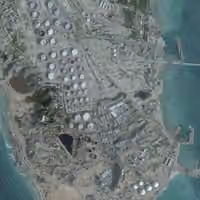
FILE PHOTO: A satellite image shows an oil terminal at Kharg Island, Iran, February 25, 2026.

New tanker-tracking data shows that Iran’s new oil exports have effectively ground to a halt, while crude exports from Arab countries in the region surpassed pre-war levels in the final week of September.

Data from commodities intelligence firm Kpler shows that regional crude exports reached their highest level since the war began in late February.

Average crude exports stood at around 16.5 million barrels per day in September, but the seven-day average rose to around 19.5 million barrels per day in the final week of the month, surpassing the pre-war level of approximately 17 million barrels per day.

By contrast, Iran has not loaded any new oil at its terminals since mid-August, while no Iranian oil cargo has crossed the US blockade line since mid-July. Data from tanker-tracking firm TankerTrackers also points to a halt in new Iranian crude shipments.

Homayoun Falakshahi, a senior analyst at Kpler, told Iran International that the halt in loadings has forced Iran to cut oil production to roughly the level required for domestic consumption, around 1.8 million barrels per day—roughly half its pre-war output.

Iran’s oil exports

Kpler data, seen by Iran International, shows that since mid-July, no Iranian oil cargo has crossed the blockade line and travelled through Asian waters toward China.

Iran continued loading oil for several weeks and, by mid-August, had stored around 67 million barrels aboard tankers anchored in its southern waters. But as access to empty tankers became increasingly limited, new loadings also came to a halt.

TankerTrackers data indicates that Iran’s oil terminals were effectively inactive in terms of crude loadings throughout September.

As of last week, around 15 million barrels of Iranian oil remained on the water in Asian waters. Falakshahi said most of those cargoes had already been sold, meaning Iran effectively has no new oil available for delivery to Chinese buyers.

China is the only major buyer of Iranian crude and purchased an average of around 1.5 million barrels per day from the Islamic Republic over the past year.

Iran also exported around 500,000 barrels per day of oil products and liquefied petroleum gas (LPG) last year to buyers including the UAE, China and other Asian countries. Those flows have also stopped since the start of the naval blockade.

Arab oil exports recover

By contrast, Arab countries in the region have restored much of their oil exports and established alternative routes for transporting crude.

Kpler says their crude exports averaged at least 16.5 million barrels per day in September, roughly matching their pre-war average. In the final week of the month, however, exports rose substantially further.

Before the war, nearly 17 million barrels per day of crude and 6.3 million barrels per day of oil products from Iran and Arab countries in the region, including Oman, were shipped to global markets through the Strait of Hormuz, the Gulf of Oman and the Red Sea—a combined 23.3 million barrels per day.

In the final week of September, crude exports from these countries reached nearly 19.5 million barrels per day, above the pre-war level. Oil-product exports, however, stood at around 3 million barrels per day, less than half their pre-war level.

Overall, crude and oil-product exports from the region reached more than 22.4 million barrels per day in the final week of September, just 900,000 barrels per day below the pre-war level.

The comparison is particularly striking because Iran accounted for around 2 million barrels per day of crude and oil-product exports before the war. Excluding Iran, exports from Arab countries in the region have therefore risen above their pre-war level, largely offsetting the disappearance of Iranian supplies from the market.

OPEC data shows that the UAE, which left the group in May, increased oil production to more than 3.8 million barrels per day in August—around 700,000 barrels per day above its pre-war level.

No new data has yet been released on UAE oil production in September. The country has production capacity of close to 5 million barrels per day.

Trump says renewed bombing of Iran after midterms 'possible'

Oct 1, 2026, 13:05 GMT+1
100%

US President Donald Trump said renewed large-scale bombing of Iran after the November midterm elections was "possible," while rejecting Tehran's latest ceasefire proposal as insufficient, according to an interview with TIME published on Thursday.

Asked directly whether Washington could ramp up bombing after the midterms, Trump replied: "Possible."

He declined to discuss potential targets but said the United States had spent the past six months replenishing its weapons stocks. "We're stocking up at levels we've never done before," he said.

Iran proposal 'not good enough'

Trump said he rejected an Iranian ceasefire proposal presented over the weekend because its terms fell short of what Washington now wanted.

"They made an offer to open up the Strait," he said, referring to the Strait of Hormuz. "It's just, it's just, it's not good enough. Nearly."

Trump said conditions he might have accepted a year earlier were no longer sufficient after months of war. He also said Iran wanted an agreement but that Washington was seeking broader terms.

"They want to make a deal, but I want to make the real deal," he said.

  • Trump may be buying time on Iran until after the midterms

    Trump may be buying time on Iran until after the midterms

Trump says he chose to prolong campaign

Asked why the war had continued into a seventh month after he initially suggested a much shorter campaign, Trump said the decision was deliberate.

"Only because I wanted to go further," he said. "I could have stopped then, but I wanted to go further."

Trump said the initial US strikes had already achieved their objective against Iran's nuclear facilities, but he decided to continue because he did not want Tehran rebuilding its capabilities "in some different form."

He said Iran had been severely weakened, saying: “Their economy is gone. Their inflation is at 300% or something like that. Their navy is gone. Their air force is gone. Everything’s gone.”

  • Saudi Arabia, UAE urge Trump to maintain pressure on Iran - WSJ

    Saudi Arabia, UAE urge Trump to maintain pressure on Iran - WSJ

Damage to Iran’s military

Trump said US operations had destroyed Iran's nuclear, naval, air and radar capabilities.

"I've destroyed their nuclear capability. I've destroyed their navy, 159 ships are at the bottom of the sea. I've destroyed their air force. All their planes are gone. I've destroyed their radar," he said.

He also said traffic through the Strait of Hormuz had reached a record level the previous night, arguing that Iran had lost its ability to control the waterway.

"They said we're going to close. I said, 'Well, you close it, you're going to have big trouble.' We took it over," Trump said. "You have to see the coastline. Everything is obliterated."

  • Why Trump said no to Iran’s Hormuz proposal

    Why Trump said no to Iran’s Hormuz proposal

Says 'annihilating Iran' remains possible

TIME also asked Trump about his recent threat to "annihilate Iran."

"Yeah, I would do that. It's possible," Trump said.

Asked how such a threat fit with his description of himself as a president of peace, Trump replied: "Because by annihilating Iran, we've created peace in the world. With Iran, I don't think you could ever have peace."

He said Iranian authorities had killed between 72,000 and 75,000 protesters in protests earlier this year.

"It's unbelievable. It's a bloodbath," Trump said.

Nuclear issue remains central

Trump repeatedly said preventing Iran from obtaining a nuclear weapon remained his central objective.

"Iran cannot have a nuclear power because they are crazy and you can't let crazy people have nuclear weapons," he said while discussing US support for Israel.

Later, while talking about the US economy and the cost of the war, Trump said he had "no choice" but to confront Tehran.

"I have to put out the fire in the Islamic Republic," he said. "Let nut jobs have nuclear weapons, you'll see some real problems. I had no choice. I'd do it again today."

Trump also said he believed the eventual outcome in Iran would resemble the result of the US operation in Venezuela.

"We're doing very well in Iran too," he said. "It's a much bigger area, much bigger country, much further away. And - but the result is going to be the same."

Iranian weapons, Chinese supplies fuel Houthi advance in Yemen - WSJ

Oct 1, 2026, 10:24 GMT+1
100%
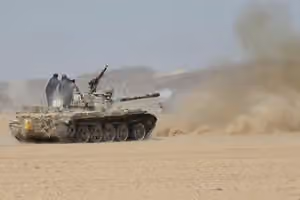
Iran-aligned Houthi fighters occupy a firing position in a screengrab from a video said to show Houthi fighters attacking Saudi-backed forces in the location given by the source as al Jawf governorate, Yemen, in this screengrab taken from a video released by Houthi Military Media on September 15, 2026.

Iranian weapons and growing supplies of Chinese dual-use components have helped Yemen's Houthis expand their territory and strengthen their ability to threaten shipping through the Red Sea, the Wall Street Journal reported.

The Iran-backed group has seized Red Sea islands and expanded along Yemen's mainland coast in recent weeks, including taking the port city of Mokha, according to the report. It has also asserted control over the Bab al-Mandeb Strait, a key route for global trade and energy shipments.

The Houthis, estimated to have about 350,000 fighters, had prepared for the offensive for months, moving weapons and thousands of troops toward Mokha in August and using their control of telecommunications networks to monitor opponents, the Journal said.

  • US officials met Iran-aligned Houthis in Oman - Reuters

    US officials met Iran-aligned Houthis in Oman - Reuters

  • Iran-backed Houthis attack Saudi cities and energy facilities, wounding at least 73

    Iran-backed Houthis attack Saudi cities and energy facilities, wounding at least 73

Iranian technology at the core

The Houthis lack a conventional navy but use Iranian-designed missiles, explosive drones, sea mines, armed fast boats and drone boats to project power along Yemen's coast.

Their arsenal includes ballistic and cruise missiles, anti-ship weapons and drones drawing heavily on Iranian technology and components, according to the report.

Around 2015, Iran's Quds Force began sending components for Iranian-designed missiles and drones and dispatched trainers to help the Houthis build weapons themselves, the Journal said.

The assistance helped turn the group into a force capable of attacking Saudi oil infrastructure, disrupting Red Sea shipping and threatening US forces.

100%
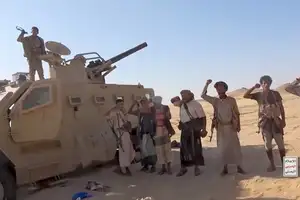
Houthi fighters stand in front of what they say is a downed Saudi jet, at a location given as Yemen, in this still image from a handout video released on September 16, 2026.

China becomes another supply source

"The Houthis now have a new source for the supplies they need to launch their attacks: China," the Journal reported.

Chinese companies are supplying dual-use goods that can serve civilian and military purposes, including components important to Houthi drone programs, according to UN reports and arms experts cited by the newspaper.

The shift comes as traditional Iranian smuggling routes have faced greater disruption. For years, Iran's Revolutionary Guards used small fishing boats to move arms, drone components and missile parts to the Houthis, but many shipments have been intercepted by US forces and Yemeni groups opposed to the Houthis.

  • Iran’s weakened axis still bites as Houthis escalate against Saudi Arabia

    Iran’s weakened axis still bites as Houthis escalate against Saudi Arabia

  • Iran-backed Houthis advance near key Red Sea shipping route as Yemeni forces retreat

    Iran-backed Houthis advance near key Red Sea shipping route as Yemeni forces retreat

Red Sea threat grows

The Houthis have also used Djibouti as a transit point for weapons and traded small arms with al-Shabaab in Somalia, according to UN reports cited by the Journal.

Since announcing a blockade on Saudi shipping on July 20, the group has struck seven vessels in the Red Sea and one in the Gulf of Aden, the report said. Four of the ships were Saudi-flagged.

The Houthis have also targeted Saudi energy infrastructure with missiles and drones, although Riyadh has reported no damage from those attacks.