Iran's Supreme Court has upheld the death sentence of Mozhdeh Hashemi Bazargani, a 27-year-old Red Crescent worker who said in a recording from Qazvin prison that interrogators beat her until her teeth broke and made her sign a confession, a source told Iran International.
Hashemi Bazargani was denied a lawyer of her own choosing throughout the proceedings, the source said. She is held in Qazvin Central Prison, in the city 150 kilometers west of Tehran, and is accused of sending the location of a military site to "the enemy," a charge she has denied.
In an audio message from prison earlier this year, she said security agents raided her home at 2:30 in the morning on April 4, cutting through the door with a metal grinder. She had been living with her elderly, ailing mother.
After her arrest, she said, she was beaten with a pipe and a baton on the head, neck and shoulders during long interrogations, breaking two teeth and leaving her with dizziness, shortness of breath and heart problems. No doctor came to examine her despite visible bruising and injuries, and her requests to be taken to the coroner's office to document the beating went unanswered.
Interrogators pressed her to confess, she said. "They pin a thousand charges on me. They force me: whatever we tell you, you have to write it down and sign it."
She said they beat her while she was blindfolded and cut her interrogation answers into a video presenting her as a terrorist. The charges put to her included espionage and receiving money from abroad. The confession footage was broadcast on Qazvin's provincial state television channel.
She also rejected the accusation of taking any money.
Her physical and mental condition is poor, the source told Iran International. Under the pressure of detention she has suffered seizures and lost consciousness several times, and was hospitalized before being returned to prison after a partial recovery.
In her message she also spoke of her mother in the town of Alvand, near Qazvin, who she said had been left with no one to care for her.
Iran's judiciary has issued sentences ranging from long prison terms to death against dozens of people this year on charges of espionage, sending information abroad or contact with hostile states, many of them arrested after the January protests.
Confessions broadcast on state television have repeatedly been described by defendants and their families as obtained under torture, and Revolutionary Court trials in such cases are closed to public scrutiny of the evidence.
Tehran prosecutors have opened a criminal case against a theater company after a spectator's phone video showed an actress resting her head against an actor's chest on stage, in a scene the production says depicts a brother and sister.
Mizan, the judiciary's news agency, said prosecutors acted over what it called behavior that violated social norms and standards of propriety during Tehran Paris Tehran / Bridge, staged at Tehran's Book Garden, a cultural complex in the north of the city.
The play is directed by Saeed Dashti and written by Sina Shafiei and stars Fatemeh Masoudifar, Mehrdad Sedighian, Amir Jafari and Sina Saei.
The scene
The footage shows Masoudifar leaning her head toward Sedighian's chest as he appears to touch her head. Physical contact between unrelated men and women in public is policed in the Islamic Republic under religious rules the state enforces, and the stage has not been exempt.
Fars News Agency, affiliated with the Revolutionary Guards, criticized the scene and said the larger problem was what it described as the gradual erosion of the boundaries governing artistic freedom and public conduct.
"It seems there is no supervision over theater stages," Fars wrote.
Production blames camera angle
The company said on Saturday the controversy rested on a "misunderstanding" and that the video did not show the true distance between the actors.
The images were filmed at a tight angle on a spectator's phone, it said, which created a misleading impression. It added that it had changed the actors' positions on stage to avoid further misunderstanding.
The two characters in the scene are brother and sister, the production said, and the contact comes at a moment of crisis in the story.
Other artists face legal action
The case comes amid other recent judicial measures involving artists and public events over compliance with the Islamic Republic’s social and religious restrictions.
An appeals court in Qom on Friday upheld sentences against singer Parastoo Ahmadi and seven musicians and others involved in the “Caravanserai Concert.” Each was sentenced to 74 lashes, a two-year ban on audiovisual and musical activity and a two-year travel ban.
The case stemmed from a concert filmed at the historic caravanserai in Qom in December 2024 and later posted on YouTube. Ahmadi performed without the mandatory hijab alongside male musicians. The lower court said the performance and its online publication had violated public morality and religious and legal norms. The appeals court rejected the defendants’ challenge and made the ruling final.
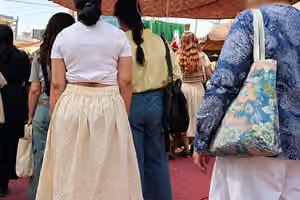
Iranian mothers accompany their daughters on the first day of school in Tehran in September. The image was reframed using AI to extend the background horizontally.
Mothers without headscarves walked daughters in regulation hoods to school in Iran this week. Women who remember 1980 describe the same scene from the year the state began imposing hijab. The picture is identical. What has changed is the society around it.
Among the images of the first day of the school year on September 23 were mothers who had dropped their daughters at the gate with their own hair uncovered, beside girls wearing the maghnaeh, the fitted hood that covers the hair, neck and shoulders and has been part of the girls' uniform in Iranian schools for four decades.
The scene is not new to the Islamic Republic. In the oral histories of women who remember the first years after the 1979 revolution, the same picture appears: mothers who still left the house without a headscarf, walking daughters who had to cover for school, because school was where the new state was making the rule stick first.
In the Islamic Republic's early years, compulsory hijab was established first in the spaces the state controlled most directly, government offices and schools, and only afterward extended to the street and the whole of public life.
Today the rules in schools and offices remain, and the law on compulsory hijab has not been repealed or even amended. But outside those spaces, part of the female population has been living differently for some time. This time, society has moved ahead of the rules.
Before the hood became the uniform
This summer an image of two designs for girls' school uniforms from 1979, first published by the popular weekly Javanan-e Emrooz, circulated again. Neither design includes the maghnaeh that later became a fixed part of the girls' uniform.
That interval did not last. In 1980, as the new state Islamized government offices and institutions, the dress code for schoolgirls changed too. For the 1980-81 school year, the requirement became a long-sleeved smock, loose trousers and a headscarf. In 1983, appearing in public without what the state called "sharia hijab" was made a crime.
The note to Article 638 of the Islamic Penal Code later became the legal basis for action against women who appear in public without the hijab the state requires.
So the history of compulsory hijab cannot be read from the street alone. School and office were among the first places it was enforced, and only later did the requirement settle across public space.
The regulation and the mandatory hood
In schools, much of that structure still stands. Article 85 of the schools' executive regulation, adopted in 2021, says students' clothing should be "simple, beautiful, varied, neat and cheerful," appropriate to Islamic-Iranian culture and identity, social custom, the student's age and the climate. The choice of style and color is left to each school's council, with the participation of the student council.
But the note to the same article fixes the range for girls. A female student's dress is either "chador, manteau, trousers and maghnaeh" or "manteau, trousers and maghnaeh," the chador being the full-length cloak and the manteau the long coat worn over trousers.
The chador is not compulsory. The maghnaeh is. The regulation provides no option for a girl to attend school with her hair uncovered.
The requirement begins in primary school. A girl of six or seven may walk to the gate hand in hand with a mother whose hair is uncovered, and must then cover her own to go in.
The distance between society and the rules can hardly be seen more clearly than in those few meters.
The fight reaches the uniform itself
This year the argument over girls' dress did not stop at the hood. The uniform itself made news.
On the eve of the new term, a message circulated about a girls' primary school in Saadat Abad, an affluent district in northwest Tehran, saying pupils would wear a shirt or blouse with trousers in place of the usual smock or manteau. Because the school is state-run, the message spread widely and reached state television.
The education office for Tehran's District 2 denied it, saying the images being shared had nothing to do with that school's uniform.
So the case cannot be treated as a confirmed change to a state school's uniform. But that such a report could circulate about a state school, and that the ministry felt obliged to answer it, shows the argument over girls' dress has reached the definition of the uniform itself.
Official policy has not moved. This year's directives asked schools to avoid unnecessary changes to the design and color of uniforms.
The result is a split. Outside school, the way women dress has changed quickly in recent years. Inside it, the manteau, trousers and maghnaeh of the official regulation remain exactly where they were.
Today's girls are not the girls of 1980
The most important difference between the two identical pictures may be the girls themselves.
The dress rules of 1980 were imposed on a society in which the Islamic Republic was still building its political, educational and cultural institutions. Today the same rules have to be enforced on a generation whose experience of how women around them dress is entirely different.
The protests of 2022 carried that difference into the schools. Among the most repeated images of the Woman, Life, Freedom uprising were teenage girls in school uniform who had taken off their hoods, in the schoolyard, the classroom and the street.
Reports of action against students over hijab followed. Amnesty International recorded the account of a 17-year-old who, after being seen with her hair uncovered on the school's cameras, was suspended and threatened with being reported to the security agencies.
That is a different experience from 1980. A student today may see bareheaded women on her way to school in the morning, be dropped off by a bareheaded mother, put on the hood to enter, and take it off again when school lets out.
For part of this generation, the maghnaeh is no longer a continuation of how they dress outside. It is a rule that applies on entering a controlled space, and stops applying on leaving it.
The law has not moved
None of this social change has become legal change.
The note to Article 638 still makes it a crime for a woman to appear in public without sharia hijab. Article 85 still lists the maghnaeh as part of a girl's dress.
The law known as Protection of the Family through the Promotion of the Culture of Chastity and Hijab, passed in December 2024, which would have widened the punishments and the means of enforcing compulsory hijab considerably, is not being implemented for now. Its suspension did not repeal the laws that came before it.
So what has happened in Iran's streets is not, in law, hijab becoming optional. The law has not recognized a right to choose. Part of society has made a different choice in practice.
A woman without a headscarf in Iran today is not uncovered because the law gave her that right. The law can still treat what she is doing as a crime, even if it is not enforced at every time and in every place.
The administrative structure behind hijab policy has not gone either. The budget for the Iranian year that began in March 2025 set aside 2.592 trillion rials, about $1.1 million at market rates, for the Headquarters for Enjoining Good and Forbidding Evil, the state body charged with policing public morality, for which hijab has been a principal concern. That is roughly the annual minimum wage of 1,300 workers.
In the budget for the year that began this March, the line was written differently: 6.284 trillion rials, about $2.7 million, in a single shared allocation for three bodies, the headquarters, Soureh University, which is run by the state's Islamic propaganda organization, and the Islamic Propagation Coordination Council, which organizes official rallies. Because the shares are not separated, the full figure cannot be described as the headquarters' budget, still less as a hijab budget.
The education ministry and other state bodies also retain duties under the existing law on dress. The retreat of enforcement in parts of public space has not removed the law, the institutions or the money behind it.
In 1980, the bareheaded mother was walking her daughter toward a rule that would soon reach her too. In 2026 she walks her daughter toward the last place the rule still holds. The picture has not changed. Its direction has. The few meters between her uncovered hair and her daughter's hood are no longer the distance between two generations, but between a society that has changed and a law that still says it hasn't.
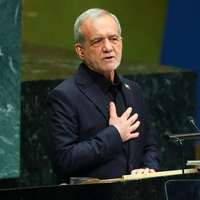
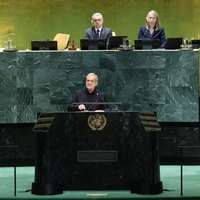
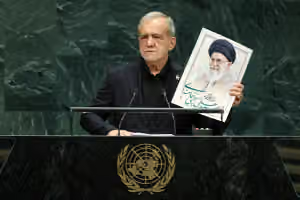
Iran's President Masoud Pezeshkian addresses the 81st United Nations General Assembly (UNGA) at UN headquarters in New York City, US, September 23, 2026.
Masoud Pezeshkian told the UN that Iran would not accept the language of force. Iranians writing to Iran International had one reply: that is the only language his government uses at home. Their messages picked apart what he said, what he left out, and how he said it.
Speaking at the 81st General Assembly on Wednesday, the president said Tehran was ready for dialogue but rejected "the language of force," called Donald Trump's words a sign of "the character of a bully and the logic of force," and held up photographs of the late Ali Khamenei and of schoolchildren killed in the strike on Minab in the war's first hours.
Three things drew the messages: the gap between the president's posture abroad and the state's conduct at home; the crackdown of January that he did not name; and the way he spoke.
The most frequent reaction set the president's words in New York beside the state's words in Iran.
"The Islamic Republic wants dialogue with anyone stronger than itself," one wrote, "and bullies its own defenseless people."
Another pointed to Pezeshkian's repeated use of the word force: inside Iran the state threatens America, he wrote, and in New York it asks "why are you bullying us."
The president's own language on the January protests was not far from writers' minds. In August he called the protests a "riot" and described those who reported the killings as "cowards and traitors," remarks that had drawn an earlier wave of messages. On January 11, days after the killings, he had called the protesters "terrorists" and demanded a "decisive" response from the security forces.
One writer put it in a single line: for 47 years the Islamic Republic has been busy with terror, and now Pezeshkian comes to play the victim.
Another watched the delivery rather than the text. "People like Pezeshkian only claim power and swagger in front of us," he wrote. "From the trembling voice, the stumbles and the level of stress in his speech, it was clear how brave he is in front of real superpowers."
Pezeshkian never used the word protests. The Iranians he described in the streets these past seven months were the crowds at the state's own rallies, organized by the Revolutionary Guards and the Basij, out at night, in his telling, to defend the country against people "America and Israel had incited and put guns in the hands of."
The millions who came out against the state, and the tens of thousands killed, did not appear in the speech at all.
A writer from Qeshm, the island in the Strait of Hormuz, said the president had repeated the state's version of the protests instead of speaking about Iran's own victims, including those killed on January 8 and 9 and in earlier crackdowns.
Others treated the speech as an occasion to list what it omitted: the protests of December 2017 and January 2018, Bloody November in 2019, the Woman, Life, Freedom uprising of 2022, the January 2026 uprising, and the poisoning of girls' schools in 2022 and 2023.
The messages came days after the UN fact-finding mission on Iran presented its latest report. Its chair, Sara Hossain, said the January crackdown had met protests with an "extremely violent" response, and that many of the violations, including killings and imprisonment, amounted to crimes against humanity.
Several writers said that Iranians themselves had been pushed to the margins of the speech. "Pezeshkian was more a defender of the Revolutionary Guards and of Palestine," one wrote, "than someone who wanted to say anything about the people of his own country."
How he said it
The third and most personal thread was the president's manner: his walk, his delivery, his command of his own text.
Many described his bearing as a street tough's swagger and compared him to Shaban Bi-Mokh, the Tehran strongman whose mobs helped bring down the government in the 1953 coup and whose nickname means "the brainless." Writers said his grip on the speech was so weak that a passerby pulled off the street and put at the UN lectern would have spoken more fluently and said more.
A writer from Tehran said he had been ashamed to watch Pezeshkian represent Iran, in a speech he found empty of manners, culture or "any diplomatic decorum."
"Why can't he speak properly?" another asked. "He talked as if someone had a gun to his head."
One writer compared the speech to those of Mohammad Reza Shah Pahlavi and said the level of language from the president of the Islamic Republic had left him astonished.
Several concluded that the delivery reflected the office. Pezeshkian, they wrote, has no authority of his own; he reads what is written for him and handed to him.
"That is why they made him president," one wrote. "The text they write for him usually has a fixed structure, and it is on file at the foreign ministry and the presidency."
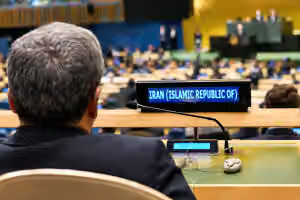
Foreign Minister Abbas Araghchi, seen from behind, listens as President Masoud Pezeshkian addresses the UN General Assembly in New York on September 23, 2026.
Iranians writing to Iran International this week did not see a diplomatic visit. They saw the men they hold responsible for January's massacre walking free in New York, and they asked the city's mayor, who once promised to arrest Netanyahu, why.
As President Masoud Pezeshkian and Foreign Minister Abbas Araghchi arrived for the UN General Assembly, the messages came in with a phrase that recurred until it became the story's own name: the "killers in suits." The demand attached to it was the same almost every time. Arrest them.
Voices from Iran draws on messages sent to Iran International by people inside the country. Names are withheld for their safety.
Foreign Minister Abbas Araghchi (left) and other members of Iran's delegation in the General Assembly hall listen as President Masoud Pezeshkian speaks in New York on September 23, 2026.
The demand
A writer from Fardis, on the western edge of Karaj, pointed to the latest human rights reports and asked why officials responsible for crushing 40,000 protesters in January were not being detained in New York.
Another wrote simply that now they were there, this was a good chance to arrest Pezeshkian and Araghchi.
The UN fact-finding mission on Iran said in its new report that many of the violations committed in the crackdown on the January 2026 protests, including murder, imprisonment and severe deprivation of liberty, amounted to crimes against humanity. Its chair, Sara Hossain, said the true number of victims could be "significantly" higher than the government's own figure.
One writer suggested that while the officials were at the United Nations, footage and documents of the killings should be handed to the same body. Others addressed Donald Trump directly, asking him to act on the crackdown rather than host or negotiate with the delegation.
And several turned to Zohran Mamdani, who as a candidate for mayor of New York said he would have Benjamin Netanyahu arrested if the Israeli prime minister set foot in the city, citing the International Criminal Court warrant against him.
"The mayor of New York who wanted to arrest Netanyahu," one wrote, "does he by any chance not intend to arrest the criminals in suits who sit on the Supreme National Security Council and whose signatures are on the massacre of January 8 and 9?"
The visas
A second thread was anger at what writers called the West's double standard: condemning the repression while receiving the men accused of it.
"My question is this," one wrote. "Didn't Mr. Trump always talk about the January massacre? So why has he given visas to the ringleaders of the killers of Iran's children?"
The State Department has said that admitting the core members of the Iranian delegation was an obligation Washington carries as host of the United Nations, and that the delegation's movements were restricted. The US government also agreed to Araghchi's request for a security detail during his stay.
"Bodies attached to the United Nations say the leaders of the Islamic Republic have committed crimes against humanity," another writer addressed the president. "Why are they now freely, and even under your escort, in America and at the UN?"
Not everyone expected an arrest. One writer said it was probably beyond the West to detain the officials, and proposed instead that Iranians abroad gather outside UN headquarters.
'A puppet'
The other constant in the messages was that Pezeshkian does not decide anything, and that his presence at the UN is a performance of the system that does.
Writers called him a marionette, a wind-up doll, and the tea boy of the power mafia, and called the trip a circus staged for legitimacy.
Some pointed to how little it achieved. One wrote that for years the Islamic Republic's only gain from attending the UN had been shopping in New York, and that Trump had taken even that away.
Last September the State Department restricted the Iranian delegation's access to wholesale and luxury stores during its stay.
Beneath the mockery ran a fear. Several writers worried that a deal might be struck, and that the file on the killings would be pushed aside for it.
Schoolchildren walk to class on the first day of the new academic year in Savadkuh, northern Iran, Sept. 23, 2026.
Iranian children returned to classrooms Wednesday for an unusually somber start to the school year, the first since young people were killed in a government crackdown on January protests and in the war with the United States.
The normally jovial ceremonies marking the first day of the Iranian school year were shadowed by the memory of children who might otherwise have returned to class this week.
Children were among those killed by Iranian security forces during the January protests, while 120 children died when a primary school in the southern city of Minab was struck on the first day of the war on Feb. 28.
More than 16.5 million students returned to over 124,000 schools across Iran for the new academic year, according to state media. Classes had been suspended after the United States and Israel launched strikes on Iran.
A United Nations fact-finding mission said last week there were reasonable grounds to believe US forces were responsible for the Minab attack and that the strike was indiscriminate and violated international law.
The mission also found that Iranian authorities committed crimes against humanity in their crackdown on the nationwide protests, including unlawful killings, torture and arbitrary detention.
War enters the classroom
But accounts sent to Iran International from several cities suggest the war and the government's response to it were following students back into school in other ways as well.
A parent in Mazandaran province said the principal of her son's school had warned students that failing to bring an Islamic Republic flag on the first day of school could negatively affect their end-of-year grades.
In Garmdareh, west of Tehran, another person said several flag-bearing vans and a vehicle equipped with loudspeakers entered Barati school on the first day, playing religious mourning music at high volume.
Military personnel were also present in the school grounds, the person said.
‘Cultural battle’
Iran's Education Ministry announced during the summer that material related to the conflict and the country’s military and nuclear capabilities would be incorporated into educational content.
The country's Organization for Educational Research and Planning has printed and distributed 12 million copies of educational materials titled “We Defend Our Iran” for older primary and secondary school students.
Officials with the student Basij have spoken of training tens of thousands of student “commanders” under a program called Yavaran-e Velayat for what they describe as a “cultural battle.”
As children filed back into classrooms across Iran, Pezeshkian was in New York addressing the UN General Assembly, where diplomacy aimed at ending the war was also gathering pace.
He held up photographs of children killed in the Minab strike as he accused the United States and Israel of attacking Iranian civilians.
For the children returning to school at home, however, the events of the past nine months were already part of the new school year.