Video: Tehran students protest compulsory hijab, repression
Students at Allameh Tabataba’i University in Tehran held a protest gathering Monday, chanting against compulsory hijab, the morality police and political repression, according to videos received by Iran International.
The students chanted, “Unemployment, exploitation; compulsory hijab for women,” and “Death to tyranny, hijab and the morality police.”
Another slogan accused authorities of preaching dialogue while confronting students with force: “Their slogan is dialogue, their guns are pointed at us.”
A separate video from the protest showed students chanting, “The streets are drenched in blood, our professors remain silent.”
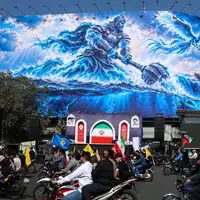
Supporters of Iran’s government wave national flags during a rally in Tehran after authorities announced a two-week ceasefire in the war with the United States and Israel, April 8, 2026
Iranian reformists are helping sustain Washington’s pressure campaign by signaling that sanctions and other coercive measures are pushing Tehran toward negotiations and concessions, the IRGC-affiliated Fars news agency argued Monday.
In a commentary titled Reformists' Game in Trump's Sanctions Pressure Puzzle, Fars said Washington looks for political and social effects inside Iran whenever it applies economic, military or diplomatic pressure, and accused reformists of providing precisely the response US policymakers hope to see.
It argued that calls for negotiations under pressure, suggestions that Iran should suspend nuclear activities, support for what some reformists have termed an “honorable peace,” and doubts about the usefulness of measures such as closing the Strait of Hormuz all send Washington the message that pressure is working.
“When the other side sees that external pressure is also turning into a domestic political demand for retreat and concessions, it naturally has greater motivation to maintain and even intensify that pressure,” the commentary said.
Fars drew a distinction between the military and economic fronts, arguing that direct US military action had encountered Iranian resistance and failed to achieve its objectives, while Washington continued to see sanctions and economic pressure as effective because their impact was quickly reflected in domestic calls for compromise.
The outlet said this created a cycle in which each new US measure was reinforced by political arguments inside Iran that the country had little choice but to negotiate or relinquish some of its leverage. Iranian society and the economy ultimately bear the cost of that cycle, it said.
Fars also accused reformists of constructing a “false dichotomy” between war and peace by presenting themselves as supporters of negotiations while portraying their opponents as advocates of violent confrontation. It argued that negotiations were only one tool of foreign policy and invoked the establishment's longstanding formulation that diplomacy and the “field” — a term commonly used for military and regional power — should complement one another.
The commentary comes amid an increasingly public dispute over the scope of negotiations with Washington.
IRGC-affiliated outlets and hardline lawmakers have criticized Foreign Minister Abbas Araghchi's contact with US envoy Steve Witkoff in New York, questioning whether he was authorized to hold direct discussions.
At the same time, Major General Yahya Rahim Safavi, a military adviser to Iran's supreme leader, has said the government has been given room to pursue negotiations.
The dispute therefore extends beyond whether Tehran should negotiate at all, focusing increasingly on how talks should be conducted, what concessions Iran can offer and whether military, nuclear and maritime leverage should be maintained alongside diplomacy.
A man displays US dollar banknotes on a street in Tehran, Iran.
Iran’s rial fell to another record low on Monday, with the dollar reaching 2.45 million rials as economic and military pressures persisted and efforts took shape for possible new indirect talks with the United States.
Mediators are expected to hold separate talks with the United States and Iran on Monday or Tuesday over an amended version of a seven-day proposal Tehran presented on the sidelines of the UN General Assembly, sources briefed on the negotiations told Reuters.
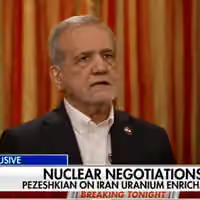
Iranian Foreign Minister Abbas Araghchi and Qatari mediators remained in the United States for the discussions, an official briefed on the negotiations said.
The diplomatic effort comes with divisions visible inside Iran over negotiations and the country’s nuclear policy, while military officials continue to warn about another confrontation with Washington.
Diplomacy meets resistance at home
A group of serving and former Iranian officials called Monday for an immediate halt to cooperation under the Nuclear Non-Proliferation Treaty and withdrawal from the pact “as soon as possible.”
“Continued membership in this treaty is not in the country’s interest, and we call for withdrawal from it as a strategic necessity,” the signatories said.
Former intelligence minister Heydar Moslehi and other former officials from the administrations of Ebrahim Raisi and Mahmoud Ahmadinejad signed the statement alongside serving lawmakers.
Hardline newspaper Kayhan also criticized Iran’s diplomatic approach, saying officials had shown excessive enthusiasm for negotiations during President Masoud Pezeshkian’s visit to New York and sent Washington “a signal of weakness.”
Supreme Leader Mojtaba Khamenei, meanwhile, emphasized Iran’s military position, describing the country as the “world’s top power” according to what he called “divine calculations” and saying enemy forces had been pushed back from waters near Iran.
Military pressure centers on Hormuz
Iranian officials continued to point to the Strait of Hormuz in their warnings to Washington.
“We are acting with authority in the northern Arabian Sea and east of the Strait of Hormuz, and we will not let anyone pass. On the other side, our IRGC brothers are also standing firm,” army deputy coordinator Habibollah Sayyari said.
Lawmaker Salar Velayatmadar said Iran could close the Strait of Hormuz and Bab al-Mandab if the United States launched another attack.
Rial falls under trade and oil pressure
The economic backdrop to the negotiations has also deteriorated, with the US dollar listed at 2.45 million rials on Iran’s open market Monday.
Iranian businesses are facing higher costs in trade with neighboring Iraq as banks tighten checks and anti-money-laundering requirements, head of the Iran-Iraq Joint Chamber of Commerce, said.
The main danger was not a complete halt in trade but a gradual loss of Iran’s share of the Iraqi market, Jahangbakhsh Sanjabi Shirazi, said.
Washington is also seeking to restrict Iran’s oil income more. Iran could have “nothing left to trade for anything” within two weeks after completing its remaining oil deliveries to China, US Treasury Secretary Scott Bessent said Sunday.
About 15 million barrels remained out for delivery, Bessent estimated.
Pressure on Iranian financial operations extends into Europe. Italy’s central bank told Iran International on Monday that the Rome branch of Iran’s Bank Sepah has remained under special administration since October 2025 following the European Union’s adoption of restrictive measures against Iran.
The weakening rial and growing obstacles to trade are adding to Iran’s economic pressure, while warnings over Hormuz and recent military exchanges keep the risk of renewed conflict hanging over the country and the region.
Drone view of oil tanker HELGA berthed at one of Iraq's southern offshore oil terminals near Basra as it prepares to load crude oil, becoming the second vessel to arrive since the closure of the Strait of Hormuz, April 24, 2026.
The UAE has found ways to blunt Iran’s ability to disrupt oil traffic through the Strait of Hormuz by exploiting its maritime tactics, Iranian state television commentators said in a recent broadcast.
Four people appeared on IRIB’s Be Vaght-e-Iran (Iran Time) program, with three speaking during an exchange on how Abu Dhabi has adapted its oil shipments to Iran’s approach to the strategic waterway.
One participant suggested Iran could target the smaller shuttle vessels moving through the strait or strike their point of origin. Another rejected that approach as insufficient.
“It makes no sense to just hit these vessels. That is not an adequate response to this change in logic,” he said.
A third participant laid out the central argument: Abu Dhabi has sought to change the economics behind Iran’s maritime leverage rather than directly challenge its military capabilities.
“The UAE has attacked the logic of closing the Strait of Hormuz,” he said.
Cheap ships change the calculation
Iran’s strategy, according to the panel, had relied partly on the vulnerability of very large crude carriers, or VLCCs, whose high value meant the prospect of an Iranian strike could make voyages commercially prohibitive as insurers withdrew coverage.
The UAE has sought to remove that pressure by creating a state-backed logistics chain and using smaller, cheaper vessels that can be readily replaced.
“It is defining a battlefield that has been designed to its advantage,” the commentator said. “It says: fight me here. You hit these small ones, and I keep replacing them.”
Abu Dhabi is also using ageing VLCCs that would otherwise be destined for scrapping because they no longer meet environmental or safety standards required at many ports, according to the discussion.
The ships can be worth considerably less than the oil they carry, reducing the economic loss if Iran damages them.
The broadcast also described a pattern in Iranian operations that the UAE could anticipate. Iranian forces radio vessels, fire warning shots if they continue and then target the bridge rather than immediately sinking the ship, giving crews around 30 to 40 minutes to evacuate.
Abu Dhabi has responded by positioning tugboats to recover damaged vessels and tow them to Sohar in Oman, where their cargo can still be unloaded, the main contributor said.
“The tugboat comes and attaches itself right there to the ship that has been hit,” he said. “They tow it to Sohar and unload it there on the Omani coast.”
The result, he argued, is that Iran can damage a vessel without preventing its oil from reaching port.
Iran’s military logic questioned
Simply striking greater numbers of replaceable vessels would not restore Iran’s leverage, the discussion suggested.
“They have attacked our military logic,” the main contributor said. “You have to hit this logic.”
The participant who opened the exchange said Iran’s problem was not a lack of political will, but its continued reliance on an approach that was no longer producing the intended outcome.
“There really is the political will to confront them. But because we are confronting them within the previous framework, we are not getting the result we want,” he said.
The main contributor described the problem as a “cognitive error.”
Another researcher and Middle East commentator Mustafa Najafi separately accused the UAE on X of spending weeks trying to reduce Iran’s leverage over the Strait of Hormuz and seeking to move oil belonging to other countries through the waterway.
Najafi also accused Abu Dhabi of obstructing an Iran-Oman agreement on managing the strait and lobbying in the United States and Israel for attacks on Iran.
“After Israel, no actor dreams of weakening and disintegrating Iran as much as the UAE does,” Najafi wrote, arguing that Tehran should move beyond a solely political and diplomatic response.
The remarks reflect concern among Iranian pro-system experts that the UAE is seeking not to overcome Iran’s military power in the Strait of Hormuz, but to diminish the strategic leverage that power is intended to provide.
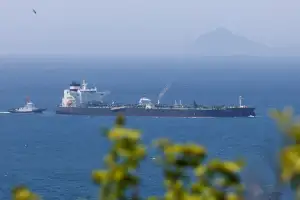
Vessels at the Strait of Hormuz, as seen from Musandam, Oman, on September 23, 2026.
Oil flows through the Strait of Hormuz have climbed despite the conflict, with Washington pointing to rising exports as Iran warns shipping companies against unauthorized passage and threatens US forces with retaliation if fighting resumes.
US Energy Secretary Chris Wright said on Sunday that oil flows through the strait were averaging nearly 13 million barrels a day, with shipments exceeding pre-conflict levels on at least one day last week.
“There was a day just this last week where over 20 million barrels of oil, more than pre-conflict levels, flowed out of the strait,” Wright told Fox News. The current average was “almost 13 million barrels a day,” he added.
Wright attributed pressure on energy prices more to limited refining capacity than to the volume of oil moving through Hormuz.
Iran warns shipping companies
Iran, meanwhile, portrayed the strait as a closely controlled corridor where vessels must comply with rules set by its authorities.
Iran’s Persian Gulf Strait Authority warned charterers against directing ships through routes it considers unauthorized, saying companies that do so could be placed on a non-compliance list and vessels associated with them could face restrictions.
The authority also published a letter it said came from the owners of an unnamed vessel apologizing for an unauthorized transit. According to the letter, the charterer instructed the ship to proceed without completing required declarations and approvals, putting the master under commercial pressure to comply.
The warnings were accompanied by threats from Iranian military officials. Armed forces spokesman Abolfazl Shekarchi said the United States would be “slapped” if it intervened in Hormuz.
A Revolutionary Guards Navy official challenged US President Donald Trump to send a warship near the strait if Washington believed it controlled the waterway, threatening US warships as far away as the Indian Ocean if fighting resumed.
Iranian army chief Amir Hatami also said the war was not over and that the military must remain prepared for further fighting.
Regional calls for safe passage
The dispute has drawn responses from countries concerned about commercial shipping and energy supplies.
Oman’s Foreign Minister Badr Albusaidi told the UN General Assembly that Muscat would continue working to safeguard navigation through Hormuz, urging restraint, dialogue and political solutions.
US Ambassador to the UN Mike Waltz said 146 countries had condemned Iran over attacks on civilian shipping, describing the Islamic Republic as increasingly isolated.
The rising oil flows point to increased movement through one of the world’s most important energy corridors, but warnings to shipping companies and threats of renewed military action show that control and security in Hormuz remain central to the conflict.
US President Donald Trump’s rejection of Iran’s proposal for a swift reopening of the Strait of Hormuz may say less about Washington’s opposition to a deal than about its changing assessment of Tehran’s most important bargaining chip.
Trump publicly rejected the proposal on Saturday. The plan would have reopened the strait within seven days and resumed nuclear negotiations in return for measures including lifting the US naval blockade of Iranian ports.
The president plainly wants normal shipping restored, but he appears unwilling to pay the price Tehran is asking for it.
Iranian officials have repeatedly described Hormuz as a strategic asset and a source of leverage. Disruption of the narrow waterway affects energy markets, shipping costs and inflation far beyond the region.
That importance has not disappeared. What may be changing is Iran’s ability to convert that disruption into immediate political concessions from Washington.
The US military has spent months trying to reduce Iran’s ability to attack shipping while expanding escorts for commercial vessels. CENTCOM commander Adm. Brad Cooper said last week that US forces had facilitated the transit of more than 2,000 commercial vessels and more than one billion barrels of crude oil through the strait.
The operation has not restored normal shipping, but it has allowed substantial volumes of oil to move without an agreement with Tehran, helping Washington turn Hormuz from an Iranian energy veto into what it increasingly appears to regard as a manageable risk.
Why Trump can wait
If Washington believes it can keep significant quantities of oil moving without Tehran’s cooperation, there is less incentive to lift the naval blockade and ease economic pressure simply to secure the full reopening of the strait.
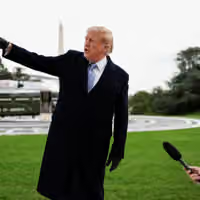
Trump’s rejection also comes as his administration is increasing rather than reducing that pressure. At the UN General Assembly this week, he called for Iran’s “complete economic isolation” and said he expected an agreement after the November midterm elections
The administration has expanded restrictions on Iranian banking and aviation. Iranian airlines have lost access to several international destinations, while companies servicing sanctioned Iranian carriers face the threat of secondary US sanctions.
Trump’s rejection therefore suggests Washington believes time is, for now, working more in its favor than Tehran’s.
Hormuz still matters
None of this means Iran’s Hormuz strategy has failed.
Keeping commercial traffic moving requires a major US military operation, while shipping and insurance costs remain elevated and the threat of attacks has not disappeared. Washington is paying a price for managing the disruption.
But the balance may have shifted. Tehran still views reopening Hormuz as something it can exchange for relief from economic and military pressure. Washington appears to believe it has reduced the costs of disruption enough that it does not yet need to meet Iran’s asking price.
Seen that way, Trump’s “no” becomes more significant. He has not necessarily rejected diplomacy: contacts through mediators continue, and Iran says it is still awaiting Washington’s formal response to its proposal. US officials have also described indirect discussions as continuing.
What Trump has rejected, for now, is Tehran’s price for ending the Hormuz crisis.
Iran still holds the Hormuz card. Washington’s calculation appears to be that it no longer has to pay as much to take it off the table.