• العربية
  • فارسی
Brand
  • Iran Insight
  • Politics
  • Economy
  • Analysis
  • Special Report
  • Opinion
  • Podcast
  • Live TV
  • Iran Insight
  • Politics
  • Economy
  • Analysis
  • Special Report
  • Opinion
  • Podcast
  • Live TV
  • Theme
  • Language
    • العربية
    • فارسی
  • Iran Insight
  • Politics
  • Economy
  • Analysis
  • Special Report
  • Opinion
  • Podcast
  • Live TV
All rights reserved for Volant Media UK Limited
volant media logo
ANALYSIS

From Hormuz to Indian Ocean: Iran threatens to redraw the map of the war

Behrouz Turani
Behrouz Turani

Iran International

Sep 24, 2026, 17:48 GMT+1
An undated file photo shows Diego Garcia, the largest island in the Chagos archipelago, in the middle of the Indian Ocean, which hosts a joint military facility operated by the United States and the United Kingdom

Tehran is signalling that its response to US pressure may be to widen the conflict, turning restrictions on its shipping and aviation into risks for airports and waterways stretching from the Persian Gulf to the Red Sea and potentially the Indian Ocean.

The emerging pattern is one of horizontal escalation: rather than confining its response to the point of pressure, Iranian officials are increasingly warning that action in one arena could produce retaliation elsewhere.

IRGC spokesman Hossein Mohebbi made that logic explicit on September 23, declaring that “Iran will certainly change the geography of the war” and adding that “our targets will no longer necessarily be the same as before”.

A day later, Yahya Rahim Safavi, military adviser to Iranian Supreme Leader Mojtaba Khamenei, gave the clearest indication yet of how far that geography might extend.

In a video released by the IRGC-linked Fars News Agency, Safavi said the front could expand further in response to continued warfare, “reaching the Indian Ocean and perhaps beyond”.

He added that linking Hormuz and Bab el-Mandeb “will change the battlefield”.

Fars noted that it was the first time an adviser to Khamenei had explicitly mentioned the Indian Ocean, home to the US-British base at Diego Garcia, nearly 4,000 kilometres from Iran.

In an earlier interview reported by Fararu, Safavi said Houthi advances mean the United States now faces a new challenge at Bab el-Mandeb and in the Red Sea.

IRGC Aerospace Force commander Majid Mousavi warned that “if you make the sacred Strait of Hormuz unsafe, we will turn the entire region into hell for you from across Iran”.

From shipping to aviation

The same logic has increasingly appeared outside the maritime arena.

Secretary of the Supreme National Security Council Mohsen Rezaei addressed Iran’s neighbouring Arab states in an interview with state broadcaster IRINN on September 23, saying: “If you stand with America, we will not just watch you.”

He warned that if Iranian flights were banned with their cooperation, “their airports will have no flights”. He did not specify any country, airport or method of disruption.

Rezaei linked the warning to the Hormuz standoff.

He also said Foreign Minister Abbas Araghchi was due to convey Iran’s seven conditions through mediators and that, until they were met, neither the strait would reopen nor negotiations resume.

Tehran had given the Americans “four to five days” to meet the conditions, he asserted.

A widening map of pressure

The statements suggest Tehran is increasingly answering different elements of Washington’s pressure campaign with threats or measures in corresponding domains.

Safavi’s framing of Hormuz and Bab el-Mandeb as a connected theatre suggests Tehran increasingly sees pressure around the two strategic chokepoints as interconnected.

The most immediate audience for many of these warnings is Iran’s Arab neighbours, whose airports, ports and territory are exposed to the consequences of US-Iran escalation.

Rezaei’s remarks appear designed to raise the potential cost for those states of cooperating with Washington’s pressure campaign.

Iran has already demonstrated a willingness during the conflict to target regional aviation infrastructure, repeatedly striking Kuwait International Airport and damaging terminals and a radar system.

The Indian Ocean references extend this widening map further.

For now, the shift is clearest at the level of rhetoric: none of the statements reviewed sets out a specific Iranian plan for operations there.

But combined with threats against regional airports and repeated references to Bab el-Mandeb, they point to an increasingly explicit message from Tehran that further US pressure could carry risks well beyond the Strait of Hormuz.

Most Viewed

Tehran sets out terms as US-Iran talks intensify in New York
1

Tehran sets out terms as US-Iran talks intensify in New York

2

Iranian airlines continue foreign flights after US sanctions deadline - Bloomberg

3

Trump sees ‘momentum’ for Iran deal after New York meetings

4
ANALYSIS

Freeway sign hack aims to frighten Iranians in Los Angeles, experts say

5

Khamenei adviser says Tehran can negotiate, hardliners say it must not

Banner
Banner

Spotlight

  • From Hormuz to Indian Ocean: Iran threatens to redraw the map of the war
    ANALYSIS

    From Hormuz to Indian Ocean: Iran threatens to redraw the map of the war

  • 'Bully at home, victim abroad': Iranians on Pezeshkian's UN speech
    VOICES FROM IRAN

    'Bully at home, victim abroad': Iranians on Pezeshkian's UN speech

  • Pezeshkian gets the generals' applause, and no word from the man above them

    Pezeshkian gets the generals' applause, and no word from the man above them

  • War deepens Iran’s energy crunch ahead of winter
    ANALYSIS

    War deepens Iran’s energy crunch ahead of winter

  • Threats and counter-threats complicate new US-Iran diplomacy
    INSIGHT

    Threats and counter-threats complicate new US-Iran diplomacy

  • They can erase you without arresting you
    TEHRAN INSIDER

    They can erase you without arresting you

Banner
Banner
•
•
•

More Stories

'Bully at home, victim abroad': Iranians on Pezeshkian's UN speech

Sep 24, 2026, 11:59 GMT+1
•
Saba Heidarkhani
100%
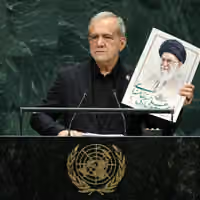
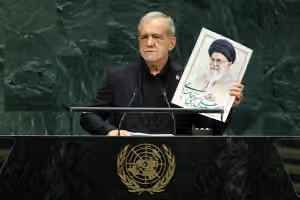
Iran's President Masoud Pezeshkian addresses the 81st United Nations General Assembly (UNGA) at UN headquarters in New York City, US, September 23, 2026.

Masoud Pezeshkian told the UN that Iran would not accept the language of force. Iranians writing to Iran International had one reply: that is the only language his government uses at home. Their messages picked apart what he said, what he left out, and how he said it.

Speaking at the 81st General Assembly on Wednesday, the president said Tehran was ready for dialogue but rejected "the language of force," called Donald Trump's words a sign of "the character of a bully and the logic of force," and held up photographs of the late Ali Khamenei and of schoolchildren killed in the strike on Minab in the war's first hours.

Three things drew the messages: the gap between the president's posture abroad and the state's conduct at home; the crackdown of January that he did not name; and the way he spoke.

  • Pezeshkian gets the generals' applause, and no word from the man above them

    Pezeshkian gets the generals' applause, and no word from the man above them

'Only brave in front of us'

The most frequent reaction set the president's words in New York beside the state's words in Iran.

"The Islamic Republic wants dialogue with anyone stronger than itself," one wrote, "and bullies its own defenseless people."

Another pointed to Pezeshkian's repeated use of the word force: inside Iran the state threatens America, he wrote, and in New York it asks "why are you bullying us."

The president's own language on the January protests was not far from writers' minds. In August he called the protests a "riot" and described those who reported the killings as "cowards and traitors," remarks that had drawn an earlier wave of messages. On January 11, days after the killings, he had called the protesters "terrorists" and demanded a "decisive" response from the security forces.

One writer put it in a single line: for 47 years the Islamic Republic has been busy with terror, and now Pezeshkian comes to play the victim.

Another watched the delivery rather than the text. "People like Pezeshkian only claim power and swagger in front of us," he wrote. "From the trembling voice, the stumbles and the level of stress in his speech, it was clear how brave he is in front of real superpowers."

  • 'Killers in suits': Iranians ask New York's mayor why Pezeshkian walks free

    'Killers in suits': Iranians ask New York's mayor why Pezeshkian walks free

What he left out

Pezeshkian never used the word protests. The Iranians he described in the streets these past seven months were the crowds at the state's own rallies, organized by the Revolutionary Guards and the Basij, out at night, in his telling, to defend the country against people "America and Israel had incited and put guns in the hands of."

The millions who came out against the state, and the tens of thousands killed, did not appear in the speech at all.

A writer from Qeshm, the island in the Strait of Hormuz, said the president had repeated the state's version of the protests instead of speaking about Iran's own victims, including those killed on January 8 and 9 and in earlier crackdowns.

Others treated the speech as an occasion to list what it omitted: the protests of December 2017 and January 2018, Bloody November in 2019, the Woman, Life, Freedom uprising of 2022, the January 2026 uprising, and the poisoning of girls' schools in 2022 and 2023.

  • UN says Iran committed crimes against humanity, US committed war crimes

    UN says Iran committed crimes against humanity, US committed war crimes

  • UN says Iran crackdown amounted to crimes against humanity

    UN says Iran crackdown amounted to crimes against humanity

  • Iran used state machinery to crush 2022 uprising, Amnesty says

    Iran used state machinery to crush 2022 uprising, Amnesty says

The messages came days after the UN fact-finding mission on Iran presented its latest report. Its chair, Sara Hossain, said the January crackdown had met protests with an "extremely violent" response, and that many of the violations, including killings and imprisonment, amounted to crimes against humanity.

Several writers said that Iranians themselves had been pushed to the margins of the speech. "Pezeshkian was more a defender of the Revolutionary Guards and of Palestine," one wrote, "than someone who wanted to say anything about the people of his own country."

How he said it

The third and most personal thread was the president's manner: his walk, his delivery, his command of his own text.

Many described his bearing as a street tough's swagger and compared him to Shaban Bi-Mokh, the Tehran strongman whose mobs helped bring down the government in the 1953 coup and whose nickname means "the brainless." Writers said his grip on the speech was so weak that a passerby pulled off the street and put at the UN lectern would have spoken more fluently and said more.

  • Iran’s nightly pro-state rallies become factional battleground

    Iran’s nightly pro-state rallies become factional battleground

  • Pezeshkian squeezed at home over meeting Trump in New York

    Pezeshkian squeezed at home over meeting Trump in New York

A writer from Tehran said he had been ashamed to watch Pezeshkian represent Iran, in a speech he found empty of manners, culture or "any diplomatic decorum."

"Why can't he speak properly?" another asked. "He talked as if someone had a gun to his head."

One writer compared the speech to those of Mohammad Reza Shah Pahlavi and said the level of language from the president of the Islamic Republic had left him astonished.

Several concluded that the delivery reflected the office. Pezeshkian, they wrote, has no authority of his own; he reads what is written for him and handed to him.

"That is why they made him president," one wrote. "The text they write for him usually has a fixed structure, and it is on file at the foreign ministry and the presidency."

China shipments help sustain Iran’s weapons programs despite US pressure - WSJ

Sep 24, 2026, 06:41 GMT+1
100%
US President Donald Trump and Chinese President Xi Jinping react as Xi arrives ahead of a state visit at Joint Base Andrews, Maryland, US, September 23, 2026.

Chinese suppliers sent around 1,300 shipments of dual-use components to Iran’s defense ministry in the first half of 2026, helping sustain its weapons programs, The Wall Street Journal reported.

Iranian customs records showed one delivery arriving on June 17, when Washington and Tehran signed a 60-day truce and China promoted its peacemaking role. More than a dozen shipments followed two days later, carrying over $6 million in parts usable in drones.

The findings put Chinese support for Tehran at the center of Xi Jinping’s Washington visit this week, alongside trade, artificial-intelligence safety and Taiwan. Trump told aides that preserving relations with Xi was a priority, the Journal reported.

  • Iranian airlines continue foreign flights after US sanctions deadline - Bloomberg

    Iranian airlines continue foreign flights after US sanctions deadline - Bloomberg

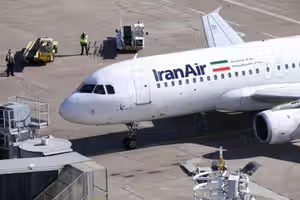
  • Iran warns it would disrupt regional airports if its flights are barred

    Iran warns it would disrupt regional airports if its flights are barred

Records supplied by ImportGenius, covering January 2025 through June 2026, listed thousands of shipments to Iranian companies and the defense ministry, including GPS devices, motors and aircraft engine parts. Many cited Article 119, which exempts defense imports from tariffs.

Days before war began on February 28, China delivered 300 tons of chemical compounds to the ministry. Trade initially collapsed, and April’s US naval blockade restricted supplies further. Iran responded by expanding air connections.

US-sanctioned Mahan Air increased flights from Beijing, Shanghai and Guangzhou to Tehran from four weekly in early March to about 27 by late April, FlightRadar24 data showed. It operated 39 China–Iran flights in September’s first week, twice its prewar level. Several were unavailable for passenger bookings. China services continued despite announced suspensions to Oman and Turkey.

  • What Operation Economic Outcast means for Iran, and for everyone trading with

    What Operation Economic Outcast means for Iran, and for everyone trading with

CSIS researcher Kate Koren identified Chinese companies advertising sensitive electronics used in Shahed drones. Suppliers cultivated Iranian customers through trade fairs and Persian-language marketing.

Chinese chemical supplies also helped replenish missile production damaged by Israeli attacks in 2024. After reports of those exports in 2025, US forces raided a ship carrying dual-use components from China to Iran.

In a December letter, sanctioned Chinese company Haokun Energy said it had coordinated confidential export licensing for sodium perchlorate, used in missile propellant, and created a Beijing shell company for the transaction. The Journal verified the company’s registration but could not establish whether the deal proceeded.

  • Iran bets on China to blunt Trump’s economic offensive

    Iran bets on China to blunt Trump’s economic offensive

  • Xi’s BRICS peace call sparks debate in Iran over China’s role in war

    Xi’s BRICS peace call sparks debate in Iran over China’s role in war

Washington also targeted networks seeking newer Chinese shoulder-fired missile systems for Iran, which manufactures versions based on older Chinese designs. One unsuccessful effort sought delivery through Belarus to conceal Iran’s Center for Innovation and Technology Cooperation as the recipient. Tasnim separately published footage of IRGC personnel training with portable launchers.

Iran's biggest buyer

China became Iran’s dominant oil buyer after Trump’s 2018 “maximum pressure” campaign; the countries signed a 25-year pact in 2021. US lawmakers put China’s share above 80% of Iranian crude exports. Banks and shell companies have facilitated payments, including in yuan, US officials and other sources told the Journal.

One arrangement involved Iranian petrochemical sales to Egypt through Banque Misr’s UAE branch. After US objections to dollar payments, proposed transactions shifted to yuan through China’s Cross-Border Interbank Payment System. Washington intervened, stopping the plan, and later moved to restrict the branch’s dollar access.

  • Iran routed up to $2.5 billion via China sanctions workaround in past year - Reuters

    Iran routed up to $2.5 billion via China sanctions workaround in past year - Reuters

  • Tehran sees ‌Beijing as potential bridge to Washington

    Tehran sees ‌Beijing as potential bridge to Washington

Egypt and the bank said they were engaging US authorities; the bank affirmed regulatory compliance. Beijing suspected Egyptian officials had shared information with Washington, and Xi raised the matter in Cairo on September 1, the Journal reported.

US officials also linked Chinese satellite imagery obtained before and after a July 17 Iranian strike to the attack, which killed three American troops in Jordan. Washington had sanctioned three Chinese imagery companies in May.

Despite hundreds of sanctions, disagreements persisted inside Trump’s administration. Hegseth said China and Russia enabled Iran; Trump cited Xi’s assurances against weapons deliveries, saying: “I trust them.” Rubio said Chinese assistance had not changed the war’s trajectory.

July measures targeted Mahan-linked entities, including a Chinese sales agent. Late-August Operation Economic Outcast targeted a Chinese-owned tanker and procurement networks, but no major Chinese companies. Kpler recorded roughly four million barrels reaching China the following week.

  • Xi snub reignites Iran’s doubts about China

    Xi snub reignites Iran’s doubts about China

Lawmakers from both parties urged tougher action; Senator Elissa Slotkin called for Iran to become central to the summit. Rubio promised frank talks, while Treasury and the White House defended their enforcement efforts.

China rejected accusations of improper support, citing export controls and opposition to unilateral sanctions. Hong Kong said it implements UN sanctions only.

Iran, US remain divided after UN talks as Hormuz blockade continues

Sep 24, 2026, 05:10 GMT+1
100%

Iran and the United States remained far apart Wednesday after renewed UN talks, with Tehran demanding an end to the US blockade of its ports and Washington keeping pressure in place as oil continued moving through the Strait of Hormuz.

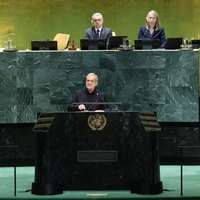
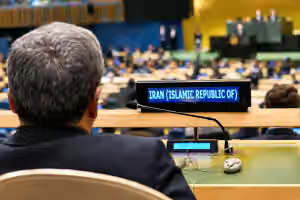
The first indirect talks between the two countries in months took place Tuesday on the sidelines of the UN General Assembly, between speeches in which US President Donald Trump threatened further military action and Iranian President Masoud Pezeshkian rejected the use of force to secure a deal.

Pezeshkian told the assembly Wednesday that Iran would not surrender to American pressure but remained willing to negotiate. He accused Trump of displaying a “bullying mentality” and argued that diplomacy could not succeed under military threats.

His address left the central dispute unresolved. A senior Iranian official told Reuters that Tehran was reviewing Washington’s response to its proposal for ending hostilities but that the sides remained far apart. The proposal prioritizes lifting the US blockade of Iranian ports and reopening Hormuz.

Trump had described Tuesday’s discussions as productive. Iranian officials confirmed that Foreign Minister Abbas Araqchi communicated with US envoys Steve Witkoff and Jared Kushner through Qatari mediation but disputed suggestions that Tehran had abandoned its conditions for reopening the strait.

Hormuz remains at the center of the dispute

The disagreement over the waterway links the diplomatic exchanges to the continuing confrontation at sea.

Pezeshkian argued in his UN speech that Iran could not be denied access to Hormuz while other countries benefited from shipping through it. Tehran has linked reopening the strait to an easing of US military pressure and the lifting of the blockade. Washington has rejected Iran’s efforts to exert greater control over navigation and collect fees from passing vessels.

While those terms remained unsettled, US Treasury Secretary Scott Bessent said American forces were helping move between 10 million and 17 million barrels of oil a day through Hormuz despite attacks on tankers.

He compared that volume with about 20 million barrels a day before the war and said roughly 3 million barrels were moving through alternative routes.

“The tankers, they may get hit. Many of them just sail on,” Bessent told Fox News.

US Central Command separately said it had redirected 115 commercial vessels as of September 23 while enforcing the blockade of Iranian ports. The figures describe two distinct parts of Washington’s maritime campaign: maintaining oil flows through the strait and restricting trade with Iran.

Continued shipments have not restored safe passage for commercial crews. A vessel was struck in Hormuz on Wednesday, killing one crew member and forcing the evacuation of more than 20 others, according to Oman’s navy. The origin of the projectile was not immediately established.

The danger also prompted India’s Forward Seamen’s Union to seek naval escorts for merchant ships after Indian sailor Suraj Yadav, 26, was killed aboard the MV Cape Dao off Oman.

European Council President António Costa raised the shipping dispute with Pezeshkian, urging Iran to halt strikes on neighboring countries, restore freedom of navigation through Hormuz and resume cooperation with the International Atomic Energy Agency.

Economic pressure continues alongside diplomacy

Washington also pressed ahead with restrictions beyond the maritime blockade.

Bessent said US sanctions had shut down more than 80% to 90% of Iran’s international flights and questioned how Tehran’s delegation to the UN would return home. The measures expose foreign companies servicing Iranian airlines to potential secondary sanctions.

The restrictions disrupted routes to neighboring countries, although some international flights continued after the US deadline. The Guardian reported that Iranian officials were seeking to preserve air links as the new measures took effect.

The diplomatic opening did not produce an announced shift in the military positions of Iran or Israel. Iran’s Armed Forces Chief of Staff Ali Abdollahi vowed retaliation for the killing of the country’s former supreme leader and children in Minab. Israel’s UN ambassador Danny Danon said Israel had not finished its mission against Iran and called for further sanctions.

By the close of Wednesday, the talks had restored a channel between Washington and Tehran but left the terms of a settlement unresolved. The US blockade remained in place, oil continued to move through a dangerous waterway, and neither side had announced an agreement on how unrestricted navigation through Hormuz would resume.

War deepens Iran’s energy crunch ahead of winter

Sep 24, 2026, 04:30 GMT+1
•
Dalga Khatinoglu
100%
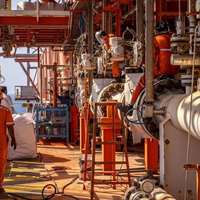
Workers carry out maintenance at Platform 18A of Iran’s South Pars gas field, August 2026

Iran’s economy contracted sharply in the spring as war hit its oil and gas sectors, with new data pointing to an energy crunch that could force Tehran to balance gas exports against rising domestic demand as winter approaches.

Iran’s Statistical Center reported that gross domestic product contracted 10.1% year on year in the spring, with almost every major sector shrinking except agriculture.

The value added of the oil and gas extraction sector, measured at constant 2021 prices, fell 26.4%. Its share of Iran’s economy also declined from 26% in the spring of last year to 21% in the same period this year.

International Energy Agency data show that Iran produced an average of about 2.6 million barrels of crude oil per day between April and June, roughly corresponding to the spring quarter. That was more than 20% below the same period last year.

Average daily oil production fell further to around 2.3 million barrels in the summer. With the United States imposing a naval blockade on Iran from mid-July, the contraction in GDP is expected to be significantly sharper in the summer than in the spring.

Gas distribution

Statistical Center data show that the value added of the gas distribution sector, measured at constant 2021 prices, fell by more than 21% in the spring from a year earlier.

Israel targeted gas-processing facilities at South Pars, the field that accounts for around 70% of Iran’s gas production, on March 18. Since then, Iranian officials have given varying estimates of the decline in gas production, ranging from 100 million to 230 million cubic meters per day.

The International Energy Agency’s initial estimates, published in May, suggested that Iran’s daily gas production may have fallen by around 100 million cubic meters.

The Statistical Center did not specify the exact daily volume of gas distributed during the spring. However, an earlier report showed that Iran produced and injected around 726 million cubic meters per day of processed gas into the distribution network in the spring of last year.

Given the 21% decline in the sector’s value added at constant prices, this suggests that gas supplied to the domestic network fell by roughly 152 million cubic meters per day this spring, to around 573 million cubic meters.

The decline is particularly significant ahead of winter. Iran faces a severe natural gas deficit during the cold months, with the daily shortfall reaching as much as 250 million cubic meters during periods of peak demand.

The government has consequently been forced to restrict supplies to industries, power plants and the petrochemical sector to meet rising residential demand.

The gas export puzzle

Despite the decline in gas supplied to the domestic network, Iran increased exports to one of its two gas customers.

Data from Turkey’s energy market regulator (EMRA) show that Iranian gas exports to Turkey increased 27% between April and June to 30 million cubic meters per day. Iran also exports gas to Iraq, although comparable data for the same period have not been published.

The increase in exports to Turkey may have two main explanations.

First, domestic gas demand is lower during the warmer months than in autumn and winter. Second, Iran’s industrial and petrochemical sectors may have experienced a significant decline in gas consumption because of the war.

According to earlier Statistical Center data, Iran’s petrochemical sector and industries consumed about 82 million and 397 million cubic meters of gas per day, respectively, in the spring of last year.

Combined, that represented roughly 75% of domestic gas sales, excluding exports, transmission and distribution losses, and gas used to operate the network itself. The combined figure was equivalent to about 66% of the total processed gas injected into the network that spring.

Israel targeted parts of Iran’s petrochemical complexes in Asaluyeh and Mahshahr during the spring. Together, those facilities account for around 70% of Iran’s petrochemical production. Israel also targeted the Mobarakeh and Khuzestan steel complexes, which together account for about half of Iran’s steel production.

It is therefore likely that gas consumption by these industries fell sharply during and after the attacks, freeing up some gas for exports.

But the situation could change rapidly as temperatures fall.

Household gas consumption rises to roughly twice its spring and summer levels in autumn and more than three times the warm-season level in winter. Households accounted for 49% of Iran’s total gas consumption last winter, according to the Statistical Center.

It remains unclear whether Iran will be able to maintain gas exports to Turkey and Iraq once domestic demand surges in the coming months.

Threats and counter-threats complicate new US-Iran diplomacy

Sep 23, 2026, 23:30 GMT+1
•
Maryam Sinaiee
100%
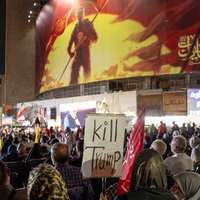
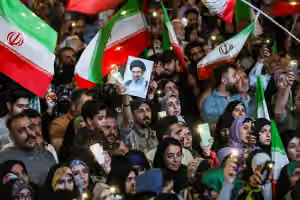
File photo: Crowds gather during a state-sponsored event in central Tehran, Iran

Iran warned Wednesday that any renewed US attack would draw a stronger military response, even as officials from the two countries pursued a new diplomatic opening in New York that has triggered a backlash among hardliners in Tehran.

The warnings followed President Donald Trump's threat at the United Nations to “annihilate” Iran, while Tehran has said further negotiations depend on Washington accepting seven conditions it has put forward for ending the conflict.

Mohsen Rezaei, secretary of Iran's Supreme National Security Council, sharply criticized Trump in remarks broadcast on state television, saying Iran would not return to what he described as the previous model of diplomacy.

He said the United States would first have to meet Iran's seven conditions before Tehran would agree to reopen the Strait of Hormuz and begin negotiations.

Rezaei said it had been agreed at a meeting with President Masoud Pezeshkian that Foreign Minister Abbas Araghchi would communicate the conditions to intermediaries during his visit to New York.

That account has become significant amid a growing dispute in Tehran over Araghchi's contact with US special envoy Steve Witkoff on Tuesday and whether the foreign minister had authorization to meet him directly.

US officials have described the latest contact between the two sides as face-to-face, while Iranian accounts have emphasized the role of mediators and said the purpose was to convey Tehran's conditions to Washington.

‘Childish and vile’

Iran's state broadcaster reported Tuesday evening that Araghchi had met Witkoff at the insistence of the American side and that the purpose of the meeting was to communicate Iran's conditions for reopening the Strait of Hormuz.

Foreign Ministry spokesman Esmail Baghaei said contact with the US side took place through Qatari mediators and was intended to communicate conditions including an end to the war on all fronts, a halt to US military operations, an end to the naval blockade and economic war, and the release of Iranian assets.

The contact prompted strong criticism of Araghchi from hardline and IRGC-affiliated media.

Tasnim News Agency, which is affiliated with the IRGC, described Araghchi's explanation as “childish and vile” and demanded an apology, questioning why he needed to meet Witkoff if Iran's conditions had already been communicated through intermediaries.

Ebrahim Rezaei, spokesman for parliament's National Security and Foreign Policy Committee, also questioned the meeting and asked Araghchi to explain what authorization he had received.

But parliament member Mojtaba Zarei defended Araghchi, saying his own review indicated that the foreign minister had been authorized to meet Witkoff.

“There was and is no negotiation,” Zarei wrote, saying Iran's seven conditions, including the lifting of the blockade of Yemen, had been communicated directly to Trump's representative.

Pezeshkian’s revised speech

The dispute unfolded as Pezeshkian and Trump publicly exchanged warnings while leaving open the possibility of diplomacy.

Pezeshkian said during his address to the General Assembly on Wednesday that he had changed his prepared remarks after hearing Trump's speech.

Holding up photographs of children killed in the attack on a primary school in Minab alongside an image of late Supreme Leader Ali Khamenei, Pezeshkian accused the United States and Israel of imposing the war on Iran and said the Islamic Republic had “powerfully” defended itself.

But he also said Iran remained open to negotiations in pursuit of peace and would not accept what he called “the language of coercion.”

Trump, meanwhile, issued a fresh warning against Iran while also expressing optimism that the dispute between Washington and Tehran could be resolved.

Speaking Wednesday at a meeting with Gulf Cooperation Council leaders in New York, Trump said the United States would “immediately” attack Iran if it carried out activities at the Kolang underground facilities.

Later Wednesday, after meeting British Prime Minister Andy Burnham, Trump said negotiations were continuing and that he believed the two sides would ultimately reach an agreement.

Iran's General Staff of the Armed Forces and the Khatam al-Anbiya Central Headquarters accused Trump of using the UN podium to justify military action and said Iran was prepared to deliver “stronger, crushing and unpredictable blows” in response to any renewed attack.

The simultaneous threats and diplomatic contacts have left the two sides pursuing negotiations while publicly warning that renewed military action remains possible.