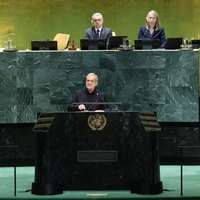
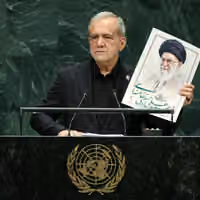
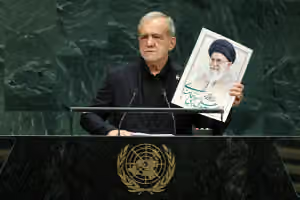
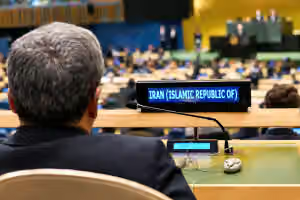
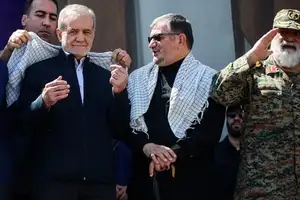
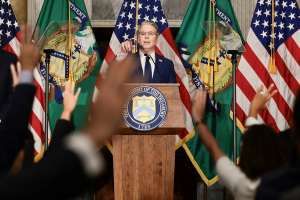
Speaking at the 81st General Assembly on Wednesday, the president said Tehran was ready for dialogue but rejected "the language of force," called Donald Trump's words a sign of "the character of a bully and the logic of force," and held up photographs of the late Ali Khamenei and of schoolchildren killed in the strike on Minab in the war's first hours.
Three things drew the messages: the gap between the president's posture abroad and the state's conduct at home; the crackdown of January that he did not name; and the way he spoke.
'Only brave in front of us'
The most frequent reaction set the president's words in New York beside the state's words in Iran.
"The Islamic Republic wants dialogue with anyone stronger than itself," one wrote, "and bullies its own defenseless people."
Another pointed to Pezeshkian's repeated use of the word force: inside Iran the state threatens America, he wrote, and in New York it asks "why are you bullying us."
The president's own language on the January protests was not far from writers' minds. In August he called the protests a "riot" and described those who reported the killings as "cowards and traitors," remarks that had drawn an earlier wave of messages. On January 11, days after the killings, he had called the protesters "terrorists" and demanded a "decisive" response from the security forces.
One writer put it in a single line: for 47 years the Islamic Republic has been busy with terror, and now Pezeshkian comes to play the victim.
Another watched the delivery rather than the text. "People like Pezeshkian only claim power and swagger in front of us," he wrote. "From the trembling voice, the stumbles and the level of stress in his speech, it was clear how brave he is in front of real superpowers."
What he left out
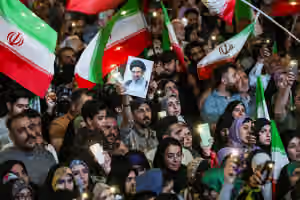
Pezeshkian never used the word protests. The Iranians he described in the streets these past seven months were the crowds at the state's own rallies, organized by the Revolutionary Guards and the Basij, out at night, in his telling, to defend the country against people "America and Israel had incited and put guns in the hands of."
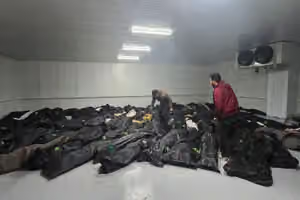
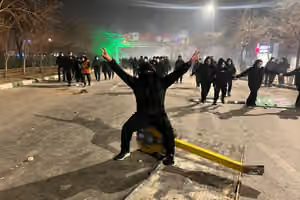
The millions who came out against the state, and the tens of thousands killed, did not appear in the speech at all.
A writer from Qeshm, the island in the Strait of Hormuz, said the president had repeated the state's version of the protests instead of speaking about Iran's own victims, including those killed on January 8 and 9 and in earlier crackdowns.
Others treated the speech as an occasion to list what it omitted: the protests of December 2017 and January 2018, Bloody November in 2019, the Woman, Life, Freedom uprising of 2022, the January 2026 uprising, and the poisoning of girls' schools in 2022 and 2023.
The messages came days after the UN fact-finding mission on Iran presented its latest report. Its chair, Sara Hossain, said the January crackdown had met protests with an "extremely violent" response, and that many of the violations, including killings and imprisonment, amounted to crimes against humanity.
Several writers said that Iranians themselves had been pushed to the margins of the speech. "Pezeshkian was more a defender of the Revolutionary Guards and of Palestine," one wrote, "than someone who wanted to say anything about the people of his own country."
How he said it
The third and most personal thread was the president's manner: his walk, his delivery, his command of his own text.
Many described his bearing as a street tough's swagger and compared him to Shaban Bi-Mokh, the Tehran strongman whose mobs helped bring down the government in the 1953 coup and whose nickname means "the brainless." Writers said his grip on the speech was so weak that a passerby pulled off the street and put at the UN lectern would have spoken more fluently and said more.
A writer from Tehran said he had been ashamed to watch Pezeshkian represent Iran, in a speech he found empty of manners, culture or "any diplomatic decorum."
"Why can't he speak properly?" another asked. "He talked as if someone had a gun to his head."
One writer compared the speech to those of Mohammad Reza Shah Pahlavi and said the level of language from the president of the Islamic Republic had left him astonished.
Several concluded that the delivery reflected the office. Pezeshkian, they wrote, has no authority of his own; he reads what is written for him and handed to him.
"That is why they made him president," one wrote. "The text they write for him usually has a fixed structure, and it is on file at the foreign ministry and the presidency."