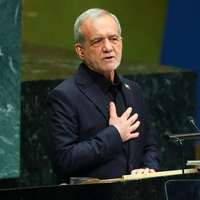
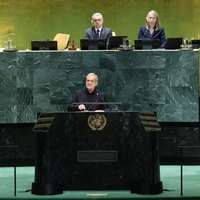
Conservatives embraced Pezeshkian’s defiant rhetoric at the General Assembly, while reformists highlighted his willingness to negotiate, allowing both sides to find something to welcome in an address that rejected surrender while keeping the door open to diplomacy.
The harder test may now come at the negotiating table.
US and Iranian negotiators in New York are exploring a phased agreement that could reopen the Strait of Hormuz in exchange for Washington lifting its economic blockade of Iran, Reuters reported Thursday.
Neither side wants to surrender its main source of leverage before the other acts, and the talks remain far from an agreement.
Any substantive movement toward such an arrangement could sharpen the domestic divisions that Pezeshkian’s speech temporarily managed to straddle, particularly among hardliners who have opposed negotiations with Washington.
‘We will not surrender’
Pezeshkian’s speech Wednesday night drew praise from senior officials including Parliament Speaker Mohammad Baqer Qalibaf, judiciary chief Gholam-Hossein Mohseni Ejei, Expediency Council Chairman Sadegh Amoli-Larijani and Army Commander Major General Amir Hatami.
Revolutionary Guards commander Ahmad Vahidi said Pezeshkian’s remarks reflected the position of the Iranian people.
“We are not afraid of war. This is the voice of the Iranian people that was heard by the world through him,” Vahidi wrote.
Acting Defense Minister Majid Ibn al-Reza also praised the speech, saying Iran’s message represented a “change in Iran’s defense doctrine” and that the country would accelerate the development of its military capabilities accordingly.
Kayhan, one of the strongest opponents of negotiations with the United States, said Pezeshkian had turned New York into a “court for prosecuting the crimes of Washington and Tel Aviv” and delivered a decisive response to US President Donald Trump.
Javan, a newspaper affiliated with the IRGC, put Pezeshkian’s “We will not surrender” phrase on its front page.
‘Strategic mistake’
Reformist newspapers, however, emphasized another part of the same address: Pezeshkian’s stated readiness for negotiations and engagement with the world.
Their headlines included “We are not afraid of war, we do not shy away from negotiations for peace” and “Neither warmongering nor fear of negotiations,” illustrating the markedly different ways the speech was being presented to domestic audiences.
The balancing act did not satisfy everyone.
Hardline journalist Davoud Modarresian described parts of the speech as worthy of praise but criticized Pezeshkian for travelling to New York and continuing to advocate negotiations.
In the face of Trump’s threats against Iran, he argued, declaring readiness for talks amounted to a “strategic mistake.”
Other hardline commentators complained that Pezeshkian had failed to demand retribution for US and Israeli attacks.
A speech for home?
Reformist journalist Ahmad Zeidabadi, meanwhile, questioned the enthusiastic reception from some of Pezeshkian’s most determined opponents of negotiations with the United States.
He asked whether those praising the president also supported his references to negotiations, or were selectively highlighting his more confrontational remarks in an effort to push the president in a more radical direction.
Some reformists saw the combination differently. Journalist Mohammad Sohofi argued that Pezeshkian sometimes employed populist slogans precisely to reduce tensions and marginalize hardline opponents of his policies.
Former Tehran Chamber of Commerce chairman Hossein Selahvarzi said the speech appeared designed more for a domestic audience than for the international community.
“Pezeshkian’s speech seemed to have been written more to be heard inside the country than to convince the world,” he wrote, arguing that the president should have presented more concrete proposals and initiatives.