US House passes Russia-Iran sanctions bill, sends measure to Trump
The US House of Representatives passed a sweeping sanctions bill targeting Russia and Iran on Wednesday, sending the measure to President Donald Trump’s desk after it cleared the Senate last month, CBS News reported.
The House approved the Lindsey O. Graham Sanctioning Russia and Iran Act of 2026 by a 262-159 vote, with 58 Democrats supporting it and seven Republicans opposed.
The bill, introduced by the late Senator Lindsey Graham, passed the Senate last month by an 86-11 vote.
The legislation would allow the president to impose tariffs of up to 100% on the largest purchasers of Russian oil or natural gas and impose sanctions on senior Russian officials, oligarchs, banks and financial institutions.
At Trump’s request, the measure also extends sanctions on Iran’s energy and weapons sectors.
Demonstrators hold Iranian flags and a banner reading “Zero enrichment we do not have a deal” during a rally outside the Atomic Energy Organization of Iran in Tehran, May 2025
Calls for Iran to withdraw from the Nuclear Non-Proliferation Treaty are gaining ground among hardliners after the IAEA referred the country to the UN Security Council and its nuclear chief was barred from attending the agency’s annual conference in Vienna.
The growing debate has exposed a divide within Iran’s political establishment between those who see NPT membership as offering little protection and others who warn that withdrawal would surrender one of Tehran’s remaining diplomatic and legal advantages.
Mohsen Rezaei, secretary of Iran’s Supreme National Security Council, appeared to threaten withdrawal from the treaty on Sunday, saying that “political and destructive actions” by the International Atomic Energy Agency would “push countries toward leaving the Nuclear Non-Proliferation Treaty.”
But President Masoud Pezeshkian reiterated the same day, during a visit to India, that Iran was not seeking nuclear weapons. “If we were seeking nuclear weapons, we would not have become a member of the NPT,” he said.
The debate intensified after Mohammad Eslami, head of Iran’s Atomic Energy Organization, was prevented from attending the IAEA General Conference in Vienna.
Austria had sought an exemption from a UN travel ban to allow Eslami to attend, but the sanctions committee did not approve it after a US objection.
Calls for immediate withdrawal
Supporters of immediate withdrawal say NPT membership has failed to protect Iran from international pressure or attacks on its nuclear facilities.
Continued membership, they argue, only makes sense if members’ nuclear rights are given equal weight alongside their obligations.
Sepehr Khalaji, who headed the Government Information Council under former President Ebrahim Raisi, questioned why Iran remained in the treaty.
“They bombed the nuclear facilities, martyred the scientists, sanctioned nuclear technology and say they will strike the remaining nuclear facilities. They referred Iran’s case to the Security Council, and they do not allow the head of the Atomic Energy Organization to enter the IAEA. So why are we still in the IAEA? Why don’t we withdraw from the NPT?” he wrote on X.
Parliamentary push
The debate has also reached parliament, where lawmakers are preparing a proposal for Iran to withdraw from the NPT.
Hassan-Ali Akhlaghi, a member of parliament, told the Fars news agency on Wednesday that lawmakers had prepared a triple-urgency bill that would be put to a vote if approved by the parliamentary leadership.
Given what he called the IAEA’s “entirely hostile and illogical” resolution, Akhlaghi said Iran should leave the treaty as soon as possible.
The proposal, however, has not yet formally reached parliament’s National Security and Foreign Policy Committee and is not currently on the parliamentary agenda.
Warnings of a trap
The conservative Khorasan newspaper on Wednesday warned that leaving the treaty could increase political and diplomatic pressure on Iran without producing significant security gains.
“On the surface, these positions may appear to be a revolutionary and deterrent response to the enemy; but when the pieces of the situation are put together, another worrying picture emerges,” it wrote.
Khorasan argued that the United States and Israel were deliberately trying to push Iran’s political debate toward more radical positions, including testing a nuclear weapon, changing its nuclear doctrine and immediately withdrawing from the NPT.
The newspaper said leaving the treaty before Iran had achieved deterrence could reveal Tehran’s intentions rather than demonstrate strength, potentially giving its opponents an opportunity to act.
“Iran has obtained an important part of the practical outcome without making an official and costly withdrawal: the IAEA no longer has its previous access, while Tehran continues to benefit from the legal protection of NPT membership and the political support of Russia and China,” Khorasan wrote.
“Official withdrawal would destroy this useful grey zone without creating a new strategic advantage.”
Reformist politician Rasoul Montajab-Nia made a similar argument.
“If the agency has not acted impartially toward Iran, we should not resort to disrupting the framework, because this would mean fuelling disputes and war with other countries.”
Montajab-Nia said withdrawal would not benefit Iran and would be “in line with Israel’s objectives.”
The nuclear threshold
At the outer edge of the debate, some advocates of developing nuclear weapons have argued that Iran should remain in the NPT unless it decides to change its nuclear doctrine — and then coordinate withdrawal with a nuclear test.
Foad Izadi, a hardline political commentator, told the Moj news agency that Iran had no need to leave the NPT while its current nuclear doctrine remained in place.
But if Tehran decided to change that doctrine, he said, Iran could withdraw from the treaty after a nuclear test or simultaneously with one.
In September 2022, the death of 22-year-old Mahsa Amini in the custody of Iran’s morality police ignited a fire that still burns.
Her arrest for “improper hijab” sparked the historic Woman, Life, Freedom movement, drawing women and men into the streets to demand an end to compulsory veiling and gender apartheid.
For many outside Iran, this seemed like a sudden eruption. But it was the continuation of a struggle that began long before 2022—and long before 1979.
Iran’s state-supported march toward women’s equality began in the early 20th century under Reza Shah, who ruled from 1925 to 1941 and believed modernization required women’s active participation in public life.
His 1936 decree compelling women to unveil—though heavy-handed—was a watershed moment, symbolizing women’s entry into civic life after centuries of seclusion.
Under the Pahlavi shahs, especially Mohammad Reza Shah, who ruled from 1941 to 1979, this state-led transformation expanded into education, political participation, family law and the workplace.
Modern schools for girls expanded dramatically, and by the late 1970s women made up a growing share of university students, entering specialized fields from medicine to engineering.
In 1963, Iranian women won the right to vote and run for office. Within a decade, women held seats in parliament, served as cabinet ministers and worked as judges. The Family Protection Laws of 1967, expanded significantly in 1975, curbed polygamy, raised the minimum marriage age and substantially expanded women’s rights in divorce and child custody.
By the late 1970s, women were increasingly visible as doctors, lawyers, executives, pilots and business leaders.
Together, these advances transformed the legal and social position of Iranian women and brought greater equality within reach.
That progressive trajectory ended abruptly in 1979. While Ayatollah Khomeini cloaked his takeover in the language of prosperity and liberation, he delivered a theocratic counter-revolution.
The Family Protection Laws were dismantled, female judges were removed from the bench, the minimum marriage age for girls was lowered, and compulsory veiling was progressively imposed.
Iranian women resisted almost immediately. In March 1979, thousands marched through the streets of Tehran against compulsory veiling. Yet the West, eager to believe Khomeini’s moderate diplomatic promises, looked away as women’s hard-won gains were rapidly erased.
The consequences of that original betrayal continue to shape Iran, though the Islamic Republic’s methods have changed dramatically. In recent years, state security networks have intensified enforcement through measures including the Noor Plan, which stepped up enforcement of compulsory hijab.
Street-level coercion has increasingly been supplemented by technology and punitive restrictions. Authorities have used surveillance cameras, heavy financial penalties and other restrictions against women who defy compulsory veiling.
Yet this expanding apparatus has failed to break the population’s resolve. The civil defiance that followed Mahsa Amini’s death helped lay the groundwork for subsequent protests that again shook the Islamic Republic.
As an immigration consultant in Canada, I speak to many Iranians seeking to leave Iran. Again and again, they tell me the same story: they want a future where their daughters can study freely, choose their own paths and live without fear.
The history of Iranian women’s struggle also carries a lesson for the outside world. In 1979, Western leaders mistook a theocratic revolution for a movement that would deliver greater political freedom. Today, the West risks repeating its mistakes if it prioritizes short-term “stability” or narrow regional de-escalation agreements over fundamental human rights.
Supporting Iranian women is not a matter of international charity. It is also a strategic question. A secular, free Iran could fundamentally reshape the political and security landscape of the Middle East, reducing the forces that have fuelled proxy warfare and threatened vital maritime routes.
Turkey has stepped in to take control of shareholder rights at a bank accused by Washington of helping Tehran turn oil revenues into cash and gold: the latest chapter in a decades-long story linking Turkish banking, US sanctions and Iranian money.
Golden Global Investment Bank was built largely by veterans of state-owned Halkbank, which itself inherited longstanding Iranian banking relationships when Turkey transferred the troubled Pamukbank to it two decades ago.
The same state fund that took control of Pamukbank in 2002 is now exercising shareholder rights covering nearly all of Golden Global.
The US Treasury sanctioned Golden Global, alleging it facilitated tens of millions of dollars in transactions for the Islamic Revolutionary Guard Corps’ Quds Force (IRGC-QF) and was established to help move Iranian oil revenues from China to Turkey for conversion into cash and gold.
Golden Global denies the allegations.
Turkey’s banking regulator moved on September 16 to put shareholder rights covering nearly all of Golden Global under the control of the country’s Savings Deposit Insurance Fund (TMSF).
The decision covers stakes held by three shareholders and excludes dividend rights. It comes three days before a US authorization to wind down dealings involving the bank expires.
Corporate filings show Golden Global drew its founding and subsequent leadership heavily from Halkbank. The bank opened in Istanbul in June 2020 with former Halkbank bankers as chairman and general manager, then recruited other veterans as chief executive, vice chairman, board member and compliance head.
Treasury’s designation does not name any of the Halkbank veterans personally. Their career connections are documented in corporate filings and published biographies; the US allegations concern Golden Global and its subsidiaries.
The sanctions came less than three months after a federal judge dismissed the US criminal case against Halkbank on June 17. That prosecution concerned alleged Iranian sanctions evasion between 2012 and 2016 and ended under a deferred prosecution agreement, without an admission of wrongdoing by Halkbank.
Golden Global faces a separate administrative sanctions action.
From Pamukbank to Halkbank
Pamukbank was a privately owned Turkish deposit bank founded in 1955. It established a representative office in Tehran in 1984 to support business between Turkey and Iran, two decades before becoming part of Halkbank.
Reporting on its opening, the Turkish newspaper Milliyet cited Pamukbank general manager Ibrahim Betil as saying inadequate banking links were hampering trade between the two countries. The bank said its Tehran presence would help financing and communication with Turkish businesses.
Pamukbank came under TMSF control in 2002 and was transferred to Halkbank in November 2004. Its assets, liabilities and branches passed to the state-owned lender, including the Tehran office and accounts Iranian banks already held at Pamukbank.
By 2005, Halkbank was publicly promoting its access to Iran’s oil business. Its annual report described it as the only Turkish bank authorized to open letters of credit directly to the National Iranian Oil Company. The Turkish edition also said its Tehran office helped handle large foreign-trade transactions with Iran.
Former Halkbank executive Hakan Atilla later testified in a US trial that the bank initially made only a preliminary assessment of the Iranian relationships inherited from Pamukbank and returned to them after its 2007 initial public offering. Halkbank itself later dated its Iran-related foreign-trade activity to 2004.
In January 2008, US Treasury Under Secretary Stuart Levey pressed Halkbank’s senior management over those Iranian ties. A US diplomatic cable records him urging the bank to close Iranian correspondent accounts and warning against expanding relationships with Iranian financial institutions seeking international partners.
The pressure continued in 2009, when Treasury officials warned Halkbank about Iranian efforts to disguise transactions. Halkbank officials said they financed documented trade and did not handle third-party, transit or cash-for-goods transactions.
From Halkbank to Golden Global
Golden Global later recruited bankers who had built their careers at Pamukbank and Halkbank, including in international banking, foreign operations and compliance.
The bank received its operating licence in early 2020 and opened for business on June 1. Its founding chairman, Mustafa Akin, had begun his career at Pamukbank in 1986 and managed branches for Pamukbank and Halkbank between 1994 and 2011.
Golden Global’s first general manager, Ozay Balta, had started at Halkbank as an assistant inspector in 2004 and served as a branch manager from 2012 to 2016. His published biography lists no other employer before Golden Global.
Yavuz Yeter became general manager in May 2024. He had joined Pamukbank’s Board of Inspectors in 1996 and moved to Halkbank in the 2004 merger, later serving in senior roles in its International Banking and Structured Finance department.
Yeter was therefore in senior international-banking roles during the period when Halkbank advertised its access to the National Iranian Oil Company and received Levey’s warning. That chronology does not establish that he handled the Iranian business. Atilla assigned responsibility for the Iranian accounts and Tehran office to a separate department.
Yeter later moved into senior central-bank roles. From 2016 to 2019 he held a banking-and-financial-institutions post at Turkey’s central bank. From 2020 to 2023 he served as its representative and economic attaché in Frankfurt, then advised its Istanbul office before joining Golden Global.
Coskun Cabuk joined Halkbank in the 2004 merger and worked across inspection, corporate banking and regional coordination, according to Golden Global’s 2025 annual report. The report gives no dates for those individual posts.
Cabuk stayed at Halkbank until 2017, then ran its leasing subsidiary, Halk Finansal Kiralama, until 2024. Golden Global shareholders elected him to the board for two years in March 2025 but his seat ended only a year later. Cabuk became general manager of Turkland Bank in July 2026.
The Halkbank connection also extended to compliance. Golden Global’s 2025 annual report identifies Cigdem Sefer as head of regulation and compliance. She began at Halkbank in 1996 and worked in its foreign operations, international banking and compliance units before joining Golden Global in November 2025.
Her unit’s responsibilities include evaluating correspondent relationships, screening customers and transactions against national and international sanctions, and overseeing obligations relating to money laundering, terrorism financing and proliferation financing.
Gold, cash and correspondent banking
Correspondent banking—the use of other banks to process payments and gain access to financial systems abroad—is central to Treasury’s allegations against Golden Global.
Treasury alleges the bank knowingly provided such services to Iranian financial institutions, enabling transactions through accounts controlled by the IRGC-QF and its proxies. It places Golden Global within Iran’s rahbar system, which it describes as a network of companies coordinating overseas payments for Iranian banks through foreign accounts and money exchangers.
The alleged network used correspondent banking, gold and cash to move funds.
The Treasury identifies Turkish businessman Sitki Ayan and his companies among the networks involved. OFAC sanctioned that network in 2022. Golden Global says it has had no direct or indirect dealings with those individuals..
Golden Global’s own figures show substantial growth in those areas of its business. Its 2025 report lists 45 accounts held at 20 banks in 17 countries and 66 accounts hosted for 25 banks from 16 countries. Those 25 banks are not identified.
Fees paid for foreign settlement services rose 56 percent in 2025 to 482 million lira. The bank also reported playing a critical role in settling $1.8 billion in gold transactions in 2025, nearly three times the $613 million reported a year earlier.
Physical banknote trading reached $4.4 billion, an increase of about 70%. Golden Global also reported $21.9 billion in interbank foreign-exchange trades, nearly double the previous year, and $14.5 billion in currency swaps, more than twice the 2024 total.
The reports document substantial activity in the same types of services Treasury says the Iranian network used. Those aggregate figures do not, on their own, establish which transactions involved sanctioned parties.
The September 19 deadline
Treasury designated Golden Global under Executive Order 13902, which targets specified sectors of Iran’s economy, including finance. It placed the action within Operation Economic Outcast, a campaign announced in August to intensify pressure on Iran’s remaining financial and trading channels.
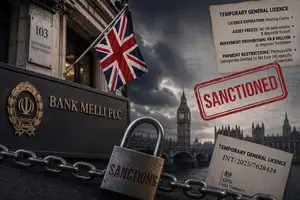
The sanctions are already in effect. OFAC’s General License CC provides limited authorization for transactions ordinarily necessary to wind down dealings involving Golden Global and other covered entities. That authorization expires at 12:01 a.m. Eastern time on September 19.
The license carries conditions, including a requirement that payments to blocked persons go into blocked, interest-bearing accounts in the United States. When it expires, transactions covered by the licence lose that authorization.
Treasury has also warned that foreign financial institutions conducting or facilitating certain significant transactions on behalf of designated entities could face prohibitions or restrictions on their US correspondent accounts.
For Golden Global, whose business reaches counterparties across more than a dozen countries, the immediate pressure therefore extends beyond its Istanbul office to the institutions connecting it to the international financial system.
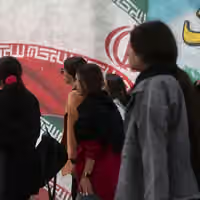
Women are seen at an outdoor market in Iran without the mandatory hijab in September 2026.
Four years after the Woman, Life, Freedom protests, Iran International asked women on Instagram to describe the first time they went out without a headscarf. The answers came back in the same four registers: fear, freedom, grief and solidarity.
“I felt like a human being, that I had the right to choose and that others could no longer decide for me,” one woman wrote.
Most of the responses portrayed removing the headscarf not simply as a change in clothing, but as an emotional experience accompanied for many by anxiety over possible consequences.
Freedom and fear
Words including freedom, relief, lightness and power appeared repeatedly in the responses. Some said going without a headscarf gave them a sense of making their own decisions about their bodies and clothing.
But many described fear alongside that sense of freedom.
Some others said they initially carried a headscarf in their bags, repeatedly looked around while walking or worried about being confronted.
One woman recalled leaving home without carrying a scarf for the first time in November 2022.
“I was wearing a hooded puffer jacket so I could do something if I had to. It was the first time I had left home without taking a scarf with me, and my heart was racing with fear the whole time. But now wearing a headscarf feels unusual to me,” she wrote.
Another respondent said seeing other women without headscarves gradually reduced her anxiety.
“I was extremely afraid, but seeing people like me made me less frightened and gave me more courage,” she wrote.
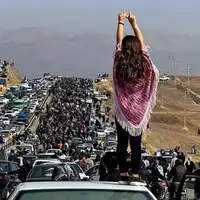
Public defiance of compulsory hijab expanded after the death of 22-year-old Mahsa Amini in September 2022, three days after her detention by Iran’s morality police, triggering the nationwide Woman, Life, Freedom protests.
‘When the wind touched my hair’
Several focused on physical sensations that had previously been denied to them in public, including feeling wind in their hair or cool air on their face and neck.
Iranian women without the mandatory hijab browse stalls at an outdoor market in August 2026.
One woman said going completely without a scarf and feeling the wind in her hair was so different that she regretted experiencing it at 40 rather than 20.
“The first time I sat behind the wheel wearing a T-shirt, I was about to cry,” another woman wrote. “Why did we have to wear so many clothes and suffocate in the heat? When the air touched me, I felt light.”
Another wrote: “When the wind touched my hair, face and neck, I enjoyed feeling it without having to fix my headscarf afterward or untangle the hair underneath it.”
The accounts come as messages sent to Iran International in recent days described the return of morality patrols and increased pressure on women in cities including Isfahan, Rasht, Fuman, Mashhad and Neyshabur.
Gholam-Ali Haddad-Adel, a member of Iran’s Expediency Council, another the Supreme Leader Mojtaba Khamenei’s father-in-law said on September 9 that the Islamic Republic could not enforce its hijab requirements as extensively as it wanted because of “war conditions,” describing the situation as more difficult than in 1980s.
Grief and solidarity
For some, taking off the headscarf brought the dead with it.
One woman wrote that the experience did not bring a sense of freedom because she remembered the “heavy price” young people had paid. Others recalled crying or experiencing happiness and grief simultaneously.
Solidarity between women also featured prominently.
A middle-aged woman in Pardis, near Tehran, said she was among the first women of her age there to remove her headscarf.
Another recalled girls periodically giving her chocolates with notes thanking her for her courage.
“I will never forget the smile I had at that moment,” she wrote.
Others described smiles and encouragement from women they did not know, while some said simply seeing others without headscarves helped their fear subside.
For some women, there was no defining first time. Years of gradually pushing back against compulsory hijab had blurred that boundary, while others said workplace rules, restrictions on clothing or decades of habit still kept them from abandoning the headscarf altogether.
The responses also showed how the experience stretched across generations. A 70-year-old woman said she had stopped wearing a headscarf completely at 60. Another, born in the 1960s, described removing it as unexpectedly recovering a piece of her youth.
“I couldn’t believe I was feeling like a teenager again,” she wrote.
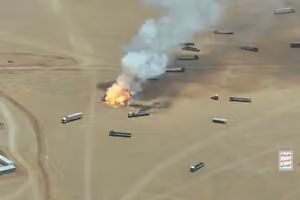
Iran-aligned Houthi fighters pose next to a captured vehicle following what the source described as an attack on Saudi-backed forces in the location given by the source as al Jawf governorate, Yemen, in this screengrab taken from a video released by Houthi Military Media on September 15, 2026
US officials met representatives of Yemen's Iran-aligned Houthis in Oman over the weekend, Reuters reported on Wednesday, citing five sources familiar with the matter, days after the group seized a strategic stretch of Yemen's Red Sea coast.
The previously undisclosed meeting was held at the US Embassy in Muscat, three of the sources told Reuters. Two said Oman, a longtime regional mediator, helped organize the talks.
One source said the meeting took place on Sunday. US embassy personnel represented Washington, while the Houthi delegation included senior official Mohammad Abdulsalam, who is under US sanctions, and Abdelmalik al-Ajiri, according to Reuters.
The Houthis told US officials they did not intend to attack American vessels and remained committed to a ceasefire reached with Washington in 2025, two sources told Reuters.
A Yemeni source said the group also said it would not attack Israeli ships or other commercial vessels, except those belonging to Saudi Arabia.
The State Department did not confirm the meeting but said protecting freedom of navigation in the Red Sea and preventing terrorism from spreading from the Middle East were core US interests.
President Donald Trump said on Saturday that the Houthis had contacted his administration and asked Washington to stay out of the Yemen war. Vice President JD Vance said on Monday that the United States was in direct contact with the group.
The Trump administration designated the Houthis a "foreign terrorist organization" in March 2025.
Washington nevertheless negotiated with the group later that year and reached a ceasefire in May after two months of US strikes aimed at stopping attacks on Red Sea shipping.
The latest talks came after the Houthis seized effective control of Yemen's Red Sea coastline, including the port of Mocha and Perim Island in the Bab el-Mandeb Strait, a key route for international shipping.
Saudi-Houthi fighting intensifies
Later on Wednesday, Houthi military spokesman Yahya Saree said that the group had attacked an airbase in Khamis Mushait as well as Aramco facilities in Yanbu. Saudi Arabia did not confirm either of the attacks.
The Houthis have fought a Saudi-led coalition for more than a decade after seizing Yemen's capital, Sanaa, in 2014.
Fighting had largely eased under a ceasefire but resumed in July after the Houthis declared a blockade of Saudi shipping in the Red Sea in response to a Saudi blockade of Yemeni ports.
Saudi warplanes have since struck Houthi positions as the group has advanced along the Red Sea coast and launched attacks toward Saudi Arabia.
Riyadh sought US help
Saudi Crown Prince Mohammed bin Salman called Trump last week seeking US military support as the Houthi offensive accelerated, Reuters reported.
Washington told Riyadh it would not become directly involved in the fighting, according to Reuters.
The escalation has also increased pressure on global energy supplies already disrupted by the Iran war and reduced shipping through the Strait of Hormuz.