• العربية
  • فارسی
Brand
  • Iran Insight
  • Politics
  • Economy
  • Analysis
  • Special Report
  • Opinion
  • Podcast
  • Live TV
  • Iran Insight
  • Politics
  • Economy
  • Analysis
  • Special Report
  • Opinion
  • Podcast
  • Live TV
  • Theme
  • Language
    • العربية
    • فارسی
  • Iran Insight
  • Politics
  • Economy
  • Analysis
  • Special Report
  • Opinion
  • Podcast
  • Live TV
All rights reserved for Volant Media UK Limited
volant media logo

Calls to quit NPT grow in Iran as critics warn of strategic trap

Maryam Sinaiee
Maryam Sinaiee

Iran International

Sep 17, 2026, 00:30 GMT+1
Demonstrators hold Iranian flags and a banner reading “Zero enrichment we do not have a deal” during a rally outside the Atomic Energy Organization of Iran in Tehran, May 2025

Calls for Iran to withdraw from the Nuclear Non-Proliferation Treaty are gaining ground among hardliners after the IAEA referred the country to the UN Security Council and its nuclear chief was barred from attending the agency’s annual conference in Vienna.

The growing debate has exposed a divide within Iran’s political establishment between those who see NPT membership as offering little protection and others who warn that withdrawal would surrender one of Tehran’s remaining diplomatic and legal advantages.

Mohsen Rezaei, secretary of Iran’s Supreme National Security Council, appeared to threaten withdrawal from the treaty on Sunday, saying that “political and destructive actions” by the International Atomic Energy Agency would “push countries toward leaving the Nuclear Non-Proliferation Treaty.”

But President Masoud Pezeshkian reiterated the same day, during a visit to India, that Iran was not seeking nuclear weapons. “If we were seeking nuclear weapons, we would not have become a member of the NPT,” he said.

The debate intensified after Mohammad Eslami, head of Iran’s Atomic Energy Organization, was prevented from attending the IAEA General Conference in Vienna.

Austria had sought an exemption from a UN travel ban to allow Eslami to attend, but the sanctions committee did not approve it after a US objection.

Calls for immediate withdrawal

Supporters of immediate withdrawal say NPT membership has failed to protect Iran from international pressure or attacks on its nuclear facilities.

Continued membership, they argue, only makes sense if members’ nuclear rights are given equal weight alongside their obligations.

Sepehr Khalaji, who headed the Government Information Council under former President Ebrahim Raisi, questioned why Iran remained in the treaty.

“They bombed the nuclear facilities, martyred the scientists, sanctioned nuclear technology and say they will strike the remaining nuclear facilities. They referred Iran’s case to the Security Council, and they do not allow the head of the Atomic Energy Organization to enter the IAEA. So why are we still in the IAEA? Why don’t we withdraw from the NPT?” he wrote on X.

Parliamentary push

The debate has also reached parliament, where lawmakers are preparing a proposal for Iran to withdraw from the NPT.

Hassan-Ali Akhlaghi, a member of parliament, told the Fars news agency on Wednesday that lawmakers had prepared a triple-urgency bill that would be put to a vote if approved by the parliamentary leadership.

Given what he called the IAEA’s “entirely hostile and illogical” resolution, Akhlaghi said Iran should leave the treaty as soon as possible.

The proposal, however, has not yet formally reached parliament’s National Security and Foreign Policy Committee and is not currently on the parliamentary agenda.

Warnings of a trap

The conservative Khorasan newspaper on Wednesday warned that leaving the treaty could increase political and diplomatic pressure on Iran without producing significant security gains.

“On the surface, these positions may appear to be a revolutionary and deterrent response to the enemy; but when the pieces of the situation are put together, another worrying picture emerges,” it wrote.

Khorasan argued that the United States and Israel were deliberately trying to push Iran’s political debate toward more radical positions, including testing a nuclear weapon, changing its nuclear doctrine and immediately withdrawing from the NPT.

The newspaper said leaving the treaty before Iran had achieved deterrence could reveal Tehran’s intentions rather than demonstrate strength, potentially giving its opponents an opportunity to act.

“Iran has obtained an important part of the practical outcome without making an official and costly withdrawal: the IAEA no longer has its previous access, while Tehran continues to benefit from the legal protection of NPT membership and the political support of Russia and China,” Khorasan wrote.

“Official withdrawal would destroy this useful grey zone without creating a new strategic advantage.”

Reformist politician Rasoul Montajab-Nia made a similar argument.

“If the agency has not acted impartially toward Iran, we should not resort to disrupting the framework, because this would mean fuelling disputes and war with other countries.”

Montajab-Nia said withdrawal would not benefit Iran and would be “in line with Israel’s objectives.”

The nuclear threshold

At the outer edge of the debate, some advocates of developing nuclear weapons have argued that Iran should remain in the NPT unless it decides to change its nuclear doctrine — and then coordinate withdrawal with a nuclear test.

Foad Izadi, a hardline political commentator, told the Moj news agency that Iran had no need to leave the NPT while its current nuclear doctrine remained in place.

But if Tehran decided to change that doctrine, he said, Iran could withdraw from the treaty after a nuclear test or simultaneously with one.

Banner

Most Viewed

After Muscat collapse, Tehran argues over what comes next
1
ANALYSIS

After Muscat collapse, Tehran argues over what comes next

2
ANALYSIS

Iran's Saudi leverage could become its liability

3

Islamic Republic asks public to identify opponents abroad

4

Hormuz traffic plunges ahead of Iran-China talks

5

Xi’s BRICS peace call sparks debate in Iran over China’s role in war

Banner

Spotlight

  • From Halkbank to Golden Global: Iran sanctions and Turkey’s banking ties

    From Halkbank to Golden Global: Iran sanctions and Turkey’s banking ties

  • A generation shaped by Woman, Life, Freedom refuses to go back
    ANALYSIS

    A generation shaped by Woman, Life, Freedom refuses to go back

  • Mahsa Amini and the century-long struggle of Iranian women
    INSIGHT

    Mahsa Amini and the century-long struggle of Iranian women

  • ‘This is the cost you must pay’: Iran accused of denying food to death-row twin

    ‘This is the cost you must pay’: Iran accused of denying food to death-row twin

  • January's unfinished love stories: Lives severed by Iran protest killings

    January's unfinished love stories: Lives severed by Iran protest killings

  • After Muscat collapse, Tehran argues over what comes next
    ANALYSIS

    After Muscat collapse, Tehran argues over what comes next

Banner
Banner
•
•
•

More Stories

Tehran political circles see US hand in postponement of Oman Hormuz talks

Sep 15, 2026, 20:28 GMT+1
•
Maryam Sinaiee
100%
Omani Foreign Minister Badr al Busaidi visited Tehran on August 25, 2026 for talks with his counterpart Abbas Araghchi.

Iranian lawmakers, hardline media and analysts have blamed Washington for postponing Oman-hosted talks on Strait of Hormuz shipping arrangements, despite officials attributing the delay to regional objections and Saudi concerns over Yemen.

Omani Foreign Minister Badr Albusaidi said the meeting, scheduled for Monday in Salalah, was postponed “in the interests of consensus.” An Iranian Foreign Ministry official separately said the delay came at the request of “some regional countries,” while spokesman Esmail Baghaei said Saudi Arabia had sought the postponement because of developments in Yemen.

No new date has been announced for the meeting.

Baghaei described the planned gathering as an “opportunity” created by Iran and Oman and urged regional states not to let it slip away.

“I don’t think any responsible party would accept that we should lose this opportunity for any reason, whether because of outside interference or because of excuses that really have nothing to do with Iran, and that we should not hold this meeting,” he said Monday.

Several voices in Iran have gone further, explicitly accusing Washington of working to derail the initiative.

Fada-Hossein Maleki, a member of parliament’s National Security and Foreign Policy Committee, told Tabnak that the United States had sought from the outset to prevent the Muscat process from taking shape or, if the meeting went ahead, to ensure Washington participated as a third party.

He said an Iran-Oman understanding on Hormuz could represent “another political defeat for the United States” because Washington had sought a role in arrangements concerning the strategic waterway, while Iran and Oman had pursued dialogue over its future management and shipping arrangements independently of Tehran-Washington negotiations.

Ali Gholhaki, an adviser to parliamentary speaker Mohammad-Bagher Ghalibaf, wrote on X that Saudi Arabia, Bahrain and the United Arab Emirates had obstructed the Oman meeting, but said “the main actor behind the cancellation of this meeting is America!”

International affairs analyst Mir-Ghasem Momeni offered a similar interpretation, telling ILNA that the postponement was aimed at increasing pressure on Iran and extracting further concessions.

“This is a scenario designed by the Americans, with Saudi Arabia and other countries carrying it out,” he said.

Saudi concerns offer another explanation

Saudi Arabia’s request came amid mounting tensions over Yemen and attacks on its energy infrastructure, providing a more immediate explanation for Riyadh’s reluctance to proceed with the talks.

The Houthis have stepped up pressure on Saudi Arabia amid fighting in Yemen, while attacks on Saudi energy infrastructure have added to concerns over the security of alternative export routes as traffic through the Strait of Hormuz remains disrupted.

Hardline Kayhan newspaper nevertheless alleged that Saudi Arabia had used the recent escalation involving the Houthis and attacks on Saudi infrastructure as a pretext to derail the planned meeting.

The Javan newspaper, affiliated with the Revolutionary Guards (IRGC), sought to connect Riyadh’s position more directly to Washington, pointing to Saudi Crown Prince Mohammed bin Salman’s meeting with US Central Command chief Adm. Brad Cooper on Monday as evidence of what it described as US-Saudi coordination against the talks.

The meeting took place after Oman announced the postponement on Sunday night, however, and there is no public evidence linking Cooper’s visit to the decision to delay the Salalah gathering. Saudi state media said Mohammed bin Salman and Cooper discussed bilateral relations and the latest regional developments.

Limits of regional diplomacy

Some Iranian analysts have interpreted the postponement as evidence of a broader problem with attempts to resolve the Hormuz crisis solely through regional diplomacy.

Momeni argued that Washington retained enough influence over Persian Gulf Arab states to prevent them from reaching an independent arrangement with Tehran.

“The solution to the Strait of Hormuz problem is not an agreement between Iran and the Arab countries, but an agreement between Iran and the United States,” he said.

Political analyst Rahman Ghahramanpour wrote on X that the postponement was a sign of President Donald Trump’s reluctance to revive the Islamabad framework and his preference for designing a new framework that would simultaneously address the reopening of the Strait of Hormuz and the nuclear issue.

International relations professor Mohsen Jalilvand told Fararu that it had been clear from the outset that the meeting either would not take place or would fail to produce a tangible outcome because the principal parties to the conflict, particularly the United States and Israel, were absent from the negotiating table.

Jalilvand said that if the objective was to establish a durable mechanism for managing transit through the Strait of Hormuz, parties with genuine deterrent capabilities and the power to enforce an agreement would have to participate.

“Otherwise, regional treaties alone cannot provide a strong security guarantee for changing the current situation,” he said.

He added that the significance of the Oman meeting lay not simply in whether it was held, but in what its postponement revealed about the limits of regional diplomacy.

Opposition inside Iran

Not all criticism inside Iran has focused on why the meeting was postponed.

Kayhan editor Hossein Shariatmadari, a strong opponent of the understanding with Oman, has argued that the proposed arrangement amounts to giving the United States “a breathing space” and that Iran should not negotiate with other Persian Gulf countries over reopening the Strait of Hormuz.

In a Monday commentary, Shariatmadari sharply criticized the decision to invite other Persian Gulf states to the meeting, accusing them of protecting US and Israeli interests.

“As long as they have not paid the price for supporting the crimes of America and Israel and have not been punished, they should have no role or presence whatsoever in the decision-making of the Islamic Republic of Iran,” he wrote.

After Muscat collapse, Tehran argues over what comes next

Sep 15, 2026, 14:14 GMT+1
•
Behrouz Turani
100%
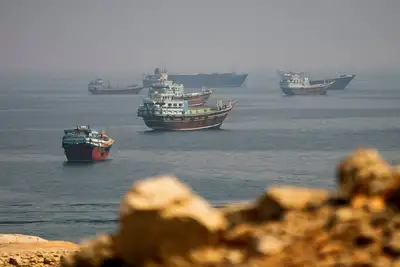
Vessels near the Strait of Hormuz, as seen from Musandam, Oman, August 31, 2026.

Iranian newspapers that agree on almost nothing agreed on Monday that the Muscat talks had collapsed. Kayhan, Shargh and Donya-ye Eghtesad all reported it, and the argument has already moved to what Tehran does next.

Kayhan on the hard right, and Shargh and Donya-ye Eghtesad on the pragmatic and pro-reform side of the divide, all reported that the talks in Oman had effectively broken down, leaving Tehran without an immediate way out and its economy exposed to worsening inflation, shortages and a lurching currency.

The meeting had been meant to give Iran a diplomatic opening. Foreign Minister Abbas Araghchi was due to present maps for a "managed transit corridor" through the Strait of Hormuz, and to seek regional endorsement of an Iran-Oman "phased framework," a temporary joint corridor and mine-clearance plan.

It did not happen. Fars News, affiliated with the Revolutionary Guards, reported that the postponement had been a joint decision by Tehran and Muscat, taken at the request of unnamed "certain regional countries."

Behind that phrasing sat a refusal. Saudi Arabia and Bahrain did not attend, and the Arab monarchies of the Persian Gulf declined to endorse Iran's transit proposal. They were being asked to back a plan for safe passage through Hormuz at a moment when Iran-aligned Houthi forces were expanding strikes on Saudi Arabia's East-West pipeline and fortifying coastal artillery at Bab el-Mandeb after taking the port of Mokha.

Washington's position was its own obstacle. It rejected treating the shipping question in isolation, insisting any transit arrangement be tied to broader nuclear concessions. Tehran's answer was that normal shipping requires an immediate halt to US tanker interdictions and the release of $24 billion in frozen Iranian assets under the Islamabad framework. Neither side moved.

The argument in Tehran

With the diplomatic route stalled, the argument inside Iran has turned to force, and the failure in Oman has sharpened it.

Kayhan, other Guards-aligned outlets and figures in the ultraconservative Paydari Front are pressing to abandon proportional retaliation altogether and to strike all Western-aligned shipping if a single Iranian vessel is hit.

They have paired this with a push to treat calls for referendums or ceasefires as treason, to cast economic hardship as an ideological duty, and to demand full withdrawal from the Non-Proliferation Treaty after the IAEA referred Iran to the UN Security Council.

Reformist and moderate figures in the administration argue instead for keeping the channels through Qatar and Oman open and putting economic survival first. But this is a dispute over method, not over the system either camp is defending: one faction would answer the blockade with escalation across the Persian Gulf and Red Sea, the other fears that combining a naval blockade abroad with intensified repression at home would leave Iran isolated on both fronts at once.

That repression is already visible. Police and the Revolutionary Guards have increased street patrols and moved additional forces into Tehran and Isfahan ahead of the anniversary of the 2022 Woman, Life, Freedom protests, which began in mid-September.

The economy behind the argument

The deadlock feeds directly into the crisis that produced the talks in the first place.

Point-to-point inflation is nearing 90 percent, and on the open market the rial is at 2.3 million to the dollar. Against a minimum monthly wage now worth about $72, the volatility alone makes household budgeting impossible.

The sharpest damage is in medicine. Container backlogs at Bandar Abbas, Iran's main southern port, have choked domestic pharmaceutical production and caused acute shortages of essential drugs. Out-of-pocket medical costs have more than doubled, pushing low-income households to abandon treatment. In call-ins to Persian-language television abroad, viewers have described selling household belongings to pay for care.

The government's own remedies have added to the strain. It has raised petrol prices and drawn on the central bank's foreign currency reserves, steps that have deepened the erosion of public trust rather than eased it.

The postponement, then, does more than delay a meeting. It removes Tehran's nearest diplomatic exit at a moment when the hardline factions are pressing for wider retaliation across the Persian Gulf and the Red Sea, and when the economy can least absorb what that would cost. Whatever Iran's rival camps decide, it is private businesses and urban households that will carry it.

Islamic Republic asks public to identify opponents abroad

Sep 15, 2026, 10:34 GMT+1
•
Hooman Abedi
100%
Photos published by Iran’s Alaj platform show Iranians abroad targeted by the project, which asks members of the public to help identify and report overseas opponents of the Islamic Republic.

The Islamic Republic has launched a platform asking citizens to identify and report opponents living abroad. Iranians met it with ridicule, pointing to how deeply the state's own security apparatus has been infiltrated.

The Alaj platform – whose name means “remedy” or “cure” in Persian – accepts information through its website, a Telegram bot and Iran's Bale messaging service.

“Alaj operates with the aim of safeguarding national security against anti-Iranian currents,” the Guards-affiliated Fars News Agency said in announcing the project on Monday.

State television also promoted Alaj, giving wider exposure to a system Iranian media had previously discussed but not promoted on the same scale.

Alaj says it has identified and monitored 1,600 people, including 600 identified through reports from members of the public, according to Iranian state media.

Its website publishes information about Iranians abroad, including names and photographs and, in some cases, national identification numbers, dates of birth and fathers' names.

  • Iran uses embassies abroad for surveillance and subterfuge, ex-staff say

    Iran uses embassies abroad for surveillance and subterfuge, ex-staff say

The platform says it targets people outside Iran who act “against the country's interests and security,” including those advocating sanctions or military action and members of separatist groups.

Alaj also lists potential measures against people it identifies, including freezing assets and withdrawing access to consular and citizenship services.

The project's name carries a pointed connotation. Alaj translates as “remedy” or “cure,” framing the people targeted by the platform as a problem to be treated.

People ridicule campaign

Responses to the post promoting Alaj ranged from mockery of Iran's security establishment to explicit warnings that people who inform on opponents could themselves be identified and punished in the future.

One commenter predicted the platform would be hacked and the identities of those submitting reports made public, arguing that previous breaches of major Iranian institutions gave little reason to trust Alaj with sensitive information.

100%

Another suggested the government's turn could eventually come, writing that authorities appeared to have little hope left even of securing future amnesty.

Others portrayed the campaign as a tactic opponents of the Islamic Republic could use themselves. One user said supporters of the Revolutionary Guards and Hamas abroad had already been publicly identified by opponents and several had lost their jobs as a result.

Several responses contrasted the effort to identify ordinary Iranians overseas with Israel's apparent intelligence penetration inside Iran.

“Start with the infiltrators inside your own ranks,” one person wrote, arguing that Israeli intelligence appeared to have extensive knowledge of Iranian officials.

Another mocked the limits of Iran's controls over information, asking whether authorities intended to “nationalize the internet outside the country” to prevent overseas opposition activity.

  • Iran International journalists face escalating threats from Tehran - Forbes

    Iran International journalists face escalating threats from Tehran - Forbes

Other comments were considerably more explicit, threatening revenge against people who cooperate with Alaj after any future change of government.

Pezeshkian targets Iranians abroad

The campaign coincides with sharper official rhetoric toward politically active Iranians overseas.

“Some Iranians abroad, aligning themselves with the enemy, seek to incite the public within the country,” President Masoud Pezeshkian said during a social event on Monday, according to state media.

Pezeshkian accused Washington of seeking “to cause social collapse through the problems and restrictions they have imposed,” and said preserving domestic unity would prevent Iran from yielding to US pressure.

Guards used similar model at home

Alaj follows a similar crowdsourcing project launched by the Revolutionary Guards Intelligence Organization in June to identify citizen journalists and social-media users inside Iran.

Known as Jasous-Yab, or “Spy Finder,” the project used channels on the Iranian Eitaa and Bale messaging platforms to ask members of the public to identify people photographing or filming missile strikes and other sensitive locations.

“This time, you identify the spies,” the campaign told users.

100%
A large gathering of Iranians in Munich, Germany, in February 2026, with participants waving Lion and Sun flags.

People were instructed to scrutinize buildings, roads, sounds, distances and other details visible in photographs and videos to determine where material had been recorded and submit information to Revolutionary Guards intelligence.

The project also sought to identify social-media users opposing the Islamic Republic, extending its scope beyond people recording events on the ground.

Alaj takes that crowdsourcing model beyond Iran's borders, asking citizens to help identify overseas opponents and feeding the resulting information into a system that advertises consequences for those it identifies.

Overseas operations

Iranian intelligence activity targeting dissidents and journalists overseas has previously prompted criminal investigations, sanctions and warnings from Western governments.

  • Western powers condemn Iran over targeting opponents abroad

    Western powers condemn Iran over targeting opponents abroad

Authorities in the United States and Europe have accused Iranian security bodies and people working on their behalf of conducting surveillance and plotting abductions or killings of opponents abroad.

Activities linked to Alaj could therefore face scrutiny under espionage, foreign-interference or transnational-repression laws in countries where targets live, depending on how information is gathered and subsequently used.

Xi’s BRICS peace call sparks debate in Iran over China’s role in war

Sep 15, 2026, 08:38 GMT+1
•
Maryam Sinaiee
100%
Chinese President Xi Jinping speaks during a meeting with India’s Prime Minister Narendra Modi on the sidelines of the BRICS Summit in New Delhi, India, September 12, 2026.

China’s call for a collective BRICS role in restoring peace in the Persian Gulf and Middle East has triggered debate in Iran over whether Beijing is preparing to mediate between Tehran and Washington.

Chinese President Xi Jinping said on Saturday that Beijing was willing to work with other BRICS members to help restore peace and stability in the Persian Gulf and the Middle East, offering a four-point proposal aimed at reducing tensions, ending hostilities and promoting peace.

Xi’s remarks at the opening of the 18th BRICS summit in New Delhi marked China’s first public signal since the Iran-US war began six months ago that it was willing to take an active role in addressing the crisis through a coordinated BRICS effort.

Beijing has so far stopped short of directly involving itself in mediation over the conflict. It has condemned attacks on Iran, issued a broad four-point proposal during Xi’s visit to Cairo in April and called on the parties to return to negotiations. Some analysts have also said China has quietly supported mediation efforts by Pakistan and Qatar in recent months.

Mixed reactions in Iran

Former Iranian foreign minister Mohammad-Javad Zarif welcomed China’s offer on Sunday in a post on X, describing it as an opportunity to reduce tensions.

He said the move provided a “timely opportunity to ease tensions” and added that multilateral diplomacy was the only viable path to achieve peace.

Ramin Mehmanparast, a former Iranian foreign ministry spokesman, told Donya-e Eqtesad that China had clear economic and strategic interests in stability in the Persian Gulf.

“China, in addition to seeking a role in the balance of power in the world, certainly sees stability in the Persian Gulf and the Strait of Hormuz as being in line with its long-term economic interests and views tensions and conflict in this region as contrary to its interests,” he said.

He added: “The Chinese are expected to become more seriously involved and, certainly, they have the necessary capacity to exert influence.”

Rahman Ghahremanpour, a senior Middle East researcher, also said Xi’s initiative was unlikely to have been made by chance.

Xi’s comments about BRICS efforts to promote peace in the Middle East should be taken seriously, he told Donya-e Eqtesad. China has both the diplomatic capacity and the incentive to act, he said, given its concerns that a prolonged crisis could harm its economic interests and regional standing.

Ghahremanpour also wrote on X that if reports of China’s willingness to mediate were accurate, they would represent a significant development that was probably not announced without coordination with Tehran.

He suggested that US President Donald Trump’s comments about an end to the war after the US midterm elections could potentially be connected to reports of China’s interest in mediation.

But not all Iranian reactions were positive.

Heshmatollah Falahatpisheh, a former chairman of parliament’s National Security and Foreign Policy Committee, accused Xi of seeking closer alignment with Washington.

“By presenting a plan for negotiations, Xi Jinping is trying to please Trump and, in return, obtain concessions from the United States over new trade tariffs,” he told Nameh News.

Reformist politician Abbas Akhoundi, who views the US-Iran war partly through the lens of US-China competition over resources transported through the Persian Gulf, argued that Tehran would ultimately need to engage with Beijing over regional security.

“I believed, and still believe, that achieving a security regime in the Persian Gulf can be achieved through dialogue with China,” he wrote on X. “Between the lines of Mr Xi’s recent positions, I understand that if we do not move towards a mechanism for the security of the Strait of Hormuz in coordination with China, we will come under pressure from China and conditions will become harder for the Iranian government and people.”

Was Xi offering to mediate?

Some Iranian media outlets and analysts have cautioned against interpreting Xi’s remarks as a formal offer to mediate between Tehran and Washington.

They argue that Xi did not explicitly refer to mediation between Iran and the United States. Instead, he stressed cooperation among BRICS members in efforts to restore peace and stability in the Persian Gulf and Middle East.

Hamed Vafaei, a professor of Chinese literature at the University of Tehran and a China researcher, said the interpretation of Xi’s remarks as a Chinese offer to mediate was “a free interpretation” of his comments.

In a note titled “What did Xi Jinping say in India and what did we hear in Iran?” he published on X, Vafaei said the remarks should not be regarded as a sudden development or an official announcement by Beijing that it would mediate between Tehran and Washington.

Rather, he said, they should be viewed as part of a gradual evolution in China’s West Asia diplomacy that began in the early stages of the 12-day war and has continued since.

“Xi Jinping’s position today, for experts who have closely monitored and analysed Beijing’s positions over the past months, contains only one important signal, several emphases and, in his own words, a kind of pioneering declaration of responsibility for the times — not a new position announcing mediation between Iran and America,” Vafaei wrote.

Why Beijing is cautious

Ghahremanpour said China was likely to proceed cautiously because it faced risks on both sides.

“On the one hand, the Chinese are concerned that Iran may not accept their demands, and on the other, they are worried that the United States may not welcome their initiative, and therefore they are acting very cautiously,” he told Donya-e Eqtesad.

“If China tries to mediate but the problem is not resolved, differences between Iran and the countries of the region will intensify and China will be regarded as one of those responsible,” he said. “If it also enters at the global level and faces a negative response from either Iran or the United States, its credibility will be called into question.”

Canada-based analyst Shahir Shahid-Saless said Xi’s caution was understandable given the need to simultaneously manage China’s relations with the United States and Israel while preserving its important strategic and economic relationships with Iran and the Arab states of the Persian Gulf.

A failed Chinese mediation effort, he said, could impose a significant political and reputational cost on Xi personally and seriously damage his credibility.

“By placing the issue within BRICS, Xi spreads the responsibility and avoids making China, and himself, the sole owner of a possible failure,” he wrote.

“There is also a fundamental obstacle: it is difficult to imagine Washington entrusting negotiations over the Iran war to BRICS, an organization increasingly presented as an alternative to Western-led institutions and one in which Iran itself is a member,” he added.

IAEA raises alarm over Iran access amid mounting Hormuz tensions

Sep 14, 2026, 13:23 GMT+1
100%
Pedestrians walk past a billboard promoting Iran’s nuclear program in Tehran.

Concern over Iran’s nuclear program intensified on Monday as the UN nuclear watchdog said it had conducted almost no inspections in the country for more than six months, while tensions surrounding Hormuz deepened and Yemen’s Iran-backed Houthis claimed another attack on Saudi.

The developments centered on the loss of international oversight of Iran’s nuclear material, mounting restrictions and threats involving shipping through Hormuz, and a new round of regional military activity that prompted Saudi emergency alerts and high-level talks with the head of US Central Command.

IAEA warns of serious proliferation concern

The International Atomic Energy Agency has carried out no in-field verification activities in Iran for more than six months, except for an inspection of the Bushehr nuclear power plant in June, Director General Rafael Grossi said at the agency’s General Conference in Vienna.

Grossi said the IAEA withdrew its inspectors after renewed attacks on Iran in late February, worsening a decline in oversight of Tehran’s nuclear program during 2026.

The agency has also lacked continuity of knowledge for more than a year regarding Iran’s previously declared inventories of low- and highly enriched uranium, including material enriched to 60% purity, at nuclear facilities affected by attacks in June 2025.

“The Agency’s lack of information about this nuclear material and access to facilities to verify it is a matter of serious proliferation concern and needs to be addressed with the utmost urgency,” Grossi said.

He called a return to diplomacy and negotiations over Iran’s nuclear program “imperative,” warning that the situation had consequences for the wider global non-proliferation system.

The remarks came as Iran summoned Austria’s chargé d’affaires over Vienna’s failure to issue a visa to Mohammad Eslami, the head of the Atomic Energy Organization of Iran. Foreign Ministry spokesperson Esmail Baghaei called the decision “completely unjustified” and said Tehran had formally protested.

Bloomberg reported earlier that Austria denied Eslami entry after pressure from the Trump administration, preventing him from addressing the IAEA conference. A US official cited by Bloomberg said Washington had urged Austria not to grant a UN-requested sanctions waiver that would have permitted the visit.

Iran threatens restrictions against 77 vessels

Maritime tensions also escalated as Iran’s Persian Gulf Strait Authority published an updated list of 77 vessels it accused of violating Iranian protocols governing passage through the Strait of Hormuz.

The authority warned that the vessels could face restrictions on future passage, including fines, detention or confiscation. Ships cooperating with vessels on the list would also be added, it said, while companies and other entities were warned not to provide services to them.

  • Hormuz diplomacy stalls as attacks deepen pressure on Persian Gulf oil routes

    Hormuz diplomacy stalls as attacks deepen pressure on Persian Gulf oil routes

Iran’s Foreign Ministry said Tehran would continue taking what it considered necessary measures for as long as the United States maintained its maritime blockade.

Baghaei said security in the Strait of Hormuz was a matter for Iran and Oman as the two coastal states and blamed US actions for instability in the waterway. He said an understanding between Tehran and Muscat establishing safe shipping routes had been reached after weeks of negotiations while preserving the sovereign rights of both countries.

But a wider regional meeting planned in Oman had been postponed. Baghaei said it could have provided even a small step toward dialogue between Tehran and Persian Gulf countries, describing its postponement as a missed opportunity.

“Israel is the only beneficiary of tensions between Iran and Persian Gulf countries,” he said, calling on neighboring states to set aside past disputes and pursue regional dialogue.

Saudi Arabia had sought amendments to the Omani-Iranian proposal over concerns that its language could establish an unacceptable new status quo in the strait, Axios reported, citing a senior regional official.

The United States, meanwhile, said its forces had redirected 101 commercial vessels while enforcing the blockade against Iran as of September 13.

Shipping traffic through Hormuz remained sharply reduced over the weekend. Only four commodity vessels exited the Persian Gulf and 10 entered, Reuters reported, citing preliminary tracking data. Daily traffic fell to single digits, compared with a 10-day average of 14 vessels, although the figures excluded ships operating with their tracking transponders switched off.

The IRGC also said that it had detected and destroyed an advanced MQ-1 drone over the Strait of Hormuz using a new Aerospace Force air-defense system. It did not identify the drone’s operator, and the statement was not independently verified.

Houthis claim Saudi air-base attack

Yemen’s Iran-backed Houthis said they attacked an air base in Khamis Mushait in southwestern Saudi Arabia on Monday. Saudi authorities did not immediately confirm that a strike had occurred.

Saudi Arabia’s Civil Defense initially issued emergency alerts warning of potential danger in Khamis Mushait and nearby Abha, but announced shortly afterward that the danger had passed in both locations.

Saudi Crown Prince Mohammed bin Salman met US Central Command chief Admiral Brad Cooper to discuss the latest regional developments.

Elsewhere, missiles struck three camps belonging to Iranian Kurdish opposition groups east of Sulaimaniya in Iraq’s Kurdistan region early Monday, two security sources told Reuters. No casualties were reported, and the sources did not identify who carried out the attacks.

The latest round of tensions has added to pressure on energy markets and regional shipping. Brent crude rose more than $3 to above $108 a barrel at the opening on Monday following fresh strikes on Saudi Arabia and vessels in the Persian Gulf over the weekend.

Pressure was also evident in Iran’s currency market with the US dollar trading at 2.34 million rials, the euro at about 2.7 million rials and the British pound at 3.16 million rials by around midday Monday.