• العربية
  • فارسی
Brand
  • Iran Insight
  • Politics
  • Economy
  • Analysis
  • Special Report
  • Opinion
  • Podcast
  • Live TV
  • Iran Insight
  • Politics
  • Economy
  • Analysis
  • Special Report
  • Opinion
  • Podcast
  • Live TV
  • Theme
  • Language
    • العربية
    • فارسی
  • Iran Insight
  • Politics
  • Economy
  • Analysis
  • Special Report
  • Opinion
  • Podcast
  • Live TV
All rights reserved for Volant Media UK Limited
volant media logo

Australian intelligence committee chair condemns IRGC threats against journalists

Sep 9, 2026, 09:31 GMT+1

Australian Senator Raff Ciccone condemned threats against journalists by Iran’s Islamic Revolutionary Guard Corps, telling Iran International they were “outrageous” and an attack on press freedom.

“It is quite wrong for the IRGC to be threatening journalists simply for doing their job,” Ciccone, Chair of Parliament’s Joint Committee on Intelligence and Security, said. “Journalists are entitled to report on what is occurring anywhere around the world, particularly the events in Iran.”

He said journalists must be able to work “without harassment or intimidation, or violence for that matter,” adding that Iranians had a right to independent reporting about events inside the country.

“The Iranian people are looking to the rest of the world to understand what is happening,” Ciccone told Iran International. “They have a right to independent reporting, and journalists must be protected while carrying out that work.”

He said the threats also affected Iranian journalists and government opponents living abroad, including members of the diaspora in Australia.

He described such threats as part of a broader pattern of intimidation by the IRGC and said governments should respond collectively.

Continue reading

Most Viewed

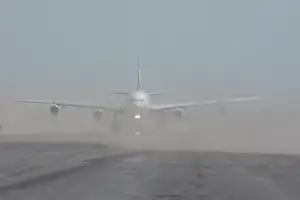
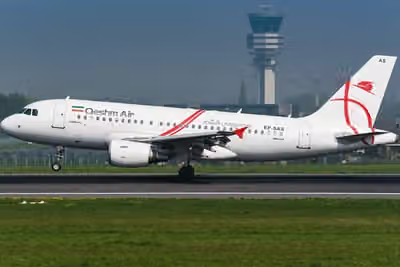
US sanctions all Iranian airlines in sweeping aviation crackdown
1

US sanctions all Iranian airlines in sweeping aviation crackdown

2
ANALYSIS

Iran’s new war strategy seeks to turn blockade into broader economic confrontation

3
VOICES FROM IRAN

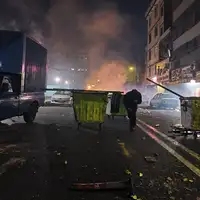
Iran deploys security forces as gasoline price rise takes effect

4

Iran-backed Houthis attack Saudi cities and energy facilities, wounding at least 73

5

UK expands Iran sanctions over nuclear program and hostile activity

Banner
Banner
Banner

Spotlight

  • Iran’s moderates question the price of prolonged war
    INSIGHT

    Iran’s moderates question the price of prolonged war

  • Former presidents push for public say on ending Iran war

    Former presidents push for public say on ending Iran war

  • Iran’s gasoline price hike may add to revenues, but can it ease fuel shortage?
    ANALYSIS

    Iran’s gasoline price hike may add to revenues, but can it ease fuel shortage?

  • Iran deploys security forces as gasoline price rise takes effect
    VOICES FROM IRAN

    Iran deploys security forces as gasoline price rise takes effect

  • Iranian protester undergoes months of secret treatment to save wounded leg
    EXCLUSIVE

    Iranian protester undergoes months of secret treatment to save wounded leg

•
•
•

More Stories

Australian intelligence committee chair condemns IRGC threats against journalists

Sep 9, 2026, 08:56 GMT+1
100%
Australian Senator Raff Ciccone, Chair of Parliament’s Joint Committee on Intelligence and Security

Australian Senator Raff Ciccone condemned threats against journalists by Iran’s Islamic Revolutionary Guard Corps, telling Iran International they were “outrageous” and an attack on press freedom.

“It is quite wrong for the IRGC to be threatening journalists simply for doing their job,” Ciccone, Chair of Parliament’s Joint Committee on Intelligence and Security, said. “Journalists are entitled to report on what is occurring anywhere around the world, particularly the events in Iran.”

He said journalists must be able to work “without harassment or intimidation, or violence for that matter,” adding that Iranians had a right to independent reporting about events inside the country.

“The Iranian people are looking to the rest of the world to understand what is happening,” Ciccone told Iran International. “They have a right to independent reporting, and journalists must be protected while carrying out that work.”

He said the threats also affected Iranian journalists and government opponents living abroad, including members of the diaspora in Australia.

He described such threats as part of a broader pattern of intimidation by the IRGC and said governments should respond collectively.

“It’s no surprise that these threats are coming from the IRGC,” Ciccone said. “But intimidation cannot be allowed to silence journalists or communities overseas.”

Ciccone pointed to steps already taken by Australia and said Canberra should continue working with international partners to hold Iranian authorities accountable.

  • Australian lawmakers back Prince Pahlavi role in Iran transition

    Australian lawmakers back Prince Pahlavi role in Iran transition

“We also have to stand by the Iranian people,” he said. “The Iranian people are looking to the rest of the world for their support, and I can say that many people in Australia are with them 100%.”

He said Australia, Canada, Germany and other countries should stand with Iranians and condemn threats against journalists. He also backed diplomatic expulsions, sanctions against those linked to the IRGC and further action against the organization.

A senior official with Iran’s armed forces said in late August that journalists working for Persian-language media abroad could be placed on a list of military targets.

“Media outlets such as Iran International, BBC Persian and Radio Farda are directly connected to Mossad, the US Central Intelligence Agency and other foreign intelligence services and receive support from them,” said Abolfazl Shekarchi, a brigadier general and senior spokesman for Iran’s armed forces.

After his remarks, Canada also said its security and intelligence agencies are using a full range of tools to counter foreign interference and transnational repression.

In a response to Iran International, Public Safety Canada said authorities continuously monitor such threat s and can respond through investigations, criminal charges and disruption activities.

  • Who is Abolfazl Shekarchi, the Iranian general calling journalists military targets?

    Who is Abolfazl Shekarchi, the Iranian general calling journalists military targets?

Iran’s weakened axis still bites as Houthis escalate against Saudi Arabia

Sep 9, 2026, 08:28 GMT+1
•
Negar Mojtahedi
100%
Houthi supporters in Yemen rally with rifles and flags, holding portraits and signs in support of the movement.

The escalating battle between Saudi Arabia and the Iran-backed Houthis may be a test of what remains of Tehran’s Axis of Resistance after months of war and mounting pressure on Iran itself.

But the fighting is also showing why a weakened axis can remain dangerous: it does not have to win territory to impose costs on Iran’s adversaries.

Yemen’s Houthis dramatically escalated their attacks on Saudi Arabia on Tuesday, striking four southern cities with missiles and drones. The group targeted a Saudi airbase in Khamis Mushait and Saudi Aramco assets in Abha, Najran and Jazan, setting oil installations ablaze. Saudi authorities said 73 people were wounded, including women and children.

The attacks also threatened to widen the war’s economic impact beyond the Strait of Hormuz, where the US-Iran conflict has already disrupted energy flows. Brent crude briefly touched $99.46 a barrel on Tuesday, its highest level since July 24.

“They’re not really fighting five separate wars, they’re just using five instruments of the same coercive strategy,” Fatima Abo Alasrar, a researcher and author on Yemen and Iran and founder of The Ideology Machine, told Iran International.

The timing, Alasrar said, matters.

Iran is exerting pressure around the Strait of Hormuz while the Houthis can create another pressure point around Bab al-Mandab, forcing Iran’s adversaries to contend with threats near two of the world’s most important maritime chokepoints.

  • From Hormuz to Bab el-Mandeb, conflict converges on vital shipping lanes

    From Hormuz to Bab el-Mandeb, conflict converges on vital shipping lanes

“The lesson that the Houthis appear to have learned is that escalation produces leverage,” she said, even without territorial gains.

That leaves Saudi Arabia with a difficult choice: escalate in an effort to substantially weaken the Houthis and risk a wider war or seek a political exit that could reinforce the belief in both Sanaa and Tehran that military pressure can ultimately produce concessions.

Houthis called Saudi Arabia’s bluff

Mohammed al-Basha, a Yemeni-American geopolitical analyst and risk adviser who heads the Washington DC-based Basha Report, said the Houthis helped bring about the renewed war by assuming Saudi Arabia and Yemen’s internationally recognized government would avoid a return to full-scale fighting.

“The Houthis were hoping to call a bluff — a Saudi and a government bluff,” al-Basha told Iran International.

Asked whether they miscalculated, he replied: “Of course, of course.”

Yet al-Basha said the Iran war has also reinforced the Houthis’ belief in the value of escalation.

“They feel that the best way for you to get what you want is to use force,” he said.

The confrontation follows an earlier dispute over an Iranian aircraft carrying a Houthi delegation back from Tehran following the funeral of Supreme Leader Ali Khamenei.

Analysts told Iran International at the time that the flight may have been an opening move in an effort to establish an air bridge into Houthi-controlled Yemen and rebuild the group’s strategic capabilities.

  • One flight, two chokepoints: why Iran wants an air bridge to Yemen

    One flight, two chokepoints: why Iran wants an air bridge to Yemen

“The alliance is no longer secretive or covert, it’s very public,” al-Basha said of the Iran-Houthi relationship.

Can battlefield gains change the equation?

Forces loyal to Yemen’s internationally recognized government have now launched counterattacks across several fronts, with officials openly declaring their intention to eventually recapture Sanaa.

But al-Basha cautioned against assuming the Houthis are close to defeat. He said losing strategically important territory, rather than simply patches of ground, could eventually push them toward negotiations.

One place to watch is Hodeidah, whose port al-Basha described as “the lung that the Houthis breathe from.” The group’s position around Hodeidah, Bab al-Mandab and the Red Sea is central to its ability to threaten maritime traffic.

Alasrar, however, said territorial losses do not necessarily eliminate Houthi leverage.

“They can lose ground and still increase their regional leverage,” she said.

The Houthis have threatened further attacks against Saudi economic and military infrastructure, raising the prospect of greater disruption around Bab al-Mandab while the Iran conflict continues to put pressure on Hormuz

A ‘win-win’ for Tehran?

Danny Citrinowicz of Israel’s Institute for National Security Studies sees that predicament as advantageous for Iran.

“For them it’s amazing. So it’s a win-win for them,” Citrinowicz told Iran International.

If Saudi Arabia backs down, he argues, Iran gains room to strengthen the Houthis. If Riyadh keeps fighting, instability around Bab al-Mandab creates another source of economic pressure while Iran contests Hormuz.

“It definitely worked in the Iranian favor,” he said. “The Iranians are learning from that, unfortunately.”

But it leaves Saudi Arabia with two costly options. Citrinowicz said the Houthis have “crossed the Rubicon” and are unlikely simply to retreat. As Saudi-backed forces approach areas the group considers critical, he expects Houthi attacks against the kingdom to intensify.

A moment of truth for the Mecca Defence Alliance

The escalation is also posing an early test for the Mecca Defence Alliance, the collective defense pact signed by Saudi Arabia, Turkey and Pakistan on August 7.

The agreement stipulates that an armed attack against any one of the three countries is to be regarded as an attack against all three.

Yet neither Turkey nor Pakistan has so far entered the fighting militarily on Saudi Arabia’s behalf.

Citrinowicz calls it “a moment of truth” for the alliance, with neither country so far entering the fighting militarily.

Will Washington hold Iran responsible?

The United States is now explicitly pointing toward Tehran.

“The Houthis in many ways are agents and proxies of the Iranians. I think behind some of this is clearly the Iranian hand,” US Secretary of State Marco Rubio told reporters when asked about the attacks on Saudi Arabia.

Rubio said Washington has a strong defensive military relationship with Riyadh and is closely watching developments.

His comments revive a warning President Donald Trump issued on July 23.

Trump said then that Washington would hold Iran responsible if the Houthis resumed attacks, describing the group as a “Surrogate and/or Proxy of Iran” and warning of “major military punishment” against Iran and the Houthis.

100%

The Houthis have now resumed major attacks against Saudi Arabia. Rubio has publicly pointed to an Iranian hand, but Trump has yet to publicly repeat the threat he made in July.

That leaves a consequential question as the conflict widens: if Washington considers the Houthis an Iranian proxy, how far is it prepared to go in holding Tehran responsible for what they do?

The coming days and weeks are likely to bring advances and retreats on both sides, with territory changing hands and apparent victories proving temporary. The battlefield remains highly fluid, and both sides appear determined to keep fighting, making it too early to draw sweeping conclusions from any single development.

But even without a clear Houthi victory, Iran may stand to gain. As long as the fighting forces Saudi Arabia to expend resources, keeps pressure on Bab al-Mandab and stretches the attention of Tehran’s adversaries, the Houthis can continue to provide Iran with leverage even while under pressure themselves.

The conflict has a long way to go for now and consequences reverberate from Yemen across an already destabilized region.

Why did Iran let back a singer who mocked its ‘sacred’ symbols?

Sep 9, 2026, 05:03 GMT+1
•
Negar Mojtahedi
100%
Iranian musician Mohsen Namjoo, who returned to Iran in 2026 after nearly two decades abroad.

Mohsen Namjoo mocked the Quran, ridiculed religious figures and crossed political red lines that have brought severe punishment for others in Iran. Now back in the country, his return contrasts sharply with restrictions still imposed on female singers.

The contradiction is hard to miss. A government that has demanded ideological conformity from Iranians appears willing to overlook Namjoo’s past transgressions at a time when the Islamic Republic is under extraordinary military, economic and domestic pressure and is openly seeking to encourage some prominent Iranians abroad to return.

Rather than a sign of moderation, his return may reveal how flexible the Islamic Republic can become when its own rules are no longer useful.

Siavash Rokni, an expert on Iranian popular culture, and historian Shahram Kholdi told Iran International’s Eye for Iran that the apparent opening serves several purposes. It can distract from executions and political prisoners, project an image of a more tolerant Iran and send a message to the diaspora that even former critics may be able to return — although the state still decides who gets through the door.

“Diversion. I’m going to make this quite simple,” Rokni said.

Kholdi questioned whether the rules were really changing at all.

“Are they bending their own rules and principles?” he asked. “Or are they temporarily deactivating them?”

Namjoo is an extraordinary figure around whom to test that question.

The Mashhad-born musician left Iran in 2007 and was later sentenced in absentia to five years in prison for “insulting sanctities” over his use of Quranic verses in his music. It remains unclear publicly what became of that sentence before his return. Outside the country, he continued to ridicule religious and political symbols, including former Supreme Leader Ali Khamenei.

He has also faced multiple allegations of sexual misconduct and abuse, which he denies.

And yet he has been allowed home.

His return was also highlighted by Iranian state media, which praised what it described as his “patriotic” opposition to US and Israeli attacks. Namjoo himself said he had encountered considerable kindness since returning.

Who gets to break the rules?

The contrast is particularly stark when Namjoo’s treatment is compared with that of female musicians inside Iran.

Singer Parastoo Ahmadi drew international attention after performing without the compulsory hijab in an online concert in 2024. She was briefly detained after the performance. In June 2026, she and members of her production team were reported to have been sentenced to 74 lashes, along with two-year bans on travel and artistic activity.

Rokni also pointed to Hiva Seyfizadeh, another female singer who was arrested during a live performance in Tehran in 2025.

The juxtaposition gets to the heart of the controversy surrounding Namjoo. A male musician known for ridiculing symbols the Islamic Republic considers sacred — and who has faced sexual misconduct allegations abroad can return, while women continue to face state pressure over their clothing and their voices.

“Why are female singers not able to sing and an alleged sexual abuser is back, is invited back to the country?” Rokni asked. “What is this double standard happening in this country?”

Namjoo’s return has generated precisely the kind of attention such a contradiction might be expected to produce. Iranians have argued over his decision to return, his past and what his presence in Tehran means.

That noise may itself be useful.

Rokni described the use of popular culture as part of a sophisticated communications strategy capable of shifting attention away from far more damaging issues for the state — among them executions, political prisoners, economic hardship and the repression of women.

“Namjoo is not, in my opinion, an important subject of conversation,” he said.

The point is not that his return is insignificant. It is that the spectacle surrounding one musician can swallow up the conversation about thousands of people who do not have the luxury of choosing whether to engage with the Islamic Republic.

An invitation with conditions

Namjoo’s homecoming also carries a message beyond Iran.

If someone who mocked the Quran and the country’s former supreme leader can return, other members of the diaspora may reasonably wonder whether the rules have changed for them too. That question is no longer hypothetical. Culture Minister Abbas Salehi has said his ministry compiled a list of more than 100 cultural, artistic and intellectual figures abroad whose return it wants to facilitate.

But the door does not open equally.

“Returning to one’s country has become a game of preferential treatment,” Rokni said.

The Islamic Republic effectively retains the power to determine which Iranians can come home, which critics can be forgiven and what compromises are required to make that possible.

History gives reason to be wary of assuming that an open door will remain open.

Kholdi recalled the experience of writer and dissident Saidi Sirjani, a prominent critic of the Islamic Republic. Following the death of its founder, Ruhollah Khomeini, Sirjani believed a different political era might be emerging and encouraged other Iranian intellectuals abroad to consider returning, Kholdi said.

Sirjani was arrested in 1994 and died in custody later that year under circumstances that remain disputed.

Kholdi also pointed to Iranian-Canadian scholar Ramin Jahanbegloo, who was arrested in Tehran in 2006 and detained for months before eventually leaving the country.

“I would not consider such moves a sign of the fact that they have become more moderate,” he said.

The history even gives Kholdi reason to worry about Namjoo himself.

“As a human who deserves the security and safety of life like any other normal person, I am worried for his safety,” he said.

Today’s welcome, in other words, does not guarantee tomorrow’s protection.

The power of an open door

That uncertainty carries particular weight for millions of Iranians abroad who still have family, professional and emotional ties to the country.

Kholdi said he was warned as a young academic that outspoken criticism of the Islamic Republic could cost him access to Iran, its archives and the field research needed for his career.

The threat did not have to be explicit. Access itself became leverage.

The same calculation can apply to artists, journalists, academics and ordinary diaspora Iranians who want to see parents or relatives. The state controls the door, and the possibility of losing access can shape behavior long before anyone attempts to cross the border.

Namjoo’s return makes that door appear wider.

It also gives the Islamic Republic a useful image to present to the outside world: a former critic who once violated some of its most sensitive taboos is back in Iran. How intolerant can the system be if someone like him is allowed to return?

Kholdi warned that there is another side to that calculation. Iran has repeatedly detained dual and foreign nationals who later became subjects of negotiations or prisoner exchanges, a practice critics of Tehran describe as hostage diplomacy.

The same state that can invite people in retains the power to prevent them from leaving.

That is why Namjoo’s return matters less as a story of one controversial musician coming home than as a glimpse of how the Islamic Republic behaves when under pressure.

It can enforce religious morality against a woman who sings without a hijab while overlooking the past of a man who mocked the Quran. It can imprison critics while advertising the return of another. And it can present selective tolerance as evidence of change without surrendering the power to reverse that tolerance later.

Namjoo’s return also appears to be part of a broader effort to selectively reopen the door to prominent Iranians abroad while the state retains the power to decide who may return and under what conditions.

The Islamic Republic’s red lines have not disappeared.

What Namjoo’s return exposes is that those lines were never equally rigid for everyone and that when the regime sees an advantage in moving them, even the principles it calls sacred can suddenly become negotiable.

Iran’s gasoline price hike may add to revenues, but can it ease fuel shortage?

Sep 8, 2026, 22:25 GMT+1
•
Dalga Khatinoglu
100%
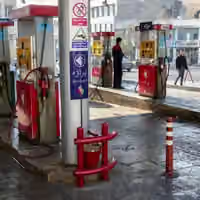
File photo shows an Iranian gasoline station

Iran’s decision to double the price of gasoline sold outside subsidized quotas could generate less than $500 million in additional annual revenue under current consumption patterns, but can it resolve the structural pressures behind the country’s growing fuel shortage?

After weeks of reduced gasoline supplies and kilometer-long queues at filling stations, the government raised the non-quota price to 100,000 rials per liter, roughly 4.3 US cents.

Iran now has a three-tier gasoline pricing system. Each vehicle receives 60 liters per month at 15,000 rials per liter, or about 0.65 US cents, and another 50 liters at 30,000 rials, or about 1.3 cents. Gasoline purchased beyond those quotas costs 100,000 rials per liter, double the previous non-quota rate.

Government spokesperson Fatemeh Mohajerani has said the increase will not affect around 85 percent of car owners because their monthly consumption remains below the combined 110-liter subsidized quota.

At first glance, selling gasoline for only about 4.3 cents per liter while continuing to provide 110 liters per month at significantly lower subsidized rates may make the financial impact of the increase appear limited.

But the figures suggest the government could still raise several hundred million dollars annually. Whether the policy can substantially reduce consumption or Iran’s dependence on gasoline imports is another matter.

Government revenue

Iranian authorities have not published detailed current figures showing exactly how much gasoline is sold at each of the three price tiers.

But with roughly 22 million gasoline-powered passenger cars and a combined monthly quota of 110 liters per vehicle, those vehicles could consume a maximum of around 80 million liters of subsidized gasoline per day even if every driver used the full quota.

With national gasoline consumption at roughly 134 million liters per day, that would leave about 54 million liters being consumed outside the subsidized quotas.

That estimate is broadly consistent with remarks last November by the head of the National Iranian Oil Products Distribution Company, who said around 40 percent of gasoline refueling was being carried out using emergency cards provided at filling stations rather than motorists’ personal fuel cards.

A confidential 94-page report by the National Iranian Oil Refining and Distribution Company reviewed by Iran International puts average gasoline consumption in the Iranian year 1403, which ended in March 2025, at around 124 million liters per day, including additives and petrochemical products.

If around 54 million liters continue to be purchased each day at the non-quota rate, the additional 50,000 rials charged per liter would generate roughly 98.5 trillion rials over a year.

At the current exchange rate of around 2.3 million rials per dollar, that amounts to approximately $428 million.

The figure is a scenario based on current consumption patterns rather than a firm revenue forecast. The higher price could encourage some motorists to reduce consumption or rely more heavily on their subsidized quotas.

The government has also eliminated subsidized gasoline quotas for newly registered and imported vehicles, requiring them to purchase fuel at the non-quota rate.

Customs and Industry Ministry data show that Iran has added an average of around one million domestically produced or imported vehicles to its roads annually over the past five years.

Once a full year’s cohort of around one million additional vehicles is subject to the higher rate for 12 months, assuming average monthly consumption of 120 to 150 liters per vehicle, the latest increase could generate about another $35 million in annualized revenue.

Under these assumptions, the government could eventually generate less than half a billion dollars in additional annual revenue from the higher gasoline price.

Can higher prices ease the shortage?

According to Central Bank of Iran statistics, the country imported approximately $2.9 billion worth of gasoline last year.

Iranian officials say the country currently needs to import around 10 million liters of gasoline per day, with the cost at regional market prices broadly comparable to last year’s import bill.

President Masoud Pezeshkian has repeatedly argued for higher gasoline prices, saying it makes little sense for Iran to purchase gasoline abroad at much higher prices and then sell it domestically at heavily subsidized rates.

But even if the higher non-quota price generates close to $500 million annually, that would amount to only around 17 percent of the $2.9 billion Iran spent on gasoline imports last year.

The additional revenue, therefore, would not come close to covering the country’s gasoline import costs.

Officials have also argued that higher prices could reduce consumption. But many of Iran’s heaviest gasoline users work in freight transport, passenger transport and other service-sector businesses that depend directly on vehicle use.

For those workers, consuming less gasoline can also mean earning less income rather than simply cutting unnecessary fuel use.

Other structural factors are simultaneously increasing gasoline demand.

Official statistics show that CNG supplies for dual-fuel vehicles have declined every year over the past five years as Iran’s natural-gas shortage has worsened.

CNG consumption fell to around 16 million cubic meters per day last year, 38 percent below its 2020 level. The decline is equivalent to adding roughly 9 million liters to daily gasoline demand.

Iran has also not commissioned a new oil refinery since 2018, while around one million vehicles continue to be added to the domestic fleet each year.

The combination of rising vehicle numbers, declining CNG availability and limited refining capacity is therefore likely to deepen the gasoline deficit and increase Iran’s need for imports even if higher prices curb some demand.

The continued depreciation of the rial poses another problem.

The US dollar has gained around 120 percent against the rial since September 2025. If the currency continues to weaken, part of the additional revenue generated by the gasoline increase will quickly lose value in dollar and real terms.

There is also inflation.

Iran’s 12-month average inflation rate has climbed to nearly 70 percent, while food prices are around 128 percent higher than a year ago.

Higher gasoline prices can feed directly into transportation costs and, in turn, the prices consumers pay for goods and services. A policy that generates less than half a billion dollars in additional revenue could therefore impose broader costs on households already struggling with steep price increases.

The much larger cost of sanctions

The sums involved become even smaller when compared with the economic losses associated with sanctions on Iran’s oil exports.

According to Central Bank statistics, Iran generated $57.4 billion in oil-related exports last year when its crude and petroleum-product exports were valued at Gulf market prices.

That represents their nominal market value. The amount Iran ultimately receives is substantially lower.

Homayoun Falakshahi, a senior analyst at commodity intelligence company Kpler, told Iran International that around 25 to 30 percent of Iran’s oil revenues are lost between loading and delivery because of the mechanisms required to circumvent sanctions.

Those costs include discounts offered to Chinese buyers, payments to brokers, falsification of shipping documents, ship-to-ship transfers, longer transit times, floating-storage costs and the expense of chartering vessels belonging to the so-called shadow fleet.

On that basis, Iran lost an estimated $15 billion to $17 billion last year from the oil it actually exported because of discounts and sanctions-circumvention costs.

There is also the oil Iran was unable to export.

Iran’s crude exports in 2025 averaged around one million barrels per day below pre-sanctions levels. At prevailing prices, the value of that foregone export volume was approximately $25 billion a year.

Taken together, those figures suggest Iran suffered more than $40 billion in potential oil-revenue losses and additional export costs associated with sanctions last year.

That is around 80 times the less than $500 million in additional annual revenue the government could generate from the gasoline measures under current consumption assumptions.

The gap has widened further this year.

Since mid-July, the movement of newly loaded Iranian crude from the country’s oil terminals toward final overseas markets has effectively ground to a halt.

Some crude has continued to be loaded, but instead of heading to its final destination, much of it has accumulated offshore in waters south of Iran. Around 55 million barrels of Iranian oil are currently held in floating storage there and effectively trapped inside the maritime blockade.

Deliveries to China have nevertheless continued because not all of the crude arriving at Chinese ports was recently loaded in Iran.

Kpler data obtained by Iran International show that Iranian crude discharged in China averaged around 500,000 barrels per day last month, down from roughly 800,000 barrels per day in June and July.

Much of that oil had left Iran earlier and was drawn from previously accumulated floating stocks in Asian waters.

That explains how Iranian crude can continue arriving in China even as the movement of newly loaded oil from Iran to overseas markets has largely stopped.

The comparison underscores the scale of Tehran’s economic problem.

The government could raise less than half a billion dollars annually by charging consumers more for gasoline, yet the price increase does little to address the structural forces driving Iran’s gasoline deficit, while the country simultaneously faces tens of billions of dollars in lost oil revenues and sanctions-related costs.

Iran plans new university hijab directive as hardliners press for enforcement

Sep 8, 2026, 18:00 GMT+1
100%
File photo shows a confrontation between Iranian hijab enforcers and a woman not wearing the mandatory head covering.

Iran is preparing to issue a new compulsory hijab directive for universities, a senior official said Tuesday, as hardliners intensify pressure on women over mandatory veiling ahead of the anniversary of Mahsa Amini’s death in morality police custody.

Saeed Karami, deputy for cultural and political affairs at the Office of the Supreme Leader’s Representative in Universities, said the directive had been drafted and would soon be issued by the ministries of Science and Health, which oversee most universities and medical schools.

Karami told the semi-official Mehr news agency that existing regulations on hijab were “very good” and only needed renewed attention.

Asked whether universities would receive a “hijab charter,” Karami said “directive” was a more appropriate term. He did not give details of the measures it would contain or specify when they would take effect.

“We will certainly not witness the bitter incidents that we sometimes see on the streets at universities,” he said, without elaborating.

The planned directive comes amid a renewed push by hardline officials, clerics and government supporters to strengthen enforcement of compulsory hijab, four years after the death of Mahsa Jina Amini in morality police custody triggered the Woman, Life, Freedom uprising.

Women appearing in public without headscarves have since become commonplace in Tehran and other major cities, making rejection of compulsory hijab one of the most visible social changes to survive the 2022 protests.

Pressure has increased in recent weeks as hardliners demand implementation of the stalled Hijab and Chastity Law and criticize President Masoud Pezeshkian’s government for what they describe as a retreat on the issue.

Hardline lawmaker Mohammad-Taghi Naghd-Ali said Tuesday the government had backed down over hijab and accused it of failing to implement the legislation, describing compulsory veiling as one of the “foundations of the revolution.”

The more sweeping Hijab and Chastity Law remains suspended after the Supreme National Security Council instructed parliament not to promulgate it, Parliament Speaker Mohammad-Bagher Ghalibaf disclosed last year. The decision was widely seen as reflecting fears that aggressive enforcement could trigger renewed unrest.

Other signs of renewed pressure have appeared across Iran. The commander of the Revolutionary Guards in North Khorasan said this week that groups tasked with verbally warning women over their clothing were being revived, while pro-government gatherings demanding stricter hijab enforcement have been held in Qom, Birjand and Isfahan.

Iran International found last month that authorities had sealed at least 42 cafés, restaurants, shops, sports clubs and other businesses in 17 cities within three weeks over alleged violations of hijab rules and other Islamic norms.

Authorities have increasingly used business closures, judicial warnings and economic pressure rather than relying solely on the large-scale morality police patrols associated with enforcement before the 2022 uprising. Reports from inside Iran have nevertheless also pointed to renewed street warnings and patrol activity in several cities.

Universities have long been a particular focus of hijab enforcement and political control. Campuses became major centers of protest during the Woman, Life, Freedom uprising, and female students were among those who openly removed their headscarves in defiance of the state.

In April 2023, the Science Ministry said universities would not be required to provide educational, welfare and other services to students who refused to comply with hijab regulations. Female students were subsequently barred from campuses, summoned to disciplinary committees and in some cases suspended or expelled from dormitories.

At the University of Tehran, authorities later deployed women with seminary backgrounds to monitor students’ clothing, while students at several other institutions reported being photographed, having their student IDs recorded or being denied entry over their clothing.

At Tehran’s Amir Kabir University of Technology, students boycotted classes in 2024 after reports that more than 200 students had been barred from campus amid stricter dress-code enforcement. Similar pressure was subsequently reported at Tehran North Islamic Azad University.

  • Have Iran’s hijab enforcers returned to Tehran streets?

    Have Iran’s hijab enforcers returned to Tehran streets?

Signs of renewed tension have emerged again this year. The Student Basij at Iran University of Science and Technology recently protested the presence of unveiled female students at an event attended by senior officials from the Science Ministry.

Despite successive enforcement campaigns, many Iranian women continue to appear without mandatory hijab in streets, cafés, shopping centers and other public spaces, maintaining a form of civil disobedience that has persisted since the Woman, Life, Freedom protests.