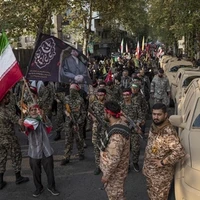
The escalation marks a potentially significant shift in Iran’s approach to the conflict. Iranian officials and hardliners are increasingly describing a strategy that goes beyond defending Iranian territory or simply maintaining the Strait’s closure, seeking instead to impose costs on US forces and economic interests across the region.
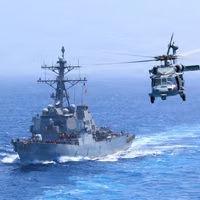
The shift followed a series of tit-for-tat attacks involving Iranian and US-linked shipping. On Saturday, Iran’s Revolutionary Guards (IRGC) said it had fired ballistic missiles at a US aircraft carrier and destroyer. Washington said none of the missiles hit the vessels.
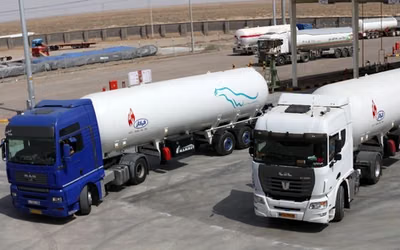
After US forces attacked three Iranian oil tankers, US Defence Secretary Pete Hegseth warned that any further Iranian attacks on American ships would be met with the destruction of Iranian oil tankers. Tehran subsequently said the Revolutionary Guards had targeted three tankers traveling through what it called unauthorized routes in the Strait of Hormuz and three US-linked vessels elsewhere.
“The rules of the game have changed”
The exchanges have fuelled increasingly explicit threats from senior Iranian officials.
Mohammad-Bagher Ghalibaf, Iran’s parliament speaker and head of its negotiating team with the United States, said after the attacks that Washington needed to understand that “the rules of the game have changed” and that any future attack on “Iran’s interests and security” would face “a faster, heavier and more painful response.”
On Monday, Ghalibaf escalated his warning by threatening US oil and gas companies in the region. Responding to Hegseth’s threat to sink Iranian oil tankers if Iran attacked American ships, he wrote: “The oil and gas chain here is sprawling, accessible, and exposed. American oil and gas companies across these waters and facilities share that exposure. Strike our assets and you get struck. We’ve already proven it. Ask the bases that are no longer viable.”
Ebrahim Rezaei, a member of parliament’s National Security and Foreign Policy Committee, said Iran would henceforth respond forcefully to US naval vessels, equipment, destroyers and bases “anywhere.” He claimed Iranian missiles had become more advanced and intelligent than they were a year ago, increasing their ability to strike American warships. He concluded that the side that would eventually have to back down would be “the Americans.”
Mojtaba Zarei, another member of the parliamentary security committee, similarly warned that the withdrawal of US warships from the range of Iranian ballistic missiles would not end the confrontation. “This is not defence; it is decisive entry into a military confrontation,” he wrote, describing the new policy as one based on “pre-emptive operations” aimed at breaking the economic blockade.
The widening confrontation has also prompted warnings that attacks on tankers could open a much more dangerous phase of the conflict.
Heshmatollah Falahatpisheh, a former chairman of parliament’s National Security and Foreign Policy Committee, warned that attacks on Iranian tankers could trigger retaliation against Iran’s energy infrastructure. “The attack on the tankers is the prelude to setting fire to Iran’s energy and civilian infrastructure,” he wrote.
“What we are seeing is not war, but the killing of a nation and a civilisation,” Falahatpisheh added. “A regional initiative is needed to bring an end to the bloodshed and fire.”
New mechanism for controlling commercial traffic
At the same time, Tehran appears to be developing a more elaborate mechanism for controlling commercial traffic around Hormuz.
Mohsen Rezaei, secretary of Iran’s Supreme National Security Council, said on state television on Sunday night that Iran considered the Strait closed and said it would establish a new “prohibited zone” outside the waterway. The zone would begin at the US blockade line and extend into parts of the Persian Gulf, with ships entering it to reach the Strait potentially subject to sanctions.
Rezaei stressed that Iran had not decided to sink oil tankers, citing the environmental consequences for the region. He also claimed that Iran had, for the first time, tested an anti-ship missile directly over a US warship.
Rezaei said Iran and Oman had also agreed on maps for a new shipping corridor through the Strait of Hormuz, which he said should be signed in the coming days. He said Iran would only commit to keeping the Strait open once the United States ended what Tehran calls sabotage, threats and attacks against Iran.
On Monday, Rezaei said Washington had received a “clear warning” from Iran’s new missiles and that economic warfare would be met with a maritime exclusion zone extending across the Persian Gulf to the US blockade perimeter. He said Iran’s operational posture toward US warships and bases had been “fundamentally recalibrated.”
Washington disputes Tehran’s description of the maritime balance. The White House said Monday that the Strait of Hormuz remained open and under US control, while the US military said it had redirected 94 commercial vessels, disabled three and boarded two as of Sept. 7 while enforcing the blockade.
Rezaei’s comments were interpreted by Nour News, a website close to the Supreme National Security Council, as evidence that Iran’s strategy was moving from restricting traffic through the Strait to establishing rules governing which vessels could pass through it.
Hardline analyst Mostafa Najafi described the emerging policy as a three-layer strategy: establishing an Iran-Oman middle corridor to manage traffic through Hormuz, entering an offensive phase against the US fleet, and imposing a sanctions-based prohibited zone between the blockade line and the Strait.
“In other words, Tehran, rather than simply closing or opening Hormuz, is defining a new equation for controlling traffic, deterrence and economic warfare,” Najafi wrote.
That approach may reflect the limits of Iran’s ability to sustain a conventional confrontation at sea.
Mohammad Ghaedi, an international relations lecturer at George Washington University, told Iran International that political considerations and Tehran’s relationships with countries such as China, India and Pakistan made it difficult or undesirable for Iran to fire on all oil tankers. The proposed sanctions regime, he said, could provide an alternative to attacking them directly.
Ghaedi nevertheless warned that Iran could eventually expand its attacks to smaller shuttle vessels that carry oil from Abu Dhabi to supertankers outside the Strait, which Iran has so far largely avoided targeting.
Hardliners push for escalation
The emerging strategy has been welcomed by some hardliners, who see attacks on US warships as evidence that Iran is overcoming its defensive posture.
Hardline commentator Nezameddin Mousavi said the missile attack sent “two clear messages”: that Iran’s missile technology had advanced to the point where US warships were now “easy prey for ballistic missiles,” and that Iran would not allow President Donald Trump to play “cat and mouse” until the November elections. “The blockade must be broken,” he wrote.
Javad Mirgalouye-Bayat went further, arguing that an attack on US warships was a political decision equivalent to extensive bombing of Tel Aviv or an attack on US territory. He said Iran should be prepared for a response “at the level of using a tactical nuclear bomb” and argued that effective attacks on warships were necessary to change the equation of the war.
But the increasingly aggressive rhetoric has also exposed a broader concern among some Iranians: whether Tehran has the military capacity to sustain the escalation it is threatening.
One social-media user warned that starting an oil-tanker war without a functioning navy would be reckless, arguing that Iran no longer had even a frigate capable of protecting tankers at sea. The user also questioned Iran’s ability to defend its own energy infrastructure if it began attacking energy facilities in the Persian Gulf.
Another critic accused the government of celebrating a failed operation after losing three tankers without hitting its intended targets, arguing that Tehran was effectively telling its adversary: “Make concessions or I will suffer more defeats.”
That criticism highlights the central risk facing Iran’s new strategy. Expanding the confrontation may allow Tehran to demonstrate that the cost of attacking Iran extends beyond Iranian territory. But each additional target also creates opportunities for a stronger US military response.
The strategy therefore appears to rest on a difficult calculation: that Iran can raise the economic and military costs for Washington without triggering a level of retaliation that its weakened military and economic infrastructure cannot absorb.
The emphasis on a prohibited maritime zone, sanctions on vessels and threats against regional energy infrastructure suggests Tehran is trying to find a middle ground between reopening Hormuz and indiscriminately attacking commercial shipping. But the more Iran seeks to enforce its new rules, the greater the risk that isolated incidents at sea will develop into a wider regional confrontation.
The result is a potentially more volatile phase of the conflict. Iran is no longer presenting the closure of Hormuz simply as a defensive response or a bargaining chip. Increasingly, officials are portraying control of maritime traffic, attacks on US forces and pressure on regional energy infrastructure as parts of a broader offensive strategy designed to break the economic blockade.