Iran lawmaker says forces will make Omani route through Hormuz unsafe for US
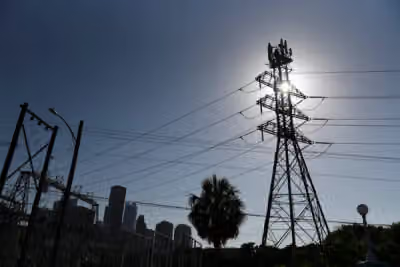
Iranian lawmaker and former Foreign Minister Manouchehr Mottaki said Iran's armed forces would make the Omani route through the Strait of Hormuz unsafe for the United States, according to Sputnik.
"Our armed forces will make the Omani route through the Strait of Hormuz so unsafe that the US will not dare send ships through it," Mottaki said.
"Just as we will not give up the Strait of Hormuz, we will not give up enrichment either," he said.
Mottaki said Washington, for Tehran to return to negotiations, must "release frozen assets, withdraw its forces from the region, fulfill its commitments regarding Lebanon and accept our sovereignty over the Strait of Hormuz."
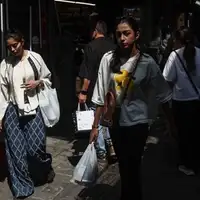
Pedestrians walk along a street in Iran in this undated file photo.
The UN’s fact-finding mission on Iran called for the immediate withdrawal of legislation that could expose Iranians to up to 30 years in prison for contact with foreign individuals and organizations, according to a statement released Thursday.
“We are appalled at the steps by the Government of Iran to subject everyday Iranians to blanket criminalisation for any contact with the outside world when people are already suffering from isolation due to long-standing international sanctions, the Government’s repression of recent protests, the longest ever Internet shutdown, and the US-Israeli airstrikes,” Sara Hossain, chair of the Independent International Fact-Finding Mission on Iran, said.
The draft “Countering Foreign Infiltration” bill would allow cooperation or interaction with designated foreign states, media organizations, academic institutions, human rights defenders and civil society groups to be prosecuted as major security offenses, the mission said.
Broad activities require approval
The legislation would require Iranians to declare and register activities involving foreign agents or nationals and obtain authorization through an online system that prioritizes security considerations from the Ministry of Intelligence and the Intelligence Organization of the Revolutionary Guards.
Publishing books or articles, sharing data and analysis, academic cooperation, interacting with foreign or designated “hostile” media, and operating newspapers or websites could require prior approval.
The requirements would also cover workshops, scientific conferences, artistic festivals and some film, music and visual-arts activities, as well as certain commercial and financial transactions.
“If implemented, this bill would subject all interactions with the outside world to Government control and sanction, the law also would further curtail the rights of citizens, with consequences for commerce, education, freedom of expression and the pursuit of justice among other areas,” mission member Viviana Krsticevic said.
UN contacts could face punishment
The mission warned that the bill could also criminalize communication with its investigators and said punishment for such cooperation would constitute a reprisal.
Students attend a lecture at a university in Iran in this undated file photo.
“Punishing any interaction by Iranians or persons living in Iran with the Mission under this bill constitutes a reprisal and the threat of criminalising such activity is a form of intimidation and oppression,” mission member Max du Plessis said.
The UN Human Rights Council established the mission in 2022 following protests sparked by Mahsa Amini’s death. Its mandate was extended for another two years in January 2026 to investigate allegations of recent and continuing serious human rights violations in Iran.
Pharmacy workers arrange medicines at a pharmacy in Iran.
Iran faces shortages of about 800 medicines, including dozens considered vital, as currency constraints and import disruptions threaten to drive some drug costs as much as threefold, Iranian local media reported on Thursday.
Shortages of foreign currency and raw materials, unpaid insurance debts, difficulties transferring money, disrupted imports and rising production costs have increased concerns about the pharmaceutical supply chain, the Iranian news outlet Rouydad24 reported.
“The alternative routes for supplying raw materials and imports are time-consuming and can increase drug costs by up to three times,” Hadi Ahmadi, spokesman for the Iranian Pharmacists Association, told the outlet.
Shortages of raw materials, Ahmadi said, were hindering domestic pharmaceutical production at the same time that imports were facing disruption.
Rouydad24 described the problem as extending across the pharmaceutical supply chain rather than being confined to individual medicines or pharmacies, leaving patients to absorb higher costs.
Iranian citizens have also told Iran International in recent months that medicine shortages and rising prices have disrupted treatment for many patients. Some said difficulties obtaining conventional medicines had prompted people to turn to traditional medicine.
Domestic production depends on imports
About 99% of medicines by volume are produced domestically, but imports account for roughly 13.86% of the market by value, according to figures cited by the website.
The disparity reflects the pharmaceutical industry's dependence on imported raw materials, equipment and specialized products even when finished medicines are manufactured inside Iran.
Disruptions to foreign-currency transfers or shipments of raw materials can therefore affect factories before shortages become visible in pharmacies weeks or months later.
Iran's Food and Drug Administration has said raw materials and medicines are being moved through alternative routes because wartime conditions have disrupted transportation.
Those routes take longer and cost more, Ahmadi said.
Economic pressures have also changed how some Iranians pay for healthcare. Eghtesad News reported in July that installment payments had increasingly spread through the health sector, including for dental treatment and medicines.
Not enough currency
Iran's pharmaceutical sector requires about $2.2 billion in foreign currency for medicines and raw materials this year, but only around half of that amount has been supplied, Ahmadi said.
Changes to Iran's subsidized foreign-exchange system have added another source of pressure on medicine prices.
A pharmacist sorts medicines at a pharmacy in Iran.
The Food and Drug Administration has said a complete removal of subsidized currency for medicines is not planned this year, although the allocation has been reduced for some products, including insulin.
The agency said the changes did not amount to ending subsidized currency for all medicines or necessarily signal a new wave of price increases.
Ahmadi offered a different assessment of the impact on medicines affected by the changes, saying the removal of subsidized currency for some pharmaceutical groups had pushed the cost of their raw materials up more than fivefold within several months.
Iran International reported in July that patients' out-of-pocket costs for insulin had risen more than 24-fold over about 50 days.
Higher prices fuel informal drug market
Shortages are only part of the pressure facing patients because medicines that remain available may become financially inaccessible as prices rise, Rouydad24 reported.
“If medicine is available on the market but its price increases several times over, for a patient who needs medication every month and permanently, the price increase can effectively be just as problematic as a shortage,” Rouydad24 wrote.
“If insurance cannot increase its contribution in line with price rises, part of the cost will be paid out of the patient’s pocket.”
The combination of shortages, rising prices and inadequate insurance coverage places particular pressure on people with chronic illnesses, older patients and those who depend on expensive or imported medicines, the outlet added.
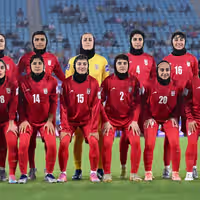
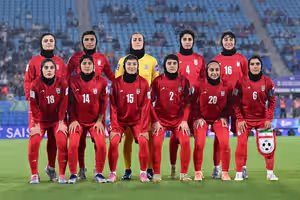
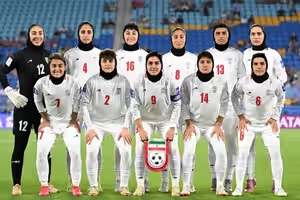
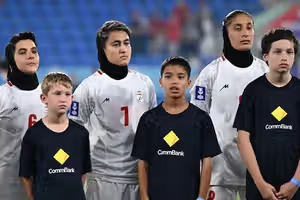
A file photo of the Iranian national football team in Australia
Five months after Iran's women footballers sought asylum in Australia, the football federation has called the squad back into camp, not to train but to film a documentary about what happened there. Some of the players it wants on camera are the ones who came home under pressure.
While two of those players are building new lives in Australia, thousands of kilometers from their families, having received citizenship there, the Islamic Republic's football federation has summoned their former teammates to record the state's account of the same events.
Farideh Shojaei, the federation's vice-president for women's football, has confirmed that a documentary about Iran's participation in the AFC Women's Asian Cup will be filmed at the camp. She described the purpose as completing the tournament archive and setting down part of the history of Iranian women's football.
The outlet Football 360 had reported earlier that the project belongs to a body outside football, and that most of the players who returned from Australia have no wish to sit in front of the federation's camera and recount what happened on that trip.
A camp that does not add up
The camp has pushed back the start of Iran's women's premier league by a week, and the federation's explanations for holding it have not been consistent.
According to Iranian media, when club coaches objected to the timing, Shojaei assured them the players would not be put under any football training load, because the point of the camp was to film the documentary. Later, explaining why a camp was being held outside a FIFA international window with no fixture ahead of the national team, she said it had been convened at the request of Marzieh Jafari, the national coach, to prepare the players.
Jafari does not currently hold an active contract with the federation. She is head coach of Khatoon Bam, the club that supplies the core of the national squad, which has just come through Asian Champions League qualifying and now needs to prepare for a new league season.
So a camp that has forced clubs to rearrange their calendars is attributed to a coach with no active federation contract, and was described to the objecting coaches as not being about training at all.
The version the state told first
The documentary is being made several months after Iranian officials gave their own account of what happened in Australia.
In the team's final days there, federation president Mehdi Taj claimed Australian police had separated the women from the men in the delegation and pressured the players into staying and claiming asylum. Esmail Baghaei, the foreign ministry spokesman, went further on television, accusing the Australian government of "taking members of the team hostage."
While those claims were being made in public, according to one club executive, money was being raised inside Iranian football to encourage the players to come home.
Alireza Babaei, chief executive of Chadormalou Ardakan, told a Football 360 live program that while the federation was working to bring the whole delegation back, its general secretary Hedayat Mombeini asked Chadormalou to pay 30 billion rials, about $15,000, for the women's national team. Chadormalou does not have a women's team.
According to Babaei, Mombeini also mentioned a payment of 50 billion rials, roughly $25,000, from the Gol Gohar club, and named Sepahan of Isfahan, a club that at that moment was weighing whether to continue fielding teams at all because of war damage to the steel industry.
In Iranian women's football, 50 billion rials from a single club is not a sum to be waved away. Afsaneh Chatrenoor, the national team forward who plays for Gol Gohar, was the premier league's leading scorer last season. She is also the player who sat across from Gholamhossein Mohseni-Ejei a few months ago and asked the head of the judiciary to help her find work for when her football career ends. At the top level of the Iranian women's game, the contracts of prominent players are still measured in a few billion rials.
For the Islamic Republic's officials, the Women's Asian Cup in Australia was never only a football tournament.
Several members of the delegation applied for humanitarian protection from the Australian government during the war and after the killing of Ali Khamenei. Some later abandoned their asylum applications and returned to Iran under pressure from security forces on their families.
In those same days, Iranian officials were assembling their own version of events. They spoke of hostage-taking and of players being deceived, while simultaneously turning to threats, intimidation and financial inducements to get the asylum seekers back.
Now some of the same players who returned after that pressure are to sit in front of a camera, in a project belonging to a body outside football, and describe those days again.
It looks less like archiving history than like producing a state edition of it.
This time the Islamic Republic is not only constructing its own account of Australia. It wants the players inside the rewriting.
People walk in Tehran's Grand Bazaar, August 17, 2026
Iran’s economic crisis is deepening, and with few answers for a population becoming poorer, Tehran is signaling how it may respond if economic anger again spills into the streets: repression and lethal force.
Judiciary chief Gholam-Hossein Mohseni-Ejei has threatened an even harsher crackdown on another uprising. Leaked Basij audio has exposed anxiety inside the security establishment, while authorities have identified gasoline, unemployment and livelihoods as potential triggers.
Security forces have already opened fire on people protesting over jobs in southwestern Iran this week.
“The economic crisis in itself is turning Iran into a powder keg,” Khosro Isfahani, research director at the National Union for Democracy in Iran (NUFDI), told Iran International.
Fixing the conditions driving the anger would require the state to change into “something that is fundamentally not the Islamic Republic,” he said, adding that Iran’s rulers are willing to “kill as many as it takes to stay in power.”
At least 950 people have been executed since the beginning of the year. Not all were political prisoners, but the accelerating use of capital punishment has added to a wider climate of fear.
The same pattern can be seen in a renewed crackdown on compulsory hijab, cafe closures, pressure on workers and pensioners and the deployment of police onto the streets.
And there is little economic relief in sight, with fewer and fewer families able to afford meat, fruit or even dairy products.
Economist Ali Dadpay points to damaged fruit, once sold cheaply to the poorest or left for the homeless, as an increasingly common measure of what many families can afford.
For decades, the Islamic Republic has sought to blame economic hardship on sanctions, foreign powers, merchants or individual officials. But Dadpay says it is becoming harder to separate what Iranians experience in the supermarket from the decisions made by the state.
Inflation, he said, has become “the perfect indirect taxation.”
Instead of openly raising the money needed to finance its policies, Tehran prints it. The rial loses value and ordinary Iranians pay the difference every time they buy food, medicine or other necessities.
They have been made “poorer and poorer and poorer,” Dadpay said, and are now in danger of being “permanently impoverished.”
Middle class no more
The deterioration is reaching people who once considered themselves middle class. Pensioners are protesting. Even some government-linked companies are struggling to pay wages that barely cover basic living costs.
“Even the middle class cannot afford,” Dadpay said.
And winter threatens to tighten the squeeze.
Gasoline is already in short supply. Mahdi Ghodsi, senior economist at the Vienna Institute for International Economic Studies, estimates Iran has lost 15% to 30% of its energy-production capacity through war damage and depreciation.
As temperatures fall, factories may have to shut down so scarce gas can be redirected to households.
Transport workers would be among those hit by worsening fuel shortages, with disruptions potentially spreading quickly through the wider economy.
‘Fragile calm’
Miad Maleki, a former senior US Treasury sanctions strategist and senior fellow at the Foundation for Defense of Democracies (FDD), says the regime is looking at the same deteriorating numbers as everyone else.
“To keep paying salaries and pensions to roughly eight million state payees, including its own security forces, the regime has been printing rials and borrowing directly from the central bank,” Maleki said.
“Ejei’s threat tells you they know how fragile that is.”
Dadpay points to Venezuela and Zimbabwe as reminders that governments can survive extraordinary economic deterioration. Money can be printed, salaries can be deposited and the machinery of the state can continue operating even as the population becomes dramatically poorer.
“Yes, it works,” Dadpay said. But what it produces is “a miserable impoverished situation.”
Iran’s rulers learned in November 2019, however, how quickly the calculation can change. A sudden gasoline price increase led to spontaneous protests that Tehran crushed with lethal force.
‘Revolutions are not advertised’
Inflation is easier to disperse. It quietly takes purchasing power from millions of people without creating a single moment around which they can mobilize.
The danger for Tehran comes when that diffuse suffering suddenly becomes concrete: an empty gas station, a bread shortage, a missed salary, a delayed pension or another sudden price decree.
That is when, Maleki said, scattered grievances can acquire “a single address and a single date.”
But there is another calculation now: fear.
Iranians have seen what happens when they confront the state. Ghodsi said the expected cost of taking to the streets has become enormous because people know they could be shot or killed.
And yet, he said, “society is boiling.”
What changes that calculation may ultimately be impossible to forecast. Ghodsi believes it could take an unpredictable shock. Isfahani looks for something even less measurable: the image, death or act of defiance that suddenly turns private anger into a collective cause.
Mahsa Amini became such a moment in 2022. Isfahani said he has not seen an equivalent tipping point yet. “It’s never about number,” he said.
He quoted his late father: “Revolutions don’t advertise their time of arrival. They arrive.”
The Islamic Republic may not know when, or whether, scattered economic grievances will converge into another uprising. But its threats, preparations and response to smaller protests are already showing how it intends to confront one.
Iran’s shadow banking network runs far deeper and wider than the network targeted by US sanctions last month, an Iran International investigation found, showing that Tehran used more than a dozen banks in China and the United Arab Emirates to access the global financial system.
Iran International also found that US investigations into some banks were years behind the activities of the network, which expanded across multiple countries and moved billions of dollars for Iran despite sanctions.
The investigation was based on leaked internal correspondence and foreign transaction records from Bank Parsian spanning November 2022 to May 2023. The Iranian bank has been under US sanctions since 2018.
These documents shed light on a multi-layered operation within Iran’s banking system. The records offer only a snapshot of one network over a seven-month period, suggesting the full scale is far greater.
Iran International found no evidence that the banks in the UAE and China knowingly facilitated Iran’s efforts to circumvent US sanctions.
The investigation identified 15 foreign-based banks that helped Iran conduct international transactions in recent years.
Thirteen of these banks have faced no US penalties or enforcement for their involvement, according to publicly available records.
Only two of the 15 banks were targeted by the United States in August as part of the “D-Day” economic campaign which Washington described as an onslaught against Iran’s financial connections around the globe.
On August 24, US Treasury Secretary Scott Bessent called on all governments to close branches of Bank Melli Iran.
Four days later, the Treasury proposed cutting Banque Misr’s UAE operations off from correspondent banking access to the US financial system.
Treasury estimates that from 2024 to 2026, Banque Misr UAE processed approximately $1.8 billion for 103 companies that are potentially part of Iranian shadow banking networks.
However, documents reviewed by Iran International showed that funds originating from Iran’s central bank were being directed to accounts at Banque Misr’s UAE branches as early as November 2022.
Banque Misr and Bank Parsian did not respond to requests for comment.
China and UAE
Iranian banks use intermediaries to move foreign currency outside the country while obscuring their involvement in transactions, according to the US Treasury. Brokers working for the banks use so-called “rahbar” companies, which in turn rely on overseas shell and front companies to bypass sanctions.
The leaked documents showed funds belonging to Iranian banks being deposited into accounts outside Iran — referred to in the records as “trustee accounts” — and then moved according to the Iranian banks’ instructions.
At each stage, identifying details disappeared, leaving foreign banks facing non-Iranian, mostly non-sanctioned trading companies rather than sanctioned institutions such as Bank Parsian, Bank Shahr or Iran’s central bank.
A May 22, 2023 letter from Bank Parsian showed the bank asking Bank Shahr, another Iranian lender, to arrange the “settlement of purchased dirhams of nominee origin.”
The letter said Bank Parsian had bought 3.06 million UAE dirhams from Iran’s central bank and that the funds were held in a “trustee account” at Bank Shahr. It asked Bank Shahr to transfer the money to an account at Banque Misr.
A Bank Parsian letter instructed Bank Shahr to transfer 3.06 million UAE dirhams from a trustee account to an account at Banque Misr.
“What keeps the regime’s shadow banking network, the so-called rahbar network, running is not clever financial engineering. It is people: trusted individuals and a handful of sarrafis, the currency brokers who serve as the regime’s gateway to the global financial system,” said Miad Maleki, a former senior Treasury official now at the Foundation for Defense of Democracies think tank.
“Just as IRGC soldiers carry out the regime’s repression at home, these businessmen and trustees carry the responsibility for funding its terrorism at home and abroad. Without them, Tehran could not move a single yuan out of its accounts in China or buy a single dollar or euro in Dubai or Istanbul,” he added.
Iran International identified 33 instruction letters in the leaked documents that directed the movement of dirham, yuan and dollars, with a total value of roughly $36 million.
Dollars made up the largest share of the value transferred, meaning the dominant currency in this shadow network was still the one US sanctions are designed to control.
A Bank Parsian letter requesting the transfer of $2.54 million purchased from Iran’s central bank to a foreign beneficiary.
UAE and China
The US Treasury described Banque Misr UAE as “a critical node for the Iranian regime’s access to U.S. dollars.”
Banque Misr was the most frequent UAE destination for Bank Parsian’s foreign transactions, the documents showed, but seven other banks operating in the Arab state also appeared in the records, including some of the UAE’s largest lenders.
The documents showed the transactions took place between 2022 and 2023, years after Bank Parsian was designated under an executive order targeting terrorism financing.
Thirteen UAE-registered companies also appeared as beneficiaries across these eight banks. Five of them held the Banque Misr accounts.
Iran International also identified seven Chinese banks that received money on behalf of Iran.
The leaked documents include 23 letters from Bank Parsian involving yuan-denominated transactions with Chinese banks, including some of the country’s largest lenders by assets.
One Chinese bank that specialises in cross-border settlements for small exporters received 11 payment instructions from Bank Parsian according to the documents.
Most of the beneficiary firms were general trading companies registered in Hong Kong and Singapore, where companies can be established relatively easily, while receiving banking services from mainland China.
None of the seven Chinese banks identified in the documents has faced US enforcement action over its dealings with Iran.
A Bank Parsian letter requesting the transfer of 20.14 million Chinese yuan purchased from Iran’s central bank to a beneficiary account in Hong Kong.
Tip of the iceberg
Bessent said in August that the department had "mapped the networks, facilitators, and financial channels that Iran uses to smuggle oil, evade sanctions, and fund terror."
President Donald Trump also said in a post on Truth Social that “ANY country that allows its financial institutions, businesses, airports, or government entities to provide any type of lifeline to Iran will itself face TREMENDOUS Economic Consequences.”
His warning included cash transfers, exchange houses and front companies.
However, U.S. sanctions have tended to focus more heavily on Iran’s oil-revenue and procurement networks than on correspondent banking and trade finance.
The Iran International investigation reveals the scale of what remains untouched by the US administration. The leaked files show that one Iranian bank, in seven months, directed money to 15 foreign-based banks in two countries through 33 beneficiary companies.
Out of 33 beneficiaries, only three have been publicly identified by the US Treasury.
The transactions identified by the investigation were carried out by Iranian financial institutions that were already under US sanctions when the instruction letters were issued.
Throughout that period, the Iranian institutions at the heart of the network - including the Central Bank of Iran, Bank Parsian, Bank Shahr, Bank Eghtesad Novin, Bank Saman, and Bank Melli - were already under extensive US sanctions. Yet the money continued to move, largely through financial institutions outside Iran.
Section 311
Washington has stopped short of targeting larger financial institutions, particularly major Chinese banks involved in financing Iranian trade, a step Washington has so far avoided amid concerns over wider financial disruption and retaliation.
Hours after the United States sanctioned dozens of Chinese entities and threatened to target an unspecified “major financial institution” over its dealings with Tehran, Beijing said in a threatening tone that its relationship with Iran “should not be disrupted or undermined.” China would take “all necessary measures” to safeguard its interests, Foreign Ministry spokesperson Lin Jian warned.
Washington has begun targeting the banking channels used by Iran’s shadow network through a more targeted tool, Section 311 of the USA Patriot Act, which can restrict foreign financial institutions’ access to the US financial system.
Unlike a sanctions designation, a Section 311 finding does not require the Treasury to show that the bank knowingly handled Iranian money — which may be why it was the instrument chosen.
Banque Misr’s UAE operations were targeted under Section 311 as part of the economic D-Day campaign.
“What makes this package different is that it isn’t operating alone. US diplomatic engagement and pressure on jurisdictions like the UAE, Turkey — and even China, is now coupled with a blockade that is choking off a large share of the imports Iran uses these networks to finance,” former Treasury official Maleki said.
“Together, that accelerates what sanctions alone would take years to do. And the regional calculus has shifted: jurisdictions that have themselves been targeted by the regime are far more willing to cooperate on enforcement — as the UAE just showed,” he added
Washington has signaled that further action against foreign banks is coming.
Whether Washington’s D-Day economic campaign succeeds will depend heavily on enforcement beyond Iran, including action against foreign institutions facilitating Iranian transactions, many of which are based in partner countries or strategic rivals.