Iranian hackers targeted US infrastructure in recent weeks - NBC News
Power lines are seen in Houston, Texas, on June 27, 2023.
Iranian hackers have targeted not only US water systems but also telecommunications, energy and other infrastructure in recent weeks, NBC News reported on Wednesday, citing four people with access to government and industry cyberthreat information.
The attempted cyberattacks focused on automated systems connected to the internet and have so far been unsuccessful, the report said.
A Telegram channel presenting itself as a voice for Iranian cyber operations also threatened attacks on US infrastructure.
“Soon, the United States will witness unexpected and critical events in the energy, water, and telecommunications industries,” the group, APT IRAN, said on Telegram, according to NBC News.
The channel provided no evidence of successful cyber operations against the United States.
The FBI said last month it was investigating cyberattacks on municipal water systems in at least seven states. NBC News previously reported those attacks were most likely carried out by Iranian hackers. They caused no major disruptions or water contamination.
US cybersecurity officials have also warned that Iranian hackers were trying to break into internet-connected industrial control systems and urged critical infrastructure operators to strengthen their defenses.
NBC News said the recent attempts were technically unsophisticated but could still pose risks because some infrastructure operators rely on basic internet-connected equipment.
The US Cybersecurity and Infrastructure Security Agency did not respond to NBC News' request for comment. The White House referred questions to the FBI, which did not respond, while the CIA declined to comment.
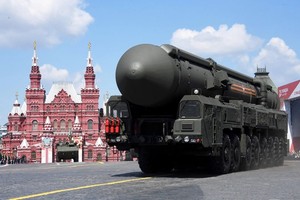
AI-generated editorial illustration depicting missile development, regional military technology and the potential threat to US naval forces. Image created for illustrative purposes.
Russia has secretly helped Iran develop supersonic cruise missile technology that experts say could give Tehran a new way to threaten US Navy vessels in the Middle East, the Financial Times reported, citing leaked Russian correspondence, travel records and military patents.
The program, codenamed C430L, began in 2023 and continued during this year's war with the United States and Israel, the FT said.
Its main focus is a ramjet propulsion system that would allow a cruise missile to sustain flight at several times the speed of sound, reducing the time available for US and allied defenses to detect and intercept it.
“For the Iranians, this would give them a qualitatively new strategic weapon system that could threaten US Navy vessels,” Jim Lamson, a former CIA military analyst focused on Iran, told the FT.
Iran has built and flight-tested the propulsion system, but there is no evidence that a Russian-assisted supersonic cruise missile has entered service, the newspaper said.
The FT said Russia's state arms exporter Rosoboronexport arranged the program with missile developer NPO Mashinostroyenia.
Russian engineers made repeated trips to Iran before a contract was signed with Iran's Ministry of Defense and Armed Forces Logistics in November 2023, according to records reviewed by the newspaper.
By 2025, Russian specialists were analyzing Iranian flight-test data and advising Tehran on the ramjet's fuel system, combustion stability, air intake and engine nozzle.
“This is the transfer of a highly strategically sensitive military technology from Russia that the Iranians have wanted to acquire for decades,” Fabian Hinz, a senior analyst with Conflict Armament Research, told the FT.
“A programme like this would require political clearance from the very top in Russia,” he said.
The Kremlin, Rosoboronexport, NPO Mashinostroyenia and the Iranian government did not respond to requests for comment from the FT.
Potential naval impact
Supersonic cruise missiles combine high speed with low-altitude flight, making them harder for air and missile defenses to detect and engage quickly.
That could be particularly significant in the Persian Gulf, where the United States and its regional allies operate advanced land- and sea-based defenses.
Hinz said Russian engineering support could be especially valuable because it would help Iran solve technical problems rather than simply provide finished weapons.
“Getting a 60-year-old engineer to fly over and problem-solve, using their experience, is hugely valuable,” he said.
The FT said the program continued into 2026, with Russia preparing technical reports and both sides discussing a further phase of development.
A June 2026 Rosoboronexport letter showed talks were still under way over that next stage, though it was unclear whether it had begun.
Deeper military ties
The program points to a deeper form of military cooperation between Moscow and Tehran, with Russia helping Iran acquire the know-how to develop an advanced weapon system of its own.
Iran previously supplied Russia with Shahed attack drones used in Ukraine and helped Moscow establish domestic production.
The FT has also reported that Russia agreed to supply Iran with Verba shoulder-fired air defense systems, while Tehran acquired a high-resolution Chinese satellite later used to monitor US military facilities in the region.
“If the Russians are able to help the Iranians fix their technical problems, I think this would be one of the more impactful areas of Russian military-technical assistance to Iran in recent years,” Lamson said.
Peru severed diplomatic relations with Iran on Tuesday, accusing Tehran of escalating conflicts in the Middle East, restricting shipping through the Strait of Hormuz and obstructing nuclear inspections.
“The government of the Republic of Peru has decided to sever diplomatic relations with the Islamic Republic of Iran,” the Foreign Ministry said.
Lima cited what it described as Iran’s repression of peaceful protests, restrictions on press freedom, discrimination against women and girls, and persecution of political opponents.
“Within the framework of its firm commitment to defending democracy, a fundamental principle of its foreign policy, Peru has observed with growing concern the deterioration of democracy in Iran, as documented by various United Nations mechanisms, particularly regarding the repression of peaceful protests, violations of press freedom, discrimination against women and girls, and the persecution of political opponents,” read the statement.
The ministry said Iranian restrictions and disruptions to international trade through Hormuz since March violated freedom of navigation, harmed energy markets and threatened global supply chains.
“The government of Peru views with deep concern the severe restrictions imposed by the Iranian regime, as well as the disruption of international trade through the Strait of Hormuz since March 2026, because they contravene principles such as freedom of navigation and the right of passage through straits used for international maritime transit, which cannot be subject to unilateral conditions, while also affecting navigational safety, the protection of human life at sea and the preservation of the marine environment, in addition to their repercussions for energy prices and the stability of global supply chains,” the foreign ministry said.
Lima also linked the diplomatic rupture to broader security concerns, accusing Tehran of fueling regional violence and denying UN nuclear inspectors’ access to facilities needed to verify that Iran was not developing nuclear weapons.
“The government of Peru also strongly rejects Iran’s incitement to violence and the escalation of conflicts in the Middle East, as well as its obstruction of the work of the International Atomic Energy Agency,” it said.
Peru will maintain consular relations to protect the two countries’ citizens and interests. The decision was communicated to Tehran through Iran’s embassy in Ecuador, which also covers Peru.
Iranian authorities did not immediately respond to Peru’s decision.
An Iranian court has sentenced Ali Zarei Doozdarresi, a protester shot by security forces and blinded in one eye during the 2022 protests, to death after he returned from Germany and was arrested upon arrival in Iran, US-based rights outlet HRANA reported.
Branch 23 of the Tehran Revolutionary Court convicted Zarei of “corruption on Earth,” based on alleged acts including extensive political activity, producing false news, propaganda against the establishment, disrupting security and unauthorized entry into and exit from the country, according to HRANA.
The death sentence was communicated to him on August 23, HRANA said.
Zarei, around 27 and from Tehran, was arrested by Intelligence Ministry agents on April 28 after returning to Iran. His case was initially handled by Branch 3 of Tehran Prosecutor’s Office District 33, known as the Security Prosecutor’s Office, before he was transferred to Qezel Hesar Prison in Karaj on June 30.
He is currently being held in Unit 3, Ward 37 of the prison, according to HRANA.
Zarei lost sight in his right eye after being shot during the 2022 Woman, Life, Freedom protests. He was later detained in December 2023 while visiting the graves of protesters killed in the crackdown at Tehran’s Behesht-e Zahra cemetery and spent 33 days in solitary confinement in Evin Prison.
He subsequently left Iran and reached Germany on a humanitarian visa.
While in Germany, Zarei appeared on stage at a February 14 rally in Munich held on the sidelines of the Munich Security Conference alongside exiled Prince Reza Pahlavi who had called for the gathering.
Iranian authorities have increasingly used the death penalty against protesters and political dissidents. Amnesty International has accused authorities of continuing to “weaponize the death penalty to repress dissent,” saying politically motivated death sentences have followed grossly unfair trials.
Last month, Norway-based Iran Human Rights said 29 people arrested in connection with the January 2026 protests had been executed since March 19, in addition to two protesters from the 2022 Woman, Life, Freedom movement. The group said hundreds of protesters were facing the death penalty and warned of an escalation in executions of political prisoners.
The US-based Center for Human Rights in Iran has also said authorities are increasingly using fast-tracked group prosecutions to sentence protesters to death, describing the practice as part of a strategy to punish those who joined protests and deter future dissent.
A woman fills her car with gasoline at a fuel station in Iran.
Iranians pushed back against a senior government official questioning cheap gasoline, contrasting fuel subsidies with low wages and soaring living costs as the US dollar traded around a historic 2.1 million rials on Monday.
“Give us a $3,000 salary and sell gasoline for 750,000 rials ($0.36) a liter. No problem,” one person wrote in response to Mohammad Jafar Ghaempanah, President Masoud Pezeshkian’s executive vice president.
Ghaempanah questioned the sustainability of selling gasoline for 15,000 rials per liter, less than one US cent at the current exchange rate, when he put its value at 700,000 rials ($0.33).
“You cannot buy gasoline that costs 700,000 rials per liter for 15,000 rials. No sound mind accepts this,” Ghaempanah said.
His comments drew responses comparing gasoline prices with wages, food, cars and the exchange rate, with several people questioning why international pricing should apply to household costs but not incomes.
An average monthly income of around 200 million to 250 million rials amounts to just $95 to $119 at an exchange rate of 2.1 million rials to the dollar, sharpening the contrast between earnings and prices increasingly measured against international market rates. At that income level, gasoline priced at Ghaempanah’s 700,000-rial ($0.33) valuation would make a 50-liter tank cost 35 million rials ($16.67), equivalent to about 14% to 18% of a month’s income.
‘Income in rials, expenses in dollars’
A worker writing from Tabriz turned Ghaempanah’s argument back on the government, questioning why wages remained so low if selling gasoline below its assessed value was unsustainable.
A man counts US dollar banknotes outside a currency exchange in Tehran, Iran.
“We workers also ask why a worker whose wage should actually be $4,000 is paid $100,” the person wrote.
Another response focused on the exchange rate, questioning why Iranians must pay more than 2.1 million rials for one US dollar while the government objects to selling domestically produced gasoline for 15,000 rials per liter.
“You can’t have income in rials and expenses in dollars,” another person wrote.
Others compared wages with what they described as the poverty line.
“You can’t have a salary of 200 million rials ($95) when the poverty line is 1.5 billion rials ($714),” one person wrote.
Cars and food enter the comparison
Cars were another recurring point of comparison, with people questioning the gap between domestic vehicle prices and those in international markets.
“But we can buy a car worth five billion rials ($2,381) for 50 billion rials ($23,810)?” one person wrote.
Another called for cars to be offered at international market prices if officials want to apply similar logic to energy, saying consumers should not have to depend on Iranian and Chinese manufacturers.
Food prices also featured prominently in the reactions.
“It’s possible to make 400,000-rial rice cost six million rials, three-million-rial meat cost 30 million rials, and a two-billion-rial salary become 200 million rials. But gasoline has to become more expensive,” one person wrote.
Ghaempanah said food prices had risen 123%. The latest figures cited from the Statistical Center of Iran also put point-to-point food inflation above 128%, almost twice the roughly 67% rate for non-food goods.
Other messages described households cutting back on basic purchases as prices rise.
One person said their 75-year-old father, a pensioner receiving 160 million rials ($76) a month and paying rent, could no longer afford meat or chicken and had long since stopped buying fruit.
Another said they wanted to buy apples for their son but could not afford the price of 1.5 million rials ($0.71) per kilogram.
Government says budget deficit drives money printing
Ghaempanah also said the government’s budget imbalance forces it to create money to cover shortfalls, contributing to inflation.
“Because our budget is unbalanced, we are forced to print money. When money is printed, it itself creates inflation,” Ghaempanah said.
A woman walks past a currency exchange displaying foreign exchange rates in Tehran, Iran.
The executive vice president attributed 67% of inflation to the banking sector, arguing that lenders issue loans that are not repaid and accept collateral without sufficient underlying value.
Banks then seek money from the Central Bank to cover their deficits, prompting further money creation, according to Ghaempanah.
He also described Iran’s economic conditions as poor and said ordinary people were bearing the greatest pressure.
“The bitter reality is that the country’s economic conditions are not good and the greatest pressure is being placed on the people,” Ghaempanah said.
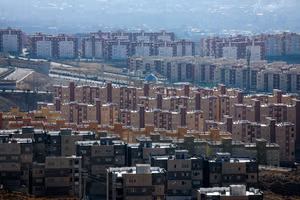
Two men look out over residential buildings in Tehran, Iran.
Forty-four percent of respondents to an Iran International Instagram poll said they would not buy a home in Iran even if they could afford one, with comments citing economic insecurity, emigration plans and concerns about keeping their wealth in the country.
Around 20,400 people participated in the online poll, with 44% saying they would not invest in property in Iran even if they could afford to do so. Only around half said they would buy a home.
Of those who participated, 67% were men and 33% women.
People aged 25 to 34 made up the largest group of respondents at 36.6%, followed by those aged 35 to 44 at 30.1%. People aged 45 to 54 accounted for 12.8%, while those aged 18 to 24 made up 11.4%.
Participants also left around 2,000 comments explaining their choices, offering a broader picture of the considerations shaping their decisions.
The responses centered on attachment to Iran, hopes for political change, plans to emigrate, economic hardship and concerns over the security of their savings.
‘If I had enough money, I wouldn't be in Iran’
For many of those opposed to buying a home, having enough money would provide an opportunity to leave Iran rather than invest more heavily in the country.
“If I had enough money, I wouldn't be in Iran at all,” one respondent wrote.
“Having enough money in this situation means having the best life abroad,” another wrote.
The responses mirror the findings of an earlier Iran International Instagram poll in which 83% of participants said they would leave Iran if given the opportunity.
Around 100,000 people participated in that poll over 24 hours. Thousands of comments cited economic problems, social restrictions, political conditions and uncertainty over the future among the reasons for wanting to emigrate.
Some participants in the latest poll associated remaining in Iran with insecurity, sanctions, inflation, power outages and difficulties meeting basic needs, saying they would rather put their money into a more stable country.
One described owning a home as inseparable from the wider conditions in which a person lives.
Residential and high-rise buildings across the Tehran skyline, Iran.
“A home needs a blue sky above it, a thriving tree with bright green leaves in its yard, air without lead coming through its windows, a meal in its kitchen that doesn't come with guilt or selling your dignity, and peace of mind because you feel safe,” the respondent wrote.
“Home is where I can look at the stars at night without waking up the next morning choked with sadness and humiliation.”
Gold and currency offer a way out
Others focused on the financial risks of property ownership.
Unlike in previous years, when buying a home was widely viewed as a relatively secure investment for the future, some said they would now prefer to keep their wealth in gold or foreign currency because those assets are more liquid and easier to take out of the country.
“Investing in a bankrupt economy is certainly a mistake because prices are unrealistic, artificial and like a hollow bubble,” one respondent wrote.
Housing has for years served as a means of preserving wealth in Iran's chronically inflationary economy, and property can provide protection against inflation over the longer term.
But international reporting has also documented a move toward assets that can be carried and quickly converted into cash during periods of uncertainty.
The Associated Press described the trend as a turn toward “portable wealth” during the 12-day war, while the World Gold Council recorded a sharp increase in investment demand for gold in Iran in 2025.
The poll comes as Iranians continue to contend with high inflation. Iran's Statistical Center put year-on-year inflation in July at nearly 88%.
‘I wouldn't trade Iran for anywhere’
For respondents who said they would buy a home, attachment to Iran and a sense of national identity emerged as leading reasons.
Some described owning a home as more than a financial investment, linking it to family, personal history and their connection to the country.
“Yes, I wouldn't trade Iran for anywhere in the world,” one wrote.
“Iran is our mother; you don't abandon your mother when times are difficult,” another wrote.
Others said the country's problems would not persuade them to build a life elsewhere.
“Iran is my first and last choice. I believe good days are ahead of us,” one participant wrote.
Some would buy only after political change
A number of respondents made their willingness to buy a home conditional on political change, greater freedoms or improvements in the country's circumstances.
“When Iran is free, 100%,” one wrote. “After Iran is free, yes, but not under these conditions,” another wrote.
Others questioned the premise of the poll itself, saying the prospect of having enough money to purchase a home was increasingly detached from the economic reality facing many people.
They pointed to difficulties paying for food, rent, medical treatment and other daily necessities, describing home ownership as an unattainable aspiration.
“We are renters, and we'll take the dream of buying a home to the grave,” one respondent wrote.
The findings follow another Iran International Instagram poll in which 90% of respondents said they did not want to marry or have children.