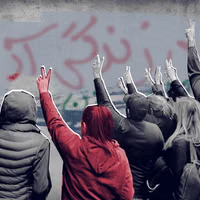
Sami sport players protesting after match, February 25, 2026
The Islamic Republic’s harsh response to recent protests has spilled beyond politics into sport, where athletes now face a stark choice: compete in silence or risk reprisal.
As families hold 40th-day memorials and students continue demonstrations on university campuses, the country’s widening crisis has left athletes weighing personal conscience against state pressure.
In the early days of unrest, athletes across disciplines signaled support through Instagram posts. Before the January crackdown, former national football team captain Mohammad Khakpour responded online to the Supreme Leader’s characterization of protesters as “rioters.”
“One cannot expect perpetual silence from the people who are being crushed under the burden of high prices, unemployment, and insecurity and then have their voices silenced by labeling them as rioters.”
He added: “The people who come to the streets defenselessly have neither weapons nor a platform; they only have voices. Silencing their voices with force, bullets, batons, or fear neither solves the problem nor makes the wound smaller."
Some have gone further. Goalkeeper Rashid Mazaheri, long known for outspoken criticism, published a defiant Instagram post on Wednesday addressing the Supreme Leader directly: “Khamenei, beware that your rule on this divine land has ended.”
In the same message, he wrote that being a champion means standing against injustice, not winning medals: “We won’t bow our heads to you!”
The post was removed within hours. His wife wrote on Instagram that she feared for his life and would hold the government responsible for his safety. Supporters interpreted the message as confirmation he had been detained, though authorities have not commented and his whereabouts remain unclear.
The pressure has also reshaped national team rosters. Two women’s national team footballers preparing for the Women’s Asia Cup in Australia this month—Zahra Alizadeh and Kousar Kamali—publicly withdrew from the squad.
Kamali wrote: “When the heart is wounded and the soul is exhausted, football is no longer a refuge. I can’t pretend everything is normal.”
“This decision is not born of anger, but of awareness; it is not out of disrespect, but out of respect for my conscience. I say goodbye not to football, but to the national team — in the hope that one day it will again be possible to play for the people with a peaceful heart.”
Symbolic gestures have also drawn scrutiny. In recent weeks, some footballers have refrained from celebrating goals altogether or marked them with muted gestures reflecting protest or solidarity rather than triumph.
In several competitions, players have reportedly been barred from wearing black armbands or other signs of mourning.
According to Sami Sport FC, match supervisors have been instructed to suspend games if players use black clothing, ribbons or armbands. Facing possible disqualification and citing mounting security pressure, the club announced it would withdraw from the remainder of the season.
Two weeks earlier, Sami Sport players entered the pitch in black kits and armbands. After scoring, they covered their faces in a gesture of mourning rather than celebrating.
The episodes echo earlier moments when Iranian athletes declined to sing the national anthem—reminders that even arenas meant for national unity have become sites of political contest.
The stakes are likely to rise further this year. Iran has qualified for the World Cup, and all three of its group-stage matches are scheduled to be played in the United States. The tournament will place the team under intense international scrutiny, including from a large Iranian diaspora that has become increasingly vocal.
During the 2022 World Cup, many fans harshly criticized the national team and even called for a boycott, accusing players of indifference to the “Women, Life, Freedom” protests and to the state’s violent crackdown.
This time, the political climate is even more charged. Iranian society has grown more radicalized, repression much harsher and mistrust deeper than three years ago.
The government is likely to exert tight control over players to prevent any gestures of dissent on the sport’s biggest stage. But with global attention fixed on the team, even silence—or the absence of it—may carry political meaning.
An illustration showing an ancient Iranian soldier and a Revolutionary Guard member holding a weapon together, displayed during a November 7 ceremony in Tehran where a statue of pre-Islamic Persian King Shapur I was unveiled.
Tehran’s unveiling of a towering statue depicting the Roman Emperor Valerian kneeling before pre-Islamic Persian King Shapur I has renewed criticism of the Islamic Republic’s appeal to nationalist sentiment following the June war with Israel.
For over forty years, the theocracy purged ancient Persian history from schoolbooks, replacing it with post-Islamic narratives. But after the 12-day conflict with Israel, officials have turned to the distant pre-Islamic past to rally a divided society.
From murals of ancient kings and soldiers to patriotic songs added to Shi’ite mourning ceremonies performed before Supreme Leader Ali Khamenei, Tehran now embraces imagery once deemed heretical by its own revolutionary ethos.
The statue unveiled in Tehran's Revolution Square
'Kneel before Iran' campaign
Tehran’s Revolution (Enghelab) Square was the scene of an unusual spectacle on Friday as officials unveiled a massive bronze statue depicting Roman Emperor Valerian kneeling in submission before Sassanid King Shapur I, commemorating Iran’s victory at the Battle of Edessa (260 AD).
The event was held under the slogan “Kneel before Iran,” part of what authorities describe as a campaign to project “national unity and historical pride” following the June war with Israel.
Tehran Mayor Alireza Zakani, a staunch ultraconservative, said on X: “Enmity with Great Iran can only end in kneeling before this historic nation.”
Municipal official Davood Goodarzi said the installation would be accompanied by visual displays depicting “other victories of Iranians over foreign aggressors,” including the defeat of British forces by local commander Rais-Ali Delvari, Mirza Kuchak Khan’s resistance against Russian troops, and Surena’s triumph over Rome at the Battle of Carrhae in 53 BCE.
The goal, Goodarzi said, is “strengthening concepts such as national dignity, social unity, and Iranian identity.”
The statue, he said, would remain temporarily at Revolution Square before being moved to a city gateway “where it will stand as the first emblem of Iran before diplomats and foreign visitors.”
Unveiled women were allowed to attend the unveiling ceremony—an uncommon scene at events organized by Tehran’s ultra-hardline municipality.
The turn to the pre-Islamic past
The sharp reversal also recalls remarks once made by Khamenei. In a 2011 speech, he asserted that “all the great military victories of this nation came after Islam,” dismissing pre-Islamic accounts as “things that are not documented.”
In 1987, he had said that prophets triumphed over kings such as Cyrus and that “nothing remains of these monarchs in history but names remembered with derision.”
Nevertheless, pro-government social media accounts have now gone so far as to circulate posters equating Khamenei himself with Shapur, showing him standing with a staff as Benjamin Netanyahu and Donald Trump kneel before him. The caption reads: “You will kneel before Iran.”
Image circulating by hardliners on social media
'Hypocrisy'
Pro-government figures have hailed the move as a patriotic success. Conservative political reporter Hossein Saremi posted: “Today’s grand Iranian gathering showed that people and the state share one essence: Iran itself. Nothing can take our homeland away.”
Others, however, called the spectacle “hypocrisy.” Journalist Gholamhossein Pashaei wrote on X: “Every year you close Pasargadae to stop people from celebrating Cyrus Day, yet you unveil Shapur’s statue in Enghelab Square with drums and fireworks during Fatimiyya (mourning period)!”
Dissident commentator Hamid Asafi called the ceremony “a perfect snapshot of the Islamic Republic’s contradictions.”
On Telegram he wrote: “A week ago they closed Cyrus’s tomb out of fear of the crowds, and now they glorify Shapur in the same breath. The Islamic Republic fears living history but poses for selfies with its corpse.”
He added: “They know people no longer respond to rosaries and sermons. That’s why they’ve brought history back to the stage—in a controlled costume. If they can’t erase the past, they’ll try to own it.”
The irony deepened as UNESCO formally recognized Cyrus’s Charter as one of the earliest human-rights documents.
President Masoud Pezeshkian wrote on X: “Iran, the cradle of dialogue, justice, and coexistence, can still inspire peace today.”
Users swiftly replied, questioning how such pride could coexist with a government that blocks access to Cyrus’s tomb each year to those wishing to visit it on his birthday.