• العربية
  • فارسی
Brand
  • Iran Insight
  • Politics
  • Economy
  • Analysis
  • Special Report
  • Opinion
  • Podcast
  • Live TV
  • Iran Insight
  • Politics
  • Economy
  • Analysis
  • Special Report
  • Opinion
  • Podcast
  • Live TV
  • Theme
  • Language
    • العربية
    • فارسی
  • Iran Insight
  • Politics
  • Economy
  • Analysis
  • Special Report
  • Opinion
  • Podcast
  • Live TV
All rights reserved for Volant Media UK Limited
volant media logo

Iran should cut Persian Gulf internet cables, hardline newspaper says

Sep 3, 2026, 05:23 GMT+1
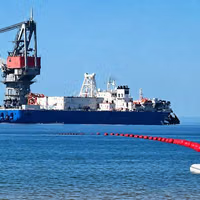
A man speaks on a mobile phone while sitting on floating pipes in the Strait of Hormuz on on July 27, 2026.

Iran’s hardline Kayhan newspaper urged Iran’s military and the Islamic Revolutionary Guards on Thursday to disrupt or sever international fiber-optic cables running beneath the Persian Gulf and the Strait of Hormuz to pressure the United States and its allies.

“Is it not our indisputable right, in order to bring these sources of evil to their knees and cut off their lifeline, to prevent internet cables from passing through the depths of the Persian Gulf and the Strait of Hormuz?” Kayhan Editor-in-Chief Hossein Shariatmadari wrote.

“This necessary measure could be carried out by seriously disrupting the cables’ operation or even cutting them,” Shariatmadari added.

He acknowledged that the action could violate international rules and harm other countries, arguing that US attacks on Iran had themselves been unlawful.

“You say other countries will also be harmed,” he wrote. “We say: Are the crimes of America and its wicked allies not crimes against all humanity? Why do they not rise up against them?”

Addressing Iran’s officials, particularly the army and IRGC, Shariatmadari concluded: “Look carefully. The global internet cables beneath the Strait of Hormuz and the ever-Persian Gulf are waving at us and asking in a thousand voices: Why have you forgotten our role in this war?”

In early May, IRGC-linked Tasnim News called for Iran to generate revenue from undersea internet cables passing through Hormuz, framing the waterway not only as an energy and shipping chokepoint but also as a digital pressure point.

Subsea cables carry the overwhelming majority of the global internet and financial traffic, connecting Europe, Asia and the Persian Gulf through a vast underwater network that powers everything from banking systems and cloud computing to government communications and energy markets.

Most Viewed

Trump dismisses Iran deal after Tehran pushes return to Islamabad memorandum
1

Trump dismisses Iran deal after Tehran pushes return to Islamabad memorandum

2
ANALYSIS

The republic of magic: How Iran turned the unseen into an instrument of rule

3

Central bank says Iran has currency reserves, ready to inject $2 billion

4

Protester blinded in one eye sentenced to death after return to Iran

5

IAEA says status of Iran’s fourth enrichment site remains unknown

Banner
Banner
Banner

Spotlight

  • Iran’s economy is a powder keg. Tehran is preparing for the spark
    ANALYSIS

    Iran’s economy is a powder keg. Tehran is preparing for the spark

  •  Hackers without borders: serving Tehran, stealing on the side
    SPECIAL REPORT

    Hackers without borders: serving Tehran, stealing on the side

  • The republic of magic: How Iran turned the unseen into an instrument of rule
    ANALYSIS

    The republic of magic: How Iran turned the unseen into an instrument of rule

  • President's son questions enrichment, ignites fierce debate in Tehran

    President's son questions enrichment, ignites fierce debate in Tehran

  • IRGC Unit 4000 plans attacks on shipping in East Asia, sources say
    EXCLUSIVE

    IRGC Unit 4000 plans attacks on shipping in East Asia, sources say

  • Iran loses ground on trade as war hits oil and non-oil exports
    ANALYSIS

    Iran loses ground on trade as war hits oil and non-oil exports

  • Iran finds a new weapon beneath Hormuz

    Iran finds a new weapon beneath Hormuz

•
•
•

More Stories

Iran’s economy is a powder keg. Tehran is preparing for the spark

Sep 3, 2026, 02:03 GMT+1
•
Negar Mojtahedi
100%
People walk in Tehran's Grand Bazaar, August 17, 2026

Iran’s economic crisis is deepening, and with few answers for a population becoming poorer, Tehran is signaling how it may respond if economic anger again spills into the streets: repression and lethal force.

Judiciary chief Gholam-Hossein Mohseni-Ejei has threatened an even harsher crackdown on another uprising. Leaked Basij audio has exposed anxiety inside the security establishment, while authorities have identified gasoline, unemployment and livelihoods as potential triggers.

Security forces have already opened fire on people protesting over jobs in southwestern Iran this week.

“The economic crisis in itself is turning Iran into a powder keg,” Khosro Isfahani, research director at the National Union for Democracy in Iran (NUFDI), told Iran International.

Fixing the conditions driving the anger would require the state to change into “something that is fundamentally not the Islamic Republic,” he said, adding that Iran’s rulers are willing to “kill as many as it takes to stay in power.”

At least 950 people have been executed since the beginning of the year. Not all were political prisoners, but the accelerating use of capital punishment has added to a wider climate of fear.

The same pattern can be seen in a renewed crackdown on compulsory hijab, cafe closures, pressure on workers and pensioners and the deployment of police onto the streets.

  • Jobs protests met with gunfire in southwestern Iran

    Jobs protests met with gunfire in southwestern Iran

‘Damaged fruit’

And there is little economic relief in sight, with fewer and fewer families able to afford meat, fruit or even dairy products.

Economist Ali Dadpay points to damaged fruit, once sold cheaply to the poorest or left for the homeless, as an increasingly common measure of what many families can afford.

For decades, the Islamic Republic has sought to blame economic hardship on sanctions, foreign powers, merchants or individual officials. But Dadpay says it is becoming harder to separate what Iranians experience in the supermarket from the decisions made by the state.

Inflation, he said, has become “the perfect indirect taxation.”

Instead of openly raising the money needed to finance its policies, Tehran prints it. The rial loses value and ordinary Iranians pay the difference every time they buy food, medicine or other necessities.

They have been made “poorer and poorer and poorer,” Dadpay said, and are now in danger of being “permanently impoverished.”

Middle class no more

The deterioration is reaching people who once considered themselves middle class. Pensioners are protesting. Even some government-linked companies are struggling to pay wages that barely cover basic living costs.

“Even the middle class cannot afford,” Dadpay said.

And winter threatens to tighten the squeeze.

Gasoline is already in short supply. Mahdi Ghodsi, senior economist at the Vienna Institute for International Economic Studies, estimates Iran has lost 15% to 30% of its energy-production capacity through war damage and depreciation.

As temperatures fall, factories may have to shut down so scarce gas can be redirected to households.

Transport workers would be among those hit by worsening fuel shortages, with disruptions potentially spreading quickly through the wider economy.

‘Fragile calm’

Miad Maleki, a former senior US Treasury sanctions strategist and senior fellow at the Foundation for Defense of Democracies (FDD), says the regime is looking at the same deteriorating numbers as everyone else.

“To keep paying salaries and pensions to roughly eight million state payees, including its own security forces, the regime has been printing rials and borrowing directly from the central bank,” Maleki said.

“Ejei’s threat tells you they know how fragile that is.”

Dadpay points to Venezuela and Zimbabwe as reminders that governments can survive extraordinary economic deterioration. Money can be printed, salaries can be deposited and the machinery of the state can continue operating even as the population becomes dramatically poorer.

“Yes, it works,” Dadpay said. But what it produces is “a miserable impoverished situation.”

Iran’s rulers learned in November 2019, however, how quickly the calculation can change. A sudden gasoline price increase led to spontaneous protests that Tehran crushed with lethal force.

‘Revolutions are not advertised’

Inflation is easier to disperse. It quietly takes purchasing power from millions of people without creating a single moment around which they can mobilize.

The danger for Tehran comes when that diffuse suffering suddenly becomes concrete: an empty gas station, a bread shortage, a missed salary, a delayed pension or another sudden price decree.

That is when, Maleki said, scattered grievances can acquire “a single address and a single date.”

But there is another calculation now: fear.

Iranians have seen what happens when they confront the state. Ghodsi said the expected cost of taking to the streets has become enormous because people know they could be shot or killed.

And yet, he said, “society is boiling.”

What changes that calculation may ultimately be impossible to forecast. Ghodsi believes it could take an unpredictable shock. Isfahani looks for something even less measurable: the image, death or act of defiance that suddenly turns private anger into a collective cause.

Mahsa Amini became such a moment in 2022. Isfahani said he has not seen an equivalent tipping point yet. “It’s never about number,” he said.

He quoted his late father: “Revolutions don’t advertise their time of arrival. They arrive.”

The Islamic Republic may not know when, or whether, scattered economic grievances will converge into another uprising. But its threats, preparations and response to smaller protests are already showing how it intends to confront one.

Canada awarded contracts to Iran ex-VP’s son despite security probe - Global News

Sep 2, 2026, 15:15 GMT+1
100%
Mohammad-Reza Ghafouri-Fard

Canada awarded more than $2 million in federal and provincial government contracts to the son of a former Iranian vice president despite a long-running investigation into allegations he helped Iran evade sanctions and develop military technology, Global News reported Wednesday.

Global News identified him as Mohammad-Reza Ghafouri-Fard, a 45-year-old Edmonton resident who has done business in Canada under the name Sal Ghafouri and whose father, HassanGhafouri-Fard, was a conservative Member of Parliament and former vice-president to Akbar Hashemi Rafsanjani.

Citing a recently declassified Canadian Security Intelligence Service (CSIS) report, Global News said Ghafouri had been the subject of a long-running investigation over his alleged work for Iran’s military and the Islamic Revolutionary Guard Corps.

According to the report, CSIS said Ghafouri was “involved in the research and development of Iranian military technologies” and allegedly helped develop a guided anti-aircraft missile system and an electronic warfare tool intended to counter US aircraft.

The report said CSIS also alleged that Ghafouri participated in a “covert procurement structure” that used a company in Southeast Asia to obtain components for Iranian military projects that were unavailable because of sanctions.

100%
Iran’s then-Supreme Leader Ali Khamenei leads prayers at the funeral of former vice-president and conservative lawmaker Hassan Ghafouri Fard in Tehran on March 10, 2023.

Government contracts

Global News said public records showed companies founded by Ghafouri received more than $2 million in government contracts, including from the Royal Canadian Mounted Police and Department of National Defence.

The report said Ghafouri had been flagged by immigration investigators for national security reasons in 2017 but later won procurement contracts, including two worth more than $1.5 million from the Canadian military. His companies continued receiving federal money after CSIS completed its security screening report in 2023, it said.

Alleged military work

Ghafouri worked for Iranian company Rabi Kosar, which CSIS described as conducting research and development for Iran’s military.

According to the CSIS report, Ghafouri worked on the Shahin missile used in Iran’s Mersad air-defense system, the RAAD electronic warfare project and the SINA direction-finding system, which had military applications including locating ships in the Persian Gulf.

  • Canada says ex-Iranian official 'critical' to revenue tied to terror funding

    Canada says ex-Iranian official 'critical' to revenue tied to terror funding

  • Canada deports former Iranian official linked to 2019 protest crackdown

    Canada deports former Iranian official linked to 2019 protest crackdown

CSIS alleged Ghafouri was later reassigned to procurement work, where requirements for military components were passed to a Malaysia-based contact who sourced parts from third countries, including the United States.

Ghafouri returned to Iran in 2015 and met twice with members of Iran’s Ministry of Intelligence and Security, who questioned him about his activities in Canada and advised him on how to respond if approached by Canadian police or intelligence services.

Citizenship case

Global News said Canada’s immigration department informed Ghafouri in May 2026 that it was launching proceedings to deny him citizenship on the grounds that he was a “threat to the security of Canada.”

Canada Border Services Agency had separately decided to launch deportation proceedings against him over his employment activities in Iran but withdrew the case in November because of an “inability to use the required evidence.”

His lawyer, Bjorna Shkurti, told Global News that Ghafouri “strongly disputes the allegations made against him” and intends to pursue all available legal avenues.

Global News said Ghafouri is also pursuing legal action over delays to his citizenship application and has argued in court filings that he answered CSIS questions truthfully, contributed significantly to Canada and does not pose a security threat.

Iranians to Trump: This time you fight, help is on its way

Sep 2, 2026, 14:19 GMT+1
100%
A scene of protests in Arak, Markazi province, on January 8, 2026

Donald Trump’s question about when Iranians would rise against the Islamic Republic drew thousands of responses arguing that fear of renewed repression, doubts over US policy and insufficient outside support are holding back another uprising.

“This time you fight. Help from the people is on its way,” one Iran International audience told the US president, turning back on Trump a phrase he used during earlier anti-government protests.

Trump asked the question on Truth Social on Tuesday night while rejecting an ABC News report that he was seeking to bring Iran into negotiations.

“I’m not trying to force Iran to the bargaining table... I couldn’t care less if they sign a worthless, to them, agreement,” Trump wrote.

“I like our position now much better, with almost total control of the Hormuz Strait, and their economy totally collapsing. They are just playing out the inevitable. When are the Iranian people going to rise up and fight?” Trump added.

  • 'Help is on the way': to whom?

    'Help is on the way': to whom?

Thousands of responses sent to Iran International pointed to a common argument: Iranians have repeatedly confronted the Islamic Republic, but many are reluctant to return to the streets without greater confidence that its forces can no longer suppress them and that outside powers will not change course.

‘People have been fighting for 47 years’

Several respondents pointed to successive waves of anti-government protests in Iran and the heavy costs borne by demonstrators.

100%

“The people of Iran fought and rose up a thousand times beyond their capacity. Now it is time for other countries to help them,” one wrote.

“The people of Iran have been fighting for 47 years,” another told Trump.

Others pointed to protesters who took to the streets on January 8 and 9, asking when people who confronted government forces without weapons would receive meaningful assistance.

Some respondents said further negotiations between Washington and the Islamic Republic would undermine Iranians seeking political change.

“This government does not represent the people. Negotiating with the killers of the people is a mistake. Help so that the people themselves can finish the job,” one respondent wrote.

Fear of another crackdown

The prospect of another crackdown featured prominently in the messages, with people arguing that the capacity of security forces would have to be weakened before another uprising could succeed.

One described reducing the strength of forces used against demonstrators as the most important condition for renewed street protests.

“No matter how brave you are, if you know you will be killed by snipers, it is foolish to fight empty-handed,” another respondent wrote, referring to Trump’s previous calls for Iranians to protest.

On March 15, Trump said: “The protesters have no guns. And I know you’re a brave person, but I don’t think you’d be protesting. And so I think it’s very hard for them to protest. I fully understand it.”

Another person said ordinary people could not be treated as “cannon fodder,” adding that an uprising without a plan would be a mistake.

Several respondents said people would return to the streets when they believed the authorities’ ability to suppress demonstrations had been sufficiently weakened. Others pointed to disabling checkpoints and disrupting security structures as steps that could change the balance.

100%
A scene of protests in Tehran on January 8, 2026

“Mr. Trump, continue the naval blockade and add a land blockade. Give [Benjamin] Netanyahu a free hand to destroy the system of repression, and then the people of Iran are ready to overthrow the Islamic Republic,” another one wrote.

Some also called for increased pressure on the Islamic Republic and clearer international backing for exiled Prince Reza Pahlavi during a potential transition.

Trump’s ‘help is on its way’ message returns

A separate strand of responses focused on mistrust of Washington and concern that Trump could encourage another uprising only to resume negotiations with the Islamic Republic.

“We are afraid that we will come out and you will negotiate with the mullahs’ regime again,” read a message.

“The people of Iran will rise when you do not negotiate with this murderous regime,” another wrote.

Trump had urged Iranians to continue protesting during demonstrations in January and told them that “help is on its way,” a message several respondents invoked in answering his latest question.

  • Iranians plead with Trump not to negotiate with the Islamic Republic

    Iranians plead with Trump not to negotiate with the Islamic Republic

“When you said help was on its way, people came into the streets, but you sat down and made a deal with the government.”

The respondent added that if Iranians returned to the streets, they would do so “to fight and regain their own freedom,” rather than to advance US strategy.

From family homes to drug dens: Middle-aged women are Iran's new face of poverty

Sep 2, 2026, 12:11 GMT+1
100%
An Iranian woman with a drug addiction sits curled up in a doorway.

Growing numbers of middle-aged women are appearing at drug-use sites in Tehran as economic hardship and homelessness push some from previously stable lives into environments rife with addiction and violence, Iran’s Shargh newspaper reported on Wednesday.

Some arrive in their own cars to buy drugs before losing their homes, sleeping in their vehicles and, in some cases, becoming homeless within weeks, according to social workers interviewed in the newspaper’s field report.

“We are now encountering a different group of women, women who sometimes had relatively normal lives until middle age, had families and children and were not even drug users before entering these spaces,” Sepideh Alizadeh, a social worker, told the daily.

There are no recent official figures showing how many homeless women live in Tehran or allowing the increase described by social workers to be precisely measured.

From homes and cars to drug sites

At one drug-use site in wasteland near Tehran’s Azadegan Highway, men and women queued to buy heroin from a dealer operating from a cavity among large rocks, paying in cash or by card before consuming the drug nearby.

100%
A woman with drug addiction holds a baby as a man sits beside her on a roadside in Iran in an undated image.

Among them were women whose appearance still differed markedly from people who had spent longer periods living at such sites.

One woman was living in her own car and using heroin there. A social worker pointed her out before she placed a metal pipe to her lips and drove away in her white sedan with another drug user.

“She still hasn't ended up like the others at the site and lives in her own car,” the social worker said.

Others described women following a similar trajectory, initially driving to the area to buy drugs before sleeping in their cars and eventually losing them.

People gathered at the site also described a young woman who had given birth several weeks earlier in one of the makeshift rooms scattered across the wasteland.

“Her baby was born right here at the drug site, but she has disappeared since that day,” one person there said.

Another man said the woman had gone into hiding because she feared the authorities would take the child away.

“She disappeared because she was afraid of the welfare authorities,” he said. “They say the baby was born addicted, but nobody knows where they are now.”

Shargh said attempts to locate the mother and baby were unsuccessful, including a visit to a makeshift room off the highway where people at the site believed they had been hiding.

Poverty and the inability to afford housing are increasingly exposing women to such environments, including some who had not previously used drugs.

The risks can extend to entire families. In another case described by a social worker, a couple and their young child were living in a vehicle until social emergency services intervened and transferred the child to the state welfare organization because of the conditions.

100%
A woman with drug addiction sits on a pavement in Tehran in an undated image.

Middle-aged women increasingly visible

Tehran has no up-to-date figures for its homeless female population, but available data point to a broader problem with homelessness in the capital.

Tehran municipality identified about 24,000 homeless people in 2021. Calls concerning homeless families increased in early 2025, and a Tehran City Council spokesman later pointed to an increase in visibly dependent drug users in parts of the capital.

Social workers say middle-aged women have become more visible at drug-use sites in recent years, particularly since the 40-day war with the US and Israel.

Many women encountered at such sites in previous years had already experienced addiction or other forms of severe social instability. Social workers now describe seeing women who maintained homes and families into middle age before financial pressures left them without secure housing.

Some initially live in cars, pickup trucks or temporary shelters. Without early support, homelessness can expose them to drug use and accelerate a descent that becomes increasingly difficult to reverse.

Violence and barriers to treatment

Women living at drug-use sites face heightened exposure to violence, theft and exploitation and can have less ability to defend themselves or escape confrontations.

100%
Four women with drug addiction sit beside an armed officer in an undated image from Iran.

Efforts to clear established gathering places can worsen their vulnerability by dispersing people to more remote areas where harm-reduction services are harder to access, the report said.

For those seeking to stop using drugs, access to voluntary treatment presents another obstacle.

The decision to seek treatment may last only a matter of hours before withdrawal, hunger or a return to the same surroundings leads someone back to drug use, social workers told Shargh.

Treatment costs, administrative procedures and admission restrictions can prevent people without money from receiving help during that window, even as resources remain available for compulsory treatment programs.

US may intensify Iran attacks after midterm elections – Reuters

Sep 2, 2026, 12:07 GMT+1
100%
A US sailor directs the takeoff of a UH-1Y Venom utility helicopter from the flight deck of USS Boxer (LHD 4) as the amphibious assault ship sails in the Arabian Sea. (CENTCOM)

Senior White House officials will consider intensifying military action against Iran after the November 3 midterm elections, Reuters reported on Wednesday, citing four people familiar with internal discussions.

No decision has been made on returning to full-scale conflict, but top aides to US President Donald Trump are pushing to keep the war relatively contained until the election as Republicans defend narrow majorities in Congress.

“We are keeping the pressure on Iran,” one White House official said. “But November is a priority.”

Vice President JD Vance and Secretary of State Marco Rubio are among the senior officials supporting efforts to keep the conflict relatively quiet until November, two White House officials told Reuters.

The sources said containing the war could limit its impact on Republican midterm campaigns and give the US military time to replenish depleted munitions. High gasoline prices have also contributed to public dissatisfaction with the conflict.

“The timetable has changed,” one senior White House official said. Another added: “The calendar is driving Iran.”

Reuters reported in August that the US military had used “virtually all” of its stock of some long-range precision missiles. The Pentagon, however, said the military had “everything it needs to execute” its mission.

The sources said Washington was focusing for now on intensifying economic pressure through sanctions and its naval blockade, seeking concessions in future negotiations that months of military action had failed to secure.

Trump warned on Tuesday that further Iranian action would bring a stronger US response.

“If the failed Nation of Iran retaliates for this very justified attack, they will be hit again at a much harder and higher level, but it will not be the biggest attack of them all, that is waiting in the wings,” he wrote on Truth Social.

White House spokeswoman Olivia Wales defended the administration’s strategy, saying: “President Trump has destroyed Iran’s military capabilities and is crippling what’s left of its abysmal economy with the most powerful naval blockade in world history and crushing sanctions.”

“The President will continue to advance America’s interests at home and abroad and will never allow Iran to have a nuclear weapon,” she added.