US may intensify Iran attacks after midterm elections – Reuters
A US sailor directs the takeoff of a UH-1Y Venom utility helicopter from the flight deck of USS Boxer (LHD 4) as the amphibious assault ship sails in the Arabian Sea. (CENTCOM)
Senior White House officials will consider intensifying military action against Iran after the November 3 midterm elections, Reuters reported on Wednesday, citing four people familiar with internal discussions.
No decision has been made on returning to full-scale conflict, but top aides to US President Donald Trump are pushing to keep the war relatively contained until the election as Republicans defend narrow majorities in Congress.
“We are keeping the pressure on Iran,” one White House official said. “But November is a priority.”
Vice President JD Vance and Secretary of State Marco Rubio are among the senior officials supporting efforts to keep the conflict relatively quiet until November, two White House officials told Reuters.
The sources said containing the war could limit its impact on Republican midterm campaigns and give the US military time to replenish depleted munitions. High gasoline prices have also contributed to public dissatisfaction with the conflict.
“The timetable has changed,” one senior White House official said. Another added: “The calendar is driving Iran.”
Reuters reported in August that the US military had used “virtually all” of its stock of some long-range precision missiles. The Pentagon, however, said the military had “everything it needs to execute” its mission.
The sources said Washington was focusing for now on intensifying economic pressure through sanctions and its naval blockade, seeking concessions in future negotiations that months of military action had failed to secure.
Trump warned on Tuesday that further Iranian action would bring a stronger US response.
“If the failed Nation of Iran retaliates for this very justified attack, they will be hit again at a much harder and higher level, but it will not be the biggest attack of them all, that is waiting in the wings,” he wrote on Truth Social.
White House spokeswoman Olivia Wales defended the administration’s strategy, saying: “President Trump has destroyed Iran’s military capabilities and is crippling what’s left of its abysmal economy with the most powerful naval blockade in world history and crushing sanctions.”
“The President will continue to advance America’s interests at home and abroad and will never allow Iran to have a nuclear weapon,” she added.
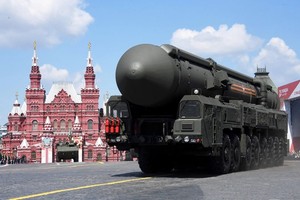
AI-generated editorial illustration depicting missile development, regional military technology and the potential threat to US naval forces. Image created for illustrative purposes.
Russia has secretly helped Iran develop supersonic cruise missile technology that experts say could give Tehran a new way to threaten US Navy vessels in the Middle East, the Financial Times reported, citing leaked Russian correspondence, travel records and military patents.
The program, codenamed C430L, began in 2023 and continued during this year's war with the United States and Israel, the FT said.
Its main focus is a ramjet propulsion system that would allow a cruise missile to sustain flight at several times the speed of sound, reducing the time available for US and allied defenses to detect and intercept it.
“For the Iranians, this would give them a qualitatively new strategic weapon system that could threaten US Navy vessels,” Jim Lamson, a former CIA military analyst focused on Iran, told the FT.
Iran has built and flight-tested the propulsion system, but there is no evidence that a Russian-assisted supersonic cruise missile has entered service, the newspaper said.
The FT said Russia's state arms exporter Rosoboronexport arranged the program with missile developer NPO Mashinostroyenia.
Russian engineers made repeated trips to Iran before a contract was signed with Iran's Ministry of Defense and Armed Forces Logistics in November 2023, according to records reviewed by the newspaper.
By 2025, Russian specialists were analyzing Iranian flight-test data and advising Tehran on the ramjet's fuel system, combustion stability, air intake and engine nozzle.
“This is the transfer of a highly strategically sensitive military technology from Russia that the Iranians have wanted to acquire for decades,” Fabian Hinz, a senior analyst with Conflict Armament Research, told the FT.
“A programme like this would require political clearance from the very top in Russia,” he said.
The Kremlin, Rosoboronexport, NPO Mashinostroyenia and the Iranian government did not respond to requests for comment from the FT.
Potential naval impact
Supersonic cruise missiles combine high speed with low-altitude flight, making them harder for air and missile defenses to detect and engage quickly.
That could be particularly significant in the Persian Gulf, where the United States and its regional allies operate advanced land- and sea-based defenses.
Hinz said Russian engineering support could be especially valuable because it would help Iran solve technical problems rather than simply provide finished weapons.
“Getting a 60-year-old engineer to fly over and problem-solve, using their experience, is hugely valuable,” he said.
The FT said the program continued into 2026, with Russia preparing technical reports and both sides discussing a further phase of development.
A June 2026 Rosoboronexport letter showed talks were still under way over that next stage, though it was unclear whether it had begun.
Deeper military ties
The program points to a deeper form of military cooperation between Moscow and Tehran, with Russia helping Iran acquire the know-how to develop an advanced weapon system of its own.
Iran previously supplied Russia with Shahed attack drones used in Ukraine and helped Moscow establish domestic production.
The FT has also reported that Russia agreed to supply Iran with Verba shoulder-fired air defense systems, while Tehran acquired a high-resolution Chinese satellite later used to monitor US military facilities in the region.
“If the Russians are able to help the Iranians fix their technical problems, I think this would be one of the more impactful areas of Russian military-technical assistance to Iran in recent years,” Lamson said.
Peru severed diplomatic relations with Iran on Tuesday, accusing Tehran of escalating conflicts in the Middle East, restricting shipping through the Strait of Hormuz and obstructing nuclear inspections.
“The government of the Republic of Peru has decided to sever diplomatic relations with the Islamic Republic of Iran,” the Foreign Ministry said.
Lima cited what it described as Iran’s repression of peaceful protests, restrictions on press freedom, discrimination against women and girls, and persecution of political opponents.
“Within the framework of its firm commitment to defending democracy, a fundamental principle of its foreign policy, Peru has observed with growing concern the deterioration of democracy in Iran, as documented by various United Nations mechanisms, particularly regarding the repression of peaceful protests, violations of press freedom, discrimination against women and girls, and the persecution of political opponents,” read the statement.
The ministry said Iranian restrictions and disruptions to international trade through Hormuz since March violated freedom of navigation, harmed energy markets and threatened global supply chains.
“The government of Peru views with deep concern the severe restrictions imposed by the Iranian regime, as well as the disruption of international trade through the Strait of Hormuz since March 2026, because they contravene principles such as freedom of navigation and the right of passage through straits used for international maritime transit, which cannot be subject to unilateral conditions, while also affecting navigational safety, the protection of human life at sea and the preservation of the marine environment, in addition to their repercussions for energy prices and the stability of global supply chains,” the foreign ministry said.
Lima also linked the diplomatic rupture to broader security concerns, accusing Tehran of fueling regional violence and denying UN nuclear inspectors’ access to facilities needed to verify that Iran was not developing nuclear weapons.
“The government of Peru also strongly rejects Iran’s incitement to violence and the escalation of conflicts in the Middle East, as well as its obstruction of the work of the International Atomic Energy Agency,” it said.
Peru will maintain consular relations to protect the two countries’ citizens and interests. The decision was communicated to Tehran through Iran’s embassy in Ecuador, which also covers Peru.
Iranian authorities did not immediately respond to Peru’s decision.
An Iranian court has sentenced Ali Zarei Doozdarresi, a protester shot by security forces and blinded in one eye during the 2022 protests, to death after he returned from Germany and was arrested upon arrival in Iran, US-based rights outlet HRANA reported.
Branch 23 of the Tehran Revolutionary Court convicted Zarei of “corruption on Earth,” based on alleged acts including extensive political activity, producing false news, propaganda against the establishment, disrupting security and unauthorized entry into and exit from the country, according to HRANA.
The death sentence was communicated to him on August 23, HRANA said.
Zarei, around 27 and from Tehran, was arrested by Intelligence Ministry agents on April 28 after returning to Iran. His case was initially handled by Branch 3 of Tehran Prosecutor’s Office District 33, known as the Security Prosecutor’s Office, before he was transferred to Qezel Hesar Prison in Karaj on June 30.
He is currently being held in Unit 3, Ward 37 of the prison, according to HRANA.
Zarei lost sight in his right eye after being shot during the 2022 Woman, Life, Freedom protests. He was later detained in December 2023 while visiting the graves of protesters killed in the crackdown at Tehran’s Behesht-e Zahra cemetery and spent 33 days in solitary confinement in Evin Prison.
He subsequently left Iran and reached Germany on a humanitarian visa.
While in Germany, Zarei appeared on stage at a February 14 rally in Munich held on the sidelines of the Munich Security Conference alongside exiled Prince Reza Pahlavi who had called for the gathering.
Iranian authorities have increasingly used the death penalty against protesters and political dissidents. Amnesty International has accused authorities of continuing to “weaponize the death penalty to repress dissent,” saying politically motivated death sentences have followed grossly unfair trials.
Last month, Norway-based Iran Human Rights said 29 people arrested in connection with the January 2026 protests had been executed since March 19, in addition to two protesters from the 2022 Woman, Life, Freedom movement. The group said hundreds of protesters were facing the death penalty and warned of an escalation in executions of political prisoners.
The US-based Center for Human Rights in Iran has also said authorities are increasingly using fast-tracked group prosecutions to sentence protesters to death, describing the practice as part of a strategy to punish those who joined protests and deter future dissent.
People browse a local market in Iran's Persian Gulf port city of Bandar Abbas, August 25, 2026
Iran’s latest strikes on American forces have brought threats of further US retaliation, but Washington increasingly sees Tehran’s military escalation as a sign of economic vulnerability rather than strategic strength.
After Iran launched missiles at US bases in Jordan in response to an American strike on Larak Island in the Strait of Hormuz, President Donald Trump promised another response.
“We’re going to hit them hard,” Trump told Fox News. “There will be a response.”
At the same time, Treasury Secretary Scott Bessent offered a different measure of who has the advantage.
“I would think that they are lashing out kinetically because they are losing economically,” Bessent said, arguing that Tehran is feeling the effects of Washington’s expanding pressure campaign.
Iran’s economy does not have to collapse, he said. “We just have to have the regime come to their senses.”
That leaves a central question hanging over the latest exchange: can Iran’s military retaliation actually improve its position as economic pressure mounts?
“Keep firing on Jordan, keep firing on Kuwait and Bahrain and UAE, but does that solve your problem at home?” Kamran Bokhari, Strategic Forecaster and Senior Resident Fellow with the Middle East Policy Council in Washington, told Iran International.
Bokhari believes Washington has little incentive to escalate into a larger war when it can respond to specific Iranian actions while maintaining the blockade and economic pressure.
“Keep the blockade,” he said. “If they try to mine, do what they did yesterday, but don’t escalate anything, and just keep the pressure up on the economic front.”
In that scenario, Iran retains the ability to retaliate, but its attacks do little to relieve the broader pressures facing the Islamic Republic.
Can economic pressure lead to something bigger?
Ali Dadpay, an Iranian American economist from Texas, said Washington’s stated objective is to change the Islamic Republic’s behavior rather than openly pursue regime change.
“Right now, they officially and legitimately say change of behavior,” Dadpay said.
But he argued that the economic deterioration Iran is experiencing could ultimately produce a more consequential outcome than Washington’s stated goal.
Dadpay pointed to the Soviet Union, East Germany and communist Poland as examples of political systems that collapsed without being invaded by a foreign power.
“A similar set of socio-economic factors can create a similar outcome,” he said of Iran.
Dadpay also said the combination of military and economic pressure could alter calculations among groups within the Islamic Republic and push the system toward what he described as a “new equilibrium.”
The immediate question is how far Washington is prepared to go with that economic pressure.
Max Meizlish, a former senior policy adviser at the Treasury Department’s Office of Foreign Assets Control, said a key test will be whether the US targets financial institutions facilitating Iranian trade with China.
Iran may still have oil to sell. The bigger question is whether Tehran can get paid. Unless financial channels through Hong Kong, the UAE and elsewhere are constrained, Meizlish said, “the regime is still going to have pathways for rearming itself.”
The pressure reaches ordinary Iranians
The expanding campaign is also having consequences beyond the regime. On August 24, OFAC suspended General License G, which had permitted certain educational services and academic exchanges involving Iranians.
ETS told Iran International it has since paused TOEFL and GRE testing inside Iran. Iranian nationals can still take the tests outside the country.
Dadpay called the impact on testing a “side effect” of the broader restrictions. Meizlish said the administration may be trying to prevent regime-linked individuals from using educational opportunities abroad.
But he acknowledged the wider cost.
“There could be an unintended effect here where ordinary Iranians are caught in the crossfire, so to speak,” Meizlish said.
Iran’s missiles have shown Tehran can still strike back. What remains unclear is whether those attacks can ease the pressure building on the Islamic Republic — or whether Washington’s economic squeeze can change the regime’s behavior without increasingly hurting the Iranians it is meant to pressure Tehran on behalf of.
Iran’s IRGC intelligence arm is recruiting non-Iranian operatives to carry out attacks on ships, waterways and ports in East Asia, including two major Chinese ports, sources familiar with the plans told Iran International.
Iran International has obtained information about three alleged recruits and an operation being developed by Unit 4000, the Special Operations Division of the Islamic Revolutionary Guard Corps Intelligence Organization.
According to the sources, the unit recruited the three individuals through Shiite clerics in Thailand and Indonesia and has begun planning attacks in the Malacca and Bangka straits, as well as at Tanjung Priok Port in Indonesia and the Ningbo-Zhoushan and Shanghai ports in China.
The operations are being overseen by Brigadier General Rahman Moghaddam, commander of Unit 4000, according to Iran International’s sources.
Moghaddam was reported killed in an Israeli strike in Tehran on March 3, during the opening days of the war. Israeli security agencies identified him among senior Iranian intelligence figures killed in Israeli attacks.
Two days later, drones struck Nakhichevan in Azerbaijan in an attack Baku blamed on Iran, although Tehran denied responsibility. CNN later reported that Iranian officials believed the drone attack was retaliation for Moghaddam’s killing, which Tehran suspected had been carried out with Israeli assistance from Azerbaijan.
Iran International has now obtained information indicating that those reports of Moghaddam’s death were incorrect. According to the new information, he survived the strike and is now overseeing what the sources describe as a new phase of Unit 4000’s overseas maritime operations.
Moghaddam, a former deputy coordinator at the Defense Ministry’s Protection and Intelligence Organization, took charge around three years ago of Unit 4000, which has been linked to assassination and sabotage operations targeting opponents of the Islamic Republic and Israeli interests abroad.
Plans to target ships in Indonesian and Chinese waters
Two sources familiar with the IRGC’s activities said Moghaddam is overseeing a new program aimed at expanding Unit 4000’s operations into East Asian waters.
The sources said the unit is considering attacks on commercial, military and privately owned vessels transiting the Malacca Strait, one of the world’s most important shipping routes, as well as the Bangka Strait.
Operatives recruited by the unit have also developed plans targeting Tanjung Priok, Indonesia’s busiest port, and the major Chinese ports of Ningbo-Zhoushan and Shanghai, the sources said.
The plans would represent a significant geographical expansion of Iran’s maritime pressure campaign.
Since the war began on February 28, Iran has sought to restrict shipping through the Strait of Hormuz, while the Iran-backed Houthis in Yemen have disrupted maritime traffic around the Bab al-Mandab and the Red Sea.
In June, Mohsen Rezaei, then a senior adviser to Iran’s supreme leader and now secretary of the Supreme National Security Council, told CNN that Tehran could expand the conflict if the war and US naval blockade continued.
“If the war continues and the naval blockade is not lifted, we will drag the war to the Indian Ocean, the Bab al-Mandab Strait, the Red Sea and the Mediterranean,” Rezaei said.
Around the same period, Quds Force commander Esmail Qaani said a new “security belt” of Iran’s so-called resistance front would extend from the Strait of Hormuz to Bab al-Mandab and from the Persian Gulf to the Red Sea.
Sources identify recruitment links in Thailand and Indonesia
Iran International’s sources said Unit 4000 had been seeking non-Iranian recruits for its East Asian maritime operations, allowing Tehran greater deniability if an operation was exposed.
The recruits were brought to Iran for training before being assigned to operations in East Asia, according to the sources.
For recruitment in Thailand, Moghaddam approached Seyyed Momen Saketicha, a prominent figure in the country’s Shiite community, the sources said.
Saketicha was part of a Thai delegation that travelled to Tehran in 2023 and met Hamas representatives in efforts to secure the release of Thai nationals taken hostage during the October 7 attack on Israel.
The sources described Saketicha as a close associate of prominent Thai Shiite cleric Seyed Sulaiman Husaini, who heads the Al-Mahdi Foundation in Thailand and serves as imam of the Ruhollah Mosque in Nakhon Si Thammarat.
Husaini also has ties to Al-Mustafa International University, an Iran-based institution sanctioned by the US Treasury in 2020 over what Washington described as its role in facilitating recruitment for the IRGC Quds Force.
In 2012, after explosions in Bangkok that Thai and Israeli officials said were part of a plot targeting Israeli diplomats, Husaini blamed Mossad. A Thai court later convicted two Iranian men over the bomb plot. Iran denied involvement.
Focus on Indonesia
The bulk of Unit 4000’s planned East Asian maritime activity is centered on Indonesia, according to Iran International’s sources.
The sources said Moghaddam used two Indonesian clerics to identify potential recruits.
One is Zahir Yahya, chairman of Ahlulbait Indonesia, a national Shiite organization. Iran International’s sources described Yahya as an intermediary who introduced potential operatives to Unit 4000.
The second is Abdullah Saqqaf, whom the sources identified as head of the Amir al-Mu’minin seminary in Bogor and as having links to Al-Mustafa International University.
According to the sources, Saketicha, Yahya and Saqqaf introduced potential recruits to the IRGC, while two Unit 4000 figures — Mohsen Aghazadeh and Vahid Yekeh-Dehqan — were responsible for recruitment and training.
Three alleged recruits identified
Iran International has identified three individuals its sources say were recruited by Unit 4000 for covert maritime operations in East Asia.
The first, Pandu Yudhawinata, is an Indonesian operative who has previously been linked in counterterrorism reporting to Hezbollah and Iranian intelligence.
Yudhawinata was implicated in a failed 1994 Hezbollah plot to bomb the Israeli Embassy in Bangkok. Counterterrorism reporting has said he underwent training in Iran and later worked with Hezbollah networks in Southeast Asia.
Iran International’s sources also linked him to attacks in Sri Lanka.
The sources said Yudhawinata and two other Indonesian nationals, Ardiyanta Mutoha and Mohammad Hossein, travelled to Tehran for training intended to prepare them for covert operations at ports and waterways across East Asia.
The alleged plans come as Washington seeks to increase pressure on Iran’s oil exports while helping move energy shipments through the Strait of Hormuz.
US Treasury Secretary Scott Bessent said last week that the United States had helped move 130 million barrels of oil through the waterway over a two-week period while preventing Iranian exports.
Asia is particularly exposed to any expansion of maritime disruption. The International Energy Agency estimates that around 80% of oil passing through the Strait of Hormuz is destined for Asian markets.
The plans described to Iran International suggest that Unit 4000 may now be seeking to threaten another critical section of the energy and commercial shipping network serving Asia — extending the potential reach of Iran’s maritime campaign from the Middle East into some of the world’s busiest waters.