• العربية
  • فارسی
Brand
  • Iran Insight
  • Politics
  • Economy
  • Analysis
  • Special Report
  • Opinion
  • Podcast
  • Live TV
  • Iran Insight
  • Politics
  • Economy
  • Analysis
  • Special Report
  • Opinion
  • Podcast
  • Live TV
  • Theme
  • Language
    • العربية
    • فارسی
  • Iran Insight
  • Politics
  • Economy
  • Analysis
  • Special Report
  • Opinion
  • Podcast
  • Live TV
All rights reserved for Volant Media UK Limited
volant media logo
INSIGHT

Actor dropped from play after pro-Palestine stance in rare reversal for Iran

Aug 31, 2026, 16:23 GMT+1Updated: 18:09 GMT+1
Iranian actor Navid Mohammadzadeh wearing a T-shirt bearing the Palestinian flag

A major Tehran theater production has dropped a prominent actor after his support for Palestine triggered fierce backlash, exposing a rare reversal where a stance strongly backed by the Islamic Republic appears to have become a liability with the public.

Navid Mohammadzadeh, one of Iran’s most prominent film and theater actors, was removed Monday from the cast of the theater-orchestral production “Arash,” according to a statement from the production team.

The producers cited “multiple controversies,” unspecified personal problems and, unusually, “the lack of audience interest in him” as reasons for the decision, saying a replacement would be announced soon.

The wording was striking in a country where support for Palestine has been promoted for decades as a foundational political and ideological cause, while expressions of sympathy for Israel can carry legal consequences.

Mohammadzadeh had drawn a wave of criticism on social media about two weeks earlier after posting an image of himself wearing clothing bearing the Palestinian flag. He responded with a video in which he made clear that his position went beyond concern for Palestinian civilians.

“I supported Palestine before, I support it now and I will continue to support it,” he said. “Why? Because I simply don’t like Israel. I will definitely choose Palestine forever.”

Mohammadzadeh pointed to football stars Diego Maradona and Cristiano Ronaldo, whom he described as personal idols, as figures whose attitudes toward the Palestinian issue helped confirm his own position.

He also pushed back against attacks on Iranian artists from rival political camps, complaining that both government hardliners and their opponents were quick to accuse people of betraying the country.

“I’m not on your side and I’m not on their side. I’m on nobody’s side,” he said. “I’m only on the side of one thing: life. And one place: Iran.”

“My love is Iran,” he added, saying he could have lived elsewhere but had chosen to remain despite the country’s difficulties.

His remarks failed to quell the criticism, as the social-media backlash over his support for Palestine continued.

The controversy coincided with another problem for “Arash”: anger over its unusually expensive tickets. Prices ranged from 990,000 tomans to nearly 5 million tomans for a limited number of premium seats, prompting criticism that the production had turned theater into a luxury product during a period of severe economic pressure. The producers later announced a 20% discount.

Reports about weak demand cited both ticket prices and opposition to Mohammadzadeh, making it impossible to establish how much of the production’s commercial difficulties resulted from his Palestine stance alone.

What distinguishes Monday’s decision is the production’s own explanation: rather than merely citing scheduling problems or artistic differences, it publicly identified a lack of audience interest in Mohammadzadeh as one of the reasons for removing one of Iran’s biggest stars.

Hardliners question ‘invisible red lines’

The decision drew sharp criticism from hardline Farhikhtegan newspaper, which linked Mohammadzadeh’s removal to his pro-Palestine post.

In a critical piece on Monday, the newspaper asked whether parts of Iran’s cultural scene had developed “invisible red lines” under which support for Palestine could lead to boycott and exclusion.

Farhikhtegan said the unusually blunt announcement — rather than the customary references to scheduling or contractual disagreements — resembled a hurried attempt to distance the production from the actor.

It suggested his removal amounted to a public warning that taking a particular political position could carry a professional cost, while disputing claims of weak demand by noting that audiences had still bought the expensive tickets.

The reaction is revealing. For most of the Islamic Republic’s history, pressure on cultural figures has generally operated in the opposite direction: artists could face bans, prosecution or professional consequences for challenging officially sanctioned causes.

In Mohammadzadeh’s case, a conservative newspaper is effectively complaining that an actor may have suffered commercially for embracing one of the state’s own defining positions.

A divide hidden by censorship

The episode brings into view a political divide that has existed in Iran for years but has been difficult to measure through the country’s tightly controlled domestic media.

Support for the Palestinian cause, and particularly for what Tehran calls the “resistance,” has been a cornerstone of the Islamic Republic’s identity since 1979. Iran has provided money, arms and training to Palestinian armed groups including Hamas and Palestinian Islamic Jihad. The US State Department estimated that Tehran provided up to $100 million annually in combined support to Palestinian militant groups before the latest regional wars.

That policy has unfolded while Iranians have faced repeated currency crises, high inflation, sanctions and declining purchasing power, helping turn Tehran’s spending abroad into a recurrent theme of anti-government protests.

“Neither Gaza nor Lebanon, my life for Iran” first emerged prominently during the 2009 Green Movement and returned during successive waves of unrest.

It was heard again during the economic protests that erupted in late December 2025, including in Tehran, Kermanshah and universities, and continued into January 2026.

The slogan does not necessarily express hostility toward Palestinians themselves. Its central message is that Iran’s resources and political priorities should be directed toward Iranians rather than Tehran’s regional allies.

But other expressions have gone considerably further.

Two days after Hamas’s October 7, 2023 attack on Israel, hundreds of Persepolis football fans at Tehran’s Azadi Stadium shouted an obscene slogan demanding the removal of Palestinian flags displayed around the pitch. At another match later that month, spectators disrupted an officially requested minute of silence for people killed in Gaza by shouting and blowing horns.

The scenes contrasted sharply with government-organized rallies supporting Palestinians and Hamas, which failed to generate participation comparable to pro-Palestinian demonstrations seen in several other countries in the region and beyond.

Iranian social media after October 7 also saw unusually visible expressions of sympathy for Israel and hostility toward Hamas, despite the risks involved. In October 2023, Iran’s attorney general designated online activity promoting or supporting Israel a criminal offense, underscoring why such attitudes are largely absent from licensed domestic media.

The divide surfaced again in 2024 when Iranian celebrities joined the global “All Eyes on Rafah” campaign. Critics responded with “All Eyes on Iran,” accusing public figures of showing greater concern for Palestinians than for Iranians killed or imprisoned by the Islamic Republic.

Is Iran’s society anti-Palestine?

Polling helps quantify the gap, while also showing why describing Iranian society simply as anti-Palestinian or pro-Israel would be misleading.

A 2021 survey by the Netherlands-based GAMAAN research foundation found that 70.6% opposed the Islamic Republic’s approach toward Hamas. Nearly 64% agreed with “Neither Gaza nor Lebanon, my life for Iran,” while 65.5% opposed the official “Death to Israel” slogan.

Those findings predate the recent wars, suggesting that resentment toward Tehran’s regional priorities is not itself a new postwar development.

A GAMAAN survey conducted after the 12-day Iran-Israel war last year showed the same divide in a more complicated form. Sixty-nine percent said the Islamic Republic should stop calling for Israel’s destruction, while 63% viewed the conflict as a war between Israel and the Islamic Republic rather than between Israel and the Iranian people.

But that did not amount to majority support for Israel. The same survey found 39% viewed Israel favorably and 48% unfavorably. Fifty-seven percent agreed that many Israeli military actions in Gaza could be considered war crimes.

The results suggest that several attitudes can coexist: opposition to Tehran’s funding of armed Palestinian groups, rejection of the “Death to Israel” ideology, anger at the use of Palestine as a compulsory political cause, sympathy toward Israel in its confrontation with the Islamic Republic, and concern about Palestinian civilians and Israel’s conduct in Gaza.

For some government opponents, Israel has also taken on a political meaning separate from the Palestinian conflict: it is an adversary of the state they themselves oppose. That dynamic has helped produce expressions of sympathy for Israel that are unusually visible by the standards of much of the Middle East.

What may be new is the consequence

It is impossible to know whether hostility toward a celebrity for publicly backing Palestine has significantly increased since the recent wars, or whether audiences previously felt much the same way but were less willing or less able to act on it.

What appears different in the Mohammadzadeh case is the consequence.

Attitudes long visible in protest slogans, football stadiums and relatively uncensored corners of social media appear to have crossed into the commercial calculations of a major, officially licensed cultural production.

That creates an extraordinary inversion.

For decades, Iranian artists have had reason to fear the consequences of straying too far from state ideology. Mohammadzadeh publicly embraced a position at the heart of that ideology — rejection of Israel and support for Palestine — yet the production employing him cited audience reluctance when removing him.

In other words, a political stance heavily promoted by the state appears, at least in this case, to have become a liability with part of the paying public.

That does not prove that support for Palestine has become broadly unacceptable in Iran. Mohammadzadeh had other controversies, and the high price of “Arash” tickets provides a separate explanation for the production’s difficulties.

Nor does the episode establish that public attitudes changed because of the wars. The “Neither Gaza nor Lebanon” slogan and polling against Tehran’s regional policies long predate them. The more significant development may instead be that such sentiment can now manifest itself openly enough to affect a high-profile cultural project.

Whether the reversal is allowed to stand is another matter.

Public theater performances in Iran require authorization from the Ministry of Culture and Islamic Guidance, giving the state considerable leverage over productions and venues. Iranian regulations require theatrical works shown to the public to obtain a performance license from the ministry.

Hardline media are already framing Mohammadzadeh’s removal as punishment for supporting Palestine, a cause the Islamic Republic regards as central to its values and foreign policy.

It remains to be seen whether “Arash” will proceed without official consequences or whether its producers will face pressure over a decision that runs so visibly against the political priorities of the state.

If the removal stands, its significance may extend beyond one actor and one play. It would offer a rare example of a sentiment largely excluded from Iran’s controlled media environment exerting enough pressure from below to produce a tangible result inside the cultural system the state itself regulates.

Most Viewed

What the US-Venezuela oil model could mean for Iran’s energy future
1
ANALYSIS

What the US-Venezuela oil model could mean for Iran’s energy future

2

Iran sanctions reach education: Duolingo blocked, TOEFL and GRE in doubt

3

Poverty pushes Iranian children into hazardous border work

4

Iran court sentences 10 protesters to death in Isfahan

5

Iran arrests alleged financial intermediary over €300 million bank debt

Banner
Banner
Banner

Spotlight

  • Iranians hit back at VP's case for pricier gasoline as dollar passes 2.1m rials
    VOICES FROM IRAN

    Iranians hit back at VP's case for pricier gasoline as dollar passes 2.1m rials

  • Nearly half in poll would not buy home in Iran even if they could afford it
    VOICES FROM IRAN

    Nearly half in poll would not buy home in Iran even if they could afford it

  • Syria veteran emerges as key figure in Shahriar crackdown

    Syria veteran emerges as key figure in Shahriar crackdown

  • Iranians tell of shrinking paths to study abroad
    VOICES FROM IRAN

    Iranians tell of shrinking paths to study abroad

  • What the US-Venezuela oil model could mean for Iran’s energy future
    ANALYSIS

    What the US-Venezuela oil model could mean for Iran’s energy future

  • Washington’s economic war on Iran starts in Dubai, not Beijing
    ANALYSIS

    Washington’s economic war on Iran starts in Dubai, not Beijing

  • 'Thank you uncle Netanyahu': some Iranians praise Israeli strikes

    'Thank you uncle Netanyahu': some Iranians praise Israeli strikes

•
•
•

More Stories

Iranians hit back at VP's case for pricier gasoline as dollar passes 2.1m rials

Aug 31, 2026, 11:59 GMT+1
•
Hooman Abedi
100%
A woman fills her car with gasoline at a fuel station in Iran.

Iranians pushed back against a senior government official questioning cheap gasoline, contrasting fuel subsidies with low wages and soaring living costs as the US dollar traded around a historic 2.1 million rials on Monday.

“Give us a $3,000 salary and sell gasoline for 750,000 rials ($0.36) a liter. No problem,” one person wrote in response to Mohammad Jafar Ghaempanah, President Masoud Pezeshkian’s executive vice president.

Ghaempanah questioned the sustainability of selling gasoline for 15,000 rials per liter, less than one US cent at the current exchange rate, when he put its value at 700,000 rials ($0.33).

“You cannot buy gasoline that costs 700,000 rials per liter for 15,000 rials. No sound mind accepts this,” Ghaempanah said.

His comments drew responses comparing gasoline prices with wages, food, cars and the exchange rate, with several people questioning why international pricing should apply to household costs but not incomes.

An average monthly income of around 200 million to 250 million rials amounts to just $95 to $119 at an exchange rate of 2.1 million rials to the dollar, sharpening the contrast between earnings and prices increasingly measured against international market rates. At that income level, gasoline priced at Ghaempanah’s 700,000-rial ($0.33) valuation would make a 50-liter tank cost 35 million rials ($16.67), equivalent to about 14% to 18% of a month’s income.

‘Income in rials, expenses in dollars’

A worker writing from Tabriz turned Ghaempanah’s argument back on the government, questioning why wages remained so low if selling gasoline below its assessed value was unsustainable.

100%
A man counts US dollar banknotes outside a currency exchange in Tehran, Iran.

“We workers also ask why a worker whose wage should actually be $4,000 is paid $100,” the person wrote.

Another response focused on the exchange rate, questioning why Iranians must pay more than 2.1 million rials for one US dollar while the government objects to selling domestically produced gasoline for 15,000 rials per liter.

“You can’t have income in rials and expenses in dollars,” another person wrote.

Others compared wages with what they described as the poverty line.

“You can’t have a salary of 200 million rials ($95) when the poverty line is 1.5 billion rials ($714),” one person wrote.

Cars and food enter the comparison

Cars were another recurring point of comparison, with people questioning the gap between domestic vehicle prices and those in international markets.

“But we can buy a car worth five billion rials ($2,381) for 50 billion rials ($23,810)?” one person wrote.

Another called for cars to be offered at international market prices if officials want to apply similar logic to energy, saying consumers should not have to depend on Iranian and Chinese manufacturers.

Food prices also featured prominently in the reactions.

“It’s possible to make 400,000-rial rice cost six million rials, three-million-rial meat cost 30 million rials, and a two-billion-rial salary become 200 million rials. But gasoline has to become more expensive,” one person wrote.

Ghaempanah said food prices had risen 123%. The latest figures cited from the Statistical Center of Iran also put point-to-point food inflation above 128%, almost twice the roughly 67% rate for non-food goods.

Other messages described households cutting back on basic purchases as prices rise.

One person said their 75-year-old father, a pensioner receiving 160 million rials ($76) a month and paying rent, could no longer afford meat or chicken and had long since stopped buying fruit.

Another said they wanted to buy apples for their son but could not afford the price of 1.5 million rials ($0.71) per kilogram.

Government says budget deficit drives money printing

Ghaempanah also said the government’s budget imbalance forces it to create money to cover shortfalls, contributing to inflation.

“Because our budget is unbalanced, we are forced to print money. When money is printed, it itself creates inflation,” Ghaempanah said.

100%
A woman walks past a currency exchange displaying foreign exchange rates in Tehran, Iran.

The executive vice president attributed 67% of inflation to the banking sector, arguing that lenders issue loans that are not repaid and accept collateral without sufficient underlying value.

Banks then seek money from the Central Bank to cover their deficits, prompting further money creation, according to Ghaempanah.

He also described Iran’s economic conditions as poor and said ordinary people were bearing the greatest pressure.

“The bitter reality is that the country’s economic conditions are not good and the greatest pressure is being placed on the people,” Ghaempanah said.

Nearly half in poll would not buy home in Iran even if they could afford it

Aug 31, 2026, 08:57 GMT+1
•
Saba Heidarkhani
100%
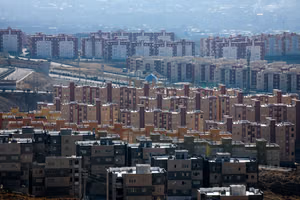
Two men look out over residential buildings in Tehran, Iran.

Forty-four percent of respondents to an Iran International Instagram poll said they would not buy a home in Iran even if they could afford one, with comments citing economic insecurity, emigration plans and concerns about keeping their wealth in the country.

Around 20,400 people participated in the online poll, with 44% saying they would not invest in property in Iran even if they could afford to do so. Only around half said they would buy a home.

Of those who participated, 67% were men and 33% women.

People aged 25 to 34 made up the largest group of respondents at 36.6%, followed by those aged 35 to 44 at 30.1%. People aged 45 to 54 accounted for 12.8%, while those aged 18 to 24 made up 11.4%.

Participants also left around 2,000 comments explaining their choices, offering a broader picture of the considerations shaping their decisions.

  • Skyrocketing rents push Iranians back to parents’ homes, shared housing

    Skyrocketing rents push Iranians back to parents’ homes, shared housing

The responses centered on attachment to Iran, hopes for political change, plans to emigrate, economic hardship and concerns over the security of their savings.

‘If I had enough money, I wouldn't be in Iran’

For many of those opposed to buying a home, having enough money would provide an opportunity to leave Iran rather than invest more heavily in the country.

“If I had enough money, I wouldn't be in Iran at all,” one respondent wrote.

“Having enough money in this situation means having the best life abroad,” another wrote.

The responses mirror the findings of an earlier Iran International Instagram poll in which 83% of participants said they would leave Iran if given the opportunity.

Around 100,000 people participated in that poll over 24 hours. Thousands of comments cited economic problems, social restrictions, political conditions and uncertainty over the future among the reasons for wanting to emigrate.

Some participants in the latest poll associated remaining in Iran with insecurity, sanctions, inflation, power outages and difficulties meeting basic needs, saying they would rather put their money into a more stable country.

One described owning a home as inseparable from the wider conditions in which a person lives.

100%
Residential and high-rise buildings across the Tehran skyline, Iran.

“A home needs a blue sky above it, a thriving tree with bright green leaves in its yard, air without lead coming through its windows, a meal in its kitchen that doesn't come with guilt or selling your dignity, and peace of mind because you feel safe,” the respondent wrote.

“Home is where I can look at the stars at night without waking up the next morning choked with sadness and humiliation.”

Gold and currency offer a way out

Others focused on the financial risks of property ownership.

Unlike in previous years, when buying a home was widely viewed as a relatively secure investment for the future, some said they would now prefer to keep their wealth in gold or foreign currency because those assets are more liquid and easier to take out of the country.

  • Tehran rents hit three times many workers’ monthly pay

    Tehran rents hit three times many workers’ monthly pay

“Investing in a bankrupt economy is certainly a mistake because prices are unrealistic, artificial and like a hollow bubble,” one respondent wrote.

Housing has for years served as a means of preserving wealth in Iran's chronically inflationary economy, and property can provide protection against inflation over the longer term.

But international reporting has also documented a move toward assets that can be carried and quickly converted into cash during periods of uncertainty.

The Associated Press described the trend as a turn toward “portable wealth” during the 12-day war, while the World Gold Council recorded a sharp increase in investment demand for gold in Iran in 2025.

The poll comes as Iranians continue to contend with high inflation. Iran's Statistical Center put year-on-year inflation in July at nearly 88%.

‘I wouldn't trade Iran for anywhere’

For respondents who said they would buy a home, attachment to Iran and a sense of national identity emerged as leading reasons.

Some described owning a home as more than a financial investment, linking it to family, personal history and their connection to the country.

“Yes, I wouldn't trade Iran for anywhere in the world,” one wrote.

“Iran is our mother; you don't abandon your mother when times are difficult,” another wrote.

  • New online poll suggests eight in ten would like to leave Iran

    New online poll suggests eight in ten would like to leave Iran

Others said the country's problems would not persuade them to build a life elsewhere.

“Iran is my first and last choice. I believe good days are ahead of us,” one participant wrote.

Some would buy only after political change

A number of respondents made their willingness to buy a home conditional on political change, greater freedoms or improvements in the country's circumstances.

“When Iran is free, 100%,” one wrote. “After Iran is free, yes, but not under these conditions,” another wrote.

Others questioned the premise of the poll itself, saying the prospect of having enough money to purchase a home was increasingly detached from the economic reality facing many people.

  • Nine out of ten shun marriage, parenthood in Iran International poll

    Nine out of ten shun marriage, parenthood in Iran International poll

They pointed to difficulties paying for food, rent, medical treatment and other daily necessities, describing home ownership as an unattainable aspiration.

“We are renters, and we'll take the dream of buying a home to the grave,” one respondent wrote.

The findings follow another Iran International Instagram poll in which 90% of respondents said they did not want to marry or have children.

US-Iran fighting flares after diplomatic push stalls

Aug 31, 2026, 00:30 GMT+1
100%
CENTCOM handout: US Sailors conduct night flight operations aboard USS George Washington as the ship sails in regional waters supporting operations in the Middle East.

US and Iranian forces exchanged attacks on Sunday after a week of intensive regional diplomacy failed to break the deadlock between Tehran and Washington, marking a renewed military escalation following heightened economic pressure.

The fighting resumed when US forces struck two Iranian launchers on Larak Island in the Strait of Hormuz, the first known American attack on Iran since late July.

A US official said Revolutionary Guards forces had been preparing to launch rockets carrying sea mines into the Strait. Iran’s Revolutionary Guards said the attack killed and wounded several Iranian fighters and civilians and vowed retaliation.

Hours later, the IRGC said it had launched a combined ballistic missile and drone attack on two US air bases in Jordan, claiming “heavy damage” to technical and maintenance infrastructure and areas where fighter jets were stationed at Muwaffaq Salti Air Base in Azraq and King Hussein Air Base.

There was no immediate independent confirmation of the damage claimed by Iran.

The renewed exchange came after a flurry of mediation efforts last week raised hopes that the two sides might find a path back toward negotiations.

Senior officials from Pakistan, Oman and Qatar visited Tehran within days of each other, with talks focused on de-escalation, the Strait of Hormuz and reviving stalled US-Iran diplomacy.

Qatar’s prime minister and foreign minister, Sheikh Mohammed bin Abdulrahman Al Thani, visited Tehran on Thursday, following visits by Omani Foreign Minister Badr Albusaidi and Pakistan’s army chief.

Iran and Oman had also been discussing a temporary navigational corridor through the Strait of Hormuz, but Tehran insisted any reopening would depend on Washington lifting its blockade and meeting other Iranian conditions.

President Donald Trump, meanwhile, said Thursday that Washington was not seeking talks with Iran.

‘Devastating response’

Iranian officials hardened their rhetoric following Sunday’s US attack.

IRGC spokesperson Sardar Mohebi called the strike a “strategic and fatal mistake” by the Trump administration in the course of its economic war, warning that Washington would face consequences “in both the economic and military arenas.”

Ebrahim Azizi, chairman of the Iranian parliament’s National Security and Foreign Policy Committee, said no attack “at any level” would go unanswered and threatened a “devastating, more painful and instructive” response.

The escalation came as Washington continued enforcing its blockade. US Central Command said Sunday that its forces had redirected 83 commercial vessels, disabled three and boarded two as of August 30 to ensure compliance.

Commercial traffic through Hormuz remains sharply depressed.

The number of visible commodity vessels transiting the Strait fell to five per day over the weekend, shipping data showed Monday, although the actual figure may be higher because some ships have switched off their tracking systems.

The return of military strikes quickly spilled into energy markets. Oil prices jumped more than 2% in early Monday trading following the Larak attack, with Brent crude rising 2.5% to above $90 a barrel and US West Texas Intermediate gaining 2.4%, Reuters reported.

Iranians tell of shrinking paths to study abroad

Aug 30, 2026, 12:47 GMT+1
•
Baharan Azadi
100%
Iranian students take an exam at a testing center.

Iranians described cancelled language tests, soaring costs, visa hurdles and internet restrictions as obstacles increasingly putting study abroad beyond reach, in messages sent to Iran International following new US sanctions.

“Are Trump’s sanctions targeting the Iranian people or Islamic Republic officials? We are looking for a way to escape this situation, but it seems all the doors of the world have been closed to us,” one citizen wrote.

Iran International asked its audience to share their experiences of barriers to studying abroad after new sanctions led to restrictions affecting international language tests for Iranians.

An analysis of responses on Instagram showed that the cost of studying and moving abroad, compounded by the falling value of Iran’s currency, and the cancellation of international language tests were the most frequently cited concerns.

The US Treasury Department’s Office of Foreign Assets Control, or OFAC, indefinitely suspended General License G on August 24 as part of the Trump administration’s latest campaign to intensify economic pressure on the Islamic Republic.

100%
Students take an exam at a testing center in Iran.

The license had since 2014 provided the legal basis for US universities, testing companies and other American entities to offer a range of educational services to Iranian people.

The Duolingo English Test subsequently announced that it would stop providing services from September 1 to people residing in Iran and holders of Iranian identification documents.

Rising costs narrow options

Financial pressures were the most common concern raised in responses to Iran International.

Respondents cited the rising cost of foreign currency, language tests, university applications, tuition, airline tickets and exit bonds as major obstacles to pursuing education overseas.

“With the euro at 2,400,000 rials, visas not being issued to Iranians, war and rising prices, the very high cost of exit bonds, terrible airline ticket prices, internet problems and language tests are all barriers to migration for us in Iran,” one respondent wrote.

Another described being caught between the expense of leaving Iran and the cost of remaining.

“We are imprisoned in Iran. We have neither the money to leave Iran nor the money to live in it,” the respondent wrote.

Some respondents also pointed to rising living expenses after reaching their destination countries, adding another financial hurdle even for those able to secure admission and leave Iran.

Years of preparation disrupted

The suspension or restriction of international language tests was the second major theme to emerge from the messages.

Some respondents said they had switched to TOEFL or the Duolingo English Test after IELTS became unavailable at various periods in Iran, only to see those alternatives restricted as well.

100%

“After several years of studying for TOEFL, getting a high GPA and working to build a good résumé, I was one step away from taking TOEFL, and now the test is no longer being held,” one respondent wrote.

Another said the cancellation of a TOEFL exam was announced on the morning it was due to take place, after years of preparation and with an embassy appointment approaching.

The Duolingo English Test, launched in 2016, has become an alternative to TOEFL and IELTS for some Iranian applicants. The online test can be taken from home and costs less than some other international English proficiency exams.

Several respondents said the latest restrictions showed how sanctions were affecting ordinary Iranians seeking academic opportunities abroad.

“Why should ordinary people be targeted by sanctions? People in Iran are not allowed to take TOEFL and Duolingo tests inside Iran; they are not even allowed to escape this country,” one respondent wrote.

Iranian passport adds to barriers

Some identified their Iranian nationality and passport as another obstacle to academic opportunities abroad.

They described university positions being closed to Iranian applicants or applications being rejected without what they considered serious consideration of their academic records.

“I think the first problem for many people in Iran who want to migrate is the financial cost, followed by the barriers to being accepted as an Iranian,” one respondent wrote.

  • Iran sanctions reach education: Duolingo blocked, TOEFL and GRE in doubt

    Iran sanctions reach education: Duolingo blocked, TOEFL and GRE in doubt

Another pointed to lengthy security screening of Iranian applicants at embassies, saying delays can prevent students from reaching universities in time to begin their programs.

Internet disruptions cost opportunities

Internet restrictions inside Iran were another recurring concern in the messages, particularly because applications depend on access to university websites, email and international financial services.

One said Iran’s internet was cut off on January 8, a day after an admissions interview with a university in Britain.

The respondent said two weeks without access to email or the university’s website ultimately resulted in the loss of the study opportunity.

Washington’s economic war on Iran starts in Dubai, not Beijing

Aug 29, 2026, 15:40 GMT+1
•
Kerri Bitsoff
100%
The United Arab Emirates flag flies over Dubai, which has long served as a key commercial and financial hub for Iran-linked trade and transactions.

The Treasury Department’s opener for Operation Economic Outcast, launched Monday to cut Iran’s remaining income, suggests Washington sees Dubai, Istanbul and Baghdad — not Beijing — as the critical channels for Tehran’s money.

The regime needs hard currency to defend the rial, pay its military and security forces, and keep salaries, pensions, and subsidies flowing. Reports from across the country already describe wages months in arrears, delayed pension payments, and near-daily protests by workers and retirees.

It also needs imports that can physically arrive in the country. China provides neither, with its overland rail corridor being marginal next to the seaborne trade the blockade cut off.

When the Islamic Republic sells oil to China it is paid in yuan, which it already had more than it could spend before the blockade was in place.

The lifeline that China provides to the Iranian regime has proven to be not as helpful in a crisis. While China buys almost all of Iran’s oil, is the largest supplier of the consumer goods Iran imports, and supplies the components that built the regime’s weapons systems, those transactions are entirely on China’s terms.

The relationship is structured around what China wants: the Islamic Republic isn’t paid in currency it can readily deploy. Its main revenue source is largely stuck in China in yuan and can only be swapped for imports that are blocked by the blockade.

China’s private sector is so connected to the rest of the world that it is susceptible to de-risking under pressure.

While Beijing gives cheap cover by condemning American sanctions and ordering its companies to ignore them, its real support has not escalated with the conflict, with the exception of a deniable shoulder-fired missile deal that may not have made it through.

The bank in Dubai

On Friday morning, Treasury named the bank Secretary Bessent had been promising all week, and as I predicted, it was not Chinese.

The Financial Crimes Enforcement Network proposed a rule to cut the UAE branches of Banque Misr, Egypt’s second-largest bank, off from the international financial system, saying they had processed roughly 1.8 billion dollars for 103 companies tied to Iranian shadow banking networks.

The proposal is subject to a 30-day comment period and, if finalized, would cut Banque Misr’s UAE branches off from US correspondent banking.

The choice of a UAE bank reflects that the Emirates is where the regime gets what it needs most. The hard currency comes back through Dubai, where front companies and brokers deal with the world on Iran’s behalf and exchange houses convert the proceeds into currency the regime can spend at home. Dubai functions for Iran the way Hong Kong functions for China.

The same traders supply the imports Iran cannot buy directly, Western machinery, electronics, and parts, purchased in their own name and re-exported across the Gulf. The Emirates also moved Iranian fuel oil, which it sold into the regional ship-fuel market through Fujairah, one of the world’s largest bunkering hubs, where blending stripped its Iranian identity. The blockade now cuts off the Iranian supply.

Even the oil money parked in China depends on this channel. What the regime manages to repatriate from those accounts moves through the Emirates, which is why a trade halt announced in Abu Dhabi reaches revenue earned in Shandong.

The pressure is landing on a country that has already turned against the Iranian regime. The Islamic Republic has fired missiles at the Emirates, and on August 19th, Abu Dhabi announced that all trade and financial transactions with Iran were halted.

American officials had pressed Abu Dhabi for years over the exchange houses and trading companies serving Iran, but the attacks aligned incentives between the U.S. and UAE as a shared security concern. The halt has no precedent in a country that has served as Iran’s commercial gateway for decades, and its value will be decided by enforcement.

The land border

What is of importance in Turkey is the remaining cross-border trade. Petrochemicals and metals earn less than oil, but the proceeds are in currency the regime can spend. The goods are also easier to sell, since petrochemicals and metals don’t carry the same fingerprint as Iranian crude, and can disappear across the border into Turkish plants to be resold.

Washington has designated small and mid-sized Turkish buyers of these commodities for years without meaningfully slowing the trade. The larger importers that have so far gone untouched are most susceptible to the renewed pressure campaign.

The UAE’s suspension leaves Turkey as one of the few channels the Islamic Republic has left, a major hub it can reach by land. Turkish banks are unlikely to handle displaced Iran business, especially after Halkbank’s decade-long criminal case ended this year with a deal barring Iran business that touches the U.S., after its deputy general manager went to American prison. Turkey’s banks avoid the regime’s business rather than process Iran-linked payments. After United Nations sanctions snapped back, Ankara froze the assets of dozens of Iranian entities, including Bank Sepah.

If the pressure on buyers is effective, what remains of the regime’s business in Turkey is what has always run outside the system, cash collected in Turkey and carried across the border.

Iraq’s oil and dollars

The Iran-Iraq border provides an accessible path through the blockade for the Islamic Republic to get its oil out. Iranian crude and fuel oil are blended with Iraqi cargoes, onshore and in ship-to-ship transfers at sea, and sold as Iraqi product. The smuggling earns the regime and its proxies at least a billion dollars a year. The regime collects its share of earnings from the U.S. dollars in Iraq’s own banking system.

The pressure on Iraq’s dollar system is already built and can tighten. Iraq sells its oil for dollars that are held at the Federal Reserve Bank of New York, and for years its banks drew those dollars through a central bank auction that Iranian networks used to buy hard currency. The Treasury Department and the New York Fed barred roughly two dozen Iraqi banks from that window, and at the end of 2024 the auction was shut and replaced with correspondent channels open only to vetted banks. In April, Washington reportedly blocked a shipment of nearly 500 million dollars in banknotes to Baghdad. Electronic transfers continued, and physical deliveries resumed months later.

Pressure here will take the form of policing the correspondent channel, monitoring the vetted banks and cutting off any that move money for the regime, with continued outreach to Baghdad. Iran-backed militias, which hold seats in parliament and units in Iraq’s security forces, run the oil trade across the border, a problem that has confounded policymakers for years due to the Islamic Republic’s meddling in Iraq.

But if the regime cannot turn the proceeds into dollars, the fact that oil crosses the border is less important and turns into the same problem the regime has in China.

What the Islamic Republic needs from its neighbors is what China cannot give it, money it can spend and imports that can arrive. That is why the campaign started in the Emirates rather than Beijing, and why the pressure everywhere aims at the point where the regime’s earnings become usable.

Stopping the trade at the source is not required. If the proceeds cannot be converted, the oil and goods crossing Iran’s borders earn the regime what its oil sales to China earn — money it cannot readily deploy.

The Islamic Republic has made the work easier, firing missiles at its neighbors’ cities and critical infrastructure and mining and attacking the strait its neighbors’ economies depend on. The countries that carried Iran’s business for years now have their own reasons to end it.