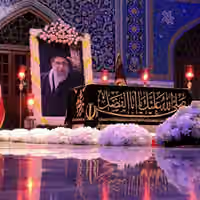
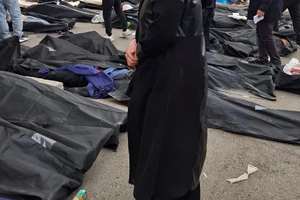
Dying has become one of the costs Iranians can no longer meet. Burial plots are advertised at years of wages, families are selling the graves they had reserved for themselves, and some are taking their dead to villages where burial is still free.
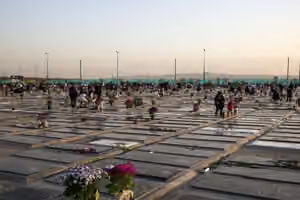
A review of grave listings in Tehran found a three-tier plot in sections 39 and 72 of Behesht-e Zahra, the vast cemetery on the southern edge of the capital where Iran's war dead and the founder of the Islamic Republic are buried, offered at 30 billion rials, about $15,000. Tiered graves are stacked burials sold as a single right, allowing several family members to be interred in one plot over time.
The official 2026 tariff for reserving the same three tiers in that part of the cemetery is 3.47 billion rials, roughly $1,740. The asking price in the listings is more than eight and a half times the state rate.
Set against wages, the figures become clearer. Iran's minimum base wage is about 166 million rials a month, around $83. The advertised grave is equivalent to more than 180 months of that wage: a worker on the minimum would have to save every rial for more than fifteen years, spending nothing at all, to reach the asking price. Even the official tariff comes to nearly 21 months of wages.
The market is not confined to the capital. At the Bagh-e Ferdows cemetery in Kermanshah, listings reach 34 billion rials, about $17,000. Two-tier graves at the Saheb al-Zaman cemetery in Kerman are advertised at up to 20 billion rials, some $10,000, and plots at 10 billion rials, around $5,000, appear in Karaj and Yazd.
In Mashhad, family tombs at Behesht-e Reza are priced at up to 18 billion rials, roughly $9,000, and published reports have put burial inside the shrine of Imam Reza, the holiest Shia site in Iran and a place many families regard as a religious privilege, at as much as 14 billion rials, about $7,000.
The bill for a last farewell
A grave is only one of the costs of dying. Transporting the body, ritual washing and the shroud, the burial itself, the headstone, a mosque, flowers, catering and the ceremonies each carry a separate charge.
Under Tehran's official 2026 tariff, basic services run from hundreds of thousands to several million rials. A private hearse costs 50 million rials, about $25, for the first three hours.
Adding the grave, cemetery services, a temporary headstone, a mosque or hall, flowers, catering and other costs, a burial and urban funeral for around 100 people can come to between 1.2 and 1.8 billion rials, roughly $600 to $900. A more expensive plot, a costlier stone, a full meal or several ceremonies can push it far higher.
For many families, though, the question is not whether to buy an expensive grave or an elaborate headstone. It is how to pay for an ordinary burial at all, a cost that pushes them to shrink the ceremonies, drop the traditional third-day and seventh-day gatherings, or find somewhere cheaper to bury their dead.
What has actually changed
Prices inside Behesht-e Zahra vary by zone and section, and the state rates rise every year. In rials the climb is steep: three tiers in the older sections cost 825 million rials in 2022 against 3.47 billion today, a fourfold increase.
Measured in dollars, though, the official price has barely moved. It was worth about $1,700 in 2022 and about $1,740 now, because the city council raises the tariff by a fraction of what the currency loses each year. What has collapsed is the ability to pay: Iran's minimum wage has fallen from more than $230 a decade ago to around $83.
That gap between a suppressed official price and what the market will bear is where the private trade lives. The cemetery's managing director said in 2023 that grave sales are the organization's main source of income, that capacity was running out and three new cemeteries were planned, and that each national identity number was now limited to a single plot, a rule introduced to stop what he called brokering and the emergence of "grave sultans." Such brokering, he acknowledged, exists.
Cemetery officials also dispute the highest figures in circulation. A previous managing director said the most expensive grave ever sold there had gone for a fraction of the sums now advertised. The listings reviewed for this report are advertisements placed by private sellers, not transactions recorded by the cemetery.
When a burial right becomes an asset
Iran International contacted three people who had advertised graves for sale in Tehran and Kermanshah, presenting itself as a prospective buyer. None is named here.
One, in Tehran, was selling an unused tier of his father's grave, a space the family had kept for his mother.
"Thank God our mother is alive, and right now we need this money more," he said.
In Kermanshah, another seller had listed his mother's grave, in Bagh-e Ferdows for about 40 years. He counted its position near the car park among its advantages, and said that whenever a buyer needed it, he would come to complete the transfer once the money had been paid, so that the grave could be given to them as a "gift."
A third seller in Kermanshah had bought a plot beside his brother's years earlier, intending to be buried next to him. He has put it up for sale. Finding a grave in Bagh-e Ferdows has become difficult, he said, but the money matters more for now: he is still alive, and he would rather use it for what his children need than worry about how easily they will be able to visit him later.
In this market, even a place kept to lie beside a father, a mother or a sibling can lose out to something more urgent: the money a family needs today.
Graves at auction
Burial rights are not only offered as assets in private listings. Court enforcement records show they can be seized and auctioned to settle debts.
In 2022, a single tier of a grave in section 36 of Behesht-e Zahra was put up for auction. In June 2025, so was a grave in section 62 of Bagh-e Ferdows in Kermanshah.
Open trade in graves is not permitted in many Iranian cemeteries, and transfers of burial rights are supposed to go through official channels. In Tehran, the right of use must be registered through the Behesht-e Zahra organization.
The restrictions have not ended the market. Listings continue to appear, and some transfers are dressed as gifts, as the Kermanshah seller described.
The result is a market with almost no transparency: there is no comprehensive official record of how many such deals are done, no clarity on the prices finally paid, and no certainty that a right advertised in a listing can lawfully be transferred at all.
The migration of the dead
Another consequence is visible in the villages around some Iranian cities.
Reports from areas near Mashhad and Gorgan describe urban families moving the bodies of relatives to village cemeteries, where burial is free or cheap, to reduce costs.
One described a rise in city families turning up at rural graveyards. In another village, residents built a fence around the cemetery to stop outsiders being buried there.
Similar accounts have emerged from other cities. There are no official figures, but the cases suggest the price of a grave is now capable of redrawing the geography of burial.
Prices are not driven by inflation alone. Older cemeteries are running short of capacity, families want to be buried alongside relatives, and the religious standing of certain sites carries a premium of its own.
The pressure works in both directions at once: one family drives a body out of the city to save money while, in the same period, a burial plot in an old cemetery becomes an asset worth the equivalent of years of work.
Mourning under financial and security pressure
For some families the difficulty of burial is not only economic.
Reporting on those killed in protests and on people executed in Iran shows that the release of a body, the place of burial and even the holding of a funeral can fall under the control of security institutions. In some cases that pressure has come with a demand for money.
The family of Babak Pourmazaheri, a 37-year-old protester killed in Alborz province, received his body after three days and a payment of 4 billion rials, about $2,000.
In the case of Jamshid Momeni, 16 billion rials, roughly $8,000, was demanded for the return of his body; when the family said they could not pay, they were asked instead to present him as a "martyr of the state."
In the case of Esmail Fekri, the family was not told where he had been buried, and a security officer demanded 1.5 billion rials, some $750, to reveal the location of the grave.
Here the cost of death is no longer the price of a plot and a ceremony. Money has become entangled with control over the body, the burial and the right to grieve.
Two sides of the market
In a market where a burial right can be worth years of wages and can be auctioned to settle a debt, some families are selling the very place they had kept for themselves or their relatives, in order to pay for living.
In Kermanshah, a man bought a grave beside his brother's years ago. He has now put it up for sale.
He says he needs the money for his children more than he needs somewhere to be buried.
A motorcyclist checks his phone on a street in Tehran, with a banner depicting Iran’s slain Supreme Leader Ali Khamenei visible in the background, August 26, 2026
As Washington targets the financial and trading networks Iran has used to withstand years of sanctions, economists and analysts in Tehran are debating how much more economic hardship the country can absorb to survive a prolonged economic war.
The latest US pressure goes beyond broad restrictions on oil exports, increasingly targeting middlemen, front companies, financial channels and other mechanisms Tehran has relied on to keep foreign currency and goods flowing under sanctions.
Ehsan Movahedian, an international affairs analyst, described the approach as an attempt to choke Iran’s access to foreign currency, fuel inflation and deepen internal economic instability.
Other analysts writing in the moderate outlets Fararu and Donya-ye Eghtesad argue that with those traditional workarounds under growing pressure and no comprehensive alternative in place, Tehran may increasingly be forced to turn inward: tightening budgets, reducing subsidies, rationing scarce resources and curbing consumption.
But austerity presents the government with its own political dilemma. Measures that conserve resources and help Iran withstand sanctions would also transfer more of the cost of the confrontation to a population already struggling with inflation and utility shortages.
Iranian governments have long been wary of abruptly reducing subsidies for precisely that reason. A sudden increase in gasoline prices in November 2019 triggered nationwide protests that were met with a deadly crackdown, leaving authorities acutely aware of the political risks attached to measures that sharply increase household costs.
President Donald Trump and Treasury Secretary Scott Bessent have made clear that economic pressure will remain central to Washington’s Iran strategy.
In Tehran, the campaign is broadly perceived as an attempt to force capitulation rather than genuine negotiations, even though President Masoud Pezeshkian has repeatedly said the two sides must eventually resolve their differences through talks.
Former diplomats Fereydoun Majlesi and Jalal Sadatian describe the current trajectory of Iran-US relations as one of strategic ambiguity and economic attrition, with neither an imminent diplomatic breakthrough nor a clear route out of the confrontation.
That uncertainty has sharpened disagreement over whether diplomacy can relieve the economic pressure before Tehran is forced to impose still greater costs at home.
Former ambassador Mohsen Pakaeen argued that the recent stream of regional mediators visiting Tehran was focused on the wrong capital.
The obstacle, he said, was Washington’s insistence on Iranian capitulation without offering credible concessions, meaning mediators seeking a breakthrough should concentrate their efforts on the United States.
Hardline voices, including the editor of the ultraconservative daily Kayhan, reject talks under economic pressure and push for a more confrontational posture capable of raising the costs for the United States and its regional partners.
The disagreement leaves Tehran confronting two related calculations: whether it can economically outlast Washington’s pressure campaign, and how much domestic hardship it can impose in doing so.
For advocates of greater economic resilience, austerity could preserve scarce government resources while buying Tehran time. But analysts also warn that the same measures could weaken domestic stability and ultimately undermine the negotiating position they are intended to protect.
China offers Iran its most important external economic lifeline, but also an uncertain one.
Majlesi and other observers argue that intensified US enforcement against buyers of Iranian goods increasingly overlaps with Washington’s wider economic competition with Beijing.
China remains crucial to Iranian trade, but Tehran cannot determine how much economic or political risk Beijing will ultimately accept on its behalf.
That leaves Iran with few easy alternatives. Informal trading networks can soften sanctions, regional diplomacy may eventually produce negotiations and austerity can stretch limited resources, but none provides a clear exit from a prolonged economic confrontation.
Austerity may therefore buy Tehran time, but not necessarily leverage. But the question is not only how long Iran’s economy can withstand Washington’s pressure, but how much more pressure its government believes Iranian society can bear.
Qatar’s Prime Minister and Foreign Minister Mohammed bin Abdulrahman Al Thani shakes hands with Iran's President Masoud Pezeshkian in Tehran. August 27, 2026
Three regional mediators have visited Tehran in three days in an intensifying diplomatic push to revive Iran-US talks, even as the two sides remain deeply divided over the Strait of Hormuz and Washington’s economic pressure campaign.
Qatar’s Prime Minister Mohammed bin Abdulrahman Al Thani arrived on Thursday, following Omani Foreign Minister Badr Albusaidi on Tuesday and Pakistan Army Chief Field Marshal Asim Munir on Monday, as regional powers seek to create a path toward de-escalation and renewed negotiations.
Al Thani’s visit, his first to Iran since the war began in late February, came after days of diplomacy focused partly on finding an arrangement over Hormuz that could provide an opening for broader talks.
He met President Masoud Pezeshkian, Foreign Minister Abbas Araghchi, Parliament Speaker and senior negotiator Mohammad-Bagher Ghalibaf and security chief Mohsen Rezaei.
The messages he received reflected the competing currents shaping Tehran’s response to the diplomatic push.
Pezeshkian praised efforts by Qatar, Pakistan, Oman and other countries to promote peace and security in the region. He also pointed to factions in the United States, Israel and Iran that he said were trying to prevent agreements from taking shape, urging US officials to ignore voices opposed to a return to stability.
Ghalibaf told Al Thani that an economic blockade of Iran would be ineffective and said Washington should implement commitments made under the Islamabad memorandum.
Rezaei struck a more confrontational tone, warning that Iran would target US military and economic interests if Washington sought to “commit mischief” against Iran. He reiterated that the Strait of Hormuz would remain closed unless the United States met Tehran’s conditions.
Qatar’s Foreign Ministry said Al Thani discussed regional developments, efforts to reduce tensions and creating conditions for the resumption of dialogue between Tehran and Washington.
Mediators push for talks
The flurry of diplomatic activity has fueled speculation in Iranian media that Tehran and Washington could return to negotiations, although there is little indication that a breakthrough is imminent.
Iran Nuances, an English-language outlet apparently linked to Iran’s Foreign Ministry, argued that the succession of visits reflected concern among regional states that intensified economic pressure could produce wider instability rather than force Iran to capitulate.
The Iranian news agency ILNA was more cautious. In a commentary headlined “Can Qatar Unlock the Negotiations?”, it said the gap between Tehran and Washington remained too wide for Qatar’s mediation to be certain of success.
“If Iran considers lifting economic pressure and ending the blockade a precondition for any opening, while the United States continues to insist on increasing pressure, even activating Qatar’s mediation channels will not necessarily lead to the resumption of negotiations,” it said.
ILNA suggested that Doha could instead begin by mediating over de-escalation and freedom of navigation in the Strait of Hormuz, potentially creating an opening for wider negotiations.
Economic daily Donya-ye Eqtesad described the succession of regional visits as a form of “multi-layered diplomacy” aimed at developing a phased roadmap involving Iran, the United States and regional mediators, with maritime arrangements providing an initial route toward de-escalation.
But optimism in parts of the Iranian media contrasts sharply with Washington’s public posture.
US President Donald Trump told Al Jazeera on Wednesday that he was “not in a hurry” to resume negotiations with Iran and had set no timetable for ending the war. He said economic pressure and military action were proving effective.
White House spokeswoman Karoline Leavitt said Thursday that there were currently no negotiations between the United States and Iran and that all options remained on the table.
Fate of missing Iranian pilots
Al Thani’s visit also brought renewed attention in Tehran to the fate of Iranian pilots who went missing in March after their Sukhoi fighter jets were shot down over Qatar.
Iranian officials say three pilots survived after ejecting from their aircraft, were captured by Qatari forces and have been held there since.
Qatar strongly rejects that account. Doha says its search-and-rescue teams found the remains of one pilot and handed them to Iran, but that it has no information about the fate of the others.
Iran has requested that an Iranian Air Force expert team and the International Committee of the Red Cross become involved in determining their fate.
Iranian army spokesman Mohammad Akraminia said Wednesday that if Qatar genuinely did not know what had happened to the pilots, it should make greater efforts to establish their whereabouts.
Fada-Hossein Maleki, a member of parliament’s National Security Commission, said Thursday that the lack of clarity over the pilots remained a source of tension with Doha and warned that any evidence they had been mistreated would affect bilateral relations.
Hardliners also seized on the issue during Al Thani’s visit, accusing Iranian officials of failing to press Qatar publicly over the pilots’ fate.
Workers at a Digikala fulfillment center in Iran process and prepare orders for delivery.
Two years ago the editor of Iran's most hardline newspaper said management of the country's biggest online retailer would "fortunately" pass to those who serve the state. It is now chaired by a former spokesman for the supreme leader's business empire.
Hojjat Niki-Maleki identifies himself on LinkedIn as chairman of Digikala Group, having joined the board as a representative of Harakat Aval, the investment arm of the mobile operator MCI. An official company filing lists him as a board member without specifying the chairmanship.
The change dates to June 10 but became public only when the formal notice was published this week, according to the Iranian technology outlet Digiato.
Niki-Maleki previously headed communications for the Execution of Imam Khomeini's Order, commonly known as Setad, a conglomerate built largely on property confiscated after the 1979 revolution, controlled by the office of the supreme leader and under US sanctions. He also spent more than four years on MCI's board.
Hojjat Niki-Maleki
His earlier work was in hardline media. He ran Afsaran, an online platform that promoted anti-Western messaging and the authorities' concept of a cultural "soft war."
His social media history also shows an affinity with the military establishment: in January 2020 he posted a photograph of himself seated beside Qasem Soleimani, then commander of the Revolutionary Guards' Quds Force, on an aircraft.
"I told him I was the son of a martyr, and his respect for me doubled," he wrote, describing Soleimani embracing him at an airport. "The sweet taste of my conversation with Haj Qasem is still with me."
Hojjat’s father, Hossein Niki-Maleki, was a member of the security team aboard Iran Air Flight 655, which was shot down by the United States in 1988.
A social media post by Hojjat Niki-Maleki shows him seated next to Qassem Soleimani on a plane.
Boycott calls
The appointment prompted calls on Persian-language social media to stop shopping at Digikala, with critics pointing to his Setad connection, his politics and his role promoting Iran's domestic Covid-19 vaccine.
"Do not buy from Digikala. This is something you can do," one user wrote on X, arguing that purchases would ultimately help finance Revolutionary Guards missiles and drones.
Another framed the appointment as part of a wider expansion of state-linked influence over the company.
Workers handle packages at a Digikala warehouse in Iran.
Much of the criticism returned to the vaccine. Niki-Maleki worked for Setad when its pharmaceutical arm developed CovIran Barekat, the domestically produced Covid-19 vaccine that authorities promoted during the pandemic, and he repeatedly used his own accounts to publicize its production and effectiveness.
That program became politically charged after the late Supreme Leader Ali Khamenei barred imports of American and British vaccines in January 2021. Critics argued that relying on domestic production delayed access to sufficient doses while Iran struggled to vaccinate its population, and some hold the officials who promoted it responsible for deaths that followed, a charge they have never accepted.
"He used to come here every day two years ago and hashtag that there would soon be good news and we would make a coronavirus vaccine," one user wrote.
About 150,000 people died from the pandemic across Iran, one of the heaviest official tolls in the region. Turkey, with a population of similar size, recorded roughly 100,000. Saudi Arabia reported fewer than 10,000 and the United Arab Emirates around 2,400. What each of those countries did have was early access to Western vaccines, the ones Iran's Supreme Leader had ruled out.
Hojjat Niki-Maleki receives a COVID-19 vaccine during a clinical trial in Iran.
A pattern, not an appointment
The reaction reflects something larger than one board seat: a sequence of events that has moved Iran's most prominent private technology company steadily closer to the state.
Digikala was founded in 2006 by the brothers Hamid and Saeid Mohammadi and grew into the country's dominant online marketplace, the most recognizable business to emerge from Iran's private technology sector.
The pressure began in the summer of 2023, when police sealed its offices after photographs circulated of female employees without compulsory hijab.
In February 2024, the judiciary filed charges over products it said insulted Islamic sanctities, after users circulated images of mugs sold on the site bearing the name Fatemeh Zahra, the daughter of the Prophet Mohammad. The company's chief executive, Masoud Tabatabai, was arrested on the order of the security prosecutor's office and released hours later pending further appearances. Pro-government vigilantes painted threatening messages on the company's building.
That same month, Hossein Shariatmadari, editor of Kayhan and Khamenei's representative at the newspaper, said management of digital companies such as Digikala and the ride-hailing platform Snapp would "fortunately" be transferred to those "who serve the state."
Negotiations over a stake in Digikala also began in that period. They concluded this spring, when Harakat Aval, MCI's venture capital arm, bought 40 percent of Digikala Group in cash, taking over the holding of the venture firm Sarava Pars along with parts of other shareholdings.
The agreed valuation was 300 trillion rials, about $146 million at current market rates, in what the company called the largest investment in the history of Iran's digital economy.
Digikala said the founders would retain 22 percent and two of five board seats, along with executive management, business strategy and the selection of senior managers, and that no single shareholder would control the company.
MCI's own ownership is the point critics return to. Iran's largest mobile operator is a subsidiary of the Telecommunication Company of Iran, privatized in 2009 in a sale to a consortium widely reported to be linked to the Revolutionary Guards.
Niki-Maleki's appointment points to a wider shift in Iran's digital economy: the steady expansion of state-linked institutions into businesses built as private enterprises – which is also why a prediction made in a hardline newspaper in 2024 reads today less like a threat than a schedule.
Abolfazl Shekarchi, spokesman for Iran’s armed forces, speaks at an event in Tehran.
The Iranian general who has threatened Persian-language journalists abroad as potential military targets has a history of incendiary attacks on critics and was among officials who initially dismissed reports that Iran had shot down Flight PS752.
Abolfazl Shekarchi, a brigadier general and senior spokesman for Iran’s armed forces, said on Wednesday journalists working for Persian-language media abroad could be placed on a list of military targets.
“Media outlets such as Iran International, BBC Persian and Radio Farda are directly connected to Mossad, the US Central Intelligence Agency and other foreign intelligence services and receive support from them,” he said.
He called the employees of the Persian-language outlets “soldiers of Israel and the United States,” adding: “They can be included in the bank of military targets because, from our perspective, these are not media outlets.”
He provided no evidence for the accusations.
The remarks extend years of military and ideological rhetoric from Shekarchi against people and organizations Iranian authorities consider hostile, from protesters and opponents of compulsory hijab to foreign officials and media organizations.
PS752 reports called ‘absolute lies’
Iran's Revolutionary Guards shot down Ukraine International Airlines Flight PS752 shortly after takeoff on January 8, 2020, killing all 176 people aboard.
Reports that an Iranian surface-to-air missile had brought down the Boeing 737 were “absolute lies” and “ridiculous,” Shekarchi said as evidence pointing to a missile strike emerged.
Abolfazl Shekarchi, spokesman for Iran’s armed forces, speaks on a program about the 12-day war, with centrifuge replicas forming the backdrop, September 24, 2026.
Shekarchi portrayed the reports as psychological warfare against Iran, while Iranian authorities initially attributed the crash to a technical problem.
Iran's armed forces acknowledged three days after the disaster that its air defenses had shot down the passenger plane, saying it had been mistakenly identified as a hostile target during a period of heightened confrontation with the United States.
The admission triggered protests in Iran and abroad and accusations that authorities had sought to conceal responsibility for the disaster.
Shekarchi's categorical denial became one of the most prominent official responses to early reporting on PS752 before the armed forces acknowledged that an Iranian missile had brought down the aircraft.
His latest accusations against foreign-based Persian-language media employ a similar framework, casting journalism and information as components of an enemy operation.
Protesters and hijab opponents
Shekarchi has also directed security and military rhetoric at domestic dissent.
During nationwide protests in 2022, Shekarchi described demonstrators as deceived and accused the United States of seeking to manufacture deaths to sustain the unrest.
The protests spread across Iran following the death in morality-police custody of Mahsa Amini, a 22-year-old woman detained over compulsory hijab rules.
His rhetoric had already extended to opponents of compulsory hijab.
Participants in a campaign encouraging women to appear in public without mandatory head coverings, along with artists supporting them, were “forces of Satan,” Shekarchi said.
Thousands detained over coronavirus information
Shekarchi also played a public role in the authorities' response to information circulating during the coronavirus pandemic.
Around 3,600 people had been detained by police and the Basij over what authorities characterized as rumors or false information about the outbreak, with more than 1,100 judicial cases opened, Shekarchi said in April 2020.
The figures showed the scale of the authorities' effort to police information about the pandemic as questions mounted over infection and death figures.
Shekarchi also drew criticism after minimizing coronavirus deaths among military personnel and healthcare workers.
The deaths of four doctors, nurses and paramedics were “not a number” of significance, Shekarchi said during the early months of the pandemic.
The coronavirus outbreak became another period in which Iranian authorities treated the dissemination of information as a security matter, with people detained or prosecuted over online material about the disease.
Threats beyond Iran
Shekarchi's rhetoric has also targeted Israeli and US officials and personnel abroad.
Israel's destruction was Iran's “greatest aspiration,” Shekarchi said in 2021, presenting it as an objective from which the Islamic Republic would not retreat.
Even tourist and recreational locations around the world would not necessarily provide safety for American and Israeli officials targeted by Iran, Shekarchi warned in March.
“From now on, based on the information we have on you, tourist destinations, resorts, and recreational and leisure venues around the world will no longer be safe for you.”
Abolfazl Shekarchi, spokesman for Iran’s armed forces, visits a news agency in Tehran.
Earlier, responding to threats by US President Donald Trump against Iran's leadership, Shekarchi said an attack on Supreme Leader Ali Khamenei would prompt Iran to “set their world on fire” and leave its adversaries without a safe haven.
“Trump knows that if a hand is raised against our leader, not only will we decisively and courageously cut off that hand, but we will set their world on fire, give them no respite and leave them no safe haven.”
His latest remarks extend such language explicitly to journalists working outside Iran.
Omani Foreign Minister Badr al Busaidi visited Tehran on August 25, 2026 for talks with his counterpart Abbas Araghchi.
Regional diplomacy around Iran appears to be gathering pace, with Pakistan, Oman and potentially Qatar seeking to turn an emerging agreement over the Strait of Hormuz into a path back to negotiations between Tehran and Washington.
In Tehran, the diplomatic push is already exposing divisions over what comes next.
Pragmatists see the visits as a possible route back to the Islamabad memorandum and negotiations with Washington, while hardliners portray them as an American attempt to escape the pressure Iran has created around Hormuz.
Farda News, a website close to Parliament Speaker Mohammad-Bagher Ghalibaf, said visits by Omani Foreign Minister Badr al-Busaidi and Pakistan’s army chief Field Marshal Asim Munir shared the objective of finding a political solution to the confrontation.
But it stressed that an agreement with Oman would not itself mean reopening Hormuz.
“Tehran insists that a technical agreement with Oman does not mean returning the strait to its pre-war conditions, and that remains tied to the implementation of US commitments under the Islamabad memorandum,” it wrote.
‘American pawn’
Economic daily Donya-ye Eqtesad similarly said the phased agreement could provide a route toward reviving the Islamabad memorandum, easing pressure around the strait and eventually returning Iran and the United States to negotiations.
But hardline Kayhan called the visits a “new phase of the White House deception operation,” arguing that Washington needed Iran back at the negotiating table to escape the energy crisis and deadlock over Hormuz.
It described Munir as an “American pawn” being used to help Washington escape what it called the quagmire of the war and declared the Islamabad memorandum dead.
The competing interpretations follow an unusually concentrated burst of regional diplomacy. Al-Busaidi visited Tehran on Tuesday, a day after Munir, while Qatar’s prime minister is expected in the Iranian capital on Thursday, according to Iranian media.
Diplomatic push
Tehran and Muscat announced after al-Busaidi’s visit that they were working on a phased framework including a temporary maritime corridor through Hormuz and a joint mine-clearance project.
Technical negotiations are continuing over a permanent corridor and the future management of the strait, with the two sides stressing the importance of discussions involving other Persian Gulf states.
After leaving Tehran, al-Busaidi discussed the proposed Hormuz framework with Qatar’s Prime Minister and Foreign Minister Mohammed bin Abdulrahman Al Thani.
Qatar, another mediator between Tehran and Washington, said Tuesday that it continued to support efforts to resolve the crisis.
Former diplomat Jalal Sadatian told Fararu that Oman’s renewed activity should be understood in light of its established mediation role. He said Munir also appeared to have carried a message from Washington aimed at reducing tensions and reopening a channel for talks.
International affairs analyst Jafar Ghanadbashi went further, writing in Arman Melli that the Pakistani and Omani visits were “a very clear sign of America’s view of the current situation and its need for negotiations at this time.”
‘No rush for talks’
But Iranian officials have made clear that progress with Oman does not mean Tehran is ready to reopen the strait.
Deputy Foreign Minister Kazem Gharibabadi said Tuesday that Iran still considered itself to be at war and that the agreement with Oman did not amount to an immediate reopening of Hormuz.
He said reopening depended on an end to the war on all fronts, the lifting of the blockade against Iran and a resolution of the situation in Yemen.
Gharibabadi also challenged US claims about mine clearance in the strait, asking why vessels had not resumed passage if the mines had been removed. He warned that US mine-clearance vessels entering the area would be targeted.
Hossein Mohebi, a spokesman for the Islamic Revolutionary Guard Corps, said Wednesday that negotiations with Oman over the past month had produced mutually acceptable results concerning the two countries’ respective waters and revenues from the strait.
But he accused Washington of obstructing a final agreement and reiterated that reopening Hormuz depended on the United States returning to the Islamabad memorandum.
“If the United States does not accept our conditions, the Strait of Hormuz will not open under any circumstances,” Mohebi said.
President Donald Trump said Wednesday he was “not in a hurry” to resume negotiations with Iran and had “no time schedule” for ending the war. He said both economic warfare and military strikes against Iran were effective.
The competing signals leave regional mediators with a difficult sequencing problem: whether an agreement over Hormuz can create enough room to restart diplomacy before either Tehran or Washington decides it has more to gain by waiting.