• العربية
  • فارسی
Brand
  • Iran Insight
  • Politics
  • Economy
  • Analysis
  • Special Report
  • Opinion
  • Podcast
  • Live TV
  • Iran Insight
  • Politics
  • Economy
  • Analysis
  • Special Report
  • Opinion
  • Podcast
  • Live TV
  • Theme
  • Language
    • العربية
    • فارسی
  • Iran Insight
  • Politics
  • Economy
  • Analysis
  • Special Report
  • Opinion
  • Podcast
  • Live TV
All rights reserved for Volant Media UK Limited
volant media logo

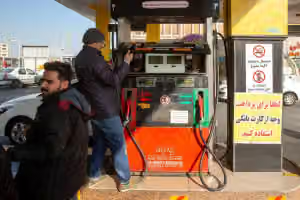
Iran VP says current gasoline situation is unsustainable

Aug 26, 2026, 19:59 GMT+1

Iran’s Executive Vice President Mohammad Jafar Ghaempanah said Iran could not import gasoline because of the US naval blockade and warned that the current fuel situation could not continue, the state-run IRNA news agency reported Wednesday.

“Continuing on this path is impossible,” Ghaempanah said, adding that domestic gasoline production was insufficient and that “with the US naval blockade, we cannot import gasoline.”

He also said the Iran-US memorandum should be pursued “with military power” to bring it to fruition.

Ghaempanah said a joint statement reached with Oman on Tuesday, under the direction of the Supreme National Security Council, required ships to use the route specified in the memorandum and not cross through Oman’s southern boundary.

Most Viewed

What Operation Economic Outcast means for Iran, and for everyone trading with
1
INSIGHT

What Operation Economic Outcast means for Iran, and for everyone trading with

2
INSIGHT

Iran shrugs off US economic war as analysts sound alarm

3
ANALYSIS

Iran keeps finding gas. Getting it out is the problem

4
INSIGHT

Who speaks for Iran? Rezaei’s threats fuels divide over war and diplomacy

5
EXCLUSIVE

Tehran mosques used to surveil, shoot at January protesters

Banner
Banner

Spotlight

  • Regional diplomacy tests path back to Iran-US talks
    INSIGHT

    Regional diplomacy tests path back to Iran-US talks

  • Tehran debates waiting out Trump’s economic war
    INSIGHT

    Tehran debates waiting out Trump’s economic war

  • Will Mojtaba Khamenei's absence help the Islamic Republic survive?
    ANALYSIS

    Will Mojtaba Khamenei's absence help the Islamic Republic survive?

  • What Operation Economic Outcast means for Iran, and for everyone trading with
    INSIGHT

    What Operation Economic Outcast means for Iran, and for everyone trading with

  • Iran keeps finding gas. Getting it out is the problem
    ANALYSIS

    Iran keeps finding gas. Getting it out is the problem

  • Tehran mosques used to surveil, shoot at January protesters
    EXCLUSIVE

    Tehran mosques used to surveil, shoot at January protesters

Banner
•
•
•

More Stories

Iran sentences two more protesters to death as executions surge

Aug 26, 2026, 18:45 GMT+1
100%
Iranian demonstrators gather in a street during a protest in Tehran, Iran, January 8, 2026.

Two more protesters detained during Iran’s nationwide demonstrations in January have been sentenced to death, US-based rights group HRANA reported, amid a rise in executions and capital sentences following the unrest.

Hossein Nazari, 25, was sentenced to death by Branch One of the Revolutionary Court in Mashhad, northeastern Iran, HRANA reported Wednesday. He is being held in the city’s Vakilabad Prison.

HRANA said Nazari was convicted of “contact with hostile governments and groups” and “assembly and collusion to commit a crime against national security.” The sentence was issued in July.

Nazari was arrested by security forces during the January protests and transferred to Vakilabad Prison after interrogation and judicial proceedings.

His case was reported a day after HRANA said Amir Mohammad Majallal Choubari, 22, another protest detainee, had also been sentenced to death.

Majallal Choubari was arrested in Tehran on January 2 during the nationwide demonstrations and transferred to Qezel Hesar Prison in Karaj, west of the capital.

He had previously faced charges at Branch 33 of Tehran’s Public and Revolutionary Prosecutor’s Office, which handles security-related cases.

The charges included “assembly and collusion with the intention of committing a crime against national security,” disrupting public order, attempting to intentionally kill officers by trying to run them over and resisting officers.

100%
Amir Mohammad Majallal Choubari

Continued crackdown

The sentences come amid a sharp increase in executions and the use of capital punishment against protesters and political prisoners.

The US-based Abdorrahman Boroumand Center said Wednesday it had documented 950 executions in Iran since the beginning of 2026, including at least 20 women and 30 protesters. It said 45 executions had been recorded in August so far.

The group said Iran’s use of the death penalty takes place within a judicial system marked by unfair proceedings, lack of transparency and political influence.

It said systematic violations of fair-trial guarantees meant executions could amount to arbitrary deprivation of life under international law.

Iran International reported in late July that rights groups estimated around 100 political prisoners and protesters had received death sentences, while hundreds more faced charges that could carry the death penalty.

UN Human Rights Chief Volker Türk said earlier this month that Iran was using executions to “instil fear among the population and suppress dissent,” while raising concerns about torture-tainted confessions, rushed proceedings and a persistent lack of fair-trial guarantees.

Tehran debates waiting out Trump’s economic war

Aug 26, 2026, 17:46 GMT+1
•
Behrouz Turani
100%
Pedestrians walk past a currency exchange near Tehran’s Grand Bazaar, as Iran faces renewed US sanctions, August 17, 2026

As Washington intensifies its economic campaign, Iranian politicians and analysts are offering sharply different prescriptions for dealing with the United States: from resistance and phased negotiations to new trade routes or waiting Donald Trump out.

The debate has sharpened since the Trump administration launched what Treasury Secretary Scott Bessent called an “economic onslaught” on Monday, expanding the threat of secondary sanctions as Washington seeks to sever Iran’s remaining financial links abroad.

Former Commerce Minister Yahya Al-e Eshaq has focused on one vulnerability made more acute by the pressure campaign: Iran’s heavy reliance on the United Arab Emirates as a gateway for foreign trade.

Al-e Eshaq called for diversifying trade across Iran’s 15 neighboring states and developing alternative hubs in Oman, Pakistan, Turkey and Iraq.

He cited previous studies, including one by the Supreme National Security Council, suggesting sanctions could inflict at most 30 percent damage under optimal conditions. But the immediate strains are already visible, with thousands of Iranian containers stranded in regional ports.

Others see economic resilience as only one part of the answer.

Hamzeh Safavi, an academic and pragmatist politician, argued in Etemad for a combination of stronger domestic resilience and step-by-step diplomacy.

Safavi rejected both unilateral resistance and all-or-nothing negotiations, advocating phased diplomacy and regional mediation as Iran confronts maritime tensions and growing economic isolation.

That diplomatic track remains active. Omani Foreign Minister Badr Albusaidi met Abbas Araghchi in Tehran on Tuesday as Muscat continued efforts to mediate between Iran and the United States and find a way toward easing the confrontation.

The visit followed a trip to Tehran by Pakistan’s army chief, Field Marshal Asim Munir, on Monday, part of a broader regional effort to keep channels between Washington and Tehran open.

That approach stands in sharp contrast to hardliners such as Resalat editor Mohammad Kazem Anbarloui, who argues that concessions to Washington would signal weakness and that mounting US pressure should instead be met with greater resistance.

Some hardliners have gone further, reviving a historical analogy from the 1979 hostage crisis: wait Trump out.

They point to Tehran’s refusal to resolve the crisis while Jimmy Carter remained president, with the American hostages ultimately released on the day Ronald Reagan was inaugurated in January 1981.

For those invoking the precedent, denying Trump a diplomatic victory and holding out for a successor could itself become a strategy.

But waiting carries its own risks. Ordinary Iranians would continue to face the economic cost, while some analysts warn that Tehran’s existing sources of leverage may weaken with time.

Former diplomat Kouroush Ahmadi, writing in Shargh, questioned whether de-escalation with the United States remains possible before the confrontation hardens into a prolonged economic war.

He argued that Iranian leverage, including pressure on shipping through the Strait of Hormuz, could face diminishing returns as governments and markets seek ways to adapt to the disruption.

His argument points to a dilemma at the center of the debate: waiting may deny Washington an immediate victory, but it could also leave Iran negotiating later with fewer effective tools.

The competing prescriptions reveal a problem deeper than disagreement over tactics. Tehran is debating whether to negotiate, escalate, diversify or wait, without an apparent consensus over which course can relieve economic pressure without appearing to capitulate to Washington.

For now, waiting may be the closest thing Iran has to a strategy.

Iran flogs two women detained in January protests

Aug 26, 2026, 16:12 GMT+1
100%
Setayesh (Behnoush) Sarabi (Left) and Neda Dadehjani (Right)

Iranian authorities flogged two women detained during January’s protests 31 times each before transferring them to prison to serve custodial sentences, according to rights groups.

Neda Dadehjani and Setayesh (Behnoush) Sarabi were summoned to a court in Qorveh on Saturday, August 22, where they were flogged before being transferred to the women’s ward of Sanandaj Central Prison, according to the Geneva-based Hana Human Rights Organization and Kurdish rights outlet Kolbar News.

A criminal court in Qorveh had sentenced each woman to one year in prison, 31 lashes and two years of exile in Nikshahr, in southeastern Sistan and Baluchestan province, after convicting them of “disrupting public peace and order.”

In a separate proceeding, the Qorveh Revolutionary Court sentenced each to another two years in prison for “assembly and collusion to commit a crime against internal security.”

The two women were first arrested by security forces during the January 2026 protests in Qorveh.

Kolbar News said Dadehjani and Sarabi had applied to serve their prison terms under electronic monitoring but received no response before being summoned to court.

Dadehjani is an artist, puppeteer, costume designer and theater makeup artist.

Hana condemned the flogging as “state torture and a tool for intimidating society” and called for the women’s release and access to independent medical care.

The group also questioned the enforcement of the flogging alongside the prison sentences, arguing that it was inconsistent with Article 134 of Iran’s Islamic Penal Code, which governs multiple convictions and sentences.

The cases come amid a broader crackdown following the January protests, during which courts have handed down prison terms, flogging, exile and death sentences.

Other people detained in connection with the protests have also received flogging sentences in recent weeks, according to rights groups.

Iran’s judiciary has used flogging against artists and activists in previous years, including singer Mehdi Yarrahi and campaigner Roya Heshmati, whose sentences were carried out.

Will Mojtaba Khamenei's absence help the Islamic Republic survive?

Aug 26, 2026, 14:19 GMT+1
•
Reza Haji Hosseini
100%

Since Mojtaba Khamenei was named the Islamic Republic's third supreme leader, no one has seen him or heard his voice. That looks like weakness. It is worth asking whether it might instead be postponing the system's political death.

For nearly half a century the Islamic Republic has reproduced the image of its leaders everywhere: on the walls of schools and government offices, in theatres, cinemas and concert halls, behind officials at podiums, on television screens. Visibility was not vanity. In a system built on the authority of one man, the leader had to be seen for the state to demonstrate that it existed.

Before the war with the United States and Israel, that was the rule. Now the same system publishes messages from its new leader without being able, or perhaps without wanting, to show him.

In the first weeks after his appointment by the Assembly of Experts, the clerical body that selects Iran's supreme leader, intelligence services and media inside and outside the country waited for one thing: his Nowruz address. The Persian new year, which falls around March 20, brings the leader's most closely watched speech of the year, and a video would have answered the essential questions at once. He would have been demonstrably alive, apparently well, and visibly in charge.

No video came. The absence stopped looking like a security precaution and started looking like a condition.

The record since has only deepened the ambiguity. There is no photograph, no audio, no film.

Written statements have appeared, attributed to his office rather than demonstrably from his hand. The absence of anything verifiable, no image, no voice, no signature, has weakened the official account of his health and strengthened the theory that he was gravely wounded.

  • Iran leader’s absence gives war camp room to shape policy

    Iran leader’s absence gives war camp room to shape policy

The effect on the state has been visible. Officials who held together in the first days of the war have since split over what comes next, and the fault line runs through the war-or-negotiation question: the state broadcaster has censored the government's own negotiators, while hardline outlets have claimed the leader opposed the process that produced the Islamabad agreement. Both camps invoke him. Neither can produce him.

So the question is whether any of this can work in the system's favor.

Absence as possibility

Consider what visibility would cost. If Mojtaba Khamenei appears and the marks of injury or incapacity are apparent, the Islamic Republic must concede that its leader is diminished. If his death is confirmed, the succession fight begins. If he turns out to be healthy and active, he must accept responsibility for the decisions of the past six months, including a war.

Absence suspends all three. He can be alive, wounded, incapacitated or dead, and the machinery of the state can go on issuing orders in his name.

Uncertainty, which ought to be the government's problem, becomes its instrument.

While the leader's status remains unresolved, no faction can settle the succession, and no official has the standing either to accept defeat or to wind the system up. Commanders and institutions can continue to say they take their orders from the center, a center that may exist but cannot be seen.

  • All Mojtaba's men: Old guard shapes Iran’s new order

    All Mojtaba's men: Old guard shapes Iran’s new order

That has a second edge, and it cuts the other way. The same fog that prevents anyone from declaring the system finished also prevents anyone from commanding it. An absent leader cannot arbitrate between the men arguing over war and diplomacy, which is very likely why they began arguing in the first place. Ambiguity buys the system time by denying it direction.

Still, on this reading, even the collapse of the state's outer structure would not necessarily be the end. A network of the Revolutionary Guards, the Basij, the intelligence services, financial channels and allied forces across the region could carry on in the name of an absent leader. What would survive, in that case, would no longer be a government. It would be an underground organization.

From state to network

The comparison that follows is about mechanics, not equivalence. The question is narrow: how does a network continue after it loses its territory or its leader disappears? On that specific question, two cases are instructive, and neither is offered as a moral parallel to a state that has governed 90 million people for nearly five decades.

Abu Bakr al-Baghdadi declared the Islamic State's caliphate from a mosque in Mosul in July 2014 and did not appear on camera again for almost five years, though audio messages attributed to him continued to circulate. In that period the group lost nearly all its territory and became a network of clandestine cells. After he was killed in 2019, a US Defense Department inspector general assessment found his death had produced no immediate decisive effect on the group's operations.

  • The strange power of Iran’s absent supreme leader

    The strange power of Iran’s absent supreme leader

Osama bin Laden spent almost a decade in hiding while releasing video and audio messages. His evasion of capture became, for his followers, evidence of invulnerability. Killing him destroyed that impression but did not destroy a network that had already devolved into regional branches.

The Islamic Republic is far better equipped for that kind of afterlife than either. It has governed for close to half a century. It has trained personnel, security intelligence, economic resources, religious institutions and cross-border networks. Driven underground, it would not be starting from nothing.

  • Who speaks for Iran: What the public rift means, and what it hides

    Who speaks for Iran: What the public rift means, and what it hides

  • From shadow to power: who is Mojtaba Khamenei?

    From shadow to power: who is Mojtaba Khamenei?

A familiar pattern of absence

Absence also carries a particular charge in Shia religious culture, and this is where the Islamic Republic has a vocabulary ready to hand.

Twelver Shia Muslims believe the twelfth imam, who vanished in the ninth century, is alive but hidden and will one day return. During the period known as the Lesser Occultation, roughly 874 to 941, his instructions are said to have reached his followers through four successive deputies who spoke on his behalf. The Greater Occultation, in which he remains hidden and has no named deputy, has continued ever since.

This is not a claim about religious rank. Mojtaba Khamenei holds no such standing for Shia believers, and the comparison is not about status. It is about the function of absence: a person who cannot be seen can still be treated as present. Intermediaries speak in his name, and waiting takes the place of proof.

The Islamic Republic itself was built on a theology of absence. Its constitution justifies the rule of a jurist explicitly as an arrangement for the era of the hidden imam, which means the state has spent 47 years governing on behalf of a leader nobody can see. Its propaganda apparatus therefore has both the language and the precedent to convert the absence of Mojtaba Khamenei into a kind of hidden presence.

That possibility is not indefinite. The longer the absence lasts, the harder it becomes to distinguish a genuine order from a manufactured one, the sharper the competition among those claiming to speak for the leader, and the more insistent the question: who is actually giving the orders in Tehran?

Mojtaba Khamenei's absence will probably not save the Islamic Republic from military defeat, economic collapse or social unrest. It may, however, allow it to go on existing after such a collapse.

As long as the fate of the absent leader remains unclear, the system's followers can treat the fall as temporary, the defeat as unfinished and the return as possible. Because sometimes governments continue not because they are still standing, but because their death has not yet been proven.

Iran fuel reserves may run dry within weeks, sources say

Aug 26, 2026, 13:28 GMT+1
100%
Cars queue at a gasoline station in Tehran

Iran's drawdown of strategic fuel reserves has reached a “red alert” level and could exhaust remaining stocks within weeks, fueling disagreement between President Masoud Pezeshkian and the Revolutionary Guards, informed sources told Iran International on Wednesday.

The reserves, intended to cushion severe shortages and emergencies, have been tapped at a pace in recent weeks that has prompted warnings from experts within the state about the consequences of continuing, the sources said.

Remaining fuel stocks could be depleted within several weeks if withdrawals continue at the current rate, limiting the government's ability to offset disruptions to domestic production or imports and prevent widespread supply stoppages, according to the sources.

The growing reliance on strategic stocks has also opened a dispute between the government and the Revolutionary Guards over how long withdrawals should continue, they said.

  • Iran keeps finding gas. Getting it out is the problem

    Iran keeps finding gas. Getting it out is the problem

Revolutionary Guards officials oppose unrestricted use of the reserves, while government officials want to keep drawing on them to keep filling stations operating and contain public concern over shortages and higher prices, the sources added.

Daily shortfall strains supplies

Iran produces about 120 million liters of gasoline a day but consumes around 135 million liters, leaving a daily deficit of about 15 million liters.

Ali-Akbar Saghab Esfahani, head of Iran's Energy Optimization and Strategic Management Organization, put the daily gasoline shortfall at 14 million to 15 million liters on August 15.

Before the shortage intensified, imports covered about half the gap, much of it through fuel supplies from Russia, the sources said.

A US maritime blockade, Ukrainian strikes on Russian refining infrastructure and the closure of the Caspian Sea supply route have sharply restricted Iran's ability to maintain those imports, according to the sources.

Iranian diplomatic efforts to secure alternative fuel supplies from allies and neighboring countries have yet to produce an agreement.

Britain and Qatar have meanwhile backed a new US economic campaign against the Islamic Republic, as Washington seeks to restrict its financial, shipping and energy trade routes.

Fuel moved to reopen Tehran stations

Gasoline shortages have reached Tehran, forcing some filling stations to close, according to information obtained by Iran International.

Authorities have ordered fuel transferred from neighboring provinces to reopen some stations in the capital, but dozens of others remain at risk of closure, the sources said.

  • Iran weighs gasoline rationing as fuel deficit widens

    Iran weighs gasoline rationing as fuel deficit widens

Videos and messages sent by citizens have also documented long lines, station closures and difficulties obtaining gasoline in Tehran, Alborz, South Khorasan and Razavi Khorasan provinces.

The Tehran regional manager of the National Iranian Oil Products Distribution Company attributed temporary closures at some stations to a sudden rise in demand and congestion along fuel transportation routes.

Reports from citizens suggest the disruption is also affecting transportation costs. Several people told Iran International that fares charged by ride-hailing services Snapp and Tapsi had risen sharply as fewer drivers accepted trips.

“Gas stations are crowded, GPS doesn't work and you can't work for Snapp. Fares have gone up, but there are no drivers to accept the trip. We're left without money and without gasoline,” a Tehran resident told Iran International.

Another citizen said the cost of a regular Snapp journey had risen from 1,000,000 rials last month to 3,200,000 rials, while a resident of Shiraz described steep increases in ride-hailing fares despite no gasoline shortage there.

A Snapp driver said fuel consumption from running air conditioning for passengers required him to refill about every two days, but his quota had been exhausted and purchases outside the quota were limited to 25 liters.

Other messages sent to Iran International accused authorities of deliberately restricting supplies before a possible price increase.

“When they want to raise the price of cooking oil, they say there isn't any. When they want to raise the price of rice, they say there isn't any. But after the price goes up, everything is available,” a resident of Mashhad said. “Now it's gasoline's turn.”

The Mashhad resident said filling stations were not receiving enough gasoline but predicted supplies would become readily available if authorities raised prices.

Another citizen questioned why a gasoline deficit of 10% to 20% was causing such widespread disruption and accused authorities of deliberately making fuel scarce to make consumers more willing to accept higher prices.

100%
File photo shows a man filling his car with gasoline at a gas station in Tehran.

“Many gas stations are either closed or have no gasoline to distribute,” a Tehran resident said, also accusing the government of diverting fuel for foreign currency earnings.

Another message accused authorities of using the shortage as justification for a gasoline price increase and manipulating distribution to create congestion at filling stations and reduce resistance to higher prices.

“Half of Pakdasht's gas stations have no gasoline and the rest are extremely crowded,” a resident said. “They are trying to force people to accept higher gasoline prices.”

Government weighs three options

The government is considering three responses to the shortage: limiting gasoline supply to domestic production levels, reducing subsidized quotas and selling additional consumption at the unrestricted price, or shifting fuel quotas from vehicles to individuals.

Concern that higher gasoline prices could trigger protests has encouraged the government to use strategic reserves to buy time, the sources said.

Fuel price increases have been politically sensitive in Iran. A sudden rise in gasoline prices in November 2019 triggered nationwide protests followed by a deadly state crackdown.

The attempt to delay harder choices by drawing on emergency stocks is now creating another problem, according to Iran International's sources: the buffer intended to protect Iran during severe supply disruptions may itself be only weeks away from exhaustion.