Iran weighs gasoline rationing as fuel deficit widens
Men are seen at a gasoline station in Qom, Iran.
Iran’s government is considering three proposals to curb gasoline consumption as war damage, import difficulties and a widening gap between domestic production and demand put growing pressure on fuel supplies.
The options include imposing a daily cap on supplies to filling stations, tightening vehicle quotas and allowing additional gasoline to be sold at market rates, or transferring fuel allocations from vehicles to individuals and permitting citizens to trade them.
No proposal has been approved, and the government has not announced any immediate change to subsidized gasoline prices.
Esmail Saghab-Esfahani, a vice president and head of Iran's Strategic Energy Policy and Management Organization, outlined the three scenarios on state television and said the public would be informed before any decision was implemented.
Daily supplies could be capped
Under the first proposal, existing prices would remain unchanged, but filling stations nationwide would receive a combined 121 million liters of gasoline per day.
Saghab-Esfahani said pumps would stop operating once that amount had been sold, effectively imposing a nationwide daily supply ceiling without formally increasing prices.
The second proposal would divide the same 121 million liters among registered vehicles through a stricter quota system. Motorists exceeding their allocation would have to purchase additional gasoline at an unsubsidized market rate.
The third option would transfer gasoline quotas from vehicles to individuals. Every citizen would receive about 30 liters per month, whether or not they owned a vehicle, and could use or sell the allocation.
Around 30 million liters per day would separately be reserved for public transportation, conventional taxis and ride-hailing services under that proposal, in an effort to prevent fare increases.
Saghab-Esfahani said the third plan would be accompanied by a three-year program to electrify 400,000 motorcycles, convert 130,000 pickup trucks to natural gas and add 7,300 buses. He did not explain how the program would be financed or provide a detailed implementation schedule.
Conflicting production figures
In his latest remarks, Saghab-Esfahani put daily gasoline production at about 121 million liters and consumption at around 135 million, implying a shortfall of approximately 14 million liters per day.
Tehran-based news website Rouydad24 cited earlier remarks by the official that put production at about 112 million liters. The reason for the nine-million-liter discrepancy was not explained and may reflect different reporting periods or production conditions.
President Masoud Pezeshkian has said Iran spent about $6 billion importing gasoline during the Iranian year that ended March 20, 2026. Officials say falling revenue, limited access to foreign currency and obstacles affecting import routes have made that approach increasingly difficult.
Kerman plan halted before launch
The debate intensified after authorities abruptly announced and then suspended a plan to sell gasoline consumed beyond existing quotas at a sharply higher rate in southern Kerman province.
The plan was halted hours before it was due to begin following talks between Kerman’s governor and national officials. Provincial authorities said the existing system would remain in place while the proposal underwent further review.
Neither the Oil Ministry nor the government disclosed the legal basis for the plan or how the new price had been calculated. Officials also did not clarify whether Kerman had been selected for a local anti-smuggling initiative or as a test for wider changes.
Legacy of the 2019 protests
Gasoline pricing remains among the most politically sensitive issues in Iran.
An overnight nationwide price increase in November 2019 triggered protests in more than 100 cities. Rights groups documented hundreds of deaths in the ensuing crackdown, during which authorities imposed a near-total internet shutdown.
Pezeshkian promised during his 2024 presidential campaign that gasoline prices would not be increased without public consent and that more fuel-efficient vehicles would be made available before any increase.
Government officials have said no immediate price rise is planned, but all three proposals now under consideration would restrict consumption or redistribute subsidies.
The proposals leave the government seeking to address a growing supply deficit without an abrupt policy change that could further strain household finances and renew public anger over gasoline prices.
Jafar Pourkabgani, a lawmaker representing the southern Iranian province of Bushehr and a former longtime member of the IRGC and Basij, personally fired at protesters during nationwide demonstrations in January, witnesses told Iran International.
Armed forces opened fire on protesters on January 8 and 9 from the rooftops of the Quran Mosque, a nearby Basij facility and surrounding buildings on Ashouri Street in the city of Bushehr, witnesses said.
Several people who said they were present identified Pourkabgani as one of the armed men in the area. Some said he carried a handgun, while others described him as holding a Kalashnikov-style rifle.
One witness said Pourkabgani shouted “Labbaik ya Khamenei,” an expression of allegiance to then-Supreme Leader Ali Khamenei, as he fired.
Other accounts described the lawmaker as a leading figure among the armed personnel deployed in the area.
Gunfire against at least 19 people attributed to Pourkabgani
Accounts collected by Iran International attributed the shooting of at least 19 people to Pourkabgani. Witnesses said at least two of those struck by his gunfire have died.
It was not immediately possible to independently establish the identities of all those shot, the weapons used or the precise circumstances of the deaths.
Some residents of Bushehr refer to Pourkabgani by the nickname “Jafar the Axe,” according to local accounts.
Pourkabgani has longstanding ties to the Quran Mosque, one of the locations from which witnesses said gunfire was directed at protesters. Public accounts identified him as head of the mosque’s board of trustees for at least part of the period between 2014 and 2022.
Pressure on bereaved families
One local source with knowledge of the matter said that Pourkabgani visited the homes of some bereaved families after protesters were killed and sought to persuade them to say their children had been killed by “terrorists,” which the families rejected.
Pourkabgani has not publicly addressed the allegations that he personally fired at protesters or pressured bereaved families.
Decades in security and local government roles
Pourkabgani joined the IRGC in the early 1980s and subsequently held security, executive and political positions in Bushehr.
In 2004-05, while holding the rank of IRGC colonel, he headed the local Basij unit responsible for enforcing the Islamic Republic’s doctrine of “enjoining good and forbidding wrong.” Accounts of the unit’s activities included searches of homes, confiscation of equipment and arrests.
He served as governor of Bushehr from about 2005 to 2013 and headed the county’s election headquarters during the disputed 2009 presidential election.
Pourkabgani later served on the Bushehr City Council, including as its chairman, before entering parliament as the representative for Bushehr, Ganaveh and Deylam.
Residents have also said that he was involved in the authorities’ response to the November 2019 protests and the 2022 Woman, Life, Freedom protests.
During the 2022 protests, Pourkabgani was injured in a knife attack in Bushehr’s Kouti neighborhood while serving on the City Council.
Calls for harsh punishment
After the January 2026 protests, Pourkabgani publicly described demonstrators as “rioters” and the demonstrations as a “terrorist operation.”
He called on the judiciary to identify protesters and create official files on them, further demanding that they face the “harshest punishment.”
Viewers who contacted Iran International pointed to what they described as a stark contradiction between Pourkabgani’s position as a representative of the public and the allegations that he fired at the people he was elected to represent.
More than 36,500 Iranians were killed by security forces during the January 8-9 crackdown on nationwide protests, making it the deadliest two-day protest massacre in history, according to documents reviewed by Iran International's Editorial Board.
Iran International's Editorial Board confirmed the death toll on January 25 after reviewing classified documents, field reports, and accounts from medical staff, witnesses, and victims’ families.
Iranian protestors met with security forces during January uprisings.
As Iran confronts military pressure abroad and mounting economic strain at home, signs are emerging that the Islamic Republic is increasingly turning its attention to another potential threat: renewed unrest on its own streets.
While veteran hardliners are returning to key positions overseeing forces responsible for domestic repression, cobblestones are being ripped out of historic pedestrian areas and replaced with asphalt.
Municipal officials have described the work as traffic management, but Iran International reporter Mehdi Sepahvand’s reporting suggests it could make the areas easier for security forces to penetrate and control during unrest.
Analysts say the developments, against a backdrop of uncertainty over the country’s new leadership, suggest the state is thinking beyond the current war to the possibility of another confrontation at home.
The return of Hossein Taeb, one of the Islamic Republic’s most feared security figures, to command the Basij is perhaps the clearest signal.
Omid Memarian, a senior Iran analyst at the think tank DAWN, said Taeb’s return shows the state is prioritizing control of the population.
Photo of Hossein Taeb
‘An undeclared coup’
“They are very much nervous, concerned about people and their demands,” Memarian told Eye for Iran, adding that the leadership understands “the domestic situation can explode at any moment.”
Taeb, Memarian said, was brought back not to reconcile with Iranians, but to consolidate loyalists and signal that authorities are prepared to “crush any dissent.”
For Kamran Bokhari, a senior resident fellow at the Middle East Policy Council and strategic forecaster, the reshuffle raises a more fundamental question: who is making these decisions?
With Iran’s new Supreme Leader remaining unseen and unheard publicly, Bokhari questioned the extent of his authority and argued that a small group within the security establishment may effectively be running the system.
“The point is who is making these appointments?” he said.
Bokhari went further, describing the emerging arrangement as an “undeclared coup” by the Revolutionary Guards, in which he believes the IRGC is consolidating authority while preserving the appearance of a functioning constitutional system.
Jason Brodsky, policy director at United Against Nuclear Iran, offered a different reading, seeing a diffusion of power in the absence of a visible Supreme Leader capable of imposing decisions across the system.
Survival is not stability
Former CIA Iran specialist Mark Fowler said the Islamic Republic has absorbed severe military damage without collapsing.
“Surviving is winning for the Iranian regime right now,” Fowler told Iran International’s Eye for Iran.
But survival does not mean stability. With Washington seeking to intensify economic pressure, Fowler said there was no single inflation rate or economic threshold at which unrest became inevitable.
“It’s just a question of who cries uncle first,” he said.
Authoritarian governments can tolerate considerable hardship among their populations because their leadership is insulated from much of it, Fowler said.
“They’re more than happy to allow people to suffer,” he added.
Economic hardship does not automatically produce revolt. But the longer it persists, the more consequential the state’s ability to contain discontent becomes.
Beneath people’s feet
Perhaps the most striking sign cited by those who see preparations for future unrest can be found not in the leadership compound, but beneath people’s feet.
In central Tehran, cobblestones are being removed from historic pedestrian areas and replaced with asphalt.
The changes affect parts of central Tehran around District 12 and the Grand Bazaar, historically an important center of political mobilization, as well as areas near universities where students have repeatedly participated in protests.
Cobblestones can be dislodged and used as projectiles. Pedestrian streets also contain bollards, benches, trees and restaurant tables that can impede motorcycles and security vehicles while giving protesters places to congregate or seek cover.
Turning them into vehicle-accessible thoroughfares could change that equation.
“By changing these pedestrian zones into thoroughfares for cars, they are actually paving the way for swift action during protests,” Sepahvand said.
The changes, he added, create “plain sight and direct shooting range” for security forces.
Sepahvand said authorities have also put pressure on restaurants and gathering places where Iranians, including women appearing without mandatory hijab, have carved out small spaces of social freedom.
Those spaces allow communities to form, he said, something authorities understand can eventually translate into collective action.
“The government is sure that they are going to be facing more and more protests,” Sepahvand said.
The Islamic Republic is bringing veterans of repression back into senior positions, positioning the Basij for a greater domestic role and, according to Sepahvand’s reporting, altering public spaces in ways that could make future protests easier to suppress.
The Islamic Republic has survived the war so far. Its next test may come not from across its borders, but from the streets at home.
File Photo: Shipping containers at Shahid Rajaei port in Chabahar, southeastern Iran.
Iran says its non-oil trade has fallen by around 30% since the war began, but figures from several of its biggest trading partners point to far steeper declines in some of the country’s most important commercial relationships.
Trade with China has fallen to roughly a quarter of last year’s level by one measure, while commerce with Turkey, India and the European Union has also contracted sharply as war and disruption in the Strait of Hormuz reshape Iran’s foreign trade.
Mohammad-Sadegh Ghanadzadeh, a senior official at Iran’s Trade Promotion Organization, said both non-oil exports and imports fell by roughly 30% during the first four months of the current fiscal year, from March 21 to July 22.
The government has stopped regularly publishing detailed foreign trade statistics since the war began, making a fuller assessment difficult.
Iranian customs data show the country recorded slightly more than $34 billion in non-oil trade during the same four-month period last year, including $15 billion in exports.
China trade plunges
China is Iran’s largest trading partner, accounting for roughly one-third of the country’s non-oil foreign trade.
Chinese data put non-oil bilateral trade at around $10 billion in 2025—substantially lower than Iranian figures, in part because the two countries classify and record parts of their trade differently, including sanctioned Iranian commodities.
According to Chinese customs records, trade with Iran totaled less than $823 million during the first four months of the war, from March through June. That is roughly one-quarter of the level recorded during the same period a year earlier.
The disruption has also sharply increased transportation costs.
Majidreza Hariri, chairman of the Iran-China Chamber of Commerce, said transporting goods from China to Iran by sea or land now costs four times as much as before the war, with shipping a container costing as much as $13,000.
Major partners hit harder
Trade with several of Iran’s other major partners has also contracted sharply.
The United Arab Emirates, Iran’s second-largest trading partner, has largely halted trade with Tehran. Before the war, annual trade between Iran and the UAE stood at around $27 billion, about 80% of it Emirati exports to Iran.
The precise impact on trade with Iraq, Iran’s third-largest trading partner, remains unclear. But official data from Turkey, its fourth largest, show Turkish exports to Iran fell by almost half between March and June to around $716 million, while imports from Iran dropped 37% to $907 million.
India has recorded a similar decline. Its exports to Iran fell by around 60% during the first four months of the war to approximately $150 million.
Indian imports from Iran moved sharply in the opposite direction, reaching around $1 billion in the first half of the year — four times the level recorded during the same period last year—after India bought several shipments of Iranian crude oil and liquefied petroleum gas.
Health Minister Mohammad-Reza Zafarghandi recently said India, Iran’s largest supplier of pharmaceutical raw materials, had stopped shipments after the IRGC closed the Strait of Hormuz.
He said India had made the resumption of pharmaceutical exports conditional on free passage for Indian vessels through the waterway.
Where has the trade gone?
Taken together, available data suggest Iran’s trade with several of its largest established partners has contracted substantially more than the 30% overall decline reported by Tehran.
The discrepancy suggests commerce with other countries may have partly cushioned those losses.
Russia, Pakistan, Iraq, Afghanistan and Central Asian states are among the possible destinations, though the absence of regularly published Iranian customs figures makes it difficult to establish how much trade has shifted or where.
The broader picture nevertheless shows the economic fallout from the war extending well beyond Iran’s oil exports, weakening some of Tehran’s most important commercial relationships even as the full extent of the shift remains obscured by the lack of detailed Iranian data.
A man gestures towards the camera as he fills up his car at a gas station in Tehran, Iran
The aborted move in Kerman Province revived one of the most politically explosive questions in Iran: how to curb gasoline consumption without repeating the upheaval that followed the last major nationwide price increase in 2019.
Authorities in Kerman announced Thursday that gasoline consumed beyond the existing monthly quota would be sold at 872,000 rials per liter, roughly 17 times the current non-quota price. The measure was halted within hours, fueling speculation that it had been intended as a test for broader changes.
Under the current system, private-car owners receive 60 liters a month at 15,000 rials per liter and another 50 liters at 30,000 rials. Once that allocation is exhausted, gasoline costs 50,000 rials per liter.
The last nationwide gasoline price increase, imposed without warning in November 2019, triggered widespread protests and a deadly crackdown.
After the Kerman scheme was withdrawn, Esmail Saghab-Esfahani, vice president and head of the Organization for Optimization and Strategic Energy Management, appeared on state television to assure citizens that the government had no plan to increase gasoline prices.
Fars news agency, which is affiliated with the Revolutionary Guards, cited a government source Friday as saying an increase had been ruled out for now.
Mohammad-Saeed Ahadian, an adviser to parliament speaker Mohammad-Bagher Ghalibaf, said the heads of the three branches of government had decided against an increase and were considering alternatives.
A widening gasoline deficit
The retreat does little to resolve the problem that prompted the debate: Iran is increasingly consuming more gasoline than it produces.
Saghab-Esfahani said gasoline consumption had reached around 135 million liters a day, compared with domestic production of approximately 121 million liters. The daily shortfall must be covered through imports or strategic reserves.
Saghab-Esfahani also said the recent war had damaged some gasoline production capacity and made imports through southern Iran more difficult. He warned that the gap between production and consumption could reach 70 million liters a day within three years.
Increasing production enough to address the problem would require between $13 billion and $30 billion in investment, he said, money the government cannot afford.
Signs of tightening supply have already emerged, with images circulating on social media in recent days showing long lines of vehicles at fuel stations.
Searching for an alternative
With economic growth below zero and access to foreign currency under pressure, the government faces a choice between raising prices and fundamentally changing how gasoline subsidies are distributed.
One alternative gaining support would shift subsidized gasoline quotas from vehicles to individuals, an idea long promoted by hardliners and associated with former presidential candidate Saeed Jalili.
A version of the scheme was briefly tested on Kish Island under President Ebrahim Raisi before being abandoned.
Supporters argue that the current system disproportionately benefits wealthier households with multiple cars, while more than 40% of Iranian households without private vehicles receive no direct benefit.
Under the proposed model, individuals would instead receive gasoline allocations linked to their national ID or bank accounts and could use or sell them.
Economist Sadegh al-Hosseini, a prominent supporter of the proposal, argued that control over the subsidy should effectively be transferred from the state to citizens.
“Gasoline quotas should be given to people for free based on production, and people themselves should determine the price by trading their quotas,” he wrote on X.
Divisions over reform
The abrupt launch and cancellation of the Kerman scheme has exposed wider divisions within Iran’s political establishment over how to address the fuel problem.
Saghab-Esfahani supports linking gasoline quotas to national ID numbers rather than simply raising prices. His intervention drew criticism from reformist figures who warned of the political risks surrounding any changes to gasoline policy.
Abdollah Ramezanzadeh, spokesman for former President Mohammad Khatami’s government, criticized the handling of the issue in a post addressed to Pezeshkian.
“Entrusting the determination of energy prices—the most political and perhaps the most security-sensitive economic issue in the country—to someone with minimal political and security experience and no experience in crisis management has caused the current confusion over gasoline prices,” he wrote.
“The society is agitated and you have no room for mistakes.”
Ali Gholhaki, a political activist close to Ghalibaf, also pointed to resistance elsewhere in the establishment.
“Using pricing tools under the current circumstances to control fuel consumption is highly sensitive, and some important institutions in the country are also opposed to it,” he wrote.
The Kerman reversal leaves the underlying problem untouched. Iran has a widening gasoline deficit, but the most obvious corrective tool—higher prices—remains perilous under the long shadow of the 2019 upheaval.
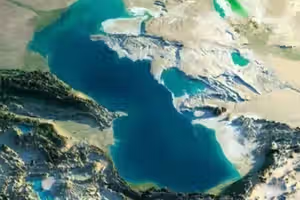
The Caspian Sea is falling by as much as 20 centimeters a year and stands at its lowest level in two centuries, an Iranian environment official said, a warning that lands just as Tehran reopens the argument over how to divide a sea that is shrinking on all five of its owners.
Mohammad Reza Kan’ani, head of the Environmental Protection Department in the northern province of Mazandaran, said Thursday that the Caspian’s water level was declining by around 10 to 20 centimeters annually, attributing much of the decline to rising temperatures, climate change and increased evaporation.
The Caspian’s water temperature had risen by about 1.5 degrees over the past two decades while evaporation had increased by an estimated 10% to 15%, he added.
Kan’ani warned that continued retreat of the shoreline could have serious consequences for coastal infrastructure, local economies and ecosystems dependent on the Caspian, including wetlands.
About 25% of the Caspian’s water comes from precipitation and 75% from rivers, Kanani said, with the Volga – which flows through Russia into the northern Caspian – accounting for the overwhelming majority of river inflow.
Shina Ansari, head of Iran’s Department of Environment, gave an even broader measure of the retreat this week, saying the Caspian’s level had fallen by around two to 2.5 meters over the past decade.
She described the decline as one of the region’s most serious environmental challenges and said reduced river inflows, alongside climate change, were contributing to the crisis.
Without cooperation among the five Caspian littoral states – Iran, Russia, Azerbaijan, Kazakhstan and Turkmenistan – the consequences could extend to ports, coastal communities and the wider ecosystem, Ansari warned.
The environmental warnings come as the Caspian has returned to the center of political debate in Iran over the government’s effort to ratify the 2018 Convention on the Legal Status of the Caspian Sea.
Hossein-Ali Haji-Deligani, deputy chairman of parliament’s Article 90 Committee, criticized what he called the government’s rush to approve the convention, saying this week that it could effectively reduce Iran’s share from 20% to between 3.5% and 5%.
The 2018 convention does not assign Iran – or any of the five littoral states – a fixed percentage of the Caspian or its seabed. Instead, it establishes territorial waters and fishing zones while leaving seabed boundaries to be negotiated between neighboring states.
Iran’s southern seabed boundaries with Azerbaijan and Turkmenistan therefore remain unresolved.
The frequently cited figure of 20% was a post-Soviet Iranian negotiating position based on dividing the Caspian equally among its five littoral states, rather than a previously established treaty entitlement.
Nor did the earlier Iran-Soviet treaties formally grant Iran 50% of the Caspian. Agreements concluded in 1921 and 1940 established a bilateral Iran-Soviet legal regime, including equal navigation rights and exclusive arrangements between the two countries, but did not divide the sea or its seabed into equal territorial halves.
After the Soviet Union collapsed in 1991, four former Soviet republics emerged as independent Caspian states. Russia subsequently reached agreements with several of them to divide northern seabed resources along modified median lines, while Iran resisted that approach and pushed for an equal 20% division if the seabed was to be partitioned.
Iran ultimately signed the five-state legal-status convention in 2018, but the agreement deliberately left the final division of seabed sectors unresolved. Tehran also stressed at the time that the method for drawing baselines – an important issue because Iran’s concave southern coastline can disadvantage it in maritime delimitation – remained to be negotiated.
The current ratification debate therefore does not amount to a parliamentary vote assigning Iran a specific percentage of the Caspian. The more consequential question is whether Tehran should fully commit to the five-state framework before its own seabed boundaries and the baseline methodology have been settled.
Pollution adds to pressure on a shrinking sea
The falling water level is only one of several environmental threats facing the Caspian.
Iranian environmental officials have also warned of mounting pollution, shrinking fish stocks and destruction of coastal habitats.
Touraj Sadeghi, head of marine ecosystem protection at the Gilan provincial environmental department, told ISNA that untreated municipal and industrial sewage, waste dumping, petroleum leaks, excessive agricultural fertilizers and pesticides, and illegal fishing were among the main sources of environmental degradation.
Many cities along Iran’s Caspian coast still lack adequate municipal wastewater treatment systems, he said, while rivers carry thousands of tons of domestic, industrial and oil-related pollution into the sea each year.
Such pollution reduces water quality, damages natural habitats and contributes to deaths among fish and bird populations, Sadeghi said.
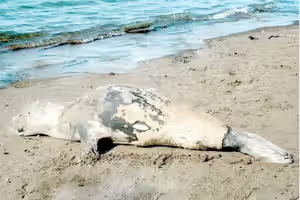
The Caspian supports distinctive wildlife including sturgeon, Caspian seals and migratory birds, but Iranian officials warn that the combination of pollution, habitat degradation and a rapidly retreating shoreline is increasingly threatening the resilience of the ecosystem.