Bessent warns countries against remaining ties with Tehran
US Treasury Secretary Scott Bessent warned Thursday that countries maintaining ties with Tehran risk accelerating their own economic decline, as he reposted President Donald Trump’s announcement of a new economic operation against Iran.
“Any remaining tie to Tehran will hasten a nation’s economic oblivion, whether that tie be purposefully constructed or willfully ignored,” Bessent wrote on X.
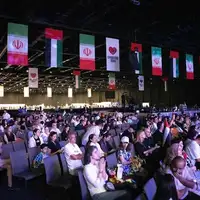
A special event honoring the Iranian community in the United Arab Emirates, held at the Dubai Exhibition Centre in Expo City Dubai on September 13, 2025. / Photo by WAM
The United Arab Emirates’ decision to halt all trade and financial transactions with Iran threatens one of Tehran’s most important routes for imports, petroleum-product sales and access to international commercial and financial networks.
The UAE Foreign Ministry said this week that all trade, commercial exchanges and financial transactions with Iran had been halted until further notice.
Afra Al Hameli, director of the Strategic Communications Department at the UAE Ministry of Foreign Affairs, said the decision came “in light of regional escalations that undermine regional and international peace and security.”
The UAE halted trade with Tehran a day after Donald Trump spoke by phone with UAE President Sheikh Mohamed bin Zayed, though it is unclear whether the decision was connected to Trump’s “Economic D-Day” campaign against Iran, announced later on Wednesday.
Trade between the two countries had already been severely disrupted after the war began in late February, when Iran launched attacks on the UAE and shipping through the Strait of Hormuz was curtailed.
In late June, however, Mohammad-Sadegh Ghannadzadeh, a deputy at Iran’s Trade Promotion Organization, said commercial exchanges with the UAE were gradually resuming through Jebel Ali Port. He said goods and containers stranded during the war were again being cleared and moved toward Iran.
The latest UAE announcement now casts doubt on the continuation of that channel.
Al Hameli also stressed that the UAE remains committed to protecting the integrity of the international financial system, complying with international law and applying the highest global standards.
That position is significant because even if political tensions eventually ease, Iranian businesses would still face serious restrictions stemming from US sanctions and Iran’s continued status as a high-risk jurisdiction subject to a Financial Action Task Force call for countermeasures.
One of Iran’s most important trading partners
The importance of the UAE to Iran can be seen in the latest official partner-by-partner trade figures available from Iranian customs.
During the first 10 months of the Iranian fiscal year that began in March 2025, Iran exported around $6.5 billion worth of non-oil goods to the UAE, equivalent to 14.3% of its non-oil exports.
Iran imported approximately $14.8 billion worth of goods from the UAE during the same period, accounting for 30.2% of its total imports.
Before the war, the UAE was therefore Iran’s largest supplier of goods and its third-largest destination for non-oil exports, behind China and Iraq.
Its importance extended well beyond ordinary merchandise trade. The UAE was also the largest destination for Iranian fuel oil, or mazut, and a market for other petroleum products.
A blow to mazut exports and fuel supply
Data from commodity intelligence firm Kpler, reviewed by Iran International, show that Iran exported an average of around 256,000 barrels per day of fuel oil in 2025.
Nearly 70% went to the UAE, making it by far Iran’s largest market for the product.
A prolonged halt in trade therefore threatens not only Iran’s non-oil exports but one of its most important outlets for petroleum products.
The UAE had also been among the destinations for Iranian liquefied petroleum gas, or LPG, although China accounts for the large majority of Iranian LPG exports. Iran’s total LPG exports generate more than $10 billion in annual revenue.
The UAE relationship is also important from the opposite direction.
An internal Iranian Oil Ministry report previously reviewed by Iran International showed that Tehran had increasingly relied on barter arrangements to meet domestic fuel shortages, exchanging part of its mazut exports for gasoline and diesel, particularly through traders operating in the UAE.
Iran is already struggling with a gasoline supply deficit, while officials have discussed measures ranging from tighter rationing to higher fuel prices.
Restricting access to the UAE could therefore affect not only export revenue but Iran’s ability to obtain products and refined fuels needed by the domestic market.
The end of Dubai’s role as Iran’s gateway to global trade?
The UAE’s importance to Iran has never been limited to direct bilateral trade.
For decades, Dubai has served as one of the principal re-export hubs for goods entering Iran, allowing Iranian companies to obtain products manufactured in countries with which direct trade is difficult, costly or restricted.
US sanctions and Iran’s exclusion from much of the international banking system have made this intermediary role particularly important.
Goods manufactured in Europe and Asia have routinely entered Iran through UAE-based traders and logistics networks, while Iranian companies have also used Dubai as a route to reach other markets.
The financial dimension is equally important. Dubai has long been a center for Iranian exchange houses, trading companies and intermediaries that help move money across borders despite Iran’s restricted access to the global financial system.
US sanctions packages targeting Iranian oil, petrochemical and procurement networks have repeatedly designated companies and individuals based in the UAE for alleged roles in facilitating transactions on Tehran’s behalf.
A broad and sustained UAE crackdown would therefore affect more than the physical movement of goods. It could also constrain financial, logistical and commercial networks that Iran has spent years using to mitigate its international isolation.
A major new gap for Iran’s economy
The latest available Iranian customs breakdown shows that merchandise trade between Iran and the UAE totaled about $21.3 billion in just the first 10 months of the previous Iranian fiscal year.
But even that figure understates the UAE’s economic importance because it does not capture Dubai’s wider role as a re-export, logistics and financial center for Iranian businesses.
Iran is now confronting the UAE halt while already under pressure from sanctions, foreign-currency constraints, weaker foreign trade and disruptions to energy exports.
Alternative routes through Oman, Iraq, Turkey and other neighboring countries can keep some trade moving, but they lack the combination of proximity, port infrastructure, financial connectivity and established commercial networks that Dubai offered.
The UAE has given no timetable for lifting its suspension.
For Iran, the risk is therefore not simply the loss of billions of dollars in bilateral trade. A prolonged halt could close one of its most important gateways to the global economy.
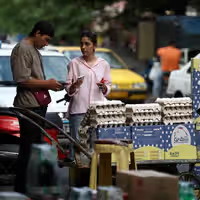
An Iranian woman buys eggs in Tehran / Photo by Reuters
Donald Trump has promised an “Economic D-Day” against Iran, a threat Tehran dismissed as another failed US policy. But with inflation, shipping costs and supply strains already biting, how much more pressure can Iran’s fragile economy absorb?
President Donald Trump on Wednesday announced what he called the “most crushing economic operation ever taken against any country,” threatening unprecedented economic isolation and consequences for countries whose financial institutions, businesses or government entities continue providing Tehran with an economic lifeline.
“Oil smuggling, swap lines, cash transfers, exchange houses, ship registries, front companies — it all needs to stop NOW,” Trump wrote on Truth Social, calling on US allies to join the campaign.
Iranian Foreign Minister Abbas Araghchi dismissed the announcement on Thursday as “doubling down on failed policies,” while Iran’s Foreign Ministry called the campaign “economic terrorism” and a “crime against humanity,” saying Tehran would continue resisting US military, economic and political pressure.
The Trump administration, however, is signaling that the campaign could go considerably further than existing sanctions.
Treasury Secretary Scott Bessent told CNBC on Thursday that Washington would impose the “toughest sanctions in history” on Iran and said the administration would outline its measures on Monday.
“It is going to work in Iran and we are going to collapse this regime,” Bessent said.
He said countries continuing to do business with Tehran would face US enforcement actions. Asked whether that could include China, which buys the overwhelming majority of Iran’s shipped oil, Bessent said some conversations were better held privately.
Bessent also suggested that “maximum economic pressure” could reduce the likelihood of another major military phase, describing the economic campaign and the US naval blockade as a “one-two punch.”
Already under strain
Even before the new US economic campaign was announced, Iranian economic reporting was documenting the price the confrontation was already imposing at home: higher shipping costs, pressure on medicine supplies and further strain on household budgets.
Emergency Central Bank allocations have enabled round-the-clock clearance of wheat and pharmaceutical imports at Shahid Rajaee Port in Bandar Abbas, yet reports by ILNA and Donya-ye Eghtesad said container freight rates remained 35 to 40 percent above baseline because of persistent war-risk surcharges.
The pressure is also reaching medicine supplies. On Monday, a major pharmaceutical company in Tehran said the government could no longer provide the foreign currency it required at subsidized rates, warning that some medicines could disappear from shelves or be sold at two to three times current prices.
Donya-ye Eghtesad has linked elevated shipping costs to domestic production bottlenecks, arguing that more expensive freight raises the cost of imported intermediate goods and adds to broader inflationary pressure.
The paper said temporary customs measures were treating symptoms rather than causes, with high insurance premiums and port congestion continuing to increase raw-material costs.
“So long as transit protocols remain uncodified,” the daily wrote, “industrial input costs will remain elevated, eroding domestic purchasing power daily.”
Those pressures are hitting an economy already struggling with steep inflation. Iran’s 12-month inflation rate reached 66 percent in July, while food prices were 128 percent higher than a year earlier. War, sanctions and disruptions to trade and imports have further squeezed household purchasing power.
Cooking oil, meat and dairy products have moved beyond the reach of many working- and middle-class families. Iranian reports describe households cutting back on staples and non-essential spending, while a kilogram of lamb can consume up to 10 percent of a minimum-wage worker’s monthly income.
Housing costs have also intensified the squeeze. Rents have risen sharply in major cities including Tehran, Mashhad and Isfahan despite nominal government caps, increasing housing insecurity and pushing some families toward cheaper districts or shared accommodation.
Iranian reports increasingly describe teachers, civil servants and office workers struggling to maintain their living standards despite holding multiple jobs. Peripheral provinces including Ilam, Sistan-Baluchestan and Kurdistan face even greater economic pressure.
Less leverage at Hormuz
Compounding that vulnerability, Iran may also be losing some of the strategic leverage it hoped to gain from disrupting traffic through the Strait of Hormuz.
CNN reported Wednesday that more than 80 percent of recent liquid cargo transits through Hormuz had either used the Omani route or traveled with transponders switched off and likely followed it.
Axios separately reported that the US military was operating a shipping corridor along the Omani side of the Strait, helping 15 to 20 tankers enter or leave the Persian Gulf each night.
The reports suggest Iran could be left absorbing many of the economic consequences of disruption at Hormuz while gaining less bargaining power from it.
That also changes the context of Iran’s negotiations with Oman over navigation through the Strait. Foreign Ministry spokesman Esmaeil Baghaei said Iranian and Omani technical teams had agreed on geographic coordinates and navigation lanes for a proposed shipping scheme.
Iranian economic commentary had portrayed formalization of such an arrangement as important to lowering insurance and shipping costs. But if Washington can increasingly move vessels through an Oman-side corridor without an agreement that gives Tehran a central role, Iran may have less ability to use the Strait to extract political or economic concessions.
Iran has endured decades of US sanctions and built extensive networks to circumvent them, giving Tehran reason to doubt whether another pressure campaign can force a change in course.
But the starting point this time is different: an economy already weakened by inflation, disrupted trade and the costs of war, while one of Tehran’s most important sources of leverage appears to be eroding.
Trump has yet to spell out the full measures behind his “Economic D-Day.” Bessent says those details will come Monday. The question is whether Washington can close enough of Iran’s remaining economic lifelines to impose pressure Tehran cannot absorb — or whether the Islamic Republic can once again adapt while passing much of the cost on to ordinary Iranians.
Days before he was killed, Ali Khamenei gave a poem to a translator, a senior cleric says. Iranian outlets published it as his prophecy of his own martyrdom. Then readers ran down the first letters: I am Ali Khamenei, born of Satan.
The account comes from Mohammad-Ali Mousavi Jazayeri, the former Friday prayer leader of Ahvaz and a former member of the Assembly of Experts, in a video that spread across Persian social media this week.
Jazayeri says he heard the story from Abbas Hazbavi, an Arabic-language poet from Khuzestan. By that account, intermediaries told Hazbavi after meeting Khamenei that the leader had urgent business with him, and a call from the office followed.
Hazbavi says he went on the first day of Ramadan, around ten days before Khamenei was killed on February 28, and that the supreme leader handed him a poem and asked him to render it into Arabic. The Khuzestan news site Sobh-e Khouzestan published the interview along with the full Persian text.
Hazbavi was a plausible choice. An established religious poet, he has translated Khomeini's ghazals into Arabic and has publicly recited his own Arabic rendering of Khamenei's verse. The office would have had his number.
The poem reads, on the surface, exactly as its promoters wanted. "Alas, I came late to my purpose," one line runs, "and heard the meaning of martyrdom from the beloved's lips." Another appears to name the month: "If the tyrant has marked my body as his target, in Esfand my soul will set out after the lovers." Khamenei was killed on the ninth day of Esfand (February 28).
The trouble is in the margin. Taking the first letter of each of the poem's 22 hemistiches in order produces a sentence: man Ali Khamenei zadeh-ye Sheytanam. "I am Ali Khamenei, born of Satan."
The device is a classical one. Persian poets have used the acrostic, known in traditional prosody as movashshah, for centuries to conceal a name or a dedication in the opening letters of successive lines. Twenty-two letters forming a grammatical sentence is not coincidence; someone built it deliberately.
Who that was is the question the story leaves open. Iran International cannot verify Jazayeri's account, Hazbavi's, or the poem's authorship, and there is no evidence that Khamenei wrote the poem.
What the establishment's own account supplies is the route the poem travelled: through the supreme leader's office, into a translator's hands, and out into print under Khamenei's name. Every step of that journey is described by his admirers, not his enemies.
Left: ILNA's report presenting the poem as Ali Khamenei's own, under the headline "The leader who counted the moments to martyrdom." Right: the same address today, after the agency removed it.
It landed among outlets primed to want it. The verses ran on ILNA, Hamshahri and Khabar Online, among others, at a time when Iranian media were combing Khamenei's life for signs he had foreseen his own end.
ILNA's version, headlined "The leader who counted the moments to martyrdom," has since been taken down.
Too late to delete
On Persian social media, where the poem returned to circulation this week with the first letters marked in red, the mood has been close to disbelief.
"Apparently Khamenei ordered a poem he could pass off as his own," one widely shared post said. "The poet delivered, all right. Now the state sites have finally noticed and they're deleting it."
"At first I thought it was a joke," another user wrote. "They've pulled it from a lot of sites, but it's still up on the eulogists' channels."
Others turned to the question of where the poem came from. "So someone inside the leader's own house did this," one post said, speculating about who in Khamenei's circle might have arranged it.
One user drew out the reversal at the heart of the affair: "They wanted to show a miracle, that he foresaw his own martyrdom. The very poem they are using as proof says the opposite: that he was born of Satan."
The appetite the poem fed is well documented. In the weeks after Khamenei's killing, Iranian media ran a steady stream of material presenting him as having anticipated it, including a genuine ghazal of his that Hamshahri Online published under the headline "The ghazal the martyred leader wrote for his own martyrdom."
The flood has been large enough that Khamenei's own Office for the Preservation and Publication of Works has had to issue a denial over a different poem attributed to him after a cleric recited it publicly, saying the attribution and the story around it "are entirely untrue."
Jazayeri's own history gives the episode a final turn. In 1989, when the Assembly of Experts chose Khamenei to succeed Khomeini, it was Jazayeri who proposed that the new leader be addressed as an ayatollah rather than by his actual, lesser clerical rank.
Thirty-seven years later, the same cleric put his name to a poem whose hidden line calls him the son of the devil.
The phrase itself has been used against Khamenei before. In January, the US ambassador to Israel, Mike Huckabee, called him "a true son of Satan" in a post on X.
What is new is where Iranians found it this week: inside a poem his own admirers were circulating as scripture.
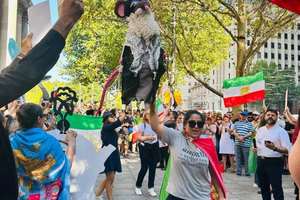
A stuffed rat is hung from a tree during protests at Sharif University in February 2026.
A student at Iran's most prestigious technical university has been expelled and banned from all universities for four years over a stuffed rat hung from a campus tree, a toy that carried the nickname protesters gave the late supreme leader.
Sharif University's student affairs office said the ruling against Reza Dalman, a 24-year-old master's student in computer engineering, was final. "The final ruling was communicated to the university for implementation on August 16," the office said.
Dalman was arrested on March 19 and released on bail about a month later. Student sources link his case to a stuffed rat that demonstrators hung from a tree during protests at Sharif in late February, before a Basij-affiliated student climbed up and took it down.
The toy was an insult with a name. Critics began calling Ali Khamenei "Moush-Ali," or Rat-Ali, after the late supreme leader largely vanished from public view during the 12-day war with Israel in June 2025, when reports said he had taken shelter in a fortified underground facility.
Moush means mouse, or rat. The nickname spread from social media into chants at protests inside Iran and among the diaspora, a way of mocking a leader his opponents said had run for cover.
Dalman published an image of the final decision, stamped "confidential," on his X account. Among the points the university listed against him was that during his defense he showed "no expression of remorse."
The expulsion sits alongside a judicial case against Dalman and a widening series of disciplinary rulings at one of Iran's most prominent universities.
Expulsion orders reach 10
Three more Sharif students have received preliminary expulsion orders, bringing to 10 the number facing such rulings, the United Students group said on Wednesday.
The latest are Ariana Kouchaki, an industrial engineering undergraduate, Ali Alirezaei, a mathematics undergraduate, and Arash Hatami, a physics undergraduate. Kouchaki and Hatami were each barred from studying at any university in Iran for one year, while Alirezaei received a five-year nationwide ban, according to the group.
Seven other Sharif students had already received expulsion orders. Dalman's is the only case finalized by the Ministry of Science; the rest remain preliminary.
Iran executed Ghaem Hosseini, also known as Arian, on Thursday over his involvement in protests in the central city of Isfahan in January, making him the fifth person put to death in a case in which UN experts have raised concerns about the defendants' trials.
Iran's judiciary described Hosseini as a foreign national but did not say which country he was from. A source familiar with the case told Iran International earlier his month that Hosseini was a cousin of Golmohammad Mohammadi, an Afghan national who was previously executed in the same case, indicating Hosseini may also have been Afghan.
The judiciary's media center said Hosseini was executed on Thursday morning after his death sentence was upheld by the Supreme Court. It said he had been convicted of charges including moharebeh, or "waging war against God," and corruption on earth, as well as destruction of property and collusion to act against national security.
Twelve people were sentenced to death in the Ali-Khani Square case, which stems from protests in Isfahan on January 8.
Iranian authorities executed Golmohammad Mohammadi and Erfan Esfandiari on July 19, followed by Amirhossein Safari and Abolfazl Sepahi on July 28. Hosseini's execution on Thursday brings the number of defendants put to death in the case to five.
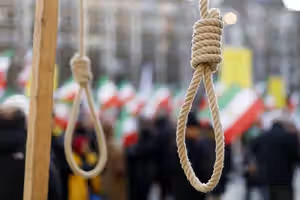
Safari and Sepahi were hanged after an execution scaffold was erected at Ali-Khani Square, the site of the January protests. People gathered near the square overnight amid a heavy deployment of security forces and fears of imminent executions.
Iranian authorities have accused the defendants of involvement in the deaths of four security personnel, as well as arson and vandalism during the protests.
Iranian authorities said Hosseini was involved in unrest at Isfahan's Ali-Khani Square on January 8, where four members of the security forces were killed.
The judiciary said Hosseini admitted being present during the unrest and carrying a bladed weapon. It said he wore a jacket, hat and mask and switched off his mobile phone to avoid being identified or tracked.
The judiciary also accused Hosseini of taking part in the burning of the Amir al-Momenin mosque in Isfahan's Malekshahr district on the same night.
The authorities said Hosseini was convicted of drawing a weapon and "creating fear and terror," causing widespread insecurity, acting against national security, destroying public property and colluding to act against national security.
The judiciary said the Supreme Court reviewed Hosseini's appeal and upheld the death sentence before it was carried out on Thursday.
Before the July 28 executions, UN human rights experts urged Iranian authorities to halt the executions of the remaining defendants in the Ali-Khani Square case.
"Sentencing 12 people to death in one hearing, in a closed courtroom and without clarity as to each defendant's individual responsibility violates established fair trial standards," the experts said.
The experts, led by Mai Sato, the UN Special Rapporteur on the situation of human rights in Iran, said the defendants, ranging from their late teens to their early twenties, had reportedly faced arbitrary detention, enforced disappearance and, in some cases, ill-treatment.
They also raised concerns that convictions relied heavily on confessions broadcast on Iranian state television, while Revolutionary Court hearings were held behind closed doors and the judgments were not made public.
Other rights groups have also raised concerns over access to independent lawyers and court files in the case.
Hosseini's execution comes amid a broader rise in the use of the death penalty for national security-related offenses following Iran's January protests.
UN human rights chief Volker Türk said on August 5 that Iran had executed at least 56 people on national security-related charges since March 19, including 27 in cases linked to protests earlier this year.
Türk said more than 100 other people faced similar charges and the possibility of the death penalty. He urged Iranian authorities to halt executions and move toward abolishing capital punishment.