• العربية
  • فارسی
Brand
  • Iran Insight
  • Politics
  • Economy
  • Analysis
  • Special Report
  • Opinion
  • Podcast
  • Live TV
  • Iran Insight
  • Politics
  • Economy
  • Analysis
  • Special Report
  • Opinion
  • Podcast
  • Live TV
  • Theme
  • Language
    • العربية
    • فارسی
  • Iran Insight
  • Politics
  • Economy
  • Analysis
  • Special Report
  • Opinion
  • Podcast
  • Live TV
All rights reserved for Volant Media UK Limited
volant media logo

A poem hailed as Khamenei's prophecy is an acrostic: Born of Satan

Arash Sohrabi
Arash Sohrabi

Iran International

Aug 20, 2026, 13:11 GMT+1Updated: 14:39 GMT+1
Iran's late Supreme Leader Ali Khameeni

Days before he was killed, Ali Khamenei gave a poem to a translator, a senior cleric says. Iranian outlets published it as his prophecy of his own martyrdom. Then readers ran down the first letters: I am Ali Khamenei, born of Satan.

The account comes from Mohammad-Ali Mousavi Jazayeri, the former Friday prayer leader of Ahvaz and a former member of the Assembly of Experts, in a video that spread across Persian social media this week.

Jazayeri says he heard the story from Abbas Hazbavi, an Arabic-language poet from Khuzestan. By that account, intermediaries told Hazbavi after meeting Khamenei that the leader had urgent business with him, and a call from the office followed.

Hazbavi says he went on the first day of Ramadan, around ten days before Khamenei was killed on February 28, and that the supreme leader handed him a poem and asked him to render it into Arabic. The Khuzestan news site Sobh-e Khouzestan published the interview along with the full Persian text.

Hazbavi was a plausible choice. An established religious poet, he has translated Khomeini's ghazals into Arabic and has publicly recited his own Arabic rendering of Khamenei's verse. The office would have had his number.

The poem reads, on the surface, exactly as its promoters wanted. "Alas, I came late to my purpose," one line runs, "and heard the meaning of martyrdom from the beloved's lips." Another appears to name the month: "If the tyrant has marked my body as his target, in Esfand my soul will set out after the lovers." Khamenei was killed on the ninth day of Esfand (February 28).

The trouble is in the margin. Taking the first letter of each of the poem's 22 hemistiches in order produces a sentence: man Ali Khamenei zadeh-ye Sheytanam. "I am Ali Khamenei, born of Satan."

The device is a classical one. Persian poets have used the acrostic, known in traditional prosody as movashshah, for centuries to conceal a name or a dedication in the opening letters of successive lines. Twenty-two letters forming a grammatical sentence is not coincidence; someone built it deliberately.

Who that was is the question the story leaves open. Iran International cannot verify Jazayeri's account, Hazbavi's, or the poem's authorship, and there is no evidence that Khamenei wrote the poem.

What the establishment's own account supplies is the route the poem travelled: through the supreme leader's office, into a translator's hands, and out into print under Khamenei's name. Every step of that journey is described by his admirers, not his enemies.

100%
Left: ILNA's report presenting the poem as Ali Khamenei's own, under the headline "The leader who counted the moments to martyrdom." Right: the same address today, after the agency removed it.

It landed among outlets primed to want it. The verses ran on ILNA, Hamshahri and Khabar Online, among others, at a time when Iranian media were combing Khamenei's life for signs he had foreseen his own end.

ILNA's version, headlined "The leader who counted the moments to martyrdom," has since been taken down.

Too late to delete

On Persian social media, where the poem returned to circulation this week with the first letters marked in red, the mood has been close to disbelief.

"Apparently Khamenei ordered a poem he could pass off as his own," one widely shared post said. "The poet delivered, all right. Now the state sites have finally noticed and they're deleting it."

"At first I thought it was a joke," another user wrote. "They've pulled it from a lot of sites, but it's still up on the eulogists' channels."

Others turned to the question of where the poem came from. "So someone inside the leader's own house did this," one post said, speculating about who in Khamenei's circle might have arranged it.

One user drew out the reversal at the heart of the affair: "They wanted to show a miracle, that he foresaw his own martyrdom. The very poem they are using as proof says the opposite: that he was born of Satan."

The appetite the poem fed is well documented. In the weeks after Khamenei's killing, Iranian media ran a steady stream of material presenting him as having anticipated it, including a genuine ghazal of his that Hamshahri Online published under the headline "The ghazal the martyred leader wrote for his own martyrdom."

The flood has been large enough that Khamenei's own Office for the Preservation and Publication of Works has had to issue a denial over a different poem attributed to him after a cleric recited it publicly, saying the attribution and the story around it "are entirely untrue."

Jazayeri's own history gives the episode a final turn. In 1989, when the Assembly of Experts chose Khamenei to succeed Khomeini, it was Jazayeri who proposed that the new leader be addressed as an ayatollah rather than by his actual, lesser clerical rank.

Thirty-seven years later, the same cleric put his name to a poem whose hidden line calls him the son of the devil.

The phrase itself has been used against Khamenei before. In January, the US ambassador to Israel, Mike Huckabee, called him "a true son of Satan" in a post on X.

What is new is where Iranians found it this week: inside a poem his own admirers were circulating as scripture.

Most Viewed

Iran weighs attacks on military targets in Europe – FT
1

Iran weighs attacks on military targets in Europe – FT

2
ANALYSIS

The 60-day deadline is over. Now what does Trump do with Iran?

3
VOICES FROM IRAN

Tehran gas stations run dry as fuel price hike fears mount

4
OPINION

For Iranian journalists, exile can last a lifetime

5

Iran campaign urges people to fund sacrifice of 10,000 sheep for Khamenei’s health

Banner
Banner
Banner

Spotlight

  • Luxury Tehran property asking prices surpass Munich and Sydney

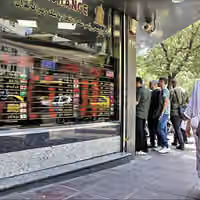
    Luxury Tehran property asking prices surpass Munich and Sydney

  • For Iranian journalists, exile can last a lifetime
    OPINION

    For Iranian journalists, exile can last a lifetime

  • Seven months on, January protests still shape Iranians’ lives
    VOICES FROM IRAN

    Seven months on, January protests still shape Iranians’ lives

  • Forced to serve in the IRGC, now fighting to stay in Canada
    INSIGHT

    Forced to serve in the IRGC, now fighting to stay in Canada

  • Iran’s ‘infiltration’ bill sparks backlash over sweeping reach

    Iran’s ‘infiltration’ bill sparks backlash over sweeping reach

  • To survive maximum pressure, Iran kept pumping and broke its oil company
    ANALYSIS

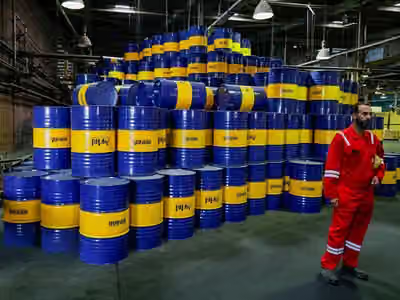
    To survive maximum pressure, Iran kept pumping and broke its oil company

•
•
•

More Stories

Pezeshkian admin says infiltration bill violates rights, could drive brain drain

Aug 19, 2026, 14:23 GMT+1
•
Niloufar Goudarzi
100%

President Masoud Pezeshkian's government has formally opposed a bill aimed at countering foreign intelligence infiltration, saying it violates citizens' rights, restricts academic ties and could accelerate the emigration of Iranian experts and researchers.

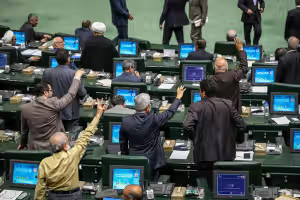
Iranian lawmakers on Sunday, August 16, approved the general principles of the "Plan to Counter the Infiltration of Intelligence Services and Foreign Governments or Institutions" by 183 votes in favor, four against and five abstentions.

The vote means parliament approved the proposal in principle but has not yet approved its individual articles or penalties. The publicly available version contains 19 articles, though lawmakers have said the details have not been finalized.

Majid Ansari, President Masoud Pezeshkian's vice president for legal affairs, said on Wednesday that the cabinet had reviewed the proposal in October last year, and sent its formal opposition to parliament because of what he described as fundamental problems in its provisions.

"The government's official position is opposition to this proposal," Ansari told the state-run IRNA news agency.

Government cites rights concerns

Ansari said the proposal conflicted with several constitutional principles covering citizens' rights, fundamental rights and individual freedoms, and in some cases was also inconsistent with Sharia law.

He said the measure would sharply restrict academic contacts between Iranian universities, researchers and specialists and institutions abroad.

"To achieve the country's important scientific goals, we must work to facilitate communication and the exchange of scientific information, but the provisions of this proposal will create serious restrictions on the country's scientific growth and development," he said.

Ansari said researchers, doctors and academics need ties with international institutions to prevent their work from becoming stagnant and warned that broad restrictions on contacts could push more specialists to leave Iran.

"If every type of contact and communication faces restrictions and is criminalized by law, naturally they will prefer to migrate and carry out their scientific and research activities in a free environment," Ansari said.

  • Iran’s new infiltration bill could make ordinary contact a crime

    Iran’s new infiltration bill could make ordinary contact a crime

Government says existing laws are enough

The Pezeshkian government said Iran already has laws and security agencies with powers to deal with foreign intelligence activity and does not need new legislation in its current form.

Ansari said any new legislation should instead be prepared with the participation of the government and judiciary and submitted as a government bill after legal, judicial, social and political review.

He called on parliament to remove the proposal from its agenda or subject it to a more detailed two-stage review, saying its broad criminal provisions required input from the judiciary.

Draft restricts foreign contacts

The publicly available draft extends beyond acts normally associated with espionage and covers a wide range of contacts between Iranians and foreign individuals and institutions.

One provision would require individuals, private companies and state bodies to notify authorities and receive written permission from the Foreign Ministry, or an Iranian embassy or consulate abroad, before contacts with foreign embassies, offices or non-Iranian organizations inside or outside Iran.

The draft provides limited exemptions for matters including civil registration and personal-status issues. Violations could result in fines and restrictions on social rights.

Another article would ban providing information, reports or statistics to foreign intelligence services, non-Iranian groups or institutions, or foreign nationals without permission from the Intelligence Ministry. It provides for prison terms and, in some cases, a permanent ban from the job through which the information was obtained or supplied.

  • Iran’s intelligence mocked by allies and foes over 'secret' Israel files

    Iran’s intelligence mocked by allies and foes over 'secret' Israel files

The draft would also make sending photographs, video, audio or other data to non-Iranian media or people engaged in media work outside Iran punishable by prison.

Interviews or other communication with some US- or Israeli-funded media would also be punishable by prison, while interviews with other foreign media would have to be reported to an Intelligence Ministry system.

Foreign visitors and academic ties

The proposal also contains restrictions affecting foreign nationals in Iran.

Foreigners who enter or remain in Iran without completing required legal procedures could be deported and fined the equivalent of 10,000 euros.

Foreign nationals who entered legally but carried out cultural activities deemed contrary to national security or the state's general policies could face the same penalties. Other offenses committed by foreign nationals in Iran could carry penalties one degree more severe than otherwise prescribed.

The Intelligence Ministry would also be required to publish each year a list of foreign governments, universities and institutions approved for scholarships, grants, academic agreements, conferences and other scientific cooperation.

Scientific cooperation with universities or institutions not on that list, as well as sending medical, research or archaeological samples to them, could result in a prison sentence.

Supporters say measure is needed after wars

Mohammad Saleh Jokar, a lawmaker from Yazd and head of parliament's Internal Affairs and Councils Committee, defended the need for stronger measures against infiltration but said the details of the proposal had not yet been finalized.

Jokar said Iran had suffered major damage from infiltration before and during what he called the 12-day war with Israel and the US last year and the 40-day war with the US this year, adding that foreign adversaries had used different channels to collect information.

He said the assassinations of a number of Iranian commanders and officials were linked to infiltration and said hostile networks inside Iran had used messages, money, weapons and other resources to pursue their objectives.

Jokar said parliament needed to identify and close routes used for infiltration, whether they involved a physical or virtual presence inside the country.

But he also said the proposal's individual provisions required detailed consideration by lawmakers and rejected suggestions that the currently circulating text had been finalized.

  • Iran’s ‘infiltration’ bill sparks backlash over sweeping reach

    Iran’s ‘infiltration’ bill sparks backlash over sweeping reach

Legal scholar warns of vague offenses

Mohsen Borhani, a prominent legal scholar and faculty member at the University of Tehran's law school, also sharply criticized the proposal.

Borhani said its wording was vague and could put the freedom of citizens, academics, political and social activists and artists at risk.

He pointed to language in the draft covering acts such as "showing a dark image of the country," promoting what authorities consider "anti-Islamic culture," taking part in courses deemed incompatible with Iranian culture and making policy proposals considered contrary to the state's fundamental interests.

The draft provides penalties for some cultural activity carried out under foreign direction, including permanent restrictions on some artistic work, and provides prison sentences for some educational courses and workshops involving specified foreign institutions.

Article 1 also provides lengthy prison terms for some policy or legislative proposals made under foreign direction if authorities determine they damaged national security, fundamental state interests, public trust or electoral participation.

Borhani said such broad wording could allow selective enforcement and urged the government, the Science Ministry, the Culture Ministry and other institutions to oppose the measure.

Criticism spreads on social media

Some Iranian social media users also reacted with alarm after parliament's Sunday vote, focusing on the proposal's restrictions on education, media contacts and links with the outside world.

"The biggest point in the proposal is that it lays the groundwork for closing off scholarships for Iranian students," one user on X wrote.

Another user described the measure as "cutting ties with the world on the path to turning Iran into North Korea," saying the proposal could bring media, scientific and civil contacts with foreign institutions under tighter security control.

"Welcome to the world's largest prison," another user wrote, pointing to proposed prison terms for interviews with some US media and restrictions on contact with foreign embassies without government permission.

The posts reflected concern among some social media users that the proposal could sharply restrict academic, media and civil contacts with organizations outside Iran. They do not represent a scientific measure of Iranian public opinion.

The draft remains subject to change. Parliament's vote on Sunday approved only its general principles, and lawmakers have not yet approved the individual articles or penalties contained in the publicly available text.

Iran’s ‘infiltration’ bill sparks backlash over sweeping reach

Aug 18, 2026, 04:44 GMT+1
•
Maryam Sinaiee
100%

A bill before Iran’s parliament that would impose new restrictions on contacts with foreign media, universities and organizations has drawn widespread objections over its potential impact on routine academic, cultural and civil-society activity.

Lawmakers approved the bill’s general principles Sunday by 183 votes to four, with five abstentions among 258 members present. Its individual provisions must still be considered and approved separately.

The latest publicly available draft contains 19 articles, although references during Sunday’s parliamentary debate to Articles 26 and 27 indicate that lawmakers may be considering a revised text.

Bill targets broader forms of foreign influence

Supporters say a new law is needed because existing legislation focuses primarily on espionage, while foreign infiltration can take broader forms.

Hassan Ghashghavi, spokesman for parliament’s National Security and Foreign Policy Committee, said Iran already had laws covering espionage but faced a legal gap on infiltration.

Ghashghavi said work on the proposal began before the 12-day war and that relevant state bodies had participated in reviewing it.

The published draft gives the Intelligence Ministry and the Revolutionary Guards’ Intelligence Organization roles in identifying prohibited foreign links and activities. Cases under the proposed legislation would be heard by Revolutionary Courts.

Proposed penalties include prison terms, deprivation of social rights, dissolution of legal entities and confiscation of assets.

The reformist newspaper Sazandegi wrote that the proposal “not only fails to provide a proper definition of infiltration, but is also a warning sign of intensified censorship, greater restrictions and a widening social divide in the country.”

The newspaper questioned why legislation intended to counter foreign infiltration extended to scientific, media, cultural and civic activity rather than concentrating on breaches within sensitive state institutions.

Sociologist Mohammad Rahbari wrote that if the bill is approved in its reported form, “it would be as if parliament had shot itself in the foot,” arguing that the proposed offenses are defined so broadly that even parliament’s own research center could fall within their scope.

Social media activist Hossein Ghatib wrote that “the path to combating infiltration is not to take revenge on society,” arguing that shortcomings in official security structures should not result in restrictions on “university professors, journalists, artists, researchers, students and ordinary citizens.”

Foreign media and embassy contacts

Article 6 of the published draft would prohibit interviews, participation in discussions or “any communication” with media designated as hostile, including US and Israeli outlets and media funded by either country.

Violations would carry a sixth-degree prison sentence, which under Iran’s penal code ranges from more than six months to two years. Parliament has not approved the provision.

Interviews with other foreign media would have to be notified through a system run by the Intelligence Ministry, with failure to do so subject to the same proposed punishment.

Article 7 would criminalize sending video, photographs, audio or “any data” to non-Iranian media or people engaged in media activity outside the country.

The proposed punishment would increase in circumstances the text describes as crisis, unrest or disorder, or when information was sent under a cooperation agreement or with the intent of acting against national security.

The wording could potentially apply beyond professional journalists to people who send images or video of events inside Iran to media organizations abroad.

Iranian daily Shargh wrote that the proposed restrictions could expose foreign-policy journalists, international-relations specialists, translators, academics and businesspeople to prosecution because their work routinely requires contact with foreign institutions.

The newspaper also questioned whether authorities could realistically process permits for the large number of diplomatic, academic and commercial contacts taking place each day.

Article 8 would require individuals and organizations to notify authorities and obtain written permission from the Foreign Ministry or Iranian diplomatic missions for many contacts with foreign embassies, international organizations and non-Iranian institutions, with limited exceptions for personal and consular matters.

Academic and civil-society activity

Article 3 of the published text would prohibit providing “information, reports or statistics” to non-Iranian institutions or foreign nationals without Intelligence Ministry authorization.

The provision itself does not limit those categories to classified information.

Civil-society organizations would also be directly covered by the bill. Article 4 would prohibit non-governmental organizations, associations, political groups and other legal entities from receiving money, contracts, commissions or other financial benefits from foreign governmental or non-governmental bodies without authorization from a state committee.

Proposed penalties include imprisonment and fines, dissolution of organizations and bans of five to 15 years on cultural or social activity for their managers.

In academia, the draft would require the Intelligence Ministry to publish a list of approved foreign universities and research institutions for scholarships, contracts and scientific events.

Cooperation with institutions outside that list could carry criminal penalties if the provision is approved.

Cultural and educational work could face penalties

Other articles of the published text cover films, television series, documentaries, theater, music and books produced with the direction or support of foreign entities specified in the bill.

Works deemed to present a “dark image of Iran” or challenge religious principles could bring financial penalties or professional restrictions if the provisions are ultimately approved.

The draft would also allow prosecutors, based on material supplied by security agencies, to stop production of some works before completion.

Asr-e Iran questioned how authorities would define a “dark image of Iran,” asking whether portrayals of poverty, addiction, discrimination, corruption or migration could fall within that category.

“A country that is afraid of seeing its own wounds is not a healthier country; it may simply have broken its mirrors,” the outlet wrote.

In-person and online courses and workshops could also fall under the legislation if authorities considered them incompatible with “Iranian culture” and linked them to foreign entities covered by the bill.

Participants could also face punishment under the published text if they knew of the organizers’ stated purpose.

Another provision would criminalize certain forms of cooperation with foreign intelligence services, foreign governments, international organizations or non-Iranian individuals and entities to implement the UN 2030 Agenda or international instruments Iran has not formally undertaken to implement under its constitutional procedures.

Scope of bill draws criticism

Osman Salari, a member of the presidium of parliament’s Judicial and Legal Commission, said much of the proposal concerned criminal and judicial matters and argued that the judiciary and his commission had not been sufficiently consulted in its preparation.

Supporters argue that existing rules are fragmented and that a broader law is needed to establish a single framework for countering what the Islamic Republic describes as foreign infiltration.

Individual provisions remain unsettled

Article 1 of the published draft would also punish certain policy, legislative or executive proposals made under the supervision, direction, training or guidance of specified foreign intelligence services, governments or organizations when they result in harms defined by the text.

Those harms include damage to Iran’s security or independence and, under specified circumstances, undermining public trust in the political system, reducing election participation or directing votes toward a particular group or political current.

Other provisions would increase penalties for some economic crimes committed under foreign direction.

Iran enacted separate legislation in October 2025 increasing punishments for espionage and cooperation with Israel and states it designates as hostile. Supporters of the new proposal argue that “infiltration” requires a broader legal framework than espionage alone.

The new bill has yet to be considered article by article. Parliament must also determine the procedure for its further examination, and any final text it approves would require Guardian Council review before becoming law.

Salari said reports about punishments contained in the circulated draft should not be treated as final because lawmakers have not yet considered the individual provisions.

The provisions may therefore change during parliamentary scrutiny. What parliament has approved so far is the principle of legislating against what it describes as foreign infiltration, not the individual restrictions or penalties contained in the publicly available draft.

Iran’s rulers turn attention to the threat from within

Aug 15, 2026, 18:00 GMT+1
•
Negar Mojtahedi
100%
Iranian protestors met with security forces during January uprisings.

As Iran confronts military pressure abroad and mounting economic strain at home, signs are emerging that the Islamic Republic is increasingly turning its attention to another potential threat: renewed unrest on its own streets.

While veteran hardliners are returning to key positions overseeing forces responsible for domestic repression, cobblestones are being ripped out of historic pedestrian areas and replaced with asphalt.

Municipal officials have described the work as traffic management, but Iran International reporter Mehdi Sepahvand’s reporting suggests it could make the areas easier for security forces to penetrate and control during unrest.

Analysts say the developments, against a backdrop of uncertainty over the country’s new leadership, suggest the state is thinking beyond the current war to the possibility of another confrontation at home.

The return of Hossein Taeb, one of the Islamic Republic’s most feared security figures, to command the Basij is perhaps the clearest signal.

Omid Memarian, a senior Iran analyst at the think tank DAWN, said Taeb’s return shows the state is prioritizing control of the population.

100%
Photo of Hossein Taeb

‘An undeclared coup’

“They are very much nervous, concerned about people and their demands,” Memarian told Eye for Iran, adding that the leadership understands “the domestic situation can explode at any moment.”

Taeb, Memarian said, was brought back not to reconcile with Iranians, but to consolidate loyalists and signal that authorities are prepared to “crush any dissent.”

For Kamran Bokhari, a senior resident fellow at the Middle East Policy Council and strategic forecaster, the reshuffle raises a more fundamental question: who is making these decisions?

With Iran’s new Supreme Leader remaining unseen and unheard publicly, Bokhari questioned the extent of his authority and argued that a small group within the security establishment may effectively be running the system.

“The point is who is making these appointments?” he said.

Bokhari went further, describing the emerging arrangement as an “undeclared coup” by the Revolutionary Guards, in which he believes the IRGC is consolidating authority while preserving the appearance of a functioning constitutional system.

Jason Brodsky, policy director at United Against Nuclear Iran, offered a different reading, seeing a diffusion of power in the absence of a visible Supreme Leader capable of imposing decisions across the system.

Survival is not stability

Former CIA Iran specialist Mark Fowler said the Islamic Republic has absorbed severe military damage without collapsing.

“Surviving is winning for the Iranian regime right now,” Fowler told Iran International’s Eye for Iran.

But survival does not mean stability. With Washington seeking to intensify economic pressure, Fowler said there was no single inflation rate or economic threshold at which unrest became inevitable.

“It’s just a question of who cries uncle first,” he said.

Authoritarian governments can tolerate considerable hardship among their populations because their leadership is insulated from much of it, Fowler said.

“They’re more than happy to allow people to suffer,” he added.

Economic hardship does not automatically produce revolt. But the longer it persists, the more consequential the state’s ability to contain discontent becomes.

Beneath people’s feet

Perhaps the most striking sign cited by those who see preparations for future unrest can be found not in the leadership compound, but beneath people’s feet.

In central Tehran, cobblestones are being removed from historic pedestrian areas and replaced with asphalt.

The changes affect parts of central Tehran around District 12 and the Grand Bazaar, historically an important center of political mobilization, as well as areas near universities where students have repeatedly participated in protests.

Cobblestones can be dislodged and used as projectiles. Pedestrian streets also contain bollards, benches, trees and restaurant tables that can impede motorcycles and security vehicles while giving protesters places to congregate or seek cover.

Turning them into vehicle-accessible thoroughfares could change that equation.

“By changing these pedestrian zones into thoroughfares for cars, they are actually paving the way for swift action during protests,” Sepahvand said.

The changes, he added, create “plain sight and direct shooting range” for security forces.

Sepahvand said authorities have also put pressure on restaurants and gathering places where Iranians, including women appearing without mandatory hijab, have carved out small spaces of social freedom.

Those spaces allow communities to form, he said, something authorities understand can eventually translate into collective action.

“The government is sure that they are going to be facing more and more protests,” Sepahvand said.

The Islamic Republic is bringing veterans of repression back into senior positions, positioning the Basij for a greater domestic role and, according to Sepahvand’s reporting, altering public spaces in ways that could make future protests easier to suppress.

The Islamic Republic has survived the war so far. Its next test may come not from across its borders, but from the streets at home.

Fear of unrest complicates Iran’s gasoline dilemma

Aug 14, 2026, 21:08 GMT+1
•
Maryam Sinaiee
100%
A man gestures towards the camera as he fills up his car at a gas station in Tehran, Iran

The aborted move in Kerman Province revived one of the most politically explosive questions in Iran: how to curb gasoline consumption without repeating the upheaval that followed the last major nationwide price increase in 2019.

Authorities in Kerman announced Thursday that gasoline consumed beyond the existing monthly quota would be sold at 872,000 rials per liter, roughly 17 times the current non-quota price. The measure was halted within hours, fueling speculation that it had been intended as a test for broader changes.

Under the current system, private-car owners receive 60 liters a month at 15,000 rials per liter and another 50 liters at 30,000 rials. Once that allocation is exhausted, gasoline costs 50,000 rials per liter.

The last nationwide gasoline price increase, imposed without warning in November 2019, triggered widespread protests and a deadly crackdown.

After the Kerman scheme was withdrawn, Esmail Saghab-Esfahani, vice president and head of the Organization for Optimization and Strategic Energy Management, appeared on state television to assure citizens that the government had no plan to increase gasoline prices.

Fars news agency, which is affiliated with the Revolutionary Guards, cited a government source Friday as saying an increase had been ruled out for now.

Mohammad-Saeed Ahadian, an adviser to parliament speaker Mohammad-Bagher Ghalibaf, said the heads of the three branches of government had decided against an increase and were considering alternatives.

A widening gasoline deficit

The retreat does little to resolve the problem that prompted the debate: Iran is increasingly consuming more gasoline than it produces.

Saghab-Esfahani said gasoline consumption had reached around 135 million liters a day, compared with domestic production of approximately 121 million liters. The daily shortfall must be covered through imports or strategic reserves.

Saghab-Esfahani also said the recent war had damaged some gasoline production capacity and made imports through southern Iran more difficult. He warned that the gap between production and consumption could reach 70 million liters a day within three years.

Increasing production enough to address the problem would require between $13 billion and $30 billion in investment, he said, money the government cannot afford.

Signs of tightening supply have already emerged, with images circulating on social media in recent days showing long lines of vehicles at fuel stations.

Searching for an alternative

With economic growth below zero and access to foreign currency under pressure, the government faces a choice between raising prices and fundamentally changing how gasoline subsidies are distributed.

One alternative gaining support would shift subsidized gasoline quotas from vehicles to individuals, an idea long promoted by hardliners and associated with former presidential candidate Saeed Jalili.

A version of the scheme was briefly tested on Kish Island under President Ebrahim Raisi before being abandoned.

Supporters argue that the current system disproportionately benefits wealthier households with multiple cars, while more than 40% of Iranian households without private vehicles receive no direct benefit.

Under the proposed model, individuals would instead receive gasoline allocations linked to their national ID or bank accounts and could use or sell them.

Economist Sadegh al-Hosseini, a prominent supporter of the proposal, argued that control over the subsidy should effectively be transferred from the state to citizens.

“Gasoline quotas should be given to people for free based on production, and people themselves should determine the price by trading their quotas,” he wrote on X.

Divisions over reform

The abrupt launch and cancellation of the Kerman scheme has exposed wider divisions within Iran’s political establishment over how to address the fuel problem.

Saghab-Esfahani supports linking gasoline quotas to national ID numbers rather than simply raising prices. His intervention drew criticism from reformist figures who warned of the political risks surrounding any changes to gasoline policy.

Abdollah Ramezanzadeh, spokesman for former President Mohammad Khatami’s government, criticized the handling of the issue in a post addressed to Pezeshkian.

“Entrusting the determination of energy prices—the most political and perhaps the most security-sensitive economic issue in the country—to someone with minimal political and security experience and no experience in crisis management has caused the current confusion over gasoline prices,” he wrote.

“The society is agitated and you have no room for mistakes.”

Ali Gholhaki, a political activist close to Ghalibaf, also pointed to resistance elsewhere in the establishment.

“Using pricing tools under the current circumstances to control fuel consumption is highly sensitive, and some important institutions in the country are also opposed to it,” he wrote.

The Kerman reversal leaves the underlying problem untouched. Iran has a widening gasoline deficit, but the most obvious corrective tool—higher prices—remains perilous under the long shadow of the 2019 upheaval.

Tehran weighs benefits of brief Hormuz reprieve

Aug 14, 2026, 16:43 GMT+1
•
Behrouz Turani
100%
Iranian children play football on the shores of the Strait of Hormuz as cargo vessels pass in the background, August 5, 2026

With a deadline to fully reopen the Strait of Hormuz only days away, parts of Iran’s media are increasingly treating any easing of tensions not as a return to normality but as a brief window to replenish essential supplies before the confrontation potentially resumes.

The debate comes amid speculation that the 60-day arrangement agreed with the United States could be extended by another 30 to 60 days, while Oman continues efforts to broker a temporary reopening of the waterway.

An ILNA report published less than a week before the deadline cited diplomatic sources as saying the atmosphere surrounding the talks had become more positive, though no final agreement had been reached.

The proposed arrangement would not constitute a broader political settlement, but a temporary de-escalation mechanism allowing commercial shipping to resume under monitored conditions.

One source described it as a “technical and security understanding,” with shipping lanes potentially restored in phases.

A ‘golden opportunity’

The possibility of even a temporary reopening has prompted debate in Tehran over how Iran should use what some commentators describe as a “60-day golden opportunity.”

Writing in the moderate Etemad newspaper, Hossein Salahvarzi argued that any easing of tensions would provide a narrow but valuable chance to stabilize trade after months of disruption.

Political de-escalation alone, he warned, would not restore normal commerce. Ships must be willing to enter the region, insurers must accept the risks, freight rates must fall and ports must be able to handle incoming cargo.

Salahvarzi urged authorities to prioritize imports of medicine, grain, livestock feed, critical spare parts and industrial inputs, warning that without clear planning, essential goods could remain stuck in bureaucratic queues until the window closes.

The argument reflects a wider sense of urgency in Iranian coverage, with any reopening increasingly portrayed as a temporary opportunity rather than the beginning of a durable return to normal trade.

ILNA similarly noted that even a short period of stability could reduce freight and insurance costs and ease pressure on essential imports.

Hardliners resist reopening

But the prospect of reopening Hormuz continues to face strong political resistance in Tehran.

Hardline lawmakers on Thursday dismissed the chances of arrangements negotiated with Omani and Pakistani intermediaries succeeding and insisted that the strait should remain closed.

Foreign Ministry officials have also publicly expressed doubts over whether the mediation will produce an agreement.

The competing positions expose a broader disagreement over how Iran should use its remaining leverage over Hormuz: whether to exploit a temporary opening to relieve pressure on its economy or preserve restrictions on shipping as a bargaining tool in negotiations with Washington.

ILNA said Oman had been mediating intensively on a temporary arrangement, while Persian Gulf Arab states, China and Pakistan were also pushing for de-escalation because of the disruption to regional trade.

“No country in the region benefits from a closed Hormuz,” the agency quoted a diplomatic source as saying.

Any agreement would nevertheless remain conditional and reversible, with deep mistrust between Tehran and Washington leaving it vulnerable to another military incident.

For those urging Tehran to seize the opportunity, that uncertainty is precisely the point. A temporary reopening would offer Iran a chance to replenish essential supplies and ease pressure on trade, but with little confidence that calmer conditions in the Persian Gulf will last.