Fuel price hike risks repeating past unrest, Iran lawmaker warns
Iranian lawmaker Ahmad Naderi criticized the government’s economic policies on Wednesday, saying it leaves privileged monopolies untouched while starting economic reforms by putting the burden on ordinary people.
“The government does nothing about trusts and privileged monopolies, but starts economic reform by reaching into people’s pockets. Gasoline priced at 87,000 tomans at the real rate, alongside cars costing three times the global price and using outdated technology, means one-sided reform. We should not repeat the experience of eliminating the preferential exchange rate and the bitter events of January 2026,” he posted on X.
Piles of historic cobblestones torn from central Tehran’s streets sit stacked beside traffic.
Tehran's municipality is tearing up the cobblestones of the capital's historic pedestrian zones and laying asphalt, a change officials call traffic management and that architects and urban sociologists read as something older: the redesign of a city to make protest harder.
The work, underway in District 12, Baharestan Square and 30 Tir Street, is presented by municipal officials as a routine measure to ease congestion, carried out at the request of the traffic police.
Critics in architecture and urban sociology argue it cannot be read as a merely technical decision, and belongs instead to a long historical tradition: the use of urban design as an instrument of control.
When the city takes away the barricade
The link between redrawing a city's body and engineering its security is not new. Its most famous case is the great reconstruction of nineteenth-century Paris, carried out by Baron Haussmann on the orders of Napoleon III.
Until the 1850s, Paris was a city of narrow, winding, organic streets that let protesting citizens pry up the paving stones, throw up barricades and take control of their own neighborhoods, the world Victor Hugo drew so vividly in Les Misérables.
By demolishing the old fabric and driving broad, straight, uniform boulevards through it, Haussmann pursued two entwined goals: to strip the public of the ability to barricade the streets, and to ease the rapid movement of troops and heavy artillery for the suppression of unrest.
Later theorists built the insight into the foundations of urban thought. Walter Benjamin in The Arcades Project and David Harvey in his work on the "right to the city" traced how space itself becomes a tool for reproducing ruling power and erasing the protester's presence from it.
Physical disarmament of public space
The replacement of segmented paving blocks with continuous asphalt functions, in effect, as the physical disarmament of the urban environment. Unlike uniform asphalt, cobblestones can be pried loose in a street confrontation, handing demonstrators ready material for barricades or for holding back advancing security forces.
Beyond removing potential projectiles, the smooth surface answers the operational needs of motorized units. Pedestrian infrastructure, with its uneven paving, varying widths, benches and street furniture, slows vehicles down. Coating these zones in asphalt creates uninterrupted corridors for special forces, water cannons and high-speed motorcycle patrols.
Pedestrians stroll along a cobblestone walkway in central Tehran.
Eradicating gathering points
The repaving projects coincide with heightened enforcement against public gathering spaces in central districts, including the sealing of outdoor cafes and the removal of street furniture.
Pedestrian-friendly designs naturally create pause points where citizens congregate, engage in conversation, and form initial nodes of public assembly.
Converting pedestrian hubs into vehicular thoroughfares prioritizes rapid transit over civic presence, reshaping central public areas into channels designed for continuous traffic flow.
The removal of seating and outdoor dining areas reinforces this operational shift by eliminating physical spaces that encourage citizens to linger.
Reclaiming the street
Public thoroughfares have consistently served as primary arenas for civil expression during periods of political tension in Iran.
Highlighting the symbolic and practical weight of public space, prominent Iranian actress Hedieh Tehrani addressed security forces in a public message during the 2022 nationwide protests, writing, "My only way of communicating with the people is the street."
Similarly, exiled Prince Reza Pahlavi emphasized the importance of public thoroughfares during his calls for widespread demonstrations in January 2026, framing the reclamation of street spaces as a central objective for people.
Replacing historical pedestrian infrastructure with asphalt prioritizes security deterrence and vehicular velocity over civic life and urban heritage. By converting public gathering hubs back into high-speed transit corridors, municipal authorities reduce public space from a venue for civic engagement into an infrastructure designed to prevent assembly.
A woman with lower-limb disabilities receives support in a rehabilitation centre in Iran.
More than 152,000 people with severe disabilities remain on a waiting list for nursing care payments because of insufficient funding, the rehabilitation deputy of Iran’s State Welfare Organization said on Wednesday.
A shortage of credit is the main reason for the long queue and responsibility for allocating the necessary resources rests with the Plan and Budget Organization, Fatemeh Abbasi told the ISNA news agency.
Payments to those who qualify will begin as soon as possible once the funds are assigned, Abbasi said.
The nursing allowance is available only to those classified as having severe or very severe disabilities under Article 7 of the 2018 Law on the Protection of the Rights of Persons with Disabilities.
Government support still falls far short of the real costs faced by people with disabilities, a report published on Tuesday by the newspaper Payam-e Ma said. Treatment, rehabilitation, equipment, transport and ongoing care consume a large share of household income, the paper added.
The actual cost of hiring a carer is several times higher than the state payment and families are forced to cover most of the expense themselves, Behrouz Morovati, director of the Campaign for the Rights of People with Disabilities, told the newspaper.
The organization must operate within the framework of the annual budget approved by the Cabinet, Abbasi said. Payments stop in a limited number of cases when a person’s disability classification is revised from severe or very severe to moderate, she noted.
Delays have also affected livelihood assistance, with payments for many recipients halted since June on the grounds of a lack of funds, the ILNA news agency reported in July.
Of roughly 600,000 people eligible for livelihood assistance, only about 245,000 currently receive it, leaving more than 300,000 still waiting, Morovati told Payam-e Ma.
Some of those who do receive the payment also get a monthly stipend of around 21 million rials ($11).
Combined, the two forms of support amount to roughly 100 million to 110 million rials ($53–$59), a sum that bears little relation to the actual cost of living and the extra needs of people with disabilities, Morovati said.
A young man in a wheelchair is assisted with paperwork in a public building in Iran.
Support levels trail global peers
By comparison, France’s adult disability allowance stands at about €1,042 a month for people with limited other income. Australia’s Disability Support Pension for a single adult reaches roughly A$1,201 per fortnight, or about A$2,600 a month, and can be paired with individualised packages under the National Disability Insurance Scheme that cover personal care.
Germany’s long-term care insurance pays cash benefits ranging from €347 a month at the lower care grade to €990 at the highest, with higher amounts available for formal services.
Nordic systems such as Norway’s typically replace 66 percent of prior earnings, subject to minimums and caps.
Even in those countries extra disability-related expenses frequently exceed benefits, yet the absolute gap between official payments and real care costs remains markedly wider where baseline amounts stay at the levels recorded in Iran and eligibility for nursing support is restricted to the most severe categories.
The distance between available payments and the actual expenses of care continues to leave large numbers of disabled people and their families carrying the main financial burden themselves.
Canada says immigration applications are assessed individually in response to cases of Iranians who completed mandatory military service with the Revolutionary Guards receiving letters warning they could be deemed inadmissible on security grounds.
In a statement to Iran International, Immigration, Refugees and Citizenship Canada (IRCC) said “membership in the IRGC and service in the IRGC are distinct considerations” for assessing inadmissibility.
Individuals who served as a result of compulsory military service are assessed individually, the department said, adding that “conscription alone does not necessarily result in inadmissibility.”
IRCC said final decisions are made by immigration officers after reviewing submitted documents, relevant case law and recommendations from security partners, including the Canada Border Services Agency (CBSA) and the Canadian Security Intelligence Service (CSIS).
Conscripts receive fairness letters
Documents and accounts obtained by Iran International indicate that Iranian applicants whose only declared connection to the IRGC was compulsory military service have received Procedural Fairness Letters (PFLs) raising possible inadmissibility.
The letters notify applicants that their cases are being assessed under paragraph 34(1)(f) of the Immigration and Refugee Protection Act (IRPA) over possible membership in an organization believed to engage in terrorism.
A finding of inadmissibility can result in the refusal of an application for permanent residence and can also affect accompanying family members.
Iran International reviewed a PFL issued to an applicant on Aug. 6 that explicitly cited the applicant’s mandatory military service with the IRGC.
“On form IMM 5546, you indicated that you served your mandatory military service with the IRGC,” the letter said, giving the applicant 30 days to submit additional information before a decision is made.
IRGC designation and compulsory service
Canada designated the IRGC a terrorist entity under the Criminal Code in June 2024, after years of debate that included concerns over Iranians who had been conscripted into the force.
A separate measure expanded later that year makes senior Iranian government officials who served at any point since June 23, 2003 inadmissible to Canada.
IRCC said procedural fairness letters give applicants an opportunity to provide additional information before a final decision is made. Community advocates and legal representatives, however, say the recent volume of letters has created widespread uncertainty among Iranians with a history of compulsory IRGC service.
Advocates estimate that thousands of Iranian families in Canada could be affected by security reviews stemming from mandatory conscription.
Several applicants also told Iran International they had participated in anti-government demonstrations and human rights rallies since arriving in Canada and feared possible repercussions if they were eventually returned to Iran.
“We served in the military solely because it is mandatory under Iranian law,” one applicant said on condition of anonymity because of security concerns. “Yet, my spouse is now also facing potential inadmissibility.”
The applicant said they were hesitant to submit evidence detailing their opposition activities in Canada because they feared the information could endanger their family if they were ultimately forced to return to Iran.
IRCC said no final decision is made until information submitted by an applicant during the response period has been evaluated.
Senior Iranian commander Mohammad Reza Naghdi speaks to PBS
A senior adviser to the commander of Iran's Revolutionary Guards said Tehran could deliberately prolong the war until US President Donald Trump leaves office to wear down its adversaries and deter future attacks.
"One way is to prolong this war until we get to the next term of the presidency and cause attrition, so that if anyone else wants to attack Iran, they will know there is a cost," Mohammad Reza Naghdi told PBS NewsHour on Tuesday.
Naghdi made the comment after being asked directly whether Iran's objective was to drag out the war and wait until Trump was out of office.
He said Iran needed to establish enough deterrence to prevent future attacks.
"We have to attain deterrence so that the enemy never dares to attack us, so we can live with security," he said.
Civilian ships in Strait of Hormuz
Naghdi also defended attacks by Iranian forces on non-military vessels attempting to cross the Strait of Hormuz.
Asked why Iran had attacked civilian ships on at least two occasions this week, Naghdi said Tehran needed to control shipping routes during wartime.
"When we are at war, vessels need to pass through a region we can control," he said. "When they leave an area that we control, it could be that they're transporting supplies for the enemy."
Asked whether attacking civilian vessels violated international law, Naghdi said Iran had the right to control routes it viewed as a threat during a war.
"When you're in a state of war, any thoroughfare deemed to be a threat, we can control it," he said.
His comments came as shipping through the Strait of Hormuz has fallen sharply amid the conflict and attacks on commercial vessels.
Khamenei absence due to security, Naghdi says
Naghdi was also asked why Supreme Leader Mojtaba Khamenei had not appeared publicly during the war.
"Naturally, it is due to security," Naghdi said when asked whether his absence was for security reasons. "Certainly, there is no other reason."
Asked whether he had personally seen Khamenei, Naghdi declined to answer.
"Let's leave this matter alone," he said.
PBS said it asked the White House for a response to Naghdi's remarks.
"It would be wise for Iran to agree to a deal," the White House said in a statement cited by PBS, adding: "Otherwise they know what will happen."
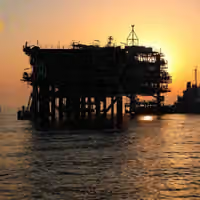
The P4 offshore platform at Iran’s Reshadat oil field in the Persian Gulf, completed in June 2026.
OPEC oil production continued its sharp post-war recovery in July, but Iran remained a notable exception, with output still around a quarter below pre-war levels and its oil revenues taking an even steeper hit.
Iran produced 2.478 million barrels per day (bpd) in July, up just 26,000 bpd from June, according to OPEC’s latest monthly report.
By contrast, Saudi Arabia increased output by about 590,000 bpd, Iraq by 665,000 bpd and Kuwait by 393,000 bpd. Combined crude production among OPEC members rose by about 1.66 million bpd in July to 23.63 million bpd.
Iran’s export revenues have recovered even more slowly.
Commodity intelligence firm Kpler told Iran International that daily deliveries of Iranian crude to Chinese refineries fell from more than 1.7 million bpd in March and April to less than 500,000 bpd in July.
Kpler said Iran offered its crude at a discount of more than $5 a barrel in July, while transportation costs exceeded $10 a barrel. Once payments to intermediaries were included, it estimated that at least 25% of the nominal value of Iran’s oil sales was lost before the proceeds reached the country.
At July’s export volumes, Kpler estimated that crude delivered to China had a nominal value of about $1.2 billion. That compares with average monthly oil revenues of about $3.8 billion last year, according to OPEC estimates.
China has long been overwhelmingly the largest destination for Iranian crude, leaving Tehran particularly exposed to changes in purchases by Chinese refineries.
Iran struggles to restore output
Iranian production fell by nearly 1 million bpd between the beginning of the Middle East war and May, according to OPEC figures.
Over the following two months, it recovered by only about 200,000 bpd, reaching 2.478 million bpd in July. The pace of that recovery slowed sharply last month, with the 26,000-bpd increase leaving production roughly a quarter below pre-war levels.
The figures contrast with the much faster restoration of production elsewhere in the Persian Gulf following the severe disruptions caused by the war.
Saudi Arabia, Iraq and Kuwait accounted for much of OPEC’s July increase as producers took advantage of the temporary ceasefire to restore output. Despite the rebound, regional production remains well below levels before the conflict, with large volumes of Persian Gulf supply still offline.
The contrast is even sharper with the United Arab Emirates, which left OPEC in May and has since sharply expanded production. OPEC continues to track UAE output in its monthly report despite its departure from the group.
OPEC estimates that UAE crude production reached around 3.78 million bpd in July, approximately 882,000 bpd above its level in the months preceding the war.
Venezuela also continued its recovery, with production reaching about 1.12 million bpd in July, up from around 940,000 bpd in January.
For Iran, however, the combination of depressed production, sharply lower deliveries to China and the costs associated with selling and transporting its crude means the financial recovery has lagged even further behind the rebound in output.