• العربية
  • فارسی
Brand
  • Iran Insight
  • Politics
  • Economy
  • Analysis
  • Special Report
  • Opinion
  • Podcast
  • Iran Insight
  • Politics
  • Economy
  • Analysis
  • Special Report
  • Opinion
  • Podcast
  • Theme
  • Language
    • العربية
    • فارسی
  • Iran Insight
  • Politics
  • Economy
  • Analysis
  • Special Report
  • Opinion
  • Podcast
All rights reserved for Volant Media UK Limited
volant media logo

IRGC says efforts to disarm Hamas doomed to fail

Aug 2, 2026, 15:00 GMT+1

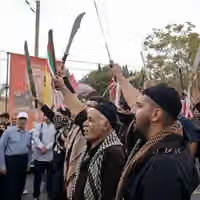
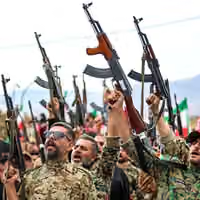
Iran’s Islamic Revolutionary Guard Corps (IRGC) said on Sunday that efforts to disarm Hamas had already failed, in a statement marking the second anniversary of Israel’s assassination of former Hamas political chief Ismail Haniyeh in Tehran.

“The final victory of Palestine” is closer than “the enemies imagine,” the statement said, describing Haniyeh’s killing while attending President Masoud Pezeshkian’s inauguration as an official guest as “a flagrant violation of the principles and norms of international law” and Iran’s sovereignty and territorial integrity.

Most Viewed

Ghalibaf reveals Tehran feared street unrest after Iran International broke Khamenei news
1

Ghalibaf reveals Tehran feared street unrest after Iran International broke Khamenei news

2
PODCAST

Iran's hangings are 'murders,' says former UN prosecutor

3
ANALYSIS

China helps Iran chip away at US air superiority despite Xi’s no-arms pledge

4

US tightens military and financial pressure as Iran talks falter

5

Iran ramps up threats to Mideast energy sites as fears of major US strike grow

Banner
Banner
Banner

Spotlight

  • China helps Iran chip away at US air superiority despite Xi’s no-arms pledge
    ANALYSIS

    China helps Iran chip away at US air superiority despite Xi’s no-arms pledge

  • Why Iran's leaders failed to see this generation coming
    INSIGHT

    Why Iran's leaders failed to see this generation coming

  • Security forces seized Iran hospital, sent wounded protesters to morgue
    EXCLUSIVE

    Security forces seized Iran hospital, sent wounded protesters to morgue

  • Where steak is a dream
    VOICES FROM IRAN

    Where steak is a dream

  • 'Western trap': calls for restraint grow in Tehran after Ukraine attack
    INSIGHT

    'Western trap': calls for restraint grow in Tehran after Ukraine attack

  • From cafes to buskers, Tehran tightens its grip on the fabric of everyday life

    From cafes to buskers, Tehran tightens its grip on the fabric of everyday life

•
•
•

More Stories

Iran ramps up threats to Mideast energy sites as fears of major US strike grow

Aug 1, 2026, 22:00 GMT+1
•
Maryam Sinaiee
100%
A composite satellite image shows trail of smoke rising from an oil facility, in Jizan, Jazan province, Saudi Arabia, July 26, 2026 after a Houthi attack.

Iranian officials on Saturday responded to reports of a possible large-scale US attack with threats to strike Israel and regional energy infrastructure, as public anxiety grows and motorists form long queues at gas stations.

Authorities and state-affiliated media reacted forcefully to reports in US media that President Donald Trump is considering a broad military campaign against Iran as early as this weekend amid escalating tensions over the Strait of Hormuz.

The Wall Street Journal and CNN reported that the White House has reviewed plans for large-scale strikes against Iran’s energy infrastructure, although Trump has not given final authorization and diplomacy remains an option.

US embassies across the Middle East, including in the UAE, Jordan, Iraq and Israel, urged Americans on Saturday to consider leaving the region or be prepared to depart if tensions escalate, warning of possible Iranian attacks, flight disruptions and airspace closures.

Israel also raised its defense alert level as an Israeli official told Channel 12 that Trump was closer than ever to approving a significant strike on Iran.

Tehran warns of devastating retaliation

Statements by Iranian officials and reports from outlets affiliated with the Revolutionary Guards indicate that Tehran is preparing for the possibility of a broad US military campaign.

Iran’s Foreign Ministry warned regional countries Saturday against allowing the United States and Israel to use their territory or facilities for attacks on Iran, saying Tehran would target the locations from which any such attacks were launched.

“The defensive strikes of our courageous armed forces continue at full force,” the ministry said, citing the naval blockade of Iranian ports and commercial shipping, attacks across the country, intensified economic pressure and unlawful threats.

Major General Ali Abdollahi, commander of Iran’s Khatam al-Anbiya Central Headquarters, also warned regional governments against supporting Washington.

“Any country that makes itself a defensive shield for criminal, aggressor America will burn in the fire of war,” he said.

Tasnim News Agency, citing what it described as a senior security official, said Iran had prepared “an extensive response” targeting “the Israeli regime’s vital infrastructure and America’s energy infrastructure in the region.”

Nour News, an outlet close to Iran’s Supreme National Security Council, described threats against Iranian infrastructure as “blackmail against global energy security” and warned that Saudi Arabia, Qatar, the United Arab Emirates and Israel could become targets if Iran’s energy facilities are attacked.

“The first missile will mark the beginning of a crisis that no one will be able to contain,” the outlet wrote.

Outreach to mediators

Iranian Foreign Minister Abbas Araghchi spoke Saturday with Pakistan’s army chief, Field Marshal Asim Munir, and the foreign ministers of Turkey and Saudi Arabia about regional developments and the risk of further escalation.

Araghchi warned that any new US or Israeli attack, or support from regional countries, would face a “decisive and proportionate response,” saying Iran was prepared to defend its sovereignty, territorial integrity and security. He added that those responsible would bear the consequences.

The warnings came as figures close to Iran’s political establishment portrayed the crisis as rooted in disputes that go well beyond the immediate military standoff. Ali Gholhaki, an activist close to Parliament Speaker Mohammad-Bagher Ghalibaf, said the conflict extends beyond maritime access or Iran’s frozen assets.

The United States is demanding a long-term—or even permanent—suspension of uranium enrichment and the transfer abroad of roughly 400 kilograms of enriched uranium, conditions Tehran refuses to accept, he wrote.

Gholhaki argued that even a large-scale conventional bombing campaign against Iran’s remaining nuclear facilities or attacks on the country’s energy infrastructure would be unlikely to alter Tehran’s strategic calculations.

“Conflict is inevitable. Escalation can only be avoided if one side makes a clear retreat,” he wrote.

Long fuel queues reflect public concern

The prospect of military escalation has also affected public sentiment.

Witnesses in Tehran reported unusually long queues at petrol stations amid rumors of a major US attack, while videos shared on social media showed motorists rushing to fill their tanks in anticipation of possible disruptions.

Social media users attributed the congestion largely to growing anxiety over the prospect of war.

Online debate exposes divisions

Iranian social media reflected both calls for retaliation and concern about the consequences of a regional war.

Ebrahim Rezaei, a hardline member of parliament’s National Security and Foreign Policy Committee, rejected suggestions that Iran could be subdued through a surprise attack.

“If Iran is struck, we will return the entire region and its facilities to the Stone Age,” he wrote, adding: “It is in your interest not to commit such stupidity.”

His remarks drew criticism from reformist journalist Mohammad Aghazadeh, who responded: “Even if that happens, what about the Iranian people? What about their own return to the Stone Age and their suffering?”

Another user questioned the logic of threatening neighboring Arab states, asking how mutual destruction would ultimately harm the United States or Israel.

Reformists urge diplomacy ‘before it is too late’

Several reformist commentators urged both sides to pursue negotiations before the conflict reaches an irreversible stage.

Journalist Mohammad Sohofi cautioned against both complacency and panic, writing that people should fear “the surrender of rational judgment to illusions” more than reports of US military plans.

Veteran journalist Ahmad Zeidabadi argued that the current moment may represent the last opportunity for diplomacy.

“If the dispute is to be resolved through negotiation and agreement, now is the time,” he wrote.

He warned that if Iran’s energy infrastructure is attacked and Tehran retaliates against regional energy facilities, “nothing will ever be the same again,” adding that people would experience “the kind of life previously depicted only in horror films.”

China helps Iran chip away at US air superiority despite Xi’s no-arms pledge

Aug 1, 2026, 21:00 GMT+1
•
Kerri Bitsoff
100%
President Donald J. Trump meets with President Xi Jinping in China, May 14, 2026.

Xi Jinping’s promise to Donald Trump that China would not arm Iran is being tested by Tehran’s alleged pursuit of Chinese MANPADS, relatively cheap weapons that could make future US and Israeli air campaigns more dangerous and expensive.

In April, an American F-15 fighter jet was shot down over southwestern Iran, likely by a Chinese-made shoulder-fired missile. Both crew members ejected and were rescued, one of them after two days on the ground in the foothills of the Zagros Mountains.

The loss was historic. No American fighter had been downed by enemy fire in decades.

Iran has reportedly been sourcing these weapons from China, through schemes Washington has been watching for months.

In early May the Treasury Department put one scheme on the public record, sanctioning a network of middlemen arming the Islamic Republic with Chinese weapons, including shoulder-fired missiles. Days later, President Trump traveled to Beijing for a state visit with Xi Jinping.

In late July, he told the public that Xi had personally assured him China would not, “under any circumstances,” sell weapons to the Islamic Republic.

Five days later Reuters reported that a Chinese company had agreed to supply the Islamic Republic with 300 to 400 shoulder-fired air defense missile systems in a deal worth $60 to $70 million.

While the two leaders met and traded assurances, the Islamic Republic appears to have kept buying, likely working several supply channels at once.

The reported deal could help the Islamic Republic close a dangerous gap at exactly the wrong time for Washington. During the 12-day war in June 2025, Israeli aircraft operated over Iran almost at will after the opening strikes severely damaged the country’s air-defense network. The United States later joined the campaign with strikes on Iran’s nuclear facilities.

A shoulder-fired missile will lose most encounters with a modern fighter, but it only has to win occasionally. After the April shootdown, every pilot flying low over Iran has to assume there may be a missile team underneath him, so planners may fly higher or less often, and spend more time and aircraft clearing threats before anyone goes in.

It’s the same effect CIA-supplied Stinger missiles had during the Soviet–Afghan War after 1986, when they made low-altitude flying dangerous enough to force Soviet pilots to change their tactics.

We’ve already seen the effect of this strategy at sea, where the Islamic Republic’s missiles, mines and drones along the Strait of Hormuz have sunk few ships yet collapsed traffic and multiplied insurance costs.

These missiles reach only a few thousand meters into the sky. They cannot touch high-flying aircraft or ballistic missiles, and they will not rebuild the air defense shield the Islamic Republic lost. What they will do is make low-altitude missions—including helicopter operations and some strike and support flights—riskier and more expensive

Since the ceasefire, Basij and Revolutionary Guard units around the country have been training with shoulder-fired air-defense weapons. They also won’t all stay in Iran.

Iran has previously been accused of supplying MANPADS to allied armed groups like the Houthis and Hezbollah, raising the risk that some systems could leave the country. Shoulder-fired missiles have also posed a longstanding threat to civilian aviation worldwide.

China’s answer to all of this has been denial. When NBC reported that a Chinese missile likely downed the F-15, Beijing dismissed the reporting as a groundless smear. When Reuters described the new deal in July, the foreign ministry called it “completely groundless” as well.

Reuters reports that the contract runs through a company registered in Hong Kong and that the missiles are set to travel from Urumqi in western China through Pakistan into Iran. Pakistan, which brokered April’s ceasefire, denies any role.

Strategic credulity?

Trump has taken America’s adversaries at their word before. Xi told him China would not arm the Islamic Republic, and he repeated the assurance to the public as though it settled the matter.

When Volodymyr Zelensky said in late July that Russia was feeding the Islamic Republic satellite imagery to help target American bases, Trump said he would ask Putin about it. He says what he says with a purpose.

Repeating Xi’s promise keeps the relationship warm and the Washington visit on track, while his own government sanctions the middlemen and works to stop the shipments. The message serves diplomacy and the action deals with the missiles, and he sees no contradiction in running both at once.

The Islamic Republic never puts all its eggs in one basket. Washington got ahead of one channel, and we are starting to see the others. The network Treasury sanctioned in May ran through Hong Kong, Belarus and Dubai, while the reported July deal runs through a different Hong Kong company and a different route, through Pakistan.

As the reported Chinese deals advanced, Tehran also signed an agreement with Russia, as reported by the Financial Times, for roughly half a billion euros’ worth of Verba shoulder-fired missiles.

Every route runs at once, and the Islamic Republic plans on losing a few. The first Chinese shipment is said to be weeks away. It should be one that the Islamic Republic loses.

Ghalibaf reveals Tehran feared street unrest after Iran International broke Khamenei news

Aug 1, 2026, 09:50 GMT+1
100%
Late Iranian Supreme Leader Ali Khamenei (L) with parliament speaker Mohammad Bagher Ghalibaf.

Iranian parliament speaker Mohammad Bagher Ghalibaf said authorities rushed to announce Ali Khamenei’s death and call supporters onto the streets after “overseas media” broke the news, fearing the situation on the streets could otherwise “take a completely different turn.”

By “overseas media,” Ghalibaf was referring to Persian-language outlets based outside Iran, a term Iranian officials sometimes use to refer to such broadcasters. Iran International was the first outlet to announce Khamenei’s death.

Ghalibaf said officials had initially decided to wait until 8 a.m. the following morning, when they planned to announce his death alongside the formation of a new Leadership Council.

“At 12:30 at night, the television channels abroad announced the martyrdom,” Ghalibaf said, adding that he and Ali Larijani re-established contact around 1 a.m. and decided the original plan could no longer stand.

Officials feared losing control of the streets

Ghalibaf said officials instead decided to announce Khamenei’s death around dawn, while people were eating their pre-dawn Ramadan meal, and immediately call supporters onto the streets.

“We decided that we absolutely had to announce it at dawn, when people were at the suhoor table, and at the same time say: whether you’ve eaten or not, everyone come out into the streets,” he said.

“Otherwise, believe me, the situation in the streets could have taken a completely different turn,” Ghalibaf added.

He described the street as one of four fronts that authorities needed to manage alongside the military, diplomacy and government services. “The military front is one front, diplomacy is one front, services are another, and the street is also a front,” he said.

Street pressure later turned on Ghalibaf

The comments shed new light on the government’s efforts to mobilize supporters immediately after Khamenei’s death. But some of the hardline demonstrators who took to the streets later turned their anger on Ghalibaf and other officials over negotiations with Washington.

The street criticism echoed a revolt among a small but vocal group of ultraconservative lawmakers, who accused Ghalibaf, Iran’s chief negotiator in talks with the United States, of crossing leadership red lines and shielding the negotiations from parliamentary scrutiny.

Iran's hangings are 'murders,' says former UN prosecutor

Aug 1, 2026, 03:37 GMT+1
•
Negar Mojtahedi
100%

Iran's latest wave of public hangings of protesters amounts to "killings" and "murders" that form part of a continuing crime against humanity, former United Nations prosecutor Professor Payam Akhavan told Iran International's Eye for Iran.

His comments came days after Iran publicly hanged two protesters in the central city of Isfahan, prompting renewed international condemnation and a rare display of public defiance.

He argued that the executions cannot be separated from the mass killing of protesters during January's nationwide uprising.

"There is no doubt that we have a crime against humanity," Akhavan told Eye for Iran.

“What we actually have in Iran are arbitrary executions. These are killings. They are murders,” Akhavan said. "Specifically, the case can be made that this is a crime of extermination, given the large scale of the killings."

Akhavan, who testified before the UN Human Rights Council during its January special session on Iran, said the scale and method of the killings could support the more specific charge of extermination.

The crime against humanity of extermination involves mass or large-scale killing. Unlike genocide, it does not require proof that the perpetrators intended to destroy a protected national, ethnic, racial or religious group.

Public hangings provoke defiance in Isfahan

Iran publicly hanged Amirhossein Safari and Abolfazl Sepahi on July 28 in Isfahan's Alikhani Square after accusing them of involvement in the killing of four police officers during the January 8 unrest.

The two men were among a group sentenced to death in connection with the case. Golmohammad Mohammadi and Erfan Esfandiari were executed in prison on July 19, while eight others reportedly remain under sentence of death.

The judiciary says Safari and Sepahi took part in the killings. Rights groups, however, have raised serious concerns about the proceedings, including restrictions on access to lawyers and case files, the rejection of potentially exculpatory evidence and the use of televised confessions that may have been obtained under coercion.

UN human rights experts called on Iran to halt the executions one day before the hangings, warning that coerced confessions must not be admitted as evidence and that broadcasting them before trial violates the presumption of innocence.

Rather than intimidating the public into silence, the hangings triggered a rare display of defiance.

Hundreds of people gathered near the execution site before dawn. Videos showed crowds booing police and chanting “shame on you” as the call to prayer rang out. Security forces later dispersed them through surrounding streets, with witnesses reporting the use of tear gas, Tasers and warning shots.

An online campaign opposing the death penalty was shared hundreds of thousands of times within a day. At Ghezel Hesar prison near Tehran, an estimated 1,500 death-row prisoners also staged a hunger strike as part of the “No to Executions” campaign.

“A death sentence which is carried out without any due process and on legal grounds that are entirely unacceptable is not really a lawful execution,” he said. “It becomes a form of murder or extrajudicial execution.”

International human rights law permits capital punishment only for the most serious crimes in countries that have not abolished it and only following strict respect for due process.

Akhavan said many of Iran’s death sentences instead rely on vague national-security charges, including moharebeh, or “waging war against God,” as well as forced confessions and trials in courts that cannot be considered independent or impartial.

“What we’re witnessing today in this surge in executions is not an isolated phenomenon,” Akhavan said. “It is inextricably connected with the events of January and it is really a continuation of the same criminal transaction.”

Article 7 of the Rome Statute defines crimes against humanity as certain acts committed as part of a widespread or systematic attack directed against a civilian population.

From January’s massacre to extermination

The UN Independent International Fact-Finding Mission on Iran previously concluded that serious violations committed during the 2022 Woman, Life, Freedom uprising amounted to crimes against humanity.

Its investigation into the January 2026 crackdown is ongoing. Akhavan acknowledged that the mission must complete its own investigation before issuing formal conclusions, but said his legal assessment is clear.

He cited the internet blackout, restrictions on reporting, allegations that hospitals were pressured to record gunshot deaths as natural causes and accounts of bodies being transported in refrigerated trucks and potentially buried in unmarked graves.

He also pointed to statements by senior Iranian officials depicting protesters as combatants, foreign agents or people “waging war against God,” language he said effectively created a licence to kill.

There is also evidence of snipers, heavy machine guns and armour-piercing ammunition being used against unarmed protesters.

“The case can be made that this is a crime of extermination, given the large scale of the killings.”

Executions as a display of control

Iran carried out at least 2,159 executions in 2025, Amnesty International has said, most in drug-related cases.

Since the January uprising, rights groups have documented a sharp increase in politically motivated executions. Amnesty says at least 52 people have been arbitrarily executed this year for alleged offences connected to the protests following torture-tainted and grossly unfair Revolutionary Court proceedings. At least 60 others remain at risk, including three who were children at the time of their alleged offences.

Public political executions remain comparatively rare. The last widely reported case was the 2022 hanging of Majidreza Rahnavard during the Woman, Life, Freedom uprising.

Akhavan said the return of cranes as public gallows was therefore particularly shocking and appeared designed to project strength and frighten a population that continues to challenge the state.

“Under cover of war, they are escalating executions in order to create fear,” he said.

“The biggest threat to the Islamic Republic is not the US and Israeli military operations, as damaging and unlawful as they may be. It is the Iranian people first and foremost.”

The authorities have now expanded their pressure beyond those facing execution. Tehran’s prosecutor has opened cases against an unspecified number of people accused of opposing executions or supporting defendants linked to the January uprising and the recent war.

US tightens military and financial pressure as Iran talks falter

Aug 1, 2026, 00:46 GMT+1
100%
US President Donald Trump speaks during the first televised Cabinet meeting at Camp David, flanked by Secretary of State Marco Rubio and Defense Secretary Pete Hegseth, July 31, 2026.

The Trump administration on Friday outlined military and financial measures against Tehran alongside negotiations that President Donald Trump said were being undermined by Iran’s conduct.

Speaking during the first televised Cabinet meeting at Camp David, Trump, Defense Secretary Pete Hegseth and Treasury Secretary Scott Bessent addressed continued talks, military action aimed at preventing Iran from obtaining a nuclear weapon and a worldwide search for assets linked to its government.

Talks continue as trust erodes

Trump said negotiations with Iran were continuing but that he was “losing faith” in Tehran because “they do lie” and “they do misrepresent.”

“They always want to talk, but they break their words so often,” he said.
Trump said Steve Witkoff, Jared Kushner, Vice President JD Vance and Secretary of State Marco Rubio were involved in the talks. “We have great people talking,” he added.

He said five missiles were fired at a US base in Jordan while negotiations were underway.

“Instead, I got a call from Pete that they just shot five missiles at one of our bases in Jordan,” Trump said.

Asked whether the attacks could continue, Trump said: “I think I’m going to be foolish to say no. You always have to keep your guard up.”

“They get weaker. They get a little stronger, maybe now, but they’ll get weaker, and then they peter out,” he added.

Military pressure and nuclear sites

Hegseth praised Trump for having “the courage to do Midnight Hammer and conclude the 12-day war by obliterating their nuclear sites.”

He said previous presidents had considered such action but “never pulled the trigger because of the complications, because of the challenge, and because of the risk.”

Hegseth said Trump remained committed to ensuring Iran never obtained a nuclear weapon and praised his willingness to negotiate with people who had “shown no willingness to do so honestly.”

Diplomacy under pressure

As hopes for diplomacy flicker, the United States is increasing military and economic pressure on Tehran while Trump and Hegseth continue to voice confidence in the US negotiating team.

“We have great people talking,” Trump said. “We have the best negotiators in the world,” Hegseth added.