• العربية
  • فارسی
Brand
  • Iran Insight
  • Politics
  • Economy
  • Analysis
  • Special Report
  • Opinion
  • Podcast
  • Iran Insight
  • Politics
  • Economy
  • Analysis
  • Special Report
  • Opinion
  • Podcast
  • Theme
  • Language
    • العربية
    • فارسی
  • Iran Insight
  • Politics
  • Economy
  • Analysis
  • Special Report
  • Opinion
  • Podcast
All rights reserved for Volant Media UK Limited
volant media logo
PODCAST

Iran's hangings are 'murders,' says former UN prosecutor

Negar Mojtahedi
Negar Mojtahedi

Iran International

Aug 1, 2026, 03:37 GMT+1

Iran's latest wave of public hangings of protesters amounts to "killings" and "murders" that form part of a continuing crime against humanity, former United Nations prosecutor Professor Payam Akhavan told Iran International's Eye for Iran.

His comments came days after Iran publicly hanged two protesters in the central city of Isfahan, prompting renewed international condemnation and a rare display of public defiance.

He argued that the executions cannot be separated from the mass killing of protesters during January's nationwide uprising.

"There is no doubt that we have a crime against humanity," Akhavan told Eye for Iran.

“What we actually have in Iran are arbitrary executions. These are killings. They are murders,” Akhavan said. "Specifically, the case can be made that this is a crime of extermination, given the large scale of the killings."

Akhavan, who testified before the UN Human Rights Council during its January special session on Iran, said the scale and method of the killings could support the more specific charge of extermination.

The crime against humanity of extermination involves mass or large-scale killing. Unlike genocide, it does not require proof that the perpetrators intended to destroy a protected national, ethnic, racial or religious group.

Public hangings provoke defiance in Isfahan

Iran publicly hanged Amirhossein Safari and Abolfazl Sepahi on July 28 in Isfahan's Alikhani Square after accusing them of involvement in the killing of four police officers during the January 8 unrest.

The two men were among a group sentenced to death in connection with the case. Golmohammad Mohammadi and Erfan Esfandiari were executed in prison on July 19, while eight others reportedly remain under sentence of death.

The judiciary says Safari and Sepahi took part in the killings. Rights groups, however, have raised serious concerns about the proceedings, including restrictions on access to lawyers and case files, the rejection of potentially exculpatory evidence and the use of televised confessions that may have been obtained under coercion.

UN human rights experts called on Iran to halt the executions one day before the hangings, warning that coerced confessions must not be admitted as evidence and that broadcasting them before trial violates the presumption of innocence.

Rather than intimidating the public into silence, the hangings triggered a rare display of defiance.

Hundreds of people gathered near the execution site before dawn. Videos showed crowds booing police and chanting “shame on you” as the call to prayer rang out. Security forces later dispersed them through surrounding streets, with witnesses reporting the use of tear gas, Tasers and warning shots.

An online campaign opposing the death penalty was shared hundreds of thousands of times within a day. At Ghezel Hesar prison near Tehran, an estimated 1,500 death-row prisoners also staged a hunger strike as part of the “No to Executions” campaign.

“A death sentence which is carried out without any due process and on legal grounds that are entirely unacceptable is not really a lawful execution,” he said. “It becomes a form of murder or extrajudicial execution.”

International human rights law permits capital punishment only for the most serious crimes in countries that have not abolished it and only following strict respect for due process.

Akhavan said many of Iran’s death sentences instead rely on vague national-security charges, including moharebeh, or “waging war against God,” as well as forced confessions and trials in courts that cannot be considered independent or impartial.

“What we’re witnessing today in this surge in executions is not an isolated phenomenon,” Akhavan said. “It is inextricably connected with the events of January and it is really a continuation of the same criminal transaction.”

Article 7 of the Rome Statute defines crimes against humanity as certain acts committed as part of a widespread or systematic attack directed against a civilian population.

From January’s massacre to extermination

The UN Independent International Fact-Finding Mission on Iran previously concluded that serious violations committed during the 2022 Woman, Life, Freedom uprising amounted to crimes against humanity.

Its investigation into the January 2026 crackdown is ongoing. Akhavan acknowledged that the mission must complete its own investigation before issuing formal conclusions, but said his legal assessment is clear.

He cited the internet blackout, restrictions on reporting, allegations that hospitals were pressured to record gunshot deaths as natural causes and accounts of bodies being transported in refrigerated trucks and potentially buried in unmarked graves.

He also pointed to statements by senior Iranian officials depicting protesters as combatants, foreign agents or people “waging war against God,” language he said effectively created a licence to kill.

There is also evidence of snipers, heavy machine guns and armour-piercing ammunition being used against unarmed protesters.

“The case can be made that this is a crime of extermination, given the large scale of the killings.”

Executions as a display of control

Iran carried out at least 2,159 executions in 2025, Amnesty International has said, most in drug-related cases.

Since the January uprising, rights groups have documented a sharp increase in politically motivated executions. Amnesty says at least 52 people have been arbitrarily executed this year for alleged offences connected to the protests following torture-tainted and grossly unfair Revolutionary Court proceedings. At least 60 others remain at risk, including three who were children at the time of their alleged offences.

Public political executions remain comparatively rare. The last widely reported case was the 2022 hanging of Majidreza Rahnavard during the Woman, Life, Freedom uprising.

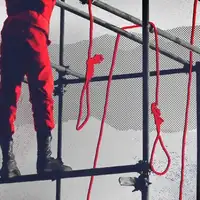
Akhavan said the return of cranes as public gallows was therefore particularly shocking and appeared designed to project strength and frighten a population that continues to challenge the state.

“Under cover of war, they are escalating executions in order to create fear,” he said.

“The biggest threat to the Islamic Republic is not the US and Israeli military operations, as damaging and unlawful as they may be. It is the Iranian people first and foremost.”

The authorities have now expanded their pressure beyond those facing execution. Tehran’s prosecutor has opened cases against an unspecified number of people accused of opposing executions or supporting defendants linked to the January uprising and the recent war.

Most Viewed

US offers $15 million reward over IRGC drone network
1

US offers $15 million reward over IRGC drone network

2

Trump likely to expand strikes on Iran rather than withdraw, ex-Pentagon official says

3

From cafes to buskers, Tehran tightens its grip on the fabric of everyday life

4
INSIGHT

'Western trap': calls for restraint grow in Tehran after Ukraine attack

5

Iranian agents cut protester's royalist tattoos before killing him

Banner
Banner
Banner

Spotlight

  • Why Iran's leaders failed to see this generation coming
    INSIGHT

    Why Iran's leaders failed to see this generation coming

  • Security forces seized Iran hospital, sent wounded protesters to morgue
    EXCLUSIVE

    Security forces seized Iran hospital, sent wounded protesters to morgue

  • Where steak is a dream
    VOICES FROM IRAN

    Where steak is a dream

  • 'Western trap': calls for restraint grow in Tehran after Ukraine attack
    INSIGHT

    'Western trap': calls for restraint grow in Tehran after Ukraine attack

  • Iran government pushes talks line, but power lies elsewhere
    INSIGHT

    Iran government pushes talks line, but power lies elsewhere

  • What does Trump mean by 'finish the job' in Iran?
    ANALYSIS

    What does Trump mean by 'finish the job' in Iran?

•
•
•

More Stories

Why Iran's leaders failed to see this generation coming

Jul 31, 2026, 21:12 GMT+1
•
Behrouz Turani
100%
Thousands gathered in Tehran's biggest mall to meet YouTuber Nima Tekido, July 25, 2026

A gathering of thousands of teenagers at a Tehran mall to meet a popular YouTuber exposed a widening blind spot in Iran, some sociologists suggested: a generation whose values, social lives and sources of authority increasingly lie beyond the state's understanding.

The chaotic gathering at the luxury shopping complex, where teenagers and young adults—predominantly from Generation Z and Generation Alpha—assembled to meet content creator Nima Tekedo, triggered widespread debate across Iranian media and academic circles.

Although officials were forced to confront Generation Z during the nationwide protests of 2022, several sociologists argue that Generation Alpha remains almost entirely outside the state's field of vision.

Moderate daily Shargh and centrist newspaper Sazandegi both argued that the surprise surrounding the Iran Mall incident reflected a deeper failure to understand younger Iranians.

They warned that repeatedly overlooking new generations had already left authorities unprepared for successive waves of unrest since 2017 and cautioned that the same blind spot persists today.

The gathering had been publicly announced on YouTube, Telegram and Instagram, yet authorities appeared unaware that thousands would attend.

A parallel universe

Sociologist Nima Shojaei told Shargh that over the past two decades traditional forms of political participation, including elections, campaigns and party politics, had steadily lost their appeal among young Iranians, while their social lives increasingly unfolded beyond the state's view.

He argued that reference groups had shifted dramatically, leaving the government unable to understand the evolving identities of younger generations.

Shojaei also pointed to the contradictions of a state that continues to portray all Iranian youth through an ideological lens—via state media, school textbooks and Friday prayer sermons—as devout Muslims committed to official values.

Believing its own narrative, he argued, the state gradually lost sight of the society it sought to govern.

The Iran Mall gathering, Shojaei said, was neither a political protest nor an act of resistance. Rather, it reflected a generation retreating into everyday life after losing faith in conventional politics.

‘Gen Z charting its course’

Another sociologist, Foad Habibi, criticized commentators who responded by blaming or mocking teenagers instead of examining broader social change.

"Attacking powerless youth is the cheapest form of analysis because it carries no personal cost, whereas criticizing state power does," he said.

Habibi agreed that the problem lay not with young people themselves.

"Generation Z has not erred; it has simply charted its own course and moved forward. The failure lies with policymakers and social scientists," he said.

Sazandegi argued that the incident highlighted a broader shift in cultural authority from formal institutions to decentralized online networks.

The paper pointed to similar episodes that had repeatedly caught authorities off guard, including a large gathering in Tehran Pars in 2024 to see hip-hop artist GodPouri.

Unlike traditional mobilization built around parties or hierarchical organizations, the newspaper argued, today's youth assemble rapidly through shared online interests and peer-to-peer communication.

What appears to older generations as a spontaneous crowd is, in reality, a highly networked social world capable of mobilizing thousands within hours.

For Sazandegi, the Iran Mall gathering was therefore less about a celebrity appearance than a glimpse of a generation that no longer looks to political parties, religious institutions or state media for authority, but chooses its own communities, its own heroes and increasingly, its own way of life.

Security forces seized Iran hospital, sent wounded protesters to morgue

Jul 31, 2026, 19:21 GMT+1
•
Farnoosh Faraji
100%

Iranian security forces took control of a hospital in the western city of Khorramabad during January's nationwide crackdown, according to medical staff, transferring dozens of critically wounded protesters to the morgue instead of receiving further treatment.

More than 200 bodies passed through Shohadaye Ashayer Hospital during the crackdown, according to an Iran International investigation based on more than two dozen sources, including medical personnel, eyewitnesses and people close to victims' families, as well as hospital records and videos obtained from inside the facility.

One eyewitness said at least 70 critically wounded protesters who could have been saved were transferred to the morgue instead of receiving further treatment.

Others were removed from treatment wards by security personnel before later reappearing in the morgue with fresh gunshot wounds to the upper body or what staff described as "finishing shots."

Iran International has so far verified the identities of 23 people killed in the city.

Hospital under siege

According to a member of the hospital's medical staff, Shohadaye Ashayer became the only hospital authorized to treat people wounded during the crackdown.

Armed security forces surrounded the hospital while police, intelligence officers and other security personnel operated inside the building. Officers stood over doctors and nurses as they treated patients, confiscated staff mobile phones and prevented them from contacting their families.

Hospital staff were effectively confined inside the facility for three days, the medical worker said. Several employees were arrested, while security forces moved through treatment wards identifying wounded protesters for detention.

Videos obtained by Iran International show dozens of bloodied bodies, many naked or partially unclothed, lying uncovered across the morgue floor and an adjoining room.

Some still had oxygen tubes in their mouths and electrocardiogram pads attached, suggesting they had been receiving treatment before being moved.

Several appeared to have been shot directly in the forehead, while others were covered with pellet wounds. Some had suffered catastrophic head injuries, with parts of their skulls missing. Several bodies also showed severe injuries to the genital area.

Some remained handcuffed despite bearing fatal gunshot wounds.

From operating room to morgue

Eyewitnesses described the hospital as overwhelmed, with blood covering corridors and bodies filling both the courtyard and the morgue. Multiple witnesses estimated that between 200 and 250 bodies passed through the hospital during the crackdown.

A student at Khorramabad University of Medical Sciences who witnessed patients arriving at the hospital described a similar pattern.

According to the student, wounded protesters repeatedly arrived alive on January 8 and 9, only for their deaths to be announced around 20 minutes after they had been taken into operating rooms. The student said the pattern was repeated across numerous patients.

The student also recalled a protester admitted on January 22 with extensive pellet wounds and a severe infection. Before treatment could be completed, security forces removed the patient from the hospital despite objections from the attending physician and took them to an unknown location.

Crackdown beyond the hospital

Witnesses said protests spread across much of Khorramabad on January 8 and 9, drawing tens of thousands of people into the streets.

They described security forces firing military-grade weapons, sniper rifles, shotguns and pellet guns at demonstrators, with several witnesses saying protesters were deliberately shot in the head and chest.

One witness said they personally saw at least five people killed after being struck from behind by bursts of gunfire.

Witnesses said security forces prevented many wounded protesters from reaching medical care, leaving some to bleed to death in the streets. Those who managed to reach Shohadaye Ashayer Hospital remained at risk of arrest, abduction or forced removal.

Witnesses also described an internet shutdown, movement restrictions and the widespread deployment of plainclothes officers, the Basij, the Revolutionary Guards and police units throughout the city.

Families under pressure

Eyewitnesses said bodies accumulated in the courtyard of Shohadaye Ashayer Hospital on January 9 while Basij forces prevented relatives from approaching them.

Some families removed the bodies of loved ones immediately, fearing security forces would seize them.

Among the victims whose identities Iran International has verified was Hossein Yaghmaei, who died after being shot and taken to a nearby home.

Retired municipal employee Hojjat Ahmadian was also among those killed. People familiar with his case said authorities pressured his family to record his death as suicide to avoid losing his pension.

Iran gambling network helped channel $4 billion through crypto exchange - Reuters

Jul 31, 2026, 10:38 GMT+1
100%
Playing cards, poker chips and dice are seen in this file image.

An illicit Iranian gambling network helped move at least $4 billion through an unlicensed Dubai-based cryptocurrency exchange that also handled funds for sanctioned Iranian institutions, a Reuters investigation found.

Blockchain data reviewed by Reuters showed the exchange, Shelbit, processed money for a Farsi-language gambling network spanning more than 2,000 websites. It also interacted with Iran's central bank, the sanctioned Iranian exchange Nobitex and wallets that Israel has linked to the Islamic Revolutionary Guard Corps.

Reuters traced tens of millions of dollars from the gambling network through Shelbit and found that at least $676 million moved from Shelbit-linked addresses to Binance, the world's largest crypto exchange, since May 2024.

Links to sanctioned entities

Shelbit processed at least $125 million connected to Iran's central bank and received funds from what blockchain investigators described as an Iranian bitcoin-mining operation, according to data reviewed by Reuters.

The exchange also handled money connected to gambling websites promoted by Iranian influencers Sasha Sobhani and Pooyan Mokhtari. Both men denied knowledge of Shelbit or any involvement in sanctions evasion, money laundering or transactions on behalf of Iranian state institutions.

Reuters found that the IRGC took control of major gambling websites accessible inside Iran years ago and used them to move money abroad. The news agency could not establish whether the Guards directly controlled Shelbit or the wider gambling network, or determine where much of the money ultimately went.

Dubai regulator takes action

Dubai's Virtual Assets Regulatory Authority said it had previously taken enforcement action against Shelbit for operating without a license. On July 24, it ordered the exchange to halt all unlicensed activity, citing concerns over money laundering, terrorism financing and cross-border transactions.

Shelbit's registered office was listed above a budget hotel in Dubai, but people working at the address told Reuters they had never heard of the company. The exchange no longer has an operating website and there is no apparent way for members of the public to use it.

Binance said Shelbit had never held an account on its platform and that transactions associated with it were not initially judged to be high risk. It said relevant accounts were investigated, frozen and reported to law enforcement.

Shelbit founder Siavash Kayvanpour, the Iranian government and the IRGC did not respond to Reuters requests for comment.

'Western trap': calls for restraint grow in Tehran after Ukraine attack

Jul 31, 2026, 00:17 GMT+1
•
Maryam Sinaiee
100%
Smoke rises from a warehouse of Russian online retailer Wildberries that the Regional Governor Oleg Melnichenko says is following a Ukranian drone attack, in Priovrazhnoe, Penza Region, Russia, July 30, 2026 in this screengrab taken from a social media video.

Signs of reluctance to widen the conflict are emerging in Tehran, with conservative politicians and media urging restraint even as they accuse the United States and Israel of orchestrating Ukraine's attack on an Iranian vessel.

The New York Times reported Wednesday that Iran had considered retaliating by striking a Ukrainian port before diplomatic efforts helped defuse the crisis, reinforcing the impression that, despite its rhetoric, Tehran is seeking to avoid opening another front.

Establishment figures have largely portrayed the attack as part of a broader US and Israeli effort to widen the conflict, warning Tehran against responding in a way that would play into that strategy.

Mohsen Sani, a member of parliament's National Security and Foreign Policy Committee, argued that the attack on the Iranian vessel and recent strikes against Iraq's Popular Mobilization Forces should be viewed within the same strategic framework.

"The United States is trying to pursue its objectives through proxy actors such as Ukraine and Saudi Arabia," he told the conservative news website Tabnak.

‘International dimension’

Former Iranian ambassador to Kuwait Mohammad Irani likewise accused Israel of encouraging Kyiv to open a new front against Tehran.

"The coming together of Netanyahu and Zelensky, in my view, represents the formation of a new front of confrontation or preparations for a new regional order," he told ILNA.

Irani nevertheless argued that Tehran should avoid creating conditions that would draw additional countries into the conflict.

"Because of pressure from Trump, Israel's hands are temporarily tied. They therefore want to bring another party into the confrontation so that the conflict expands beyond the region and acquires an international dimension," he said.

"If an immediate response is considered, every possible consequence and every option that could be used against us must also be taken into account so that the opposing side does not achieve greater cohesion."

A Western trap

Nour News, a media outlet closely aligned with Iran's Supreme National Security Council, argued that Ukraine's actions formed part of a coordinated US strategy stretching "from Yemen to the Caspian Sea," designed to increase pressure on Iran while allowing Israel time to recover militarily and politically.

In a separate editorial, the outlet argued Kyiv's subsequent diplomatic outreach—including Foreign Minister Andrii Sybiha's assurances to Abbas Araghchi that Ukraine sought no escalation—reflected concern over Iran's deterrence capabilities rather than a genuine attempt at reconciliation.

The conservative daily Resalat likewise argued Washington was attempting to use Ukraine as another proxy against Iran while warning that escalation in the Caspian Sea could ultimately draw Russia more directly into the conflict.

The moderate conservative newspaper Jomhouri-ye Eslami similarly urged Tehran not to fall into what it described as a Western trap, arguing that reducing tensions with Kyiv would better serve Iran's interests than opening another front.

Little appetite for escalation

Javid Ghorbanoghli, Iran's former ambassador to South Africa, said another Ukrainian attack was unlikely, arguing that Tehran had already signalled it would respond to any repeat incident.

"It is highly unlikely that Tehran seeks to expand the war," he said. "Iran prefers not to allow its already tense relations with European countries to deteriorate even further."

He added that Iran's political establishment was trying to avoid opening new fronts that could generate additional political and economic pressure.

Russia analyst Rouhollah Modabber argued the attack was intended to disrupt the International North-South Transport Corridor and undermine Iran's economic cooperation in the Caspian region.

He also claimed President Volodymyr Zelensky publicly accepted responsibility in an effort to secure additional US military and financial support.

State TV dispute exposes limits of oversight in Iran

Jul 30, 2026, 22:10 GMT+1
•
Behrouz Turani
100%
The headquarters of Iran's state broadcaster, IRIB in northern Tehran, undated file photo

Iran's state broadcaster has ignored a formal order from its own watchdog to stop censoring senior officials, highlighting the gap between the country's formal institutions and where authority is exercised in practice.

The Islamic Republic of Iran Broadcasting (IRIB) has refused to comply with a ruling by the IRIB Supervisory Board ordering it to stop censoring President Massoud Pezeshkian, Foreign Minister Abbas Araghchi, Parliament Speaker and chief nuclear negotiator Mohammad Bagher Ghalibaf.

The dispute has drawn criticism from government officials and reformist and moderate newspapers while prompting little public sympathy.

Instead, many Iranians mocked the complaints, saying state television had long ignored ordinary people and was now simply extending the same treatment to members of the political establishment.

Before the Supervisory Board issued its ruling, government spokeswoman Fatemeh Mohajerani said the public expected the national broadcaster to uphold professional ethics, democratic principles and the national interest.

"All tastes and viewpoints must be reflected in the national broadcaster's narrative," she said.

Little public sympathy

On social media, many users joked that it was refreshing to see senior officials finally experiencing the neglect ordinary citizens had long endured from state television.

A Tehran-based journalist summed up the mood more bluntly, saying most people did not care whether politicians appeared on television; they wanted to see themselves and their own problems reflected instead.

For years, many Iranians have complained that IRIB neither reflects their lives nor represents their concerns.

Critics say television dramas rarely portray people like themselves, while supposedly spontaneous interviews on political and social issues feature only carefully selected voices. Others note that cooking programmes routinely feature meals beyond the reach of many families.

Meanwhile, IRIB responded to Araghchi's complaint with a sarcastic remark, saying it was "impossible to give him 24/7 coverage."

A watchdog without teeth

Earlier this week, the IRIB Supervisory Board formally warned the broadcaster over its repeated censorship of senior officials.

Board secretary Mohammad Mirzaei said "necessary cautions were issued" and that IRIB had pledged to implement reforms and prevent similar incidents from recurring. Deputy political director Hassan Abedini also publicly promised fairer coverage of officials' remarks and activities.

Yet the broadcaster showed no sign of changing course, declining even to report the Supervisory Board's meeting—a story carried by nearly every major Iranian news agency.

Established under Article 175 of Iran's Constitution, the Supervisory Board brings together representatives of the executive, parliament and judiciary to oversee IRIB's editorial conduct.

It can issue warnings, but ultimate authority over the broadcaster, including appointing its chief, rests with the Supreme Leader.

Current IRIB chief Payman Jebelli and his management team have long faced criticism over partisan editorial policies, discrimination and censorship directed at both ordinary citizens and politicians outside the ultraconservative camp.

Leadership under scrutiny

Jebelli's five-year term expires in less than a month, raising questions over whether Supreme Leader Mojtaba Khamenei will retain the current management or appoint a new leadership team.

The latest dispute comes amid an unusually coordinated campaign by media close to the Pezeshkian administration.

Last week, the reformist dailies Etemad and Shargh, together with the government's own newspaper Iran, accused IRIB of systematically censoring senior officials and promoting voices at odds with government policy.

Iran newspaper also alleged that the broadcaster censored remarks by Judiciary Chief Gholamhossein Mohseni Ejei praising Pezeshkian.

The episode has exposed more than a dispute over television coverage. It has highlighted the growing gap between Iran's formal institutions and the centres of authority that increasingly operate beyond their reach.