• العربية
  • فارسی
Brand
  • Iran Insight
  • Politics
  • Economy
  • Analysis
  • Special Report
  • Opinion
  • Podcast
  • Iran Insight
  • Politics
  • Economy
  • Analysis
  • Special Report
  • Opinion
  • Podcast
  • Theme
  • Language
    • العربية
    • فارسی
  • Iran Insight
  • Politics
  • Economy
  • Analysis
  • Special Report
  • Opinion
  • Podcast
All rights reserved for Volant Media UK Limited
volant media logo

Iran says navy air defense officer killed in attack near Strait of Hormuz

Jul 12, 2026, 08:55 GMT+1

An Iranian navy air defense officer was killed during attacks on the southern county of Jask early on Sunday, the Rokna news website reported.

The officer, Hamidreza Dehghan, was killed while carrying out a defensive mission during US attacks.

Most Viewed

Ali Khamenei was killed at meeting on protest crackdown - security-linked outlet
1

Ali Khamenei was killed at meeting on protest crackdown - security-linked outlet

2
ANALYSIS

Iran bears biggest economic cost of Hormuz closure

3
INSIGHT

Trump threat to hit Pickaxe renews calls in Iran for nuclear bomb, NPT exit

4

Iran-US rhetoric shifts from ships to infrastructure

5

Hormuz traffic falls to one as US-Iran fighting escalates

Banner
Banner
Banner

Spotlight

  • Tehran braces for possible new phase of war
    INSIGHT

    Tehran braces for possible new phase of war

  • Cafés close, tolerance ends: Iran’s post-war shift on compulsory hijab
    INSIGHT

    Cafés close, tolerance ends: Iran’s post-war shift on compulsory hijab

  • Iran bears biggest economic cost of Hormuz closure
    ANALYSIS

    Iran bears biggest economic cost of Hormuz closure

  • Iran-US rhetoric shifts from ships to infrastructure

    Iran-US rhetoric shifts from ships to infrastructure

  • Russia’s gasoline imports add pressure to Iran’s strained fuel market
    ANALYSIS

    Russia’s gasoline imports add pressure to Iran’s strained fuel market

  • Raid on Tehran's cafés was a show of contempt
    TEHRAN INSIDER

    Raid on Tehran's cafés was a show of contempt

•
•
•

More Stories

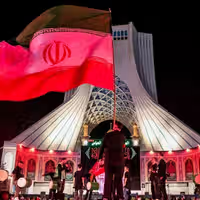
Iran tells pro-government rallies to continue until leader orders otherwise

Jul 12, 2026, 06:12 GMT+1
100%

Iranian authorities on Saturday instructed pro-government street gatherings to continue until Supreme Leader Mojtaba Khamenei orders them to end.

The directive, carried by the state-run ISNA news agency, described participants as Iran’s “summoned people” and said the gatherings had expanded with the supreme leader’s approval and guidance.

It said government supporters remained in mourning and were seeking revenge for those killed in the war, particularly former Supreme Leader Ali Khamenei, and should therefore remain in public squares until further notice.

The nightly gatherings began after Ali Khamenei’s death was announced at the start of the war in late February. Government institutions sustained them through speeches, religious ceremonies, patriotic performances and food distribution, while state media portrayed them as evidence of national unity and support for the Islamic Republic.

The phrase “summoned people” echoes remarks Ali Khamenei made before the war, when he said God would mobilize the public during a national crisis and that “the people would finish the job.”

The rallies later became a means of political pressure, with participants chanting against officials involved in negotiations with Washington. Some accused negotiators of betraying those killed in the war and called for talks with the United States to be halted.

Ali Khomeini, a grandson of Islamic Republic founder Ruhollah Khomeini, reinforced that position on Friday, saying negotiations with the United States should not be viewed as a path to peace.

“Negotiation means war; war has different forms,” he said, adding that anyone seeking peace with Washington was a traitor.

The gatherings have also highlighted the government’s shifting approach to women without the mandatory hijab. While some clerics criticized their presence, other officials welcomed them as part of a broader pro-government front.

Mojtaba Khamenei has not been seen in public since the war began, including after his father’s death, the announcement of his succession and Ali Khamenei’s burial. His positions have so far been conveyed only through written statements.

Khamenei doubles down on revenge after Trump vows to decimate Iran if targeted

Jul 11, 2026, 19:40 GMT+1
100%
A person displays an image of US President Donald Trump in crosshairs during the funeral procession of former Supreme Leader Ali Khamenei in Iran.

Iran’s Supreme Leader Mojtaba Khamenei renewed his vow Saturday to avenge his father’s killing after US President Donald Trump said he had ordered the US military to “decimate and destroy” Iran if Tehran attempted to assassinate him.

In a message issued after the burial of former supreme leader, Mojtaba Khamenei described retaliation for his father’s death in a February 28 airstrike as “a national demand”, adding that it “will most certainly be carried out.”

It was the second time Khamenei had publicly pledged revenge, after first doing so in his initial written message following his father’s killing and the announcement of his succession.

He has not appeared in public, including at Ali Khamenei’s funeral prayers or burial ceremonies, since the airstrike on the leader’s compound which also reportedly injured him.

Hours earlier, Trump said 1,000 US missiles were “locked and loaded” and aimed at Iran, with thousands more ready to follow if the Iranian government acted on threats to kill him.

Trump said he had authorized the US military, for one year and subject to extension, to “completely decimate and destroy all areas of Iran” if an attempt were made on his life.

Khamenei did not name Trump but pledged to bring his father’s killers to justice, saying they would not be allowed to “die peacefully in their beds.”

He said the revenge campaign did not depend on his own survival or the presence of any other official, adding that it would be completed whether he was alive or dead.

The exchange followed state-run funeral ceremonies during which mourners displayed calls for the deaths of Trump and Israeli Prime Minister Benjamin Netanyahu.

The Wall Street Journal reported last week that Israel had recently shared information with Washington suggesting Iranian officials had discussed assassinating Trump, citing US and Israeli officials.

Diplomacy continues under pressure

The threats unfolded alongside diplomatic efforts to contain the conflict, with regional mediators pursuing talks even as Washington signaled that time for an agreement was running short.

Iranian Foreign Minister Abbas Araghchi traveled to Oman on Saturday for talks on the Strait of Hormuz. Qatari officials also joined the Iran-Oman discussions in Muscat, where the parties were considering a statement on fully reopening the strait’s “median lane” in international waters to unrestricted navigation, Axios reported, citing a diplomat familiar with the talks.

US officials told the Associated Press that Trump had given American negotiators limited time to reach an agreement with Iran and retained a wide range of options if the talks failed.

CBS reported on Saturday, citing a US official, that Vice President JD Vance would not travel to Muscat and that Secretary of State Marco Rubio, White House Special Envoy Steve Witkoff and Trump’s son-in-law Jared Kushner would not take part in the talks there.

Washington also continued to set conditions for any agreement. The officials cited by the Associated Press said a nuclear deal would require Tehran to hand over its highly enriched uranium stockpile and stop attacks on shipping in the Strait of Hormuz.

Iran faces region’s harshest mix of wartime contraction and inflation

Jul 11, 2026, 12:32 GMT+1
•
Arash Sohrabi
100%

War has erased Iran’s already weak growth prospects. The economy shrinks as prices rise at one of the region’s fastest rates, forcing households to bear war, sanctions and years of economic mismanagement through fewer jobs, weaker incomes and collapsing purchasing power.

The International Monetary Fund expects Iran’s economy to contract by 6.1% in 2026, after an estimated decline of 1.5% last year. Average consumer-price inflation, already above 50% in 2025, is forecast to accelerate to 68.9%.

The combination matters more than either number alone. A recession means the economy is producing less, companies are selling less and opportunities for work and investment are narrowing. Inflation approaching 70% means the income that remains loses value at extraordinary speed.

  • For many Iranians, paychecks now barely cover food

    For many Iranians, paychecks now barely cover food

  • Iran’s economic pain deepens as factions trade blame

    Iran’s economic pain deepens as factions trade blame

For Iranian households, the result is a squeeze from both directions: fewer ways to earn money and far less purchasing power once they receive it.

The scale of the deterioration is also visible in the IMF’s revision. Only three months earlier, it had expected Iran to record modest growth of about 1.1%. It has now cut that estimate by 7.2 percentage points, one of the sharpest downgrades in the report.

“Growth in Iran in 2026 is revised downward by 7.2 percentage points, relative to January, to –6.1 percent,” the IMF said.

The fund links the reversal to damage to energy and transport infrastructure, diminished production and exports, and disruption around the Strait of Hormuz. It places Iran alongside Iraq, Qatar, Kuwait and Bahrain among the regional economies most directly exposed to the conflict.

The downturn is expected to reach the labor market. Unemployment is forecast to rise from 8% to 9.2%, though that figure captures only part of the pressure in an economy where informal work, underemployment and falling real wages are widespread.

  • Two-week banking disruption leaves Iranians struggling to access money

    Two-week banking disruption leaves Iranians struggling to access money

  • Iran's costly farewell for supreme leader draws backlash

    Iran's costly farewell for supreme leader draws backlash

The inflation data are even more severe. The IMF forecasts average inflation of 68.9% over the year and an end-of-year rate of 48.7%. The difference suggests the pace of price rises may slow later in the year, but not enough to restore anything resembling price stability.

It also means that a lower inflation rate would not make goods cheaper. Prices would still be rising rapidly from an already much higher base, leaving food, housing and other essentials increasingly beyond the reach of households whose wages have failed to keep pace.

The regional comparisons make Iran’s position clearer. Saudi Arabia and the United Arab Emirates are each expected to grow by 3.1%, while Oman is projected to expand by 3.5%. Their inflation rates are forecast at 2.3%, 2.5% and 1.7% respectively.

Qatar and Iraq face even deeper contractions, at 8.6% and 6.8%, largely because of damage and disruption to energy production. But inflation in both is expected to remain close to 3% or 4%. Iran’s particular crisis is that it combines a wartime recession with an inflation problem that was already deeply entrenched before the fighting.

Türkiye offers another useful comparison. It has struggled with years of high inflation, yet the IMF still expects its economy to grow by 3.4% in 2026 while inflation averages 28.6%. Iran’s inflation rate is more than twice as high, while its economy is moving sharply in the opposite direction.

Iran’s external position is also weakening. The current account – the broad measure of money flowing into and out of the country through trade and other transactions – is expected to move from a surplus of 0.6% of GDP to a deficit of 1.8%.

For a major oil and gas producer, that reversal points to lost export earnings, damaged production and less access to foreign currency. By contrast, the UAE is expected to retain a surplus of 11.4%, Qatar 11% and Oman 7.5%, giving those governments far larger financial cushions.

The figures should still be treated with caution. The IMF’s Iran data depend partly on national accounts, inflation and balance-of-payments information supplied by the Islamic Republic’s finance and monetary institutions. The fund also uses staff estimates where complete information is unavailable and says the timeliness, accuracy and completeness of its database cannot be guaranteed.

That makes the report an informed estimate, not an independent audit of Iran’s economy. Official statistics under the Islamic Republic are often delayed, incomplete or shaped by a system with several exchange rates and limited transparency.

The IMF itself uses the NIMA (an acronym for integrated system of foreign exchange) trade-related rate to convert Iranian GDP into dollars from 2018 onward, rather than the official rate that is lower, because it considers NIMA more representative of transactions.

  • Inside Iran’s maze of multiple exchange rates

    Inside Iran’s maze of multiple exchange rates

Even that does not fully reflect the much weaker market rate experienced by many Iranians because it still overstates the rial’s value compared with the open market: the dollar is about 1.48 million rials at the NIMA rate today, against roughly 1.78 million rials on the street, a gap of about 21%.

South Pars carries the shock beyond Iran

The damage is not confined to Iran. The IMF says strikes on the South Pars gas field sharply reduced the prospect of a quick recovery in regional gas supplies and were followed by Iran’s attacks on Persian Gulf energy facilities, including Qatar’s Ras Laffan complex.

  • Iran’s energy growth slows to a crawl as demand races ahead

    Iran’s energy growth slows to a crawl as demand races ahead

European benchmark gas prices rose 61% between August 2025 and March 2026, while Asian LNG prices jumped by more than 80%. Asia is particularly exposed because more than three-quarters of LNG shipments passing through the Strait of Hormuz are bound for Asian markets.

The IMF’s central forecast still assumes a relatively short conflict and a gradual restoration of production and transport. Under that assumption, global growth slows to 3.1% and inflation rises to 4.4%. But the report says a longer disruption could push global growth close to 2% and inflation toward 6%.

The same warning applies more acutely to Iran: the forecast contraction of 6.1% is not a worst-case estimate, but one built on the assumption that the war’s economic damage begins to ease.

Is the Iran-US MoU dead – or are we asking the wrong question?

Jul 11, 2026, 12:18 GMT+1
•
Negar Mojtahedi
100%
Smoke rises from boats on fire at a fishing pier in Banood, Bushehr Province, Iran, after a U.S. projectile struck the area around Iran's Bushehr nuclear power plant on Thursday, according to the deputy governor of Bushehr Province, in this screengrab from a video obtained from social media and released on July 9, 2026. Social Media via Reuters

Less than three weeks after Washington and Tehran began implementing a 60-day memorandum, the ceasefire is broken, commercial ships have again come under attack in the Strait of Hormuz, and US forces have struck Iran. Yet the two sides are still talking.

President Donald Trump declared the ceasefire over after the Islamic Revolutionary Guard Corps fired on three merchant vessels, but said negotiations would continue because Iran “wants to make a deal so badly.”

The contradiction suggests the memorandum may be doing something narrower than ending the conflict. It has failed to prevent renewed violence, but may still provide a structure through which Washington and Tehran can contain escalation, preserve communication and negotiate between military exchanges.

The latest crisis has already damaged one of the memorandum’s main objectives: restoring safe commercial passage through the Strait of Hormuz while the two sides pursued a broader agreement over Iran’s nuclear program and other disputes.

The question is no longer simply whether the ceasefire survived. It is whether the memorandum was ever a peace agreement, or a system for managing an unfinished war.

Experts who spoke to Iran International’s Eye for Iran podcast differed over whether the arrangement remains viable, but broadly agreed that both Washington and Tehran still have reasons to prevent the confrontation from returning to full-scale war.

Jonatan Sayeh, a research analyst at the Foundation for Defense of Democracies, said Tehran may have calculated that it could test US limits, absorb a contained response and retain many of the economic benefits it secured under the agreement.

“That to them was a gamble that was kind of worth it,” Sayeh said.

From the IRGC’s perspective, the outcome may still fall short of its worst-case scenario. Iran was struck, but the broader maritime blockade has not been fully restored, Tehran can continue selling oil to China, and the confrontation did not immediately return to all-out war.

Sayeh also questioned claims that Iran’s civilian government had simply lost control of the Guards.

Tehran may instead be using a new version of its longstanding “good cop, bad cop” strategy, he said, with civilian officials seeking concessions while presenting the IRGC as an independent force they cannot fully restrain.

Historian and Atlantic contributing writer Arash Azizi said the attacks had not necessarily destroyed the broader framework.

“I certainly don’t think it was doomed to fail,” Azizi said. “And I don’t, in fact, think it has failed actually yet.”

Neither Washington nor Tehran appears eager to resume full-scale war, he said. That shared interest could preserve negotiations even after the immediate ceasefire collapsed.

Azizi said hardline pressure on President Masoud Pezeshkian and Foreign Minister Abbas Araghchi may also help explain the attacks. Factions opposed to the agreement could fear that 60 days of normal traffic through Hormuz would make it harder for Iran to reassert control of the waterway as a source of leverage.

Fatima Al-Asrar, a senior policy analyst at Ideology Machine, argued that the memorandum’s ambiguity may have benefited the IRGC from the outset.

She called it a “memorandum of undoing,” saying it postponed or weakened earlier US demands concerning Iran’s nuclear program, armed allies and regional conduct.

“The MoU gives you this kind of maybe false sense of progress, and I think it’s performative mostly,” Al-Asrar said. “It’s a truce, and that’s great, but it’s driven by short-term political wins.”

Rather than removing Iran’s capacity to threaten shipping, she said, the arrangement may have allowed Tehran to retain what amounts to a geopolitical switch.

Iran can reduce tensions when it seeks sanctions relief, oil revenue or diplomatic concessions, then disrupt the strait again when it wants greater leverage.

The consequences extend far beyond Washington and Tehran. Disruption in Hormuz raises shipping and energy costs and can affect fertilizer supplies and food prices across Asia and other import-dependent regions.

Itai Reuveni, director of communications at NGO Monitor, described the memorandum as a deliberately flexible answer to the immediate needs of all sides.

Iran wanted to stop US and Israeli strikes before they threatened the survival of the Islamic Republic. Washington wanted to avoid another prolonged Middle Eastern war. Israel had demonstrated its ability to strike Iran but also faced the costs and risks of a sustained campaign.

The agreement reduced the intensity of the war without settling the disputes that caused it.

“It seems to me that the line is always being pushed,” Reuveni said.

The United States, Israel and Iran may now be entering a prolonged cycle in which each side tests how far it can go without triggering another major war.

That may explain why military action and diplomacy are continuing at the same time.

The memorandum did not create a conventional peace process in which violence stopped before negotiations began. It created a framework in which strikes, threats, retaliation and mediation could unfold alongside one another.

The attacks in Hormuz have damaged that framework and increased the danger of miscalculation. Another round of fighting could be broader and more destructive.

But whether the memorandum is dead depends on what it was expected to achieve.

The ceasefire may be over. The managed confrontation it created may only be beginning.

Episode 111 of Eye for Iran is available on YouTube and all major podcast platforms.
US declares end of Iran truce as diplomacy collides with retaliation threats

Jul 10, 2026, 22:00 GMT+1
100%
Officials from the United States, Iran, Qatar and Pakistan gather ahead of talks at the Lake Lucerne Summit in Switzerland in June 2026.

A day after Ali Khamenei was buried, US President Donald Trump declared the ceasefire with Iran over while agreeing to continue negotiations and warning of overwhelming retaliation if Tehran targeted him, as Iranian officials and clerics intensified calls for revenge.

“We have agreed to Iran talks, but the United States has stated to them, in no uncertain terms, that the ceasefire is over,” Trump said Friday, after renewed military exchanges raised questions over the future of a temporary memorandum signed last month.

Trump also told the New York Post that he had left instructions for Iran to be bombed at unprecedented levels if Tehran succeeded in killing him. “I’ve left instructions — if anything happens, to just literally bomb them at levels that they’ve never seen before,” he said.

The warning came as calls to target Trump and avenge Khamenei spread across official and religious platforms in Iran. Ahmad Reza Hajati, the Friday prayer leader in Ahvaz, urged anyone with missiles or drones to kill the US president and “purge the earth” of his existence.

IRGC commander-in-chief Ahmad Vahidi said punishing those who carried out, ordered or supported the killings of Khamenei and several Iranian military commanders would remain a “certain, legitimate and unforgettable demand.” Other senior clerics and hardline politicians also called revenge a national, legal or religious right.

Diplomatic contacts nevertheless continued. Axios reported that a new round of US-Iran talks was expected next week, possibly in Switzerland, while Al Arabiya said technical teams from the two countries were due to meet in Pakistan on Sunday, July 12.
The Trump administration is also pressing Iran to issue a public statement acknowledging that the Strait of Hormuz is open and pledging to stop firing on commercial ships, Axios reported Friday citing US officials.

Iran publicly disputed the accounts. Foreign Ministry spokesperson Esmaeil Baghaei said Tehran had not requested negotiations with Washington, but had accepted a regional mediator’s request to visit Iran and discuss recent developments. He said the meeting took place Friday in Mashhad and that Iran conveyed its positions to the Qatari side.

As regional diplomacy continued, Iranian Foreign Minister Abbas Araghchi was due to travel to Oman on Saturday at the head of a diplomatic delegation for talks on regional developments, particularly the situation in the Strait of Hormuz, state-run IRNA reported. The report gave no details about his planned meetings.

A source close to Iran’s negotiating team separately denied that preparations for new talks had been finalized, IRGC-affiliated Fars News reported.

Qatar and Pakistan continued mediation efforts, seeking to de-escalate tensions, preserve the diplomatic track and address disputes over the Strait of Hormuz.

The military warnings also extended to Israel. Israeli Defense Minister Israel Katz said on X Friday that the Israeli military was prepared “at all times for any scenario in attack and defense.” Iran’s Supreme National Security Council Secretary Mohammad Bagher Zolghadr warned that any attack on Iranian infrastructure would draw a reciprocal response and that Israel would not be spared.
Senior US officials said Washington had military options to ensure Iran’s nuclear sites remained inaccessible, Reuters reported Friday.

The day ended with both sides signaling readiness for talks while trading threats that left the prospect of renewed conflict firmly in view.