Workers remove a damaged vehicle from a bridge near Bandar Abbas after a US airstrike, as the conflict between Iran and the United States continues to intensify, July 18, 2026
Recent statements by officials in Tehran and Washington illustrate how public rhetoric has shifted beyond military deterrence toward explicit threats against civilian and energy infrastructure across the Middle East.
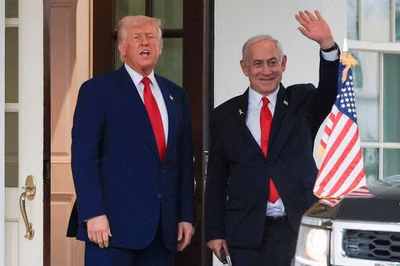
The escalation accelerated after President Donald Trump warned that the United States would destroy an Iranian bridge or power plant for every attack on shipping in the Strait of Hormuz.
Iranian officials responded not by narrowing the confrontation but by broadening it, signaling that any future conflict would no longer be confined to military targets or the strategic waterway itself.
Until recently, Iranian messaging had focused largely on asserting its authority over the Strait of Hormuz and threatening commercial shipping.
Since Trump's warning, however, officials and state media have increasingly portrayed bridges, power grids, oil infrastructure and other civilian facilities across the region as legitimate targets in a broader campaign of reciprocal retaliation.
Iranian Foreign Minister Abbas Araghchi responded on Wednesday by declaring that Iran would follow an "eye for an eye" doctrine.
"I believe any attack on Iran's bridges, power plants or civilian infrastructure will be met with a powerful and decisive response," he said, warning that retaliation would target not only US assets but also any regional country facilitating such attacks.
On Thursday, Secretary of State Marco Rubio escalated the rhetoric further, saying Trump's Iran policy amounted to "a head for an eye" and warning Tehran it would pay a heavy price for attacks on Americans or US interests.
Iran's chief negotiator, Parliament Speaker Mohammad Bagher Ghalibaf, dismissed Washington's warnings and declared that the confrontation had entered an "either all or none" phase.
"If Iran is prevented from exporting oil or securing its domestic infrastructure, no infrastructure in the region will be safe, and no one will be able to sell oil," he warned.
His remarks reflected a growing effort to frame attacks on Persian Gulf energy infrastructure not simply as retaliation but as an integral part of Iran's deterrence strategy.
State and IRGC-linked media quickly amplified that message.
The IRGC-linked Tasnim News Agency quoted senior military sources as saying Iran had a "steel determination" to control the Strait of Hormuz and would strike multiple energy targets across the region in response to any attack on Iranian bridges or power plants.
State television likewise warned that Trump's infrastructure threats "will have no result other than the expansion of the war."
The rhetoric broadened further after Trump said he was considering strikes on Iran's nuclear facilities under Pickaxe Mountain.
In response, the Khatam al-Anbiya Central Headquarters warned such an attack would constitute an existential escalation, compelling Iran to target "all interests of America, its allies and supporters" throughout the Middle East.
Not everyone in Tehran supported the increasingly confrontational tone.
Former Iranian ambassador to Germany Hossein Mousavian argued that "continued military confrontation between Iran and the United States will produce no winner and will instead drag the region and the global economy into a costly war of attrition."
Writing in Rouydad24, he said the only viable exit lay in "an immediate return to diplomacy, an agreement on the security of the Strait of Hormuz, and the achievement of a durable nuclear deal."
Yet those voices remain overshadowed by an increasingly reciprocal exchange of threats.
Rubio has warned that Iran "will have to pay a price" if it continues attacking US interests, while Iranian hardliners increasingly argue that accepting a ceasefire itself was a strategic mistake.
Lawmaker Abolfazl Abutorabi told Didban Iran that Washington would have "kissed our boots" had Tehran continued fighting for another two weeks.
The increasingly symmetrical rhetoric suggests both governments are treating attacks on civilian and energy infrastructure not as exceptional acts of escalation but as legitimate retaliation, lowering the threshold for a conflict that could spread well beyond the battlefield and the Strait of Hormuz.
A view the panel at Iran International town hall in Washington, DC (July 2026)
The US may be peeling away layers of Iran's leadership, but without a plan for what comes next, bombing the coast and seizing islands cannot reach the problem in Tehran, and risk delivering an IRGC takeover rather than real change, experts said at an Iran International town hall.
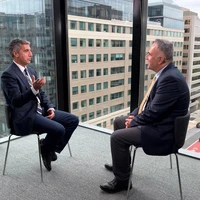
The panel, held at Iran International's Washington headquarters and moderated by Fardad Farahzad, brought together Michael Rubin of the American Enterprise Institute, Ilan Berman of the American Foreign Policy Council, and Iranian-American analyst Fereshteh Pezeshk.
The discussion came amid renewed US strikes, with attacks tearing through bridges and infrastructure across Iran's south.
Is Washington heading for a ground operation?
The question hanging over the room was whether the air campaign is a prelude to something larger. Rubin framed the choice in stark terms.
"When you have a hornet's nest, you have two good options. One is to leave it alone. The other one is to get rid of it," he said. "The last thing you want to do is sit underneath it lightly tapping it with a stick, and we're getting to the point where that stick tapping is over."
The open question, he added, is "are we heading to boots on the ground? And if we're heading to boots on the ground, are we simply talking about the islands in the Persian Gulf, or are we talking about some of the ports?"
Pezeshk talked about the risks. A move onto Iranian soil, she argued, would be "disastrous," and not only in military terms. "A very good population of Iranians, unlike the rest of the Middle East, are pro-American," she said, describing "a chasm between the people and the Islamic Republic" after the killing on Iran's streets.
Michael Rubin of the American Enterprise Institute at Iran International town hall in Washington
An occupation, she warned, could close that chasm rather than widen it. "The solution is in Tehran, not on the coasts. You've got to resolve that problem."
Berman placed the same question inside American politics, noting that gasoline prices and looming midterm elections are shaping every decision the administration makes.
The task now, he said, is to establish what military planners call escalation dominance, "to show the Iranian regime that they have more firepower and they have politically more will to stay and to fight."
Regime change or transformation?
The most contested idea of the evening came from Berman, who argued that a quieter transformation has already taken place inside the Islamic Republic.
The current rulers, he said, "have a different DNA. They behave differently, they negotiate differently," a shift he traced in part to a war that opened at the very top of the escalation ladder with the killing of the supreme leader.
However, he pointed out that the change has not produced true regime change. “The Trump administration hasn’t dug deep enough... “You haven’t had regime change as most of us have historically thought about it – a transition from the Islamic Republic to a fundamentally different governing system.”
Rubin pushed the logic toward the machinery of power, describing an effort to peel away the leadership layer by layer. With the Revolutionary Guards numbering well over 100,000, he argued, "somewhere along those ranks there is someone who wants to enrich himself" and would deal with Washington.
But he cautioned that the administration may not know who actually runs the country, comparing its approach to "negotiating with the doorman in a skyscraper rather than negotiating with the owner."
Both men returned to a warning that any transition badly managed could produce something worse.
Iranian-American analyst Fereshteh Pezeshk at Iran International town hall
Pezeshk offered the strongest caution against treating decapitation strikes as a complete regime-change strategy. “You have to resolve the political issue in Tehran, not the manifestation.”
She pressed the point harder: removing the leadership without a plan for the day after risks chaos. "How do you ensure it's not going to be a Taliban-like power that comes in? Are you working with the opposition? Are you inclusive enough?" She saw little sign of that groundwork.
"The guy sitting in Tehran is going to be there forever until they die. The US president, two and a half years from now, is gone."
The next uprising, and a fumbled chance
If there was a shared conviction, it was that Iran's streets, not its negotiators, will decide the outcome, and that Washington keeps missing its moments there.
Berman described unrest in Iran as a cyclical force, erupting roughly every two and a half years and accelerating. The lesson of the past six months, he said, is that the US was caught flat-footed when it mattered.
When the internet went dark in January, he recounted, the administration assumed it could "just pierce that veil" with Starlink units and VPNs. Instead it found the jamming, aided by Russia and China, far more robust than expected, and its own tools not prepositioned.
"One of the most important lessons that this last half year has brought is we should be thinking now about the next round of protests, because the next protest is going to start."
Pezeshk argued it already had. She credited the January protests, set off in part by an opposition call to the streets, as "one of the biggest protests ever in Iranian history," met with a killing she put at around 40,000. Her frustration was that such a force draws so little attention in Washington.
The Kurds, the islands, and a mafia state
Asked whether the US might arm Kurdish or other groups to open a ground front, the panel was wary. Rubin noted Washington's long reluctance to back separatist movements in the region, and Pezeshk attributed the on-again, off-again talk to "the chaos of the Trump administration."
Berman said officials he had spoken to were "very nervous about the steadfastness and the resolve of these elements."
Ilan Berman of the American Foreign Policy Council
Rubin, speaking "as an analyst rather than advocate," sketched where a limited campaign might fall: not the ports, but strategic islands, from Abu Musa and the Tunbs to Kish and Qeshm, "the gateway to Bandar Abbas."
He warned that seizing Iranian territory could backfire by rallying a fiercely nationalist public. The Islamic Republic, he argued, would not be moved by the loss of land the way a normal state would.
"They act like a mafia. They don't care if part of the country is gone as long as they're still in power."
Pezeshk’s argument was that territorial occupation – whether by US forces, Kurdish groups or another regional actor – could unite Iranians around national sovereignty.
Can an ideological system make a lasting deal?
Rubin argued that the Islamic Republic’s political identity limits its ability to reach the kind of pragmatic agreement sought by the Trump administration. Rubin argued that the Islamic Republic’s political identity limits its ability to reach the kind of pragmatic agreement sought by the Trump administration.
Pezeshk was skeptical any lasting deal is possible with a system she sees as ideological to its core.
Persian Gulf states, she said, want development, not confrontation, "they do not want to go back to the 18th century," while the Islamic Republic "has a tolerance for absorbing a lot of pain just because they don't care about their people."
Whether the war ends at the table or on the coast, the panel's consensus held that its true resolution lies elsewhere.
As Rubin put it, the nuclear file, the missiles and the proxies are all "the manifestation of the root cause, which is the Islamic Republic."
A US Air Force pilot conducts pre-flight checks on an F-16 fighter jet in an image published by US Central Command on X.
Bulgaria moved Tuesday toward allowing US aerial refueling aircraft to support Middle East operations, drawing a warning from Tehran and raising the risk of the NATO member being pulled into the Iran-US conflict.
The parliamentary Defense Committee approved a government proposal permitting up to eight US tanker aircraft and 250 American military personnel to be stationed at Bezmer Air Base in southeastern Bulgaria, CNN reported.
Bulgarian President Iliana Iotova said on Tuesday hosting up to eight US KC-135 refueling aircraft and 250 military personnel at Bezmer Air Base would not make Bulgaria a party to the war in Iran.
She added that parliamentary approval was required by law and that the government was following the proper procedure.
The United States requested that the deployment run from July 24 to October 1 in support of operations in the Middle East, according to CNN. Aerial refueling tankers allow other military aircraft to remain airborne longer and operate at greater distances.
The report said that US Central Command declined to discuss the proposed deployment, adding, “For operational security reasons, we do not discuss troop movements or speculate on future force posture.”
The move builds on an established military relationship between Sofia and Washington. Under a bilateral Defense Cooperation Agreement signed in 2006, Bulgaria designated Bezmer as a facility for joint use by Bulgarian and US forces.
The agreement provides a framework for an American military presence at the base, but the scale and stated purpose of the latest deployment have brought Bulgaria closer to the confrontation between Washington and Tehran.
Iran warns Sofia against involvement
Iranian Foreign Ministry spokesperson Esmaeil Baghaei warned Bulgaria not to allow its territory or military facilities to be used in support of US operations targeting Iran.
Baghaei said any participation in planning or carrying out such operations would amount to complicity in what he called “the crime of aggression and war crimes.” He urged Bulgaria’s full parliament to reject the proposal.
Bulgaria’s NATO membership adds a wider security dimension. Article 5 of the North Atlantic Treaty states that an armed attack on one member is considered an attack on all.
If Bulgaria were attacked, each NATO ally would be required to assist by taking, individually and with the other members, the action it deemed necessary. That response could include the use of armed force, but would not automatically require every ally to enter the conflict in the same way.
In the 11 days since the Islamabad memorandum of understanding expired, Iran has repeatedly attacked Persian Gulf states and other countries in the region, saying it was targeting US military bases used in operations against it.
That record, combined with the emerging diplomatic confrontation between Tehran and Sofia, raises the possibility that Bulgaria could be drawn more directly into the conflict if its territory is used to support US military operations against Iran.
File photo: Greek-registered tanker ship Sounion burns after an attack by Yemen's Iran-aligned Houthi militants in the Red Sea, September 6, 2024 in this satellite image. 2024 Planet Labs Inc via REUTERS
Several tankers carrying Saudi crude oil reversed course on Tuesday after Tehran-backed Houthis declared a blockade on shipping through Bab el-Mandeb, raising fears that the US-Iran war could disrupt a second major energy chokepoint.
Yemen’s Houthis, who control much of northern and western Yemen and its coastline near the southern entrance to the Red Sea, declared a maritime embargo against Saudi Arabia on Monday, potentially opening another front in the widening regional conflict.
The order targets Saudi-linked shipping rather than all vessels passing through Bab el-Mandeb. The strait has not been closed, and a US Navy-led maritime information center said Tuesday that there had been no confirmed attacks on vessels in the Red Sea over the previous 48 hours.
But the announcement was already affecting commercial shipping.
In a letter sent to shipping companies and seen by Reuters, the Houthis warned that vessels loading or discharging oil at Saudi ports could be attacked anywhere within the reach of their forces.
The group described the measure as a “blockade for blockade,” accusing Saudi Arabia of imposing land, sea and air restrictions on Yemen and targeting Houthi-controlled ports and airports, including Sanaa International Airport.
US President Donald Trump said Tuesday that the Houthis had not yet shut Bab el-Mandeb, known as the “Gate of Tears,” but warned that Washington would respond if they did.
“So far it hasn’t happened. Might happen, but we take care of things,” Trump said. “If something like that happens, we take care of it.”
Tankers alter course after Houthi threat
Two tankers that had loaded Saudi crude at the Red Sea port of Yanbu for customers in China and India reversed course Tuesday, heading north toward the Suez Canal rather than south through Bab el-Mandeb into the Indian Ocean.
The vessels, Xin Long Yang and Rodos, had both been sailing south through the Red Sea before turning around. A third tanker, New Prime, which had been heading empty toward Yanbu, also reversed course off Oman.
British maritime risk-management company Vanguard described them as the first confirmed changes to commercial tanker routes following the Houthi announcement and warned of growing disruption to Saudi crude exports and regional shipping.
No evidence has emerged that the vessels were directly threatened, but their diversions showed that shipping companies were already responding to the risk of Houthi attacks.
Saudi Arabia pledges to protect shipping
Riyadh rejected the Houthis’ accusations as false and said it would take all necessary measures to protect its vessels under international law and the 1982 UN Convention on the Law of the Sea.
The Saudi-led coalition in Yemen said threats against ships passing through Bab el-Mandeb would be dealt with firmly and that measures were being implemented to safeguard commercial traffic.
Riyadh accused the Houthis of exploiting the wider regional conflict to pursue their own agenda, worsen the suffering of Yemenis and threaten regional security.
Hormuz disruption raises Red Sea stakes
With traffic through the Strait of Hormuz severely reduced by the US-Iran war, Saudi Arabia has increasingly relied on its East-West Pipeline to transport crude across the kingdom to Yanbu for export through the Red Sea.
Saudi Arabia has shipped an average of more than 4.5 million barrels per day of crude and fuel from Yanbu since April, with about 70% destined for Asia, according to data cited by Reuters.
A successful Houthi effort to close Bab el-Mandeb would remove Saudi Arabia’s main alternative to Hormuz and leave much of its oil exports facing lengthy diversions.
Tankers unable to sail south from the Red Sea would have to travel north toward the Suez Canal and the Mediterranean before circling Africa to reach Asian customers. Analysts said the detour could delay some deliveries by about a month and sharply increase freight and insurance costs.
Oil prices rose more than 2% Tuesday, with Brent crude trading above $91 a barrel and US gasoline prices returning to more than $4 a gallon.
Iranian Foreign Minister Abbas Araghchi speaks during an interview for the YouTube program Majaray-e Jang (Story of War) in an image published on his Telegram channel.
Criticism of Foreign Minister Abbas Araghchi's recent interview has spread across Iranian conservative media, with critics arguing he disclosed sensitive information about wartime security and internal decision-making following its publication this week.
The backlash followed Araghchi's appearance on the YouTube program Majaray-e Jang (Story of War), in which he discussed the wars with the United States and Israel, internal security planning, succession preparations and negotiations with Washington. He also said security gaps that enabled attacks on senior officials and leadership sites "probably still have not been fully resolved."
"If you wanted publicity or to repair your image, you made it worse," Mostafa Khoshcheshm, a political analyst appearing on Iranian state television, said in response to the interview.
Araghchi's remarks, Khoshcheshm said, reflected what he described as "a lack of strategic thinking," adding: "I am genuinely concerned." He called the interview "a disaster in public relations, image-building and image repair."
Araghchi had said attacks on the former Supreme Leader Ali Khamenei's compound were carried out through "security gaps" that continued to affect decision-makers and the public atmosphere.
He also described wartime contingency plans, including preparations for the possible killing of the country's leader and the government's response to attacks on senior officials.
Conservative newspapers criticize disclosures
Javan, a newspaper affiliated with the Revolutionary Guards, wrote on Tuesday that confirming details surrounding the attacks, discussing the day the former leader was killed or revealing that the foreign minister had no contact with new Supreme Leader Mojtaba Khamenei were not matters that should have been disclosed publicly.
"Please keep the locations of the remaining tunnels and military bases to yourself in future interviews, and exercise restraint when discussing important events," the newspaper wrote.
Safeguarding national security, protecting public trust and defending the country's interests should outweigh the appeal of widely viewed media interviews, Javan added.
Conservative outlet Tabnak also questioned Araghchi's decision to give the interview to documentary filmmaker and online host Javad Mogoei rather than an experienced journalist.
The outlet wrote that some of the information discussed was likely to be of greater value to Israeli and US intelligence services than to viewers. It also argued that diplomacy and journalism are both specialized professions, asking whether senior officials should grant interviews to content creators without established experience covering political affairs.
The commentary compared Araghchi's media approach with that of former Foreign Minister Mohammad Javad Zarif, arguing that although Zarif also preferred interviews with individuals rather than media organizations, he chose interviewers who better understood political and security sensitivities.
Reaction from Raisi allies
Raja News, a media outlet close to supporters of former president Ebrahim Raisi, also criticized the interview, focusing on remarks by Mogoei identifying locations of underground tunnels and saying military commanders frequently used them.
Araghchi, the outlet said, should not have disclosed such information and argued that the program's producers should have removed those passages during editing. It also questioned why the host publicly identified locations associated with senior commanders, even if foreign intelligence agencies were already aware of them.
The wide-ranging interview touched on issues that Iranian officials have rarely discussed publicly, including internal security failures, wartime contingency plans and high-level decision-making during the conflict.
Iranian officials are discussing a possible increase in petrol prices, although no proposal has yet been formally presented to parliament, the spokesman for parliament’s Energy Committee said.
Reza Sepahvand told ILNA that discussions were taking place within the government and the Plan and Budget Organization, but said raising fuel prices while Iran faces war and severe inflation would be “in no way advisable.”
Sepahvand said the government has the legal authority to change energy prices and that officials from the Oil Ministry and the National Iranian Oil Products Distribution Company were expected to discuss the issue with lawmakers this week.
“No issue has yet been raised with parliament or the Energy Committee,” he said, adding that lawmakers would seek a clearer answer from ministry officials.
Iran currently sells the first 60 liters of monthly petrol allocated to private cars at 15,000 rials per liter, equivalent to about $0.008 at an open-market exchange rate of about 1.9 million rials to the dollar.
A further 100 liters are available at 30,000 rials per liter, or about $0.016, while additional petrol purchased using station fuel cards costs 50,000 rials per liter, about $0.026.
Sepahvand warned that even from this heavily subsidized base, an increase could push up transport costs and the prices of goods and services.
“Any increase in petrol prices could fuel a new wave of price rises and place additional pressure on people’s livelihoods,” he said.
He urged the government to avoid changing petrol prices while households are already dealing with the economic effects of war and what he described as runaway inflation.
Petrol pricing is one of the most politically dangerous economic issues for the Islamic Republic. Iranian officials have repeatedly approached even limited changes cautiously because higher fuel costs quickly feed into transport, food and other prices, while falling real wages leave households with little capacity to absorb another shock.
The caution is rooted in the nationwide unrest of November 2019. A sudden overnight increase raised the subsidized petrol price by 50% and tripled the price charged above the monthly quota, setting off demonstrations within hours in cities and towns across Iran. The protests quickly broadened from anger over fuel costs into demands directed against the political system.
Authorities responded by cutting Iran off from the global internet for nearly a week and using lethal force against protesters. Amnesty International has documented 321 men, women and children killed by security forces, while Reuters, citing Iranian Interior Ministry officials, reported that about 1,500 people died.
The memory of those protests continues to shape government calculations. A petrol price increase during war and severe inflation would risk being viewed not simply as a fuel-policy change but as another sudden transfer of the state’s economic burden onto households already facing collapsing purchasing power.